Tag: instability

  • Granular Gaps

    Granular Gaps

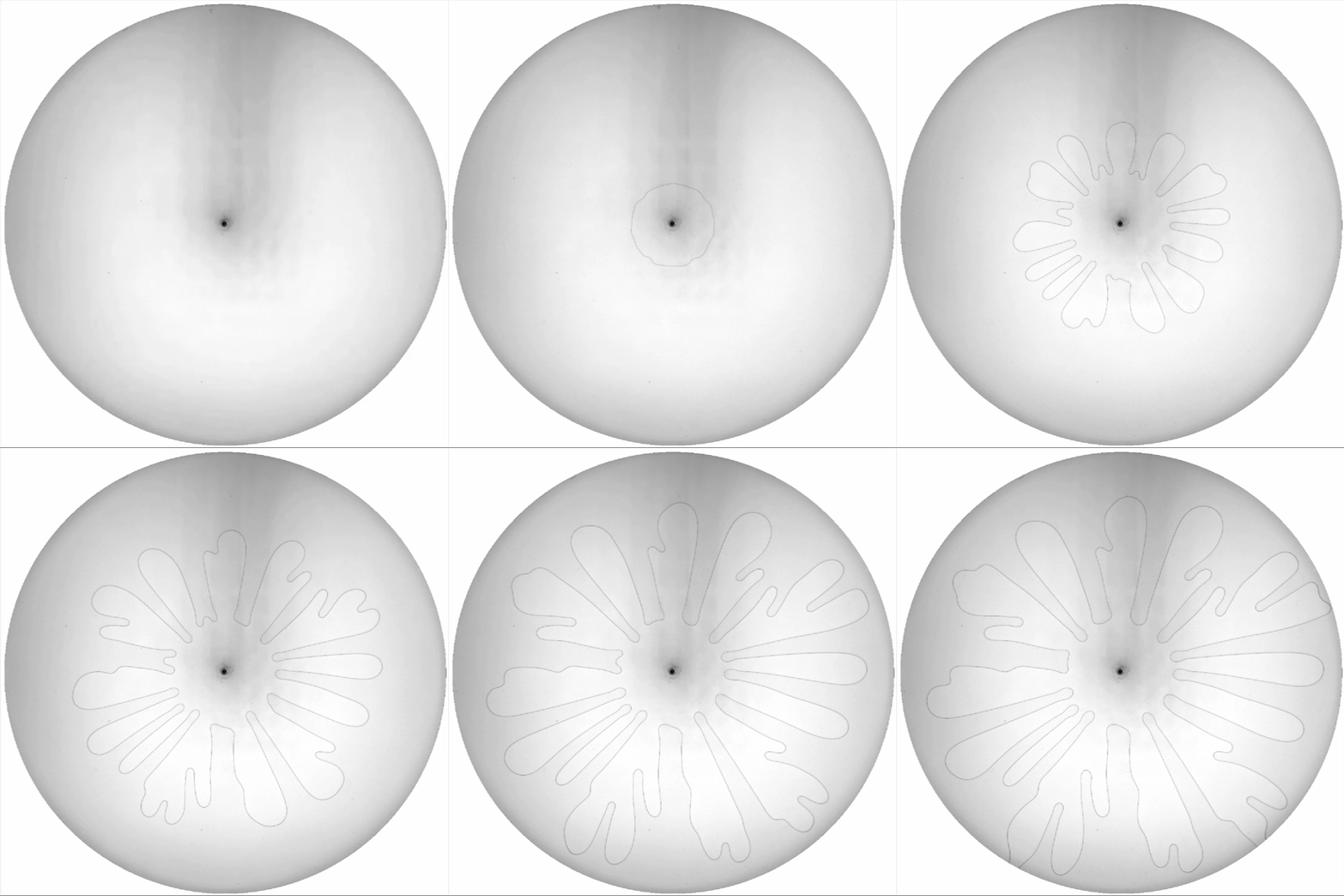
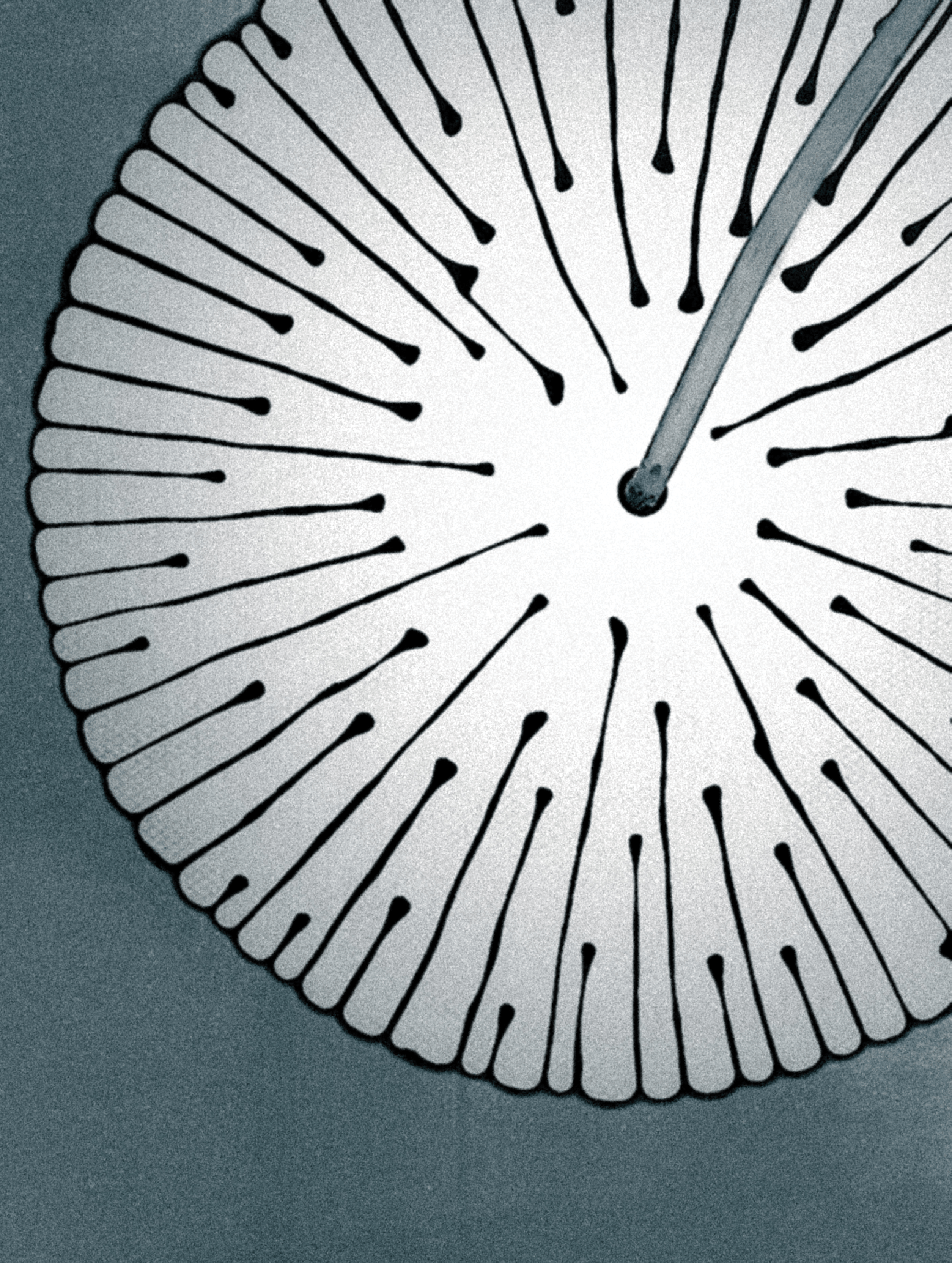
    Push air into a gap filled with a viscous fluid, and you’ll get the branching, dendritic pattern of a Saffman-Taylor instability. Here, researchers use a similar set-up: injection into a narrow gap between transparent planes to explore something quite different. In this experiment, the gap was initially filled with a mixture of air and tiny hydrophobic glass beads. When the team injected a viscous mixture of water and glycerol, new patterns emerged. At low injection rates, a single finger structure formed. But at high injection rates, a whole spoke-like pattern formed. (Image and research credit: D. Zhang et al.; via Physics Today)

  • Turbulent Thermal Convection

    Turbulent Thermal Convection

    In the winter, warm air rises from our floor vents or radiators, creating a complex, invisible flow in the background of our lives. Buoyancy lifts warmer air upward while cooler, denser air sinks back down. This thermal convection is everywhere: in our buildings, the ocean, the sky overhead — even in the visible layer of our sun.

    In nature, these systems are so large and complex that fully measuring or simulating them remains impossible. Instead, researchers focus on a simplified system — a Rayleigh-Bénard cell — that’s essentially an idealized version of a pot on a stovetop. The lower surface of the cell is heated — like the bottom of a pan on the burner — while the upper surface of the fluid cools. Even this idealized system is a challenge, though, and neither lab-scale versions nor simulations can reach the same conditions that we find in nature.

    To bridge the gap, scientists rely on mathematical models — theories built on our best understanding of the physics — and physical analogies to similar systems — like flow over a flat plate — that are “easier” to measure. For a thorough overview of recent work in the area, check out this review in Physics Today. (Image credit: A. Blass; research credit: D. Lohse and O. Shishkina in Physics Today)

  • Imitating a Cough

    Imitating a Cough

    Coughing and sneezing create violent air flows in and around our bodies. As that fast air rushes over mucus layers in our lungs, throat, and sinuses, the resulting flow breaks up the mucus into droplets. To explore the details of that process, researchers built a “cough machine” that sends a rush of air over a thin film of water mixed with glycerol. The setup allows them to observe the physics in a way that’s nearly impossible in a human cough or sneeze.

    Imitating a cough: high-speed video shows how a thin film made of water and glycerol breaks down in a strong airflow. Parts of the film inflate into hollow bags that form thinner weak spots. When the film breaks in those places, it forms rims and ligaments that break up into droplets.
    Imitating a cough: high-speed video shows how a thin film made of water and glycerol breaks down in a strong airflow. Parts of the film inflate into hollow bags that form thinner weak spots. When the film breaks in those places, it forms rims and ligaments that create a spray of droplets.

    As seen above, air flowing past shears the viscous fluid, stretching it out. The leading edge of the film destabilizes and breaks into large drops, but it’s what comes next that really gets things going. Areas of the film inflate to form hollow bags. When sections of the bag thin to about 1 micron, the film ruptures and the bags burst. This triggers a cascade of instabilities in the film’s rim that ultimately rip the film into a spray of tiny aerosol droplets. The researchers found that, despite their tiny size, these droplets collectively carry a large volume of liquid, making them all the more important for understanding transmission of respiratory illnesses. (Image credit: top – A. Piacquadio, experiment – P. Kant et al.; research credit: P. Kant et al.)

  • Leidenfrost Collapse

    Leidenfrost Collapse

    When a droplet encounters a surface much hotter than its boiling point, it forms a thin layer of vapor that insulates the liquid from the surface. But this Leidenfrost effect can’t last forever. Eventually, the vapor layer destabilizes and the drop touches the surface, causing explosive boiling that destroys the drop.

    To determine how the layer destabilizes, researchers simulated the breakdown. To their surprise, they found that inertial forces in the micron-thin vapor layer were critical for destabilization. The gas inertia caused reductions in pressure that pulled the liquid toward the surface. Usually at these small scales, we’d ignore inertial effects and focus instead on viscosity, but, for Leidenfrost drops, that simplification doesn’t work. (Image credit: L. Gledhill; research credit: D. Harvey and J. Burton)

  • Frozen Ripples

    Frozen Ripples

    Normally, freezing is a slow enough process that transient phenomena like ripples get smoothed out. But with the right conditions, even ripples can get frozen in time. This picture shows a backyard bird bath after a frigid winter storm passed overnight. For much of that time, the wind was active enough to keep the bath’s water from freezing. But when freezing did start, it happened so rapidly that the wavelets generated by the wind got frozen in place, too. Here’s a similar-looking effect (also in Colorado, ironically) that’s thought to have formed entirely differently. (Image credit: K. Farrell; via EPOD; submitted by Kam-Yung Soh)

  • Featured Video Play Icon

    “Aquakosmos”

    Colorful chandeliers, passing spirits, sprouting mushrooms, and fountains of falling ink appear in Christopher Dormoy’s “Aquakosmos.” Driven by the slight density difference between ink and water, many of these elaborate shapes result from the Rayleigh-Taylor instability. Anytime you see mushroom-like plumes and chandelier-like splitting vortex rings, there’s probably a Rayleigh-Taylor instability behind it. Check out the full video above, and, if you want to give this kind of flow visualization a try yourself, a glass of water and vial of food coloring is a great place to start. (Video and image credit: C. Dormoy)

  • Featured Video Play Icon

    “Space Iris”

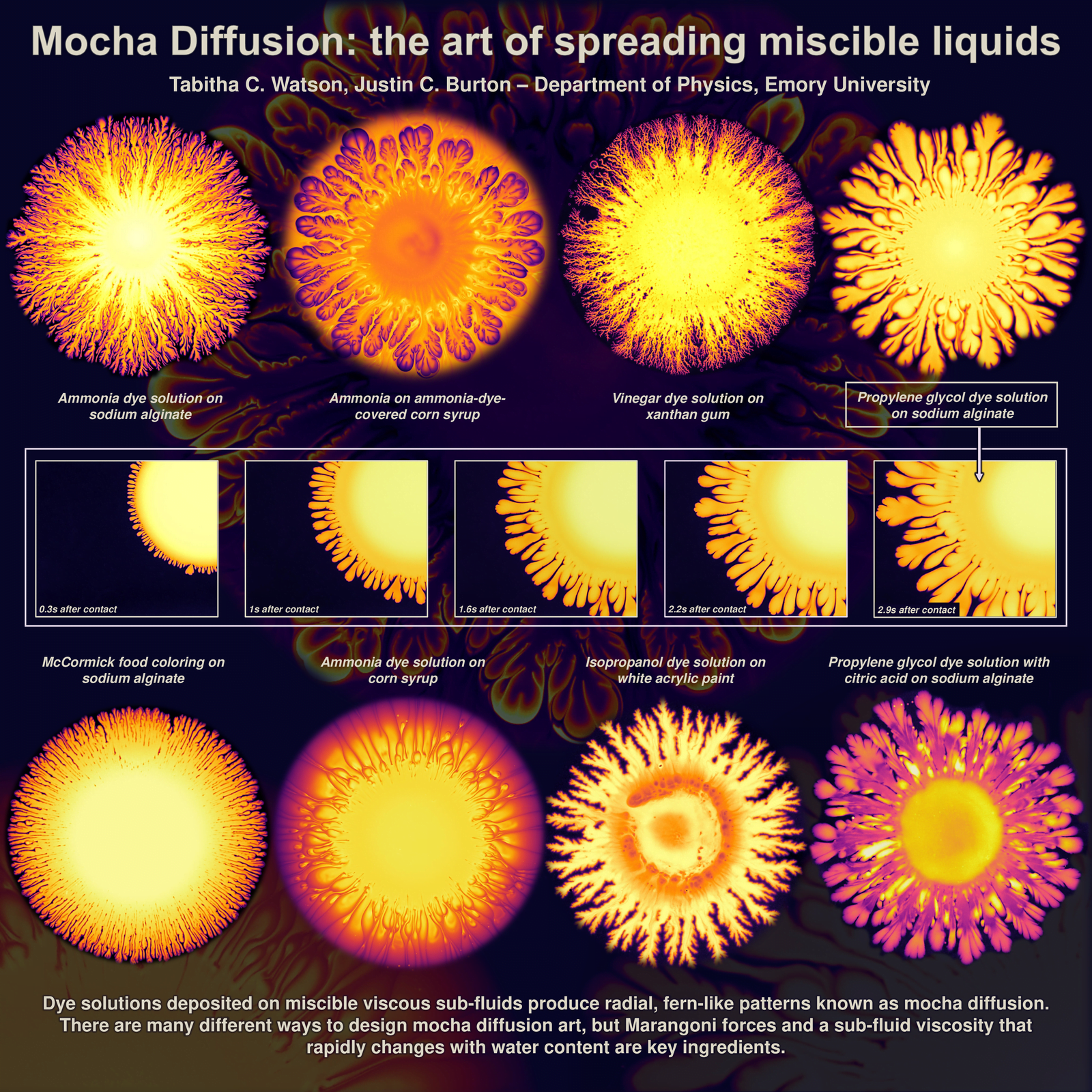
    Ruslan Khasanov’s “Space Iris” explores the similarities between nebulae and eyes. Made entirely with common fluids like paint, soap, and alcohol, the film shows off the gorgeous possibilities of surface-tension- and density-driven instabilities. Marangoni flows abound! I even see some hints of solutal convection, perhaps? (Video and image credit: R. Khasanov; via Colossal)

  • Liquid Lens Rupture

    Liquid Lens Rupture

    A blob of sunflower oil floating on soapy water forms a disk known as a liquid lens. But add some dyed ethanol and things take a turn. The lens rapidly expands and distorts as the ethanol and soapy water meet. These surface flows are driven by the imbalance of surface tension between the different liquids. The liquid lens deforms and abruptly ruptures, releasing dye and ethanol before rebounding into a stable lens again. Adding more ethanol to the lens will repeat the cycle. (Image credit: C. Kalelkar and P. Dey; research credit: D. Maity et al.)

  • Bubble Trails – Straight or Wonky?

    Bubble Trails – Straight or Wonky?

    Watch the bubbles rising in a glass of champagne and you’ll see them form tiny straight lines, with each bubble following its predecessor. But in a carbonated soda, the bubbles rise all over the place, each following its own zig-zaggy line. Why the difference? A recent study points out the culprits: bubble size and surfactants.

    As bubble size increases from left to right, the bubble trail straightens.
    As bubble size increases from left to right, the bubble trail straightens.

    Looking at a variety of beverage scenarios, researchers found that both a bubble’s size and its surfactant concentration affected what sort of path it followed. For clean (surfactant-free) bubbles, small bubbles take a winding path, but bigger ones move in a straight line. Simulations show that bubbles can only form a straight path if they produce enough vorticity on their surface. Small bubbles just can’t deform enough to do that.

    For bubbles of the same size, increasing the surfactant on the bubbles straightens their path.
    For bubbles of the same size, increasing the surfactants on the bubbles straightens their path.

    When surfactants get added, though, the story changes. For bubbles of a set size, adding surfactants made their paths straighter. This was due, the team found, to a bump in vorticity provided by the stabilizing effect of the surfactants. Champagne, they concluded, has straight bubble paths despite its tiny bubbles because of the drink’s high number of flavorful surfactants. (Image credit: top – D. Cook, experiments – O. Atasi et al.; research credit: O. Atasi et al.; via APS Physics)

  • Featured Video Play Icon

    Polymers and Fluid Sheets

    Even adding a small amount of polymers to a fluid can drastically change its behavior. Often polymer-doped fluids act more like soft solids, able to hold their shape like your toothpaste does when squeezed onto your toothpaste. Under a little stress, though, the fluids still flow; that’s why your toothpaste gets less viscous as you scrub.

    To study the changes polymers make, this research team collides two jets of fluid to create a liquid sheet. Depending on the flow rate and the added polymers, the break-up pattern of the sheet changes. By observing changes in the sheet thickness and the holes that form, they can draw conclusions about what the polymers are doing. (Video credit: C. Galvin et al.)