Tag: instability

  • Featured Video Play Icon

    Chemical Flowers

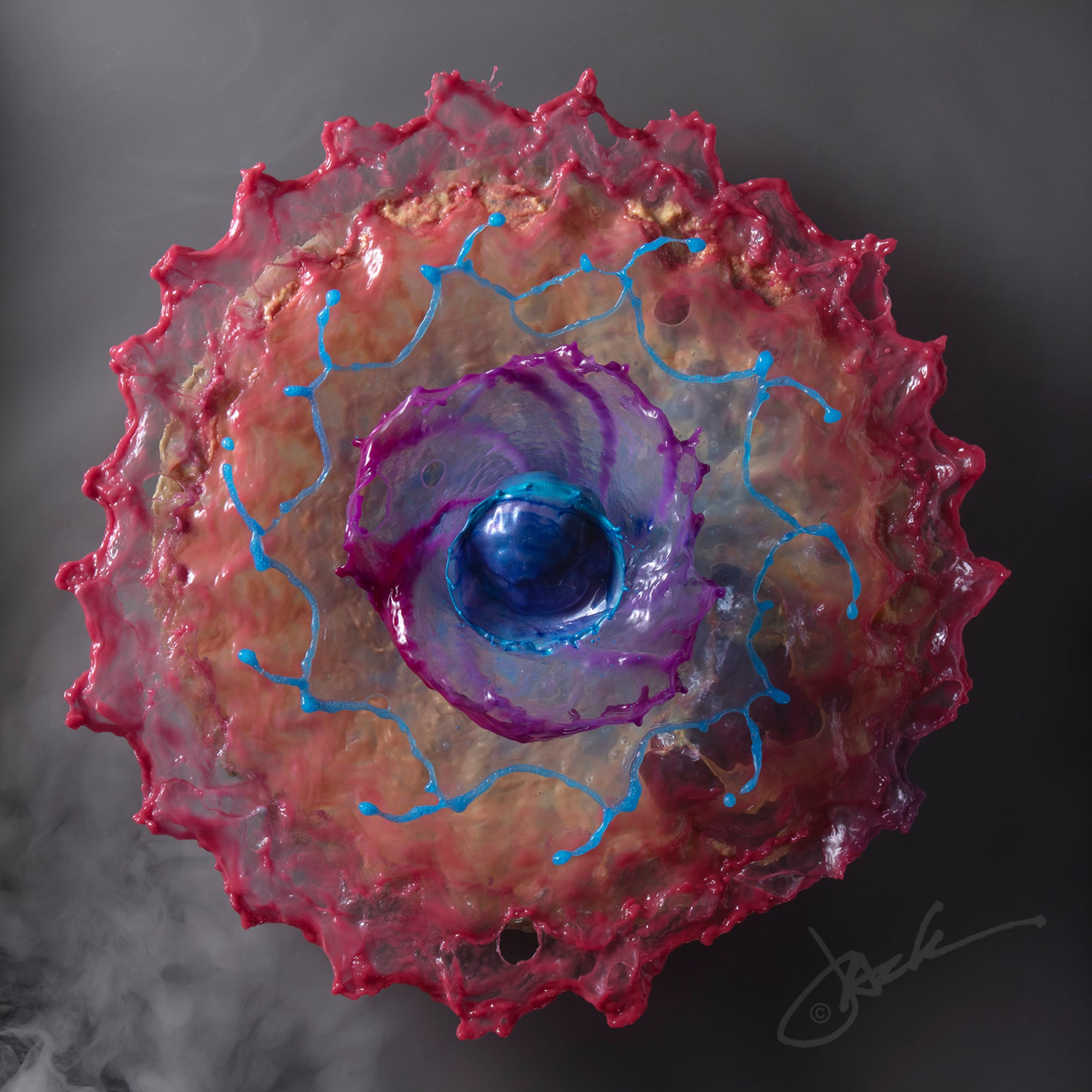
    These “flowers” blossom as two injected chemicals react in the narrow space between two transparent plates. The chemical reaction produces a darker ring that develops a streaky outer edge due to competition between convection and chemical diffusion.

    To show how gravity affects the instability, the researchers repeated the experiment on a parabolic flight. In microgravity conditions, no instability formed. That’s exactly what we’d expect if convection (i.e. flow due to density differences) is a major cause. No gravity = no convection. In contrast, under hypergravity conditions, the instability was initially spotty before developing streaks. (Image and video credit: Y. Stergiou et al.)

  • “Keeping Our Sheet Together”

    “Keeping Our Sheet Together”

    When two liquid jets collide, they form a falling liquid sheet. Here researchers explore how that sheet breaks up when the liquids involved contain polymers. The intact areas of the sheet show as dark red or almost black. The edges of the sheet appear in brighter red and yellow, outlining the holes that form and grow during breakup. The type of breakup observed depends on the concentration of polymer in the liquid. (Image credit: C. Galvin et al.)

  • Flowers Through a Hazy Veil

    Flowers Through a Hazy Veil

    A smoke-like haze obscures colorful bouquets in these photographs from artist Robert Peek. To achieve the effect, Peek submerges his subjects underwater with white dye that sinks due to its greater density. The wakes traced by the dye are impressively laminar, so the dye must drift rather slowly past each petal. The overall effect is beautifully dream-like. You can find more of Peek’s work on Behance and Instagram. (Image credit: R. Peek; via Colossal)

  • When Rivers Jump

    When Rivers Jump

    Avulsions — sudden changes in the course of a river — are a river’s equivalent of an earthquake, and they can be similarly devastating for those in the river’s path. In a recent study, authors combed through 50 years’ worth of satellite data to catalog over 100 avulsions and categorize them into three regimes. About a quarter of the observed avulsions took place in the river delta’s fan, where the river spreads out once it exits a canyon or valley. These avulsions, they found, occur when rivers lose confinement and sediment can build up.

    This animation of satellite images shows the sudden avulsion -- a dramatic change in the river's course -- that took place on the Kosi River in 2008.
    This animation of satellite images shows the sudden avulsion — a dramatic change in the river’s course — that took place on the Kosi River in 2008.

    Among the other observations, the team linked avulsion location to the river’s flow properties. Most of these remaining avulsions took place in the river’s backwater region, where the river begins to slow down before its outlet. The last category of avulsion took place far upstream of the backwater region on rivers with high sediment flows. During flood conditions, erosion can travel far upstream on these rivers, causing avulsions in unexpected places. Changes in sediment load due to human activities, like deforestation, could even cause rivers to change from the backwater regime to the high-sediment load one. (Image credit: top – R. Simmon/USGS, bottom – S. Brooke et al.; research credit: S. Brooke et al.; via AGU Eos; submitted by Kam-Yung Soh)

  • Saffman-Taylor Instability

    Saffman-Taylor Instability

    Air and blue-dyed glycerin squeezed between two glass plates form curvy, finger-like protrusions. This is a close-up of the Saffman-Taylor instability, a pattern created when a less viscous fluid — here, air — is injected into a more viscous one. If you reverse the situation and inject glycerin into air, you’ll get no viscous fingers, just a stable, expanding circle. Although you sometimes come across this instability in daily life — like in a cracked smartphone screen — the major motivation for studying this phenomenon historically has been oil and gas extraction. (Image credit: T. Pohlman et al.)

  • Featured Video Play Icon

    A Levitated Boil

    When acoustically levitated, objects tend to clump together and move like a single, large solid. But researchers found more fluid-like states for their levitated particles when the particles were smaller. At low acoustic power, the particles behave like a liquid and shift primarily within a plane. But as the acoustic power increases, the granular liquid begins to “boil” and transition into a gaseous state, with particles moving in all directions. It’s amazing how often these metaphors (e.g., treating a group of particles as a “liquid”) hold true when observing different physical systems! (Image and video credit: B. Wu et al.)

  • Microscale Kelvin-Helmholtz

    Microscale Kelvin-Helmholtz

    When we think of cavitation in a flow, we often think of it occurring at a relatively large scale — on the propeller of a boat, for example. But cavitation takes place on microscales, too, including around fuel-injection nozzles. In this study, researchers investigated submillimeter-scale cavitation using a flow through a tiny Venturi tube. What they found was something we usually associate with larger scale flows: the Kelvin-Helmholtz instability.

    The Kelvin-Helmholtz instability takes place on this cavitation bubble.

    The wavy shape of a Kelvin-Helmholtz instability forms when two layers of fluid move past one another at different speeds and the interface where they meet becomes unstable. Here, that happens along a cavitation bubble, where the bubble and the flow meet. Interestingly, at these scales, the Kelvin-Helmholtz instability seems to be the primary method of break-up, instead of shock wave interactions.

    For those keeping track, we’ve now seen the Kelvin-Helmholtz instability from the quantum scale up to 160 thousand light-years. It’s hard to achieve a much wider range than that! (Image and research credit: D. Podbevšek et al.; submitted by M. Dular)

  • Featured Video Play Icon

    “Art of Paint”

    Filmmaker Roman De Giuli is always coming up with spectacular and visually fascinating new ways to manipulate ink and other liquids. In “Art of Paint,” he applies thin layers atop a custom plate that can be tilted in any direction. The results sometimes resemble acrylic paint pours, sometimes Marangoni flows, and sometimes look more like salt fingers or Rayleigh-Taylor instabilities. The extreme variety of forms is quite unique among these sorts of films and is well worth taking the time to view in fullscreen. (Image and video credit: R. De Giuli)

  • Rotating Waves of Grains

    Rotating Waves of Grains

    Rotating drums are a popular way to explore granular dynamics. Here, researchers fill a cylinder (seen below) with heavy grains and a low-viscosity fluid, then rotate the mixture about a horizontal axis. This sets up a contest between centrifugal forces and gravitational forces on the grains. At the right rotation rates, the grains form annular rings around the outside of the cylinder, where they rotate at a different speed than the fluid. This difference in speed between the two layers can trigger a Kelvin-Helmholtz instability and cause waves along the interface between the grains and the fluid, as seen in the examples above. (Image and research credit: V. Dyakova and D. Polezhaev; top image adapted by N. Sharp)

    Image of the experimental apparatus when not rotating.
  • Featured Video Play Icon

    How Dunes Form

    On its face, the idea that sand and wind can come together to form massive mountainous dunes seems bizarre. But dunes — and their smaller cousins, ripples — are everywhere, not just on Earth but on other planetary bodies where fine particles and atmospheres interact. In this video, Joe Hanson gives a great overview of sand dynamics, beginning with what sand is, how it moves, and what it can ultimately form. It’s well worth a watch, even if you know a little about dunes already; I know I learned a thing or two! (Image and video credit: Be Smart)