One way to reduce carbon dioxide in the atmosphere is to pump the CO2 into saline aquifers deep below the surface. Such aquifers are thin but stretch over large areas and are sometimes gently sloping. Since carbon dioxide is relatively buoyant, it may migrate up-slope after injection and potentially leak elsewhere. Dissolving the carbon dioxide into the groundwater helps prevent this undesirable migration. The video above shows a laboratory analog of the fluid instability at the heart of this trap. Imagine the video tilted by a few degrees so it slopes upward toward the right. The initially buoyant carbon dioxide, represented by the dark fluid, rises on the left and moves rightward, up-slope. As the CO2 dissolves into the ambient groundwater, the water becomes denser and fingers of the CO2-rich water drift downward, effectively halting the carbon dioxide’s escape. This is known as convective dissolution. (Video credit: C. MacMinn and R. Juanes)
Tag: instability

Beads-on-a-string
Viscoelastic fluids are a type of non-Newtonian fluid in which the stress-strain relationship is time-dependent. They are often capable of generating normal stresses within the fluid that resist deformation, and this can lead to interesting behaviors like the bead-on-a-string instability shown above. In this phenomenon, a uniform filament of fluid develops into a series of large drops connected by thin filaments. Most fluids would simply break into droplets, but the normal stresses generated by the viscoelastic fluid prevent break-up. For this particular photo, the stresses are generated by clumps of surfactant molecules within the wormlike micellar fluid. Similar effects are observed in polymer-laced fluids. (Photo credit: M. Sostarecz and A. Belmonte)

“Orchid”
Artist Fabian Oefner enjoys capturing both art and science in his work. In his latest series, “Orchid”, the blossom-like images are the result of splashes. He layered multiple colors of paint, ending with a top layer of black or white, then dropped a sphere into the paint. The images show how the colors mix and rebound, a delicate splash crown seen from above. The liquid sheet thickens at the rim and breaks up into ligaments from the instability of the crown’s edge. It makes for a remarkable demonstration of the effects of momentum and surface tension. Several of Oefner’s previous collections have appeared on FYFD (1, 2, 3). (Photo credit: F. Oefner)

Holey Splashes
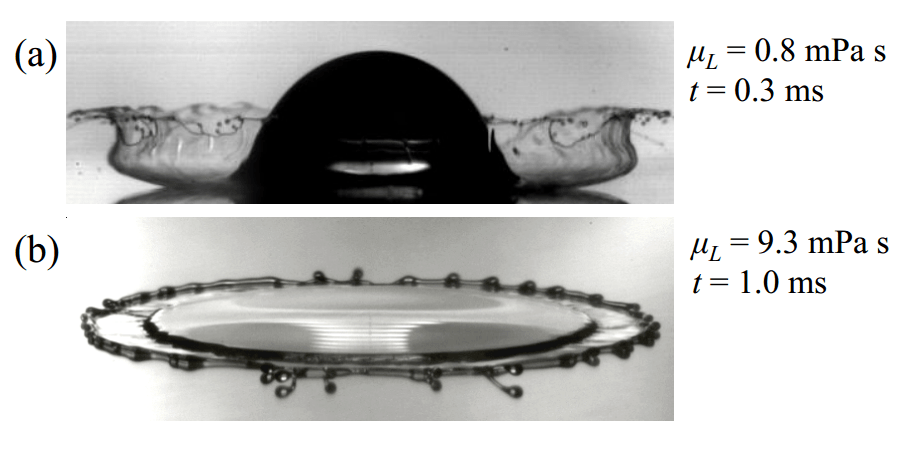
A liquid’s surface tension can have a big effect on its splashes. In this video, a 5-mm droplet hits a surface covered in a thin layer of a liquid with lower viscosity and surface tension. The result is a dramatic effect on the spreading splash. As the initial curtain grows and expands, the lower surface tension of the impacted fluid thins the splash curtain. Fluid flows away from these areas due to the Marangoni effect, causing holes to grow. The sheet breaks up into a network of liquid filaments and ejected droplets before gravity can even bring it all to rest. For more, see this previous post and review paper. (Video credit: S. Thoroddsen et al.)
Liquid Sculptures
[original media no longer available]
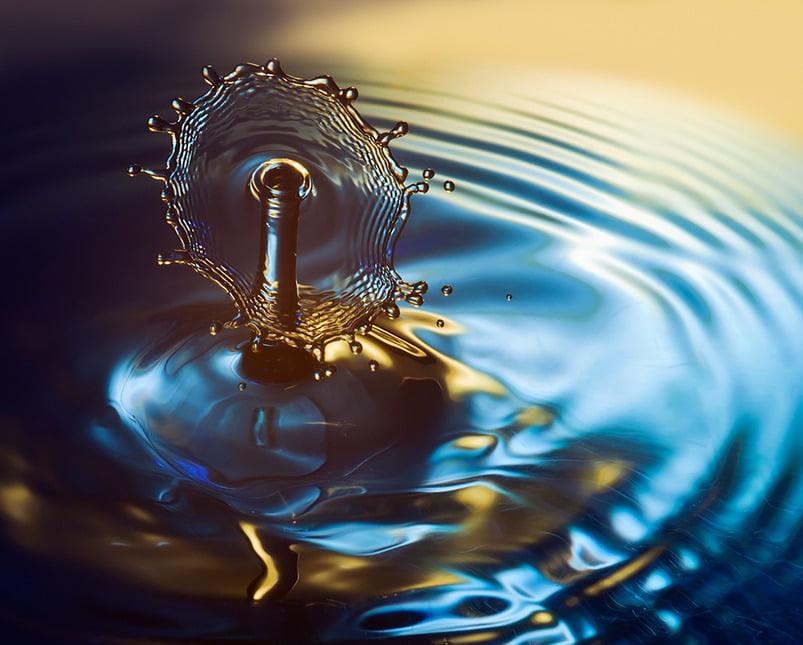
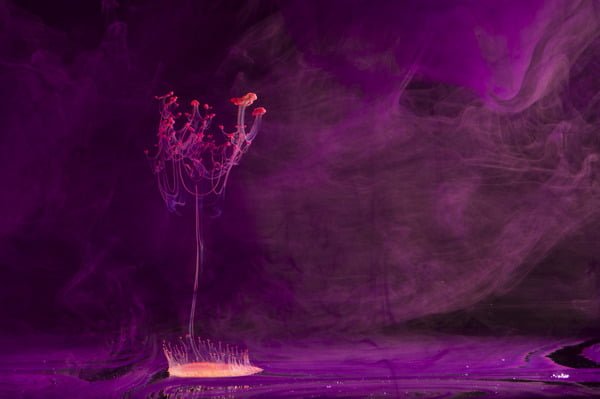
Water sculptures–a marriage of liquids, photography, and timing–are spectacular form of fluid dynamics as art. Artist Markus Reugels is a master of the form. This video captures the life and death of such water sculptures at 2,000 fps, beginning with the fall of the initial blue droplet. The droplet’s impact causes a rebounding Worthington jet, which reaches its pinnacle just as a second droplet strikes. The impact spreads into an umbrella-like skirt consisting of a thin, expanding liquid sheet with a thicker rim. The rim itself is unstable, breaking into regularly spaced filaments and tiny satellite droplets that shoot outward before the entire structure collapses into the pool. One especially cool aspect of watching this in video is seeing how the blue dye from each droplet spreads as the water splashes and rebounds. You can see the set-up Reugels uses for his photography here. (Video credit: M. Reugels and L. Lehner)

How Fast Do Holes Grow?
Taylor and Culick predicted a constant velocity for the rim of an opening hole in a soap film of uniform thickness. Unfortunately, it is difficult to experimentally produce a soap film of uniform thickness. It is much easier to create films of uniform thickness with liquid crystals in their smectic-A phase, in which the molecules are ordered in layers along a single direction. When smectic-A bubbles burst, however, it bears little resemblance to a soap bubble. Smectic-A bubbles burst spontaneously during oscillations, the holes in the film growing until a network of filaments is left behind. The filaments themselves will rapidly break up into droplets due to the Plateau-Rayleigh instability. (Photo credit: R. Stannarius et al.)

Marangoni Flows
Differences in surface tension cause fluid motion through the Marangoni effect. Because an area with higher surface tension pulls more strongly on nearby liquid than an area of low surface tension, fluid will flow toward areas of higher surface tension. Here surfactants, shown in white, are constantly injected onto a layer of water dyed blue. You can also see the flow in motion in this video. Outside of the central source flow, the pattern features lots of 2D mushroom-like shapes reminiscent of Rayleigh-Taylor instabilities. But these shapes are driven by variations in surface tension rather than unstable density variations. For more, check out the original paper or learn about other examples of Marangoni effect. (Photo credit: M. Roché et al.)

Fluid Sculptures From Bursting Bubbles
A bubble initiated near a free surface–like the air-water interface here–can generate some spectacular dynamics. Beginning at the far left, the expanding subsurface bubble causes a dome at the surface that sharpens into a spike. By Frame 3, the bubble is collapsing but overshoots and rebounds, which introduces the tiny instability in Frame 4 that grows in subsequent time steps to form the water skirt that surrounds the spike. Although generated entirely differently, the end result is reminiscent of the water sculptures made by artists like Marcus Reugels, Corrie White, Jack Long, and others. (Image credit: A. M. Zhang et al.)

Shaping and Levitating Droplets
Opposing ultrasonic speakers can be used to trap and levitate droplets against gravity using acoustic pressure. Changes to field strength can do things like bring separate objects together or flatten droplets. The squished shape of the droplet is the result of a balance between acoustic pressure trying to flatten the drop and surface tension, which tries to pull the drop into a sphere. If the acoustic field strength changes with a frequency that is a harmonic of the drop’s resonant frequency, the drop will oscillate in a star-like shape dependent on the harmonic. The video above demonstrates this for many harmonic frequencies. It also shows how alterations to the drop’s surface tension (by adding water at 2:19) can trigger the instability. Finally, if the field strength is increased even further, the drop’s behavior becomes chaotic as the acoustic pressure overwhelms surface tension’s ability to hold the drop together. Like all of this week’s videos, this video is a submission to the 2103 Gallery of Fluid Motion. (Video credit: W. Ran and S. Fredericks)

Spiraling Break-up
Instabilities in fluids are sometimes remarkable in their uniformity. Here we see a hollow spinning cup with a thin film of fluid flowing down the interior. The rim of fluid at the cup’s lip stretches into long, evenly spaced, spiraling threads. These filaments stretch until centrifugal forces overcome surface tension and viscous forces and break the liquid into a multitude of tiny droplets. This process is called atomization and is vital to everyday applications like internal combustion and inkjet printing. (Photo credit: R. P. Fraser et al.)