Behind airplanes in flight, water vapor from the engine exhaust will sometimes condense in the wingtip vortices, thereby forming visible contrails. The two initially parallel vortex lines are unstable and any small perturbation to them–a slight crosswind, for example–will cause an instability known as the Crow instability. The contrails become wavy, with the amplitude of the wave growing exponentially in time due to interactions between the two vortices. Eventually, the vortex lines can touch and pinch off into vortex rings. The effect is also quite noticeable when smoke generators are used on a plane, and there are some great examples in this air show video between 3:41:00 and 3:44:00. (Video credit: M. Landy-Gyebnar; h/t to Urs)
Tag: instability

Flames in Space

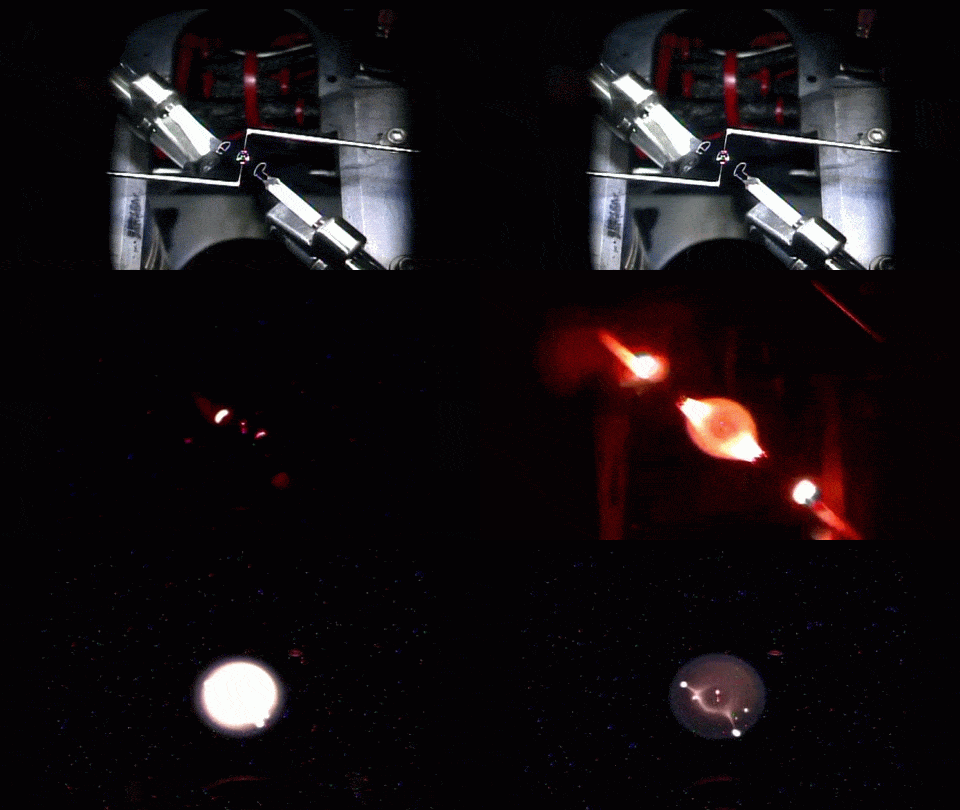
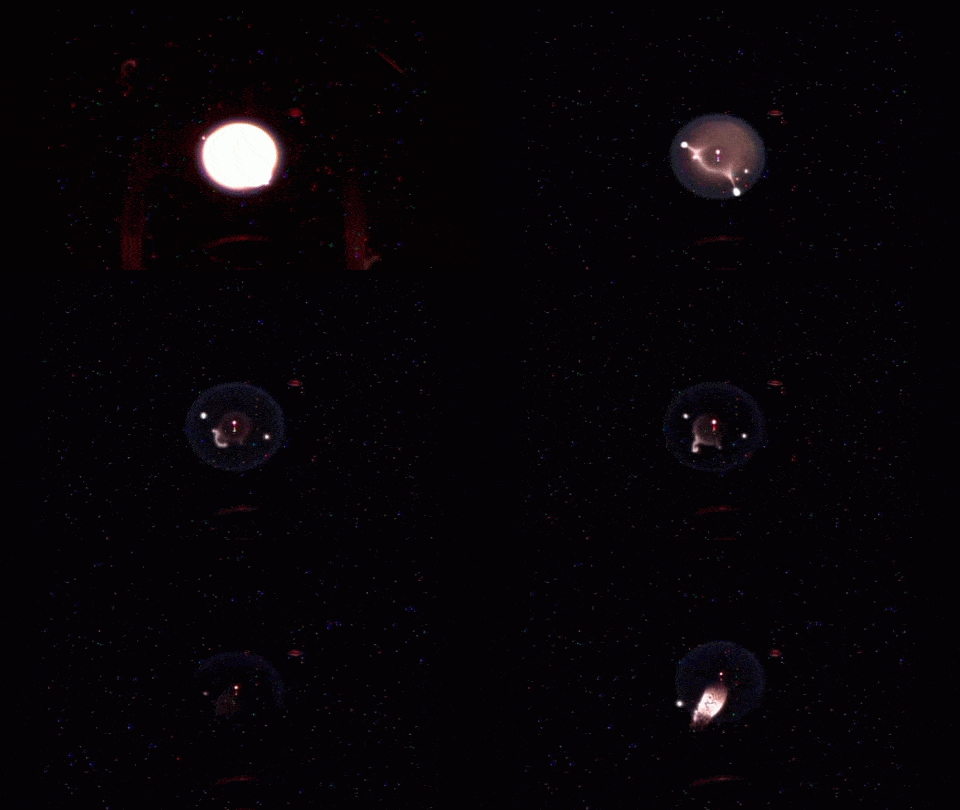

The jellyfish-like light show in the animations above shows the life and death of a flame in microgravity. The work is part of the Flame Extinguishment Experiment 2 (FLEX-2) currently flying aboard the International Space Station. When ignited, the fuel droplet creates a blue spherical shell of flame about 15 mm in diameter. The spherical shape is typical of flames in microgravity; on Earth, flames are shaped like teardrops due to the effects of buoyancy, which exists only in a gravitational field. The bright yellow spots and streaks that appear after ignition are soot, which consists mainly of hot-burning carbon. The uneven distribution of soot is what causes the pulsating bursts seen in the middle animation. When soot products drift back onto the fuel droplet, it causes uneven burning and flame pulses. The final burst of flame in the last animation is the soot igniting and extinguishing the flame. Fires are a major hazard in microgravity, where oxygen supplies are limited and evacuating is not always an option. Scientists hope that experiments like FLEX-2 will shed light on how fires spread and can be fought aboard spacecraft. For more, check out NASA’s ScienceCast on microgravity flames. (Image credits: NASA, source video; submitted by jshoer)

Lava Physics
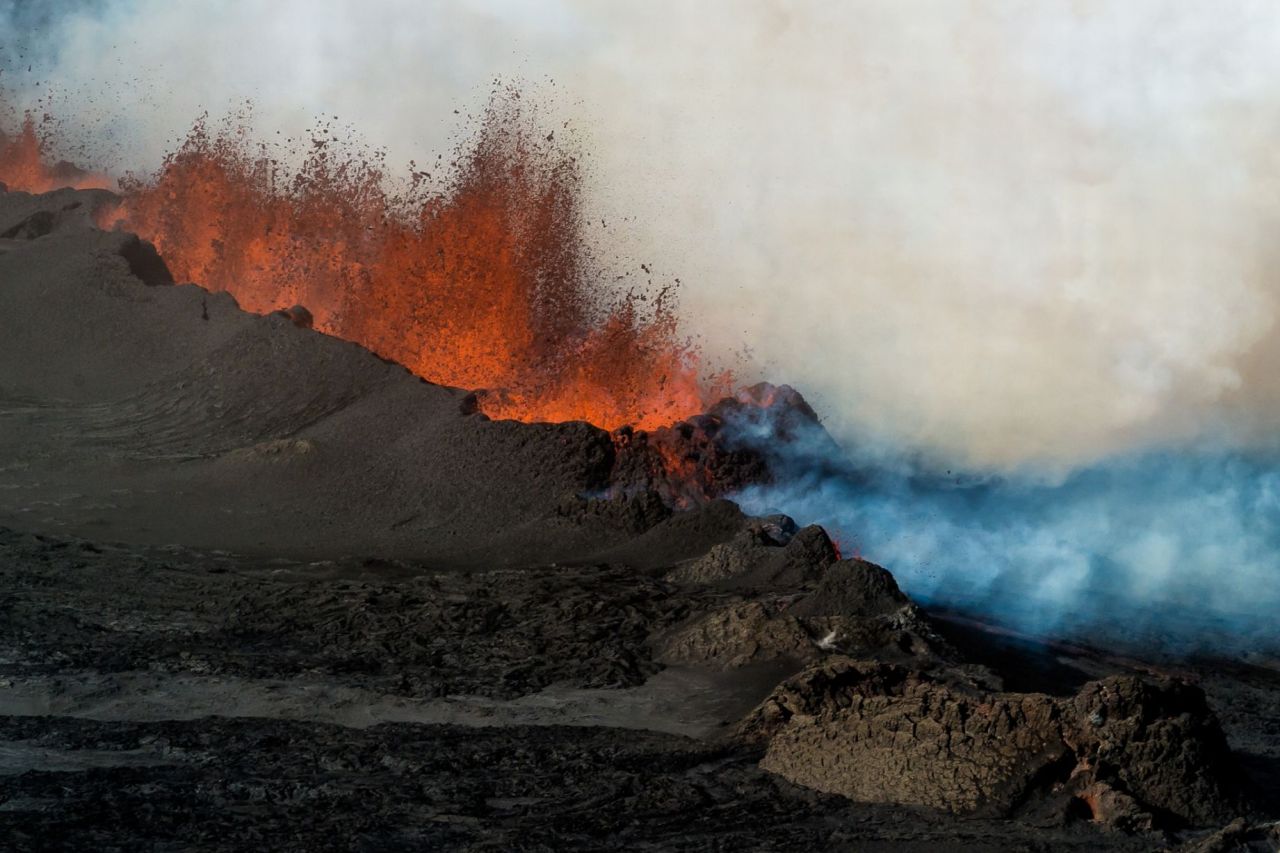
Lava is rather fascinating as a fluid. Lava flow regimes range from extremely viscous creeping flows all the way to moderately turbulent channel flow. Lava itself also has a widely varying rheology, with its bulk properties like viscosity and its response to deformation changing strongly with temperature and composition. As lava cools, instabilities form in the fluid, causing the folding, coiling, branching, swirling, and fracturing associated with different types and classes of lava. (Image credit: E. Guddman, via Mirror)

Water-Based Tractor Beam
 Researchers in Australia have demonstrated a “tractor beam” capable of manipulating floating objects from a distance using surface waves on water. And, unlike some research, you can try to replicate this result right in the comfort of your own bathtub! When a wave generator oscillates up and down, it creates surface waves that move objects and particles on the water’s surface. When the wave amplitudes are small, the outgoing wave fronts tend to be planar, as in part (a) of the figure above. These planar waves push surface flow away from the wave generator in a central outward jet, and new fluid is entrained from the sides to replace it. This creates the kind of flowfield shown in the streaklines of part (b).
Increasing the amplitude of the surface waves drastically changes the surface flow’s behavior. Larger wave amplitudes are more susceptible to instabilities due to the nonlinear nature of the surface waves. This means that the planar wave fronts seen in part (a) break down into a three-dimensional wavefield, like the one shown in part (c). Near the wave-maker, the surface waves now behave chaotically. This pulsating motion ejects surface flow parallel to the wave-maker, which in turn draws fluid and any floating object toward the wave-maker. The corresponding surface flowfield is shown in part (d). The researchers are refining the process, but they hope the physics will one day be useful in applications oil spill clean-up. (Video credit: Australia National University; image and research credit: H. Punzmann et al. 1, 2; via phys.org; submitted by Tracy M)

Supernova Explosion
Type 1a supernovae occur in binary star systems where a dense white dwarf star accretes matter from its companion star. As the dwarf star gains mass, it approaches the limit where electron degeneracy pressure can no longer oppose the gravitational force of its mass. Carbon fusion in the white dwarf ignites a flame front, creating isolated bubbles of burning fluid inside the star. As these bubbles burn, they rise due to buoyancy and are sheared and deformed by the neighboring matter. The animation above is a visualization of temperature from a simulation of one of these burning buoyant bubbles. After the initial ignition, instabilities form rapidly on the expanding flame front and it quickly becomes turbulent. (Image credit: A. Aspden and J. Bell; GIF credit: fruitsoftheweb, source video; via freshphotons)

The Real Shape of Raindrops
We often think of raindrops as spherical or tear-shaped, but, in reality, a falling droplet’s shape can be much more complicated. Large drops are likely to break up into smaller droplets before reaching the ground. This process is shown in the collage above. The initially spherical drops on the left are exposed to a continuous horizontal jet of air, similar to the situation they would experience if falling at terminal velocity. The drops first flatten into a pancake, then billow into a shape called a bag. The bags consists of a thin liquid sheet with a thicker rim of fluid around the edge. Like a soap bubble, a bag’s surface sheet ruptures quickly, producing a spray of fine droplets as surface tension pulls the damaged sheet apart. The thicker rim survives slightly longer until the Plateau-Rayleigh instability breaks it into droplets as well. (Image credit: V. Kulkarni and P. Sojka)
Fireworks Taking Off
Aerial fireworks are essentially semi-controlled exploding rockets. Here Discovery Channel shares high-speed video of fireworks taking off. The turbulent billowing exhaust on the ground is reminiscent of other rocket launches. The tube-launched firework clip is a great example of an underexpanded nozzle. The pressure of the gases in the tube is higher than the ambient air, so when the gases escape, the exhaust fans out to equalize the pressure. And, finally, the explosion that propels the colorful chemicals outward forms jets that can affect the final form of the display. To my American readers: Happy 4th of July! And be safe! (Video credit: Discovery Slow-Down)

“Clourant”


Photographers Cassandra Warner and Jeremy Floto produced the “Clourant” series of high-speed photographs of colorful liquid splashes. The artists took special care to disguise the origin of splashes, making them appear like frozen sculptures. The photos are beautiful examples of making fluid effects and instabilities. Many of them feature thin liquid sheets with thicker rims just developing ligaments. In other spots, surface tension has been wholly overcome by momentum’s effects and what was once ligaments has exploded into a spray of droplets. (Photo credit: C. Warner and J. Floto; submitted by jshoer; via Colossal)

Distorted Rings
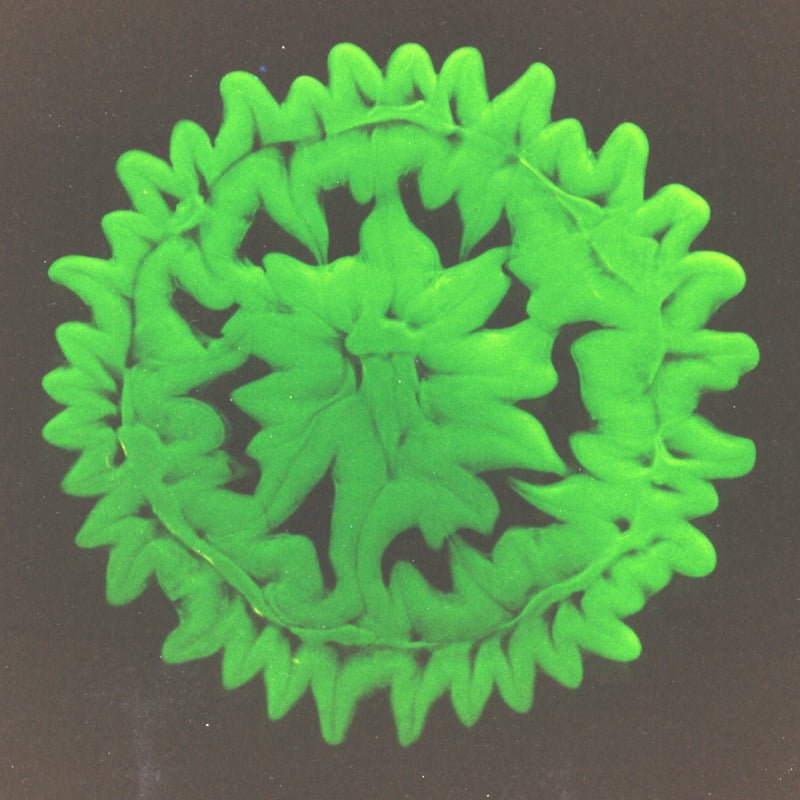
The Marangoni effect is generated by variations in surface tension at an interface. Such variations can be temperature-driven, concentration-driven, or simply due to the mixing between fluids of differing surface tensions as is the case here. The pattern in the image above formed after a dyed water droplet impacted a layer of glycerin. The initial impact of the drop formed an inner circle and outer ring. This image is from 30 seconds or so after impact, after the Marangoni instability has taken over. The higher surface tension of the water pulls the glycerin toward it, resulting in a flower-like pattern. (Photo credit: E. Tan and S. Thoroddsen)
“Chromatic Mushrooms”
Chemical Bouillon’s art often mixes chemistry and fluid dynamics. Here dense UV dyes falling through a less dense fluid form long strings with mushroom-like caps or tree-like branches. (For reference, gravity is pointing up relative to the video frame in most clips.) This behavior is related to the Rayleigh-Taylor instability that deforms interfaces and causes mixing between unstably stratified fluids. (Video credit: Chemical Bouillon)
 Researchers in Australia have