The Kelvin-Helmholtz instability looks like a series of overturning ocean waves and occurs between layers of fluids undergoing shear. This video has a great lab demo of the phenomenon, including the set-up prior to execution. When the tank is tilted, the denser dyed salt water flows left while the fresh water flows to the right. These opposing flow directions shear the interface between the two fluids, which, once a certain velocity is surpassed, generates an instability in the interface. Initially, this disturbance is much too small to be seen, but it grows at an exponential rate. This is why nothing appears to happen for many seconds after the tilt before the interface suddenly deforms, overturns, and mixes. In actuality, the unstable perturbation is present almost immediately after the tilt, but it takes time for the tiny disturbance to grow. The Kelvin-Helmholtz instability is often seen in clouds, both on Earth and on other planets, and it is also responsible for the shape of ocean waves. (Video credit: M. Hallworth and G. Worster)
Tag: instability

The March of Drops
I love science with a sense of humor. This video features a series of clips showing the behavior of droplets on what appears to be a superhydrophobic surface. In particular, there are some excellent examples of drops bouncing on an incline and droplets rebounding after impact. For droplets with enough momentum, impact flattens them like a pancake, with the rim sometimes forming a halo of droplets. If the momentum is high enough, these droplets can escape as satellite drops, but other times the rebound of the drop off the superhydrophobic surface is forceful enough to overcome the instability and draw the entire drop back off the surface. (Video credit: C. Antonini et al.)
Supercell Timelapse
The storm chasing group Basehunters captured this stunning timelapse of a supercell thunderstorm forming in Wyoming. This class of storm is characterized by the presence of a mesocyclone, seen here as a large, rotating cloud. These rotating features form when horizontal wind shear is redirected upright by an updraft. This requires a strong updraft, which is often formed by a capping inversion, where a layer of warm air traps colder air beneath it. Supercells can be very dangerous in their own right, releasing torrential rains and large hail, but they are also capable of spawning violent tornadoes. (Video credit: Basehunters; via Bad Astronomy; submitted by jshoer)
Double-Diffusive Convection
Convection can be driven several mechanisms, including temperature and concentration differences. The video above shows convection between a a layer of sucrose solution and a layer of saline solution. Initially, the lighter sucrose layer sits over the denser salt water. After the interface is perturbed, the differences in concentration – and thus in density – between the fluids causes diffusion both upward and downward in the form of fingers. This instability behavior is analogous to salt-fingering, which occurs in the ocean when a layer of warm, salty water lies over a layer of cooler, less saline water. In the ocean, these temperature and salinity differences help drive ocean circulation as well as the mixing that occurs between different depths. (Video credit: William Jewell College)

Viscous Fingers
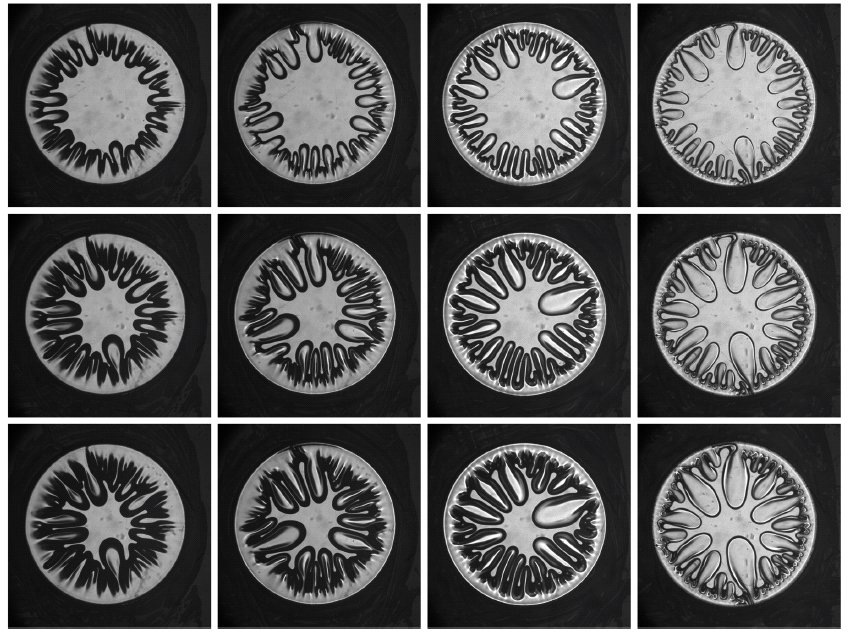
Viscous liquid placed between two plates forms a finger-like instability when the top plate is lifted. The photos above show the evolution of the instability for four initial cases (top row, each column) in which the initial gap between the plates differs. Each row shows a subsequent time during the lifting process. As the plate is pulled up, the viscous liquid adheres to it and air from the surroundings is entrained inward to replace the fluid. This forms patterns similar to the classic Saffman-Taylor instability caused when less viscous fluid is injected into a more viscous one. (Photo credit: J. Nase et al.)
Instability
[original media no longer available]
Many systems can exhibit unstable behaviors when perturbed. The classic example is a ball sitting on top of a hill; if you move the ball at all, it will fall down the hill due to gravity. There is no way to perturb the ball in such a way that it will return to the top of the hill; this makes the top of the hill an unstable point. In many dynamical systems, a very small perturbation may not be as obviously unstable as the ball atop the hill, especially at first. Often a perturbation will have a very small effect initially, but it can grow exponentially with time. That is the case in this video. Here a tank of fluid is being vibrated vertically with a constant amplitude. At first, the sloshing effect on the fluid interface is very small. But the vibration frequency sits in the unstable region of the parameter space, and the perturbation, which began as a small sloshing, grows very quickly. In a real system (as opposed to a mathematical one), this kind of unstable or unbounded growth very quickly leads to destruction. (Video credit: S. Srinivas)
Convection Cells
Human eyesight is not always the best for observing how nature behaves around us. Fortunately, we’ve developed cameras and sensors that allow us to effectively see in wavelengths beyond those of visible light. What’s shown here is a frying pan with a thin layer of cooking oil. To the human eye, this would be nothing special, but in the infrared, we can see Rayeigh-Benard convection cells as they form. This instability is a function of the temperature gradient across the oil layer, gravity, and surface tension. As the oil near the bottom of the pan heats up, its density decreases and buoyancy causes it to rise to the surface while cooler oil sinks to replace it. Here the center of the cells is the hot rising oil and the edges are the cooler sinking fluid. The convection cells are reasonably stable when the pan is moved, but, even if they are obscured, they will reform very quickly. (Video credit: C. Xie)

“Wallwave Vibration”


Loris Cecchini’s “Wallwave Vibration” series is strongly reminiscent of Faraday wave patterns. The Faraday instability occurs when a fluid interface (usually air-liquid though it can also be two immiscible liquids) is vibrated. Above a critical frequency, the flat interface becomes unstable and nonlinear standing waves form. If the excitation is strong enough, the instability can produce very chaotic behaviors, like tiny sprays of droplets or jets that shoot out like fountains. In a series of fluid-filled cells, the chaotic behaviors can even form synchronous effects above a certain vibration amplitude. (Image credit: L. Cecchini; submitted by buckitdrop)
The Kaye Effect
The Kaye effect is particular to shear-thinning non-Newtonian fluids – that is, fluids with a viscosity that decreases under deformation. The video above includes high-speed footage of the phenomenon using shampoo. When drizzled, the viscous liquid forms a heap. The incoming jet causes a dimple in the heap, and the local viscosity in this dimple drops due to the shear caused by the incoming jet. Instead of merging with the heap, the jet slips off, creating a streamer that redirects the fluid. This streamer can rise as the dimple deepens, but, in this configuration, it is unstable. Eventually, it will strike the incoming jet and collapse. It’s possible to create a stable version of the Kaye effect by directing the streamer down an incline. (Video credit: S. Lee)

Supernova Core Collapse
A core-collapse, or Type II, supernova occurs in massive stars when they can no longer sustain fusion. For most of their lives, stars produce energy by fusing hydrogen into helium. Eventually, the hydrogen runs out and the core contracts until it reaches temperatures hot enough to cause the helium to fuse into carbon. This process repeats through to heavier elements, producing a pre-collapse star with onion-like layers of elements with the heaviest elements near the center. When the core consists mostly of nickel and iron, fusion will come to an end, and the core’s next collapse will trigger the supernova. When astronomers observed Supernova 1987A, the closest supernova in more than 300 years, models predicted that the onion-like layers of the supernova would persist after the explosion. But observations showed core materials reaching the surface much faster than predicted, suggesting that turbulent mixing might be carrying heavier elements outward. The images above show several time steps of a 2D simulation of this type of supernova. In the wake of the expanding shock wave, the core materials form fingers that race outward, mixing the fusion remnants. Hydrodynamically speaking, this is an example of the Richtmyer-Meshkov instability, in which a shock wave generates mixing between fluid layers of differing densities. (Image credit: K. Kifonidis et al.; see also B. Remington)