Opposing ultrasonic speakers can be used to trap and levitate droplets against gravity using acoustic pressure. Changes to field strength can do things like bring separate objects together or flatten droplets. The squished shape of the droplet is the result of a balance between acoustic pressure trying to flatten the drop and surface tension, which tries to pull the drop into a sphere. If the acoustic field strength changes with a frequency that is a harmonic of the drop’s resonant frequency, the drop will oscillate in a star-like shape dependent on the harmonic. The video above demonstrates this for many harmonic frequencies. It also shows how alterations to the drop’s surface tension (by adding water at 2:19) can trigger the instability. Finally, if the field strength is increased even further, the drop’s behavior becomes chaotic as the acoustic pressure overwhelms surface tension’s ability to hold the drop together. Like all of this week’s videos, this video is a submission to the 2103 Gallery of Fluid Motion. (Video credit: W. Ran and S. Fredericks)
Tag: instability

Spiraling Break-up
Instabilities in fluids are sometimes remarkable in their uniformity. Here we see a hollow spinning cup with a thin film of fluid flowing down the interior. The rim of fluid at the cup’s lip stretches into long, evenly spaced, spiraling threads. These filaments stretch until centrifugal forces overcome surface tension and viscous forces and break the liquid into a multitude of tiny droplets. This process is called atomization and is vital to everyday applications like internal combustion and inkjet printing. (Photo credit: R. P. Fraser et al.)

Ink Diffusion


Alberto Seveso’s gorgeous high-speed photos of ink diffusing in water have a dramatic sense of texture to them. Though still delicate, the whorls of fluid seem almost solid enough to touch. Watch the edges, though, and you can see thin wisps of color and hints of instabilities. Like cream poured into coffee, these ink sculptures are short-lived. Some of his works are available as prints or wallpapers (zip file). (Photo credit: Alberto Seveso)

The Real Raindrop
What is the shape of a falling raindrop? Surface tension keeps only the smallest drops spherical as they fall; larger drops will tend to flatten. The very largest drops stretch and inflate with air as they fall, as shown in the image above. This shape is known as a bag and consists of a thin shell of water with a thicker rim at the bottom. As the bag grows, its shell thins until it ruptures, just like a soap bubble. The rim left behind destabilizes due to the surface-tension-driven Plateau-Rayleigh instability and eventually breaks up into smaller droplets. This bag instability limits the size of raindrops and breaks large drops into a multitude of smaller ones. The initial size of the drop in the image was 12 mm, falling with a velocity of 7.5 m/s. The interval between each image is 1 ms. (Photo credit: E. Reyssat et al.)

Shocking Instabilities
The Richtmyer-Meshkov (RM) instability occurs when the interface between two fluids of different density is impulsively accelerated – usually by the passage of a shock wave. The image above shows a thin layer of gaseous sulfur hexafluoride embedded in air. Each vertical line, from left to right, shows the distortion of the two fluids at subsequent time steps after a Mach 1.2 shock wave passes through the gases. The interface’s initial waviness grows into mushroom-like shapes that mix the two gases together, ultimately leading to turbulence. Scenarios involving the RM instability include supersonic combustion ramjet engines, supernovas, and inertial confinement fusion. The RM instability is closely related to Rayleigh-Taylor instability and shares a similar morphology. (Photo credit: D. Ranjan et al.)

Flame Feedback
When a flame is enclosed in a combustion chamber, it can create violent oscillations in the pressure field. Flames have a natural unsteadiness in their heat release. These temperature fluctuations create pressure waves in the chamber. In the right enclosure, those pressure waves resonate and feed energy back into the initial perturbation. This creates a self-exciting oscillation, not dissimilar from aeroelastic flutter. This combustion instability is known as a thermoacoustic instability because of the coupling between temperature and pressure (acoustic) waves. The quick demo above lets you see and hear such an instability; here’s the same setup in high-speed, which makes the oscillating flame even clearer. The violence of this instability can be great enough to destroy engines. Famously, the F1 engine used in the Saturn V rocket had a history of instability issues before the fuel-injector was redesigned. For another great demo of this effect, check out this video from T. Poinsot. (Video credit: V. Anandan)

Elastic Walls and Viscous Fingers
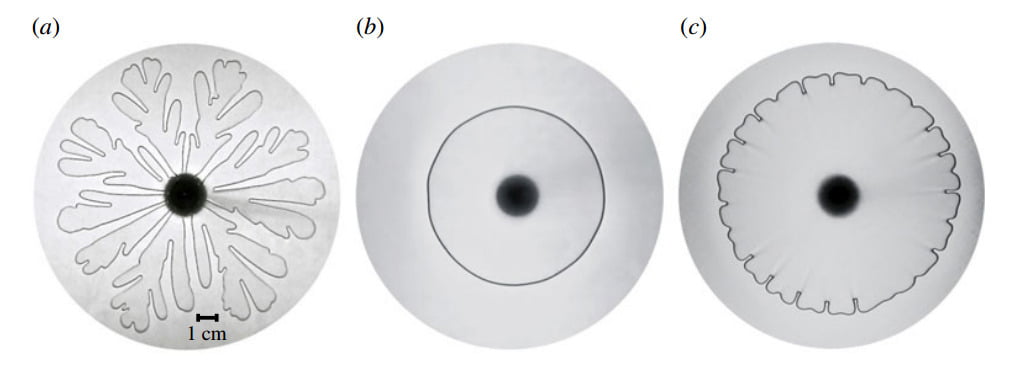
The Saffman-Taylor instability, characterized by the branchlike fingers formed when a less viscous fluid is injected into a more viscous one, is typically demonstrated between two rigid walls, as in part (a) of the figure above. But what happens if one of the rigid walls forming the Hele-Shaw cell is replaced with an elastic wall? This is the case for (b) and (c) in the figure. The flexibility of the wall causes the expansion of the air-fluid interface to slow down relative to the rigid wall case and causes the interface to move toward a narrowing fluid-filled gap (as opposed to a constant thickness one). Both of these effects reduce the viscous instability mechanism that drives the fingering instability. With a high enough mass flow rate as in ©, there is still some instability in the interface, but it is dramatically reduced. (Photo credit: D. Pihler-Puzovic et al.)
Bubbles With Tails
In water and other Newtonian fluids, a rising bubble is typically spherical, but for non-Newtonian fluids things are a different story. In non-Newtonian fluids the viscosity–the fluid’s resistance to deformation–is dependent on the shear rate and history–how and how much deformation is being applied. For rising bubbles, this can mean a teardrop shape or even a long tail that breaks up into fishbone-like ligaments. The patterns shown here vary with the bubble’s volume, which affects the velocity at which it rises (due to buoyancy) and thus the shear force the bubble and surrounding non-Newtonian fluid experience. (Video credit: E. Soto, R. Zenit, and O. Manero)

Flow Over a Delta Wing
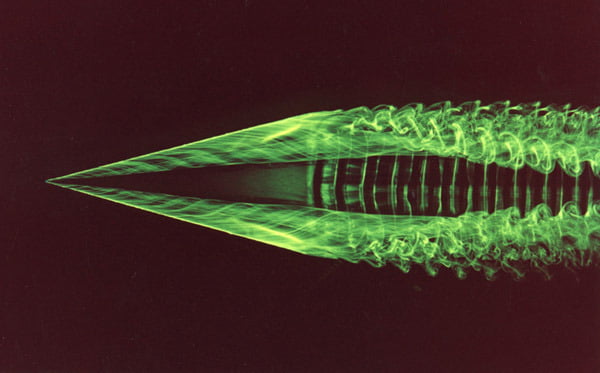
Fluorescent dye illuminated by laser light shows the formation and structure of vortices on a delta wing. A vortex rolls up along each leading edge, helping to generate lift on the triangular wing. As the vortices leave the wing, their structure becomes even more complicated, full of lacy wisps of vorticity that interact. Note how, by the right side of the photo, the vortices are beginning to draw closer together. This is an early part of the large-wavelength Crow instability. Much further downstream, the two vortices will reconnect and break down into a series of large rings. (Photo credit: G. Miller and C. Williamson)
Instability: Dense Over Light
Here on Earth, placing a dense layer of fluid atop a less dense layer is unstable. Specifically, the situation causes the interface between the two fluids to break down in what is known as the Rayleigh-Taylor instability.The video above shows a 2D numerical simulation of this breakdown, with the darker, denser fluid on top. The waviness of the initial interface provides a perturbation–a small disturbance–which grows in time. The two fluids spiral into one another in a fractal-like mushroom pattern. The continued motion of the dense fluid downward and the lighter fluid upward mixes the entire volume toward a uniform equilibrium. For those interested in the numerical methods used, check out the original video page. (Video credit: Thunabrain)