A sphere falling into water generates a spectacular crown
splash at the surface. The object’s impact ejects a thin sheet of fluid
that rises vertically. The air pulled down into the cavity by the
sphere’s passage makes the air pressure inside the sheet lower than the
ambient air pressure on the exterior of the sheet. This pressure
difference is part of what draws the crown inward to seal the cavity. As
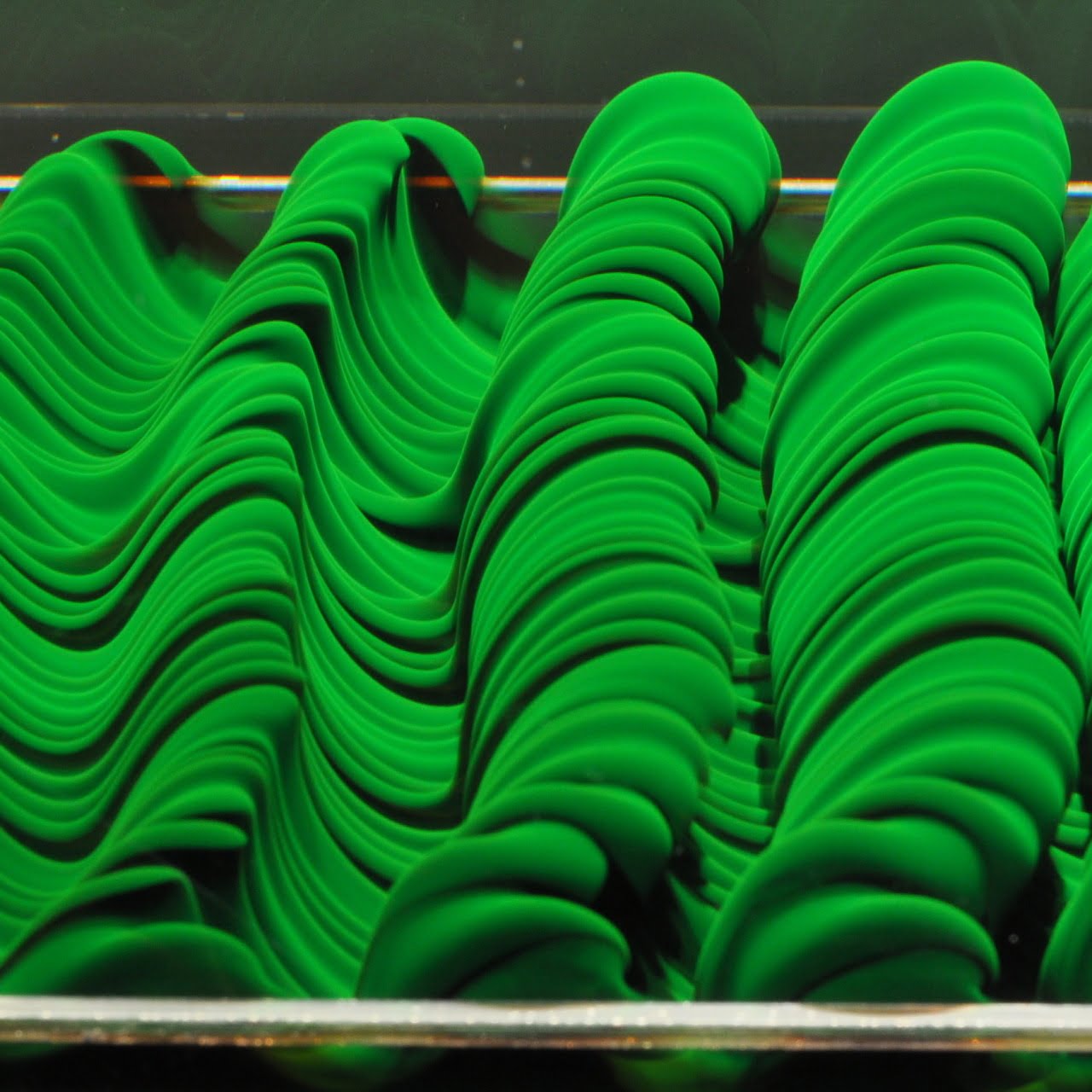
the splash collapses inward and seals, the liquid sheet starts to
buckle and wrinkle, leaving periodic stripes around the closing neck.
This so-called buckling instability occurs when the radius of the neck
collapses faster than the vertical speed of the splash. For more, see
the research paper or this award-winning video. (Image credit: J. Marston et al., source)
Tag: instability

Crown Splash Sealing

Electric Coiling
A falling jet of viscous fluid–like honey or syrup–will often coil. This happens when the jet falls quickly enough that it gets skinnier and buckles near the impact point. Triggering this coiling typically requires a jet to drop many centimeters before it will buckle. In many manufacturing situations, though, one might want a fluid to coil after a shorter drop, and that’s possible if one applies an electric field! Charging the fluid and applying an electric field accelerates the falling jet and induces coiling in a controllable manner.
An especially neat application for this technique is mixing two viscous fluids. If you’ve ever tried to mix, say, food coloring into corn syrup, you’ve probably discovered how tough it is to mix viscous substances. But by feeding two viscous fluids through a nozzle and coiling the resulting jet, researchers found that they could create a pool with concentric rings of the two liquids (see Figure C above). If you make the jet coil a lot, the space between rings becomes very small, meaning that very little molecular motion is necessary to finish mixing the fluids. (Image credits: T. Kong et al., source; via KeSimpulan)

Falling Ink
Photographer Linden Gledhill created these nebula-like composites from photos of ink diffusing in water. The work was inspired by Mark Stock’s “Spherical Rayleigh-Taylor Instabilities” series featured here last week. Like Stock’s computational art, the twisted fingers and vortex rings above form due to the denser ink falling through less dense water. The interface between the two fluids distorts under the effects of gravity and the fluids’ relative motion. Such shapes are ephemeral at best; the falling ink will quickly become turbulent and diffuse throughout the water. (Photo credit and submission: L. Gledhill)

Inside a Popping Bubble
Popping a soap bubble is more complicated than what the eye can see. In high-speed video, we find that the action is very directional, with the soap bubble film pulling away from the point of rupture. As it does so, waves, like those in a flapping flag, appear along the surface and strings of fluid form along the edge of the film before breaking into droplets. This video takes matters a step further, looking at what happens to air inside a bubble when it pops. Those subtle waves and strings of fluid we see in the high-speed rupture have a distinctive effect on air inside the bubble. As the film pulls away, it leaves behind a rippled, wavy surface rather than a smooth sphere of foggy air. (Video credit: Z. Pan et al.)

Icebergs and Caramel
What do icebergs and caramel have in common? Both have similar scalloped erosion patterns as they dissolve. When caramel dissolves in water, the denser caramel sinks in the buoyant water. An initially smooth surface will first form lines, then the flowing caramel and the uneven surface interact, forming chevrons, followed by larger scallops. A similar process happens with melting icebergs. The meltwater from an iceberg is less dense than the surrounding seawater, so it will rise as it melts. This causes variations in the salt concentration and temperature near the iceberg, which cause it to melt differently in different spots, ultimately leading to the same scallop shapes observed in the caramel. Check out the full-size PDF of the poster here. (Image credit: C. Cohen et al.)

The Fluidic Oscillator
A fluidic oscillator is a device with no moving parts that sprays a fluid from side to side. The animations above illustrate how they work. A nozzle funnels a fluid jet through a chamber with two feedback channels. When the jet sweeps close to one side of the chamber, part of the fluid is directed along the feedback channel and back toward the inlet. That flow feeds into a recirculating separation bubble in the middle of the chamber. As that bubble grows, it pushes the jet back toward the other feedback channel, continuing the cycle. Many automobiles use fluidic oscillators in their windshield washer sprays. Check out the award-winning full video from the Gallery of Fluid Motion. (Image credit: M. Sieber et al., source)

Oil Film on Water
This award-winning short film features a thin layer of volatile oil on water. The oil evaporates quickest from shallow pools only microns deep, which appear bluish in the video. Surface instabilities along the edge of the pool create flow that draws oil in, generating the iridescent droplets seen floating among the evaporation pools. The droplets combine and coalesce as they come in contact with one another. Since droplets have a larger volume per surface area than the shallow pools, they evaporate more slowly. The behaviors observed here are important to applications like oil and fuel spills, which can persist longer if the floating fluid layer tends to form droplets. (Video credit: J. Hart; via txchnologist)

From Dripping to Beading

When water drips, it quickly breaks up into a string of smaller droplets due to a surface-tension-driven instability called the Plateau-Rayleigh instability. But adding just a tiny bit of polymer to the fluid changes the behavior entirely. Instead of breaking into droplets, a narrow filament dotted with tiny satellite droplets forms between the larger drops. This is known as the beads-on-a-string instability. The viscoelasticity the polymers add is one key to seeing this behavior. Polymers consist of large molecule chains that, when stretched, act a little like rubber bands–they pull back against the stretch, providing an elastic effect. Without this elasticity, the tiny filament connecting the drops would break up immediately. (Image credit: M. Berman, source; research credit: P. Bhat et al.)

Viscous Fingers
Take a viscous fluid, like laundry detergent, and sandwich it between two plates of glass. Fluid dynamicists call this set-up a Hele-Shaw cell. If you then inject a less viscous fluid, like air, between the plates–or if you try to pry them apart–you’ll see a distinctive pattern of dendritic fingers form. This viscous fingering, also known as the Saffman-Taylor instability, occurs because the interface between the two fluids is unstable. Invert the problem, though–inject a more viscous fluid into a less viscous one–and no special shapes will form because the interface will remain stable. (Image credit: Random Walk Studios, source)

Cream in Coffee
Pouring cream in coffee produces some of the most mesmerizing displays of fluid dynamics. The density difference between the two fluids sets up Rayleigh-Taylor instabilities that mushroom out and help create the turbulence that eventually mixes the drink. You can learn more about Rayleigh-Taylor instabilities in this FYFD video, and, if you need more awesome caffeine-filled examples of fluids, check out the coffee dynamics blog. (Video credit: S. Geraldine and L. Kang)