Tag: instability

  • Waves Over the Rockies

    Waves Over the Rockies

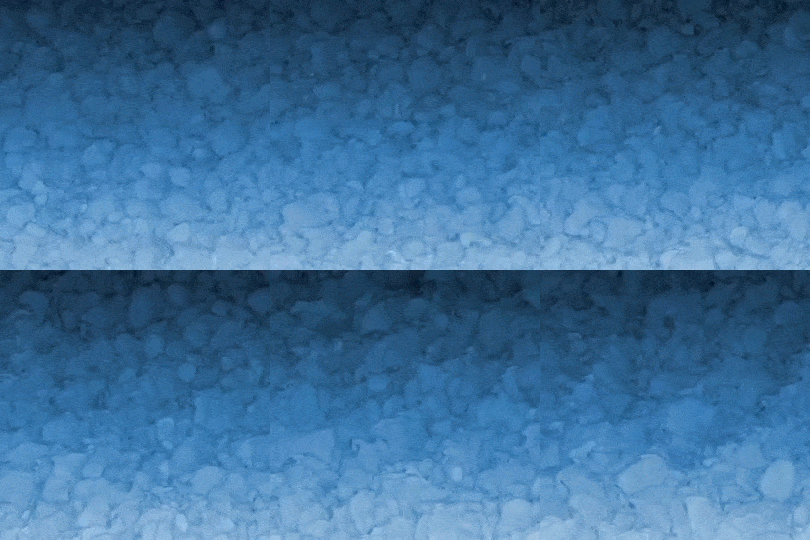
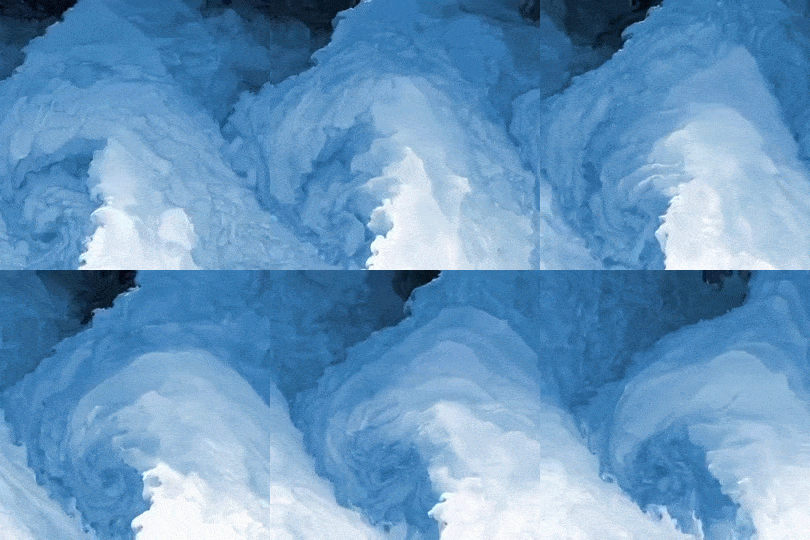
    These spectacular wave-like clouds are the result of the Kelvin-Helmholtz instability. When two layers of air move past one another at different velocities, an unstable shear layer forms at their interface. Disturbances in this shear layer grow exponentially, creating these short-lived overturning waves that quickly turn turbulent. The strong resemblance of these clouds to breaking ocean waves is no coincidence–the Kelvin-Helmholtz instability occurring between the wind and water is what generates many ocean waves. Kelvin-Helmholtz patterns are also common on other planets, like Jupiter, Saturn, and Mars. (Image credit: Breckenridge Resort; submitted by jshoer)

  • Featured Video Play Icon

    Pollock-Style Physics

    Here on FYFD, we like to show off the artistic side of fluid dynamics. But some researchers are actively studying how artists use fluid dynamics in their art. In this video, they examine one of Jackson Pollock’s painting techniques, in which filaments of paint were applied by flinging paint off a paintbrush. Getting the technique to work requires a fine balance of forces and effects. Firstly, the paint must be viscous enough to hold together in a filament when flung. Secondly, the centripetal acceleration of the rotation must be high to both form the catenary filament and throw it off the brush. And, finally, the Reynolds number needs to be high enough to add some waviness and instability to the filament so that it looks interesting once it hits the canvas. Also be sure to check out the group’s previous work exploring Siqueiros’s painting techniques. (Video credit: B. Palacios et al.)

  • Featured Video Play Icon

    Printing in Glass

    A group at MIT have created a new 3D printer that builds with molten glass. This allows them to manufacture items that would difficult, if not impossible, to create with traditional glassblowing or other modern techniques. One of the coolest aspects of this technique is that it can use viscous fluid instabilities like the fluid dynamical sewing machine to create different effects with the glass. You can see this around 1:56 in the video. Varying the height of the head and the speed at which it moves will cause the molten glass to fall and form into different but consistent coiling patterns. All in all, it’s a very cool application for using some nonlinear dynamics! (Video credit: MIT; via James H. and Gizmodo)

  • Boiling Water in Oil

    Boiling Water in Oil

    Most people know that throwing water into hot oil is a bad idea. But, as dramatic as the results can be, the boiling of a water droplet submerged in oil is remarkably beautiful, as seen in the animations above. The initial water droplet expands as it shifts from liquid to vapor (top). At a critical volume, the expansion occurs explosively (middle), causing the bubble to overexpand relative to the pressure of the surrounding fluid. The higher pressure of the oil around it collapses the drop, which then re-expands, creating the cycle we see in the final two animations. This oscillation triggers a Rayleigh-Taylor type instability along the bubble’s interface, causing the surface corrugations observed. The vapor bubble will continue to rise through the oil, eventually breaking the surface and scattering hot oil droplets.  (Image credits: R. Zenit, source)

  • Wave Clouds Over the Galapagos

    Wave Clouds Over the Galapagos

    This dramatic example of Kelvin-Helmholtz clouds was taken near the Galapagos Islands last week. The shark-fin-like clouds are the result of two air layers moving past one another. The velocity difference at their interface creates an unstable shear layer that quickly breaks down. The resemblance of the clouds to breaking ocean waves is no coincidence – the wind moving over the ocean’s surface generates waves via the same Kelvin-Helmholtz instability. In the case of the clouds above, the lower layer of air was moist enough to condense, which is why the pattern is visible. Clouds like these don’t tend to last for long because the disturbances that drive the instability grow exponentially quickly, leading to turbulence. (Image credit: C. Miller; via Washington Post; submitted by @jmlinhart)

    ——————

    Help us do some science! I’ve teamed up with researcher Paige Brown Jarreau to create a survey of FYFD readers. By participating, you’ll be helping me improve FYFD and contributing to novel academic research on the readers of science blogs. It should only take 10-15 minutes to complete. You can find the survey here.

  • Breaking Jets Into Drops

    Breaking Jets Into Drops

    A falling stream of water will break into droplets due to the Plateau-Rayleigh instability. Small disturbances can create a wavy perturbation in the falling jet. Under the right conditions, the pressure caused by surface tension will be larger in the narrower regions and smaller in the wider ones. This imbalance will drive flow toward the wider regions and away from the narrower ones, thereby increasing the waviness in the jet. Eventually, the wavy jet breaks into droplets, which enclose the same volume of water with less surface area than the perturbed jet did. The instability is named for Joseph Plateau and Lord Rayleigh, who studied it in the late 19th century and showed that a falling jet of a non-viscous fluid would break into droplets if the wavelength of its disturbance was larger than the jet’s circumference.  (Image credit: N. Morberg)

  • Sharkskin Instability

    Sharkskin Instability

    Homemade spaghetti noodles exhibit a roughened surface that’s the result of viscoelastic behavior known as the sharkskin instability. It’s usually observed in the industrial extrusion of polymer plastics. In the case of spaghetti, the long, complex polymer molecules necessary for the instability come from the proteins in eggs. The characteristically rough surface of the extruded material is caused by the transition from flow through the die to air. Inside the die, friction from the walls exerts a strong shear force on the outer part of the fluid while the inner portion flows freely. When the material exits the die, the sudden lack of friction on the outer portion of the fluid causes it to accelerate to the same velocity as the middle of the flow. This acceleration stretches the polymers until they snap free of the die; after the strained polymers relax, the material keeps a rough, saw-tooth pattern. In industry, the sharkskin instability can be prevented by regulating temperature or flow speed. In the case of spaghetti, though, Modernist Cuisine suggests the roughness is desirable because it helps trap the pasta sauce. Bon appetit!  (Image credit: Modernist Cuisine)

  • The Dance of the Droplets

    The Dance of the Droplets

    Milk and juice vibrating on a speaker can put on a veritable fireworks display of fluid dynamics. Vibrating a fluid can cause small standing waves, called Faraday waves, on the surface of the fluid. Add more energy and the instabilities grow nonlinearly, quickly leading to tiny ligaments and jets of liquid shooting upward. With sufficiently high energy, the jets shoot beyond the point where surface tension can hold the liquid together, resulting in a spray of droplets. (Image credit: vurt runner, source video; h/t to @jchawner)

  • Reader Question: Rippling Runoff

    Reader Question: Rippling Runoff

    Reader junolivi asks:

    When shallow water (like runoff from melting snow) flows across pavement, it creates small repeated wave-like ripples. What creates that texture and why isn’t it just a steady flow?

    This is a great question that’s probably crossed the mind of anyone who’s seen water running down the gutter of a street after a storm. The short answer is that this gravity-driven flow is becoming unstable.

    Fluid dynamicists often like to characterize flows into two main types: laminar and turbulent. Most flows in nature are turbulent, like the wild swirls you see behind cars driving in the rain. But there are laminar flows in nature as well. Often flows that begin as laminar will become turbulent. This happens because those laminar flows are unstable to disturbances.

    The classic example of stability is a ball on a hill. If the ball is at the top of the hill and you disturb it, it will roll down the hill because its original position was unstable. If, on the other hand, the ball is in a depression, then you can prod the ball and it will eventually settle back down into its original place because that position was stable. Another way of looking at it is that, in the unstable case, the disturbance–how far the ball is from its original position–grows uncontrollably. In the stable case, on the other hand, the disturbance can be initially large but eventually decays away to nothing.

    There are many ways to disturb a laminar flow–surface roughness, vibrations, curvature, noise, etc., etc. These disturbances enter the flow and they can either grow (and become unstable) or decay (because the flow is stable to the disturbance). Just as one can look at the stability of a pendulum, one can mathematically examine the stability of a fluid flow. When one does this for water flowing down an incline, one finds that the flow is quite unstable, even in the ideal case of a pure, inviscid fluid flowing down a smooth wall.

    The reason that one sees distinctive waves with a particular wavelength (assuming that they aren’t caused by local obstructions) is directly related to this idea of instability. Essentially, the waves are the disturbance, having grown large enough to see. One could imagine that any wavelength disturbance is possible in a flow, but mathematically, what one finds, is that different wavelengths have different growth rates associated with them. The wavelength we observe is the most unstable wavelength in the flow. This is the wavelength that grows so much quicker than the others that it just overwhelms them and trips the flow to turbulence. This is very common. For example, you can see distinctive waves showing up before the flow goes turbulent in both this mixing layer simulation and this boundary layer flow.

    (Image credits: anataman, mo_cosmo; also special thanks to Garth G. who originally asked a similar question via email)

  • Featured Video Play Icon

    Behind the Science

    FYFD features lots of science, but this new video gives you a chance to see the scientists, too! It’s a behind-the-scenes look at the American Physical Society Division of Fluid Dynamics meeting that took place in San Francisco recently. You may recognize some of the stories, but I guarantee there’s new stuff, even if you were there! Special thanks to everyone who helped me make the video; I had a blast doing this. (Video credit: N. Sharp)