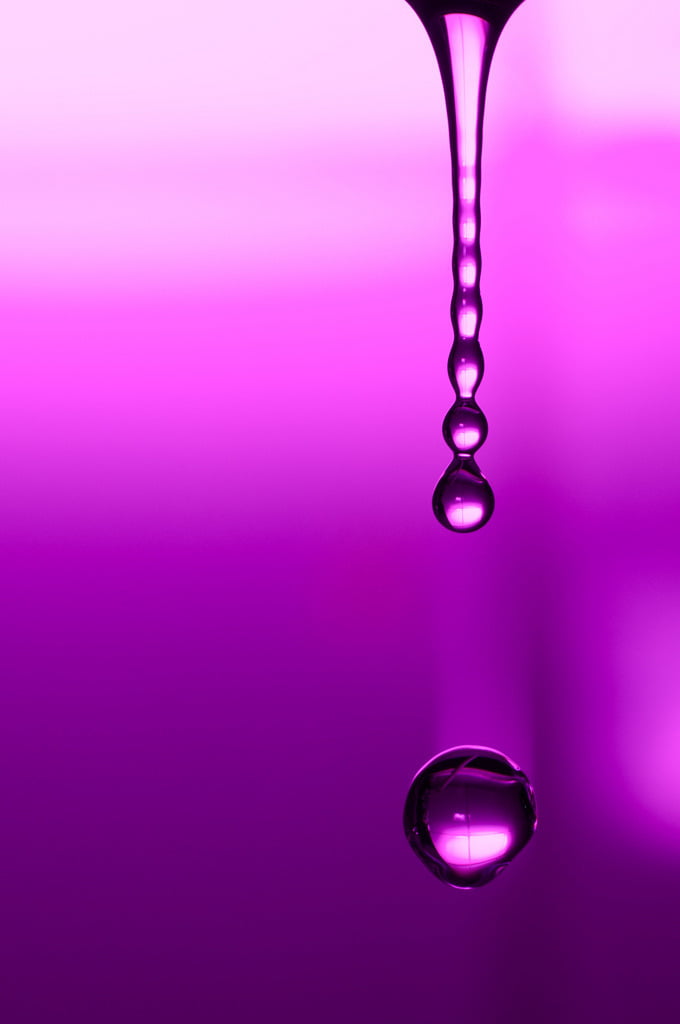
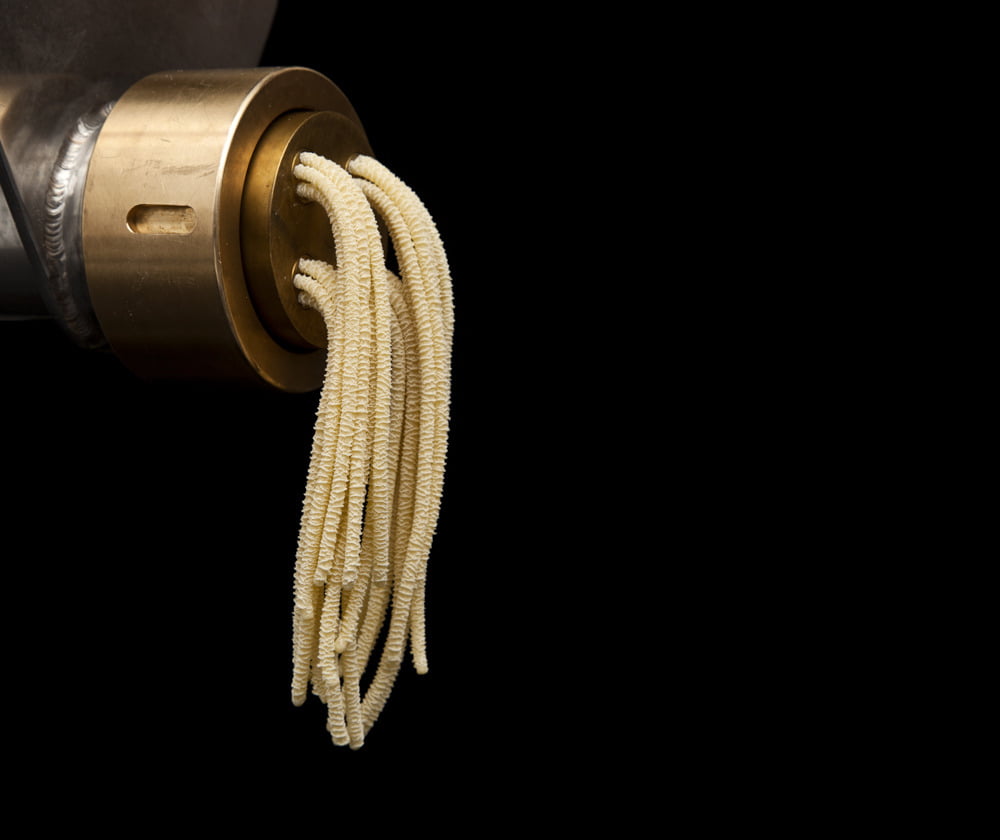
Objects falling into a liquid pool create a beautiful splash, and, in this beautiful, award-winning video, the Splash Lab explores a peculiar instability that occurs just as the splash closes. The buckling instability they describe involves distinctive ridges that form along the splash’s ejecta sheet as it domes over and closes. The number of ridges depends both on the object size and the liquid’s properties. (Video credit: J. Marston et al.)
Tag: instability

Piazza del Popolo
The lions of the fountain in Rome’s Piazza del Popolo eject a turbulent sheet of water. Random fluctuations in the water sheet cause holes to form. Driven by surface tension, these holes grow and merge, leaving behind ligaments of water which quickly break up into a spray of unevenly-sized drops. (Image credit: E. Villermaux)

The Rayleigh-Taylor Instability
What’s this? An FYFD video?! Yes, at long last, I’ve begun filming some videos of my own. This first one takes a look at the Rayleigh-Taylor instability and all that action that goes on in your coffee cup. I hope to bring you more FYFD-produced videos in the future, including some videos from the American Physical Society Division of Fluid Dynamics conference in San Francisco next week. What kind of topics would you guys be interested in for the future? (Video credit: N. Sharp)

Momentary Crown
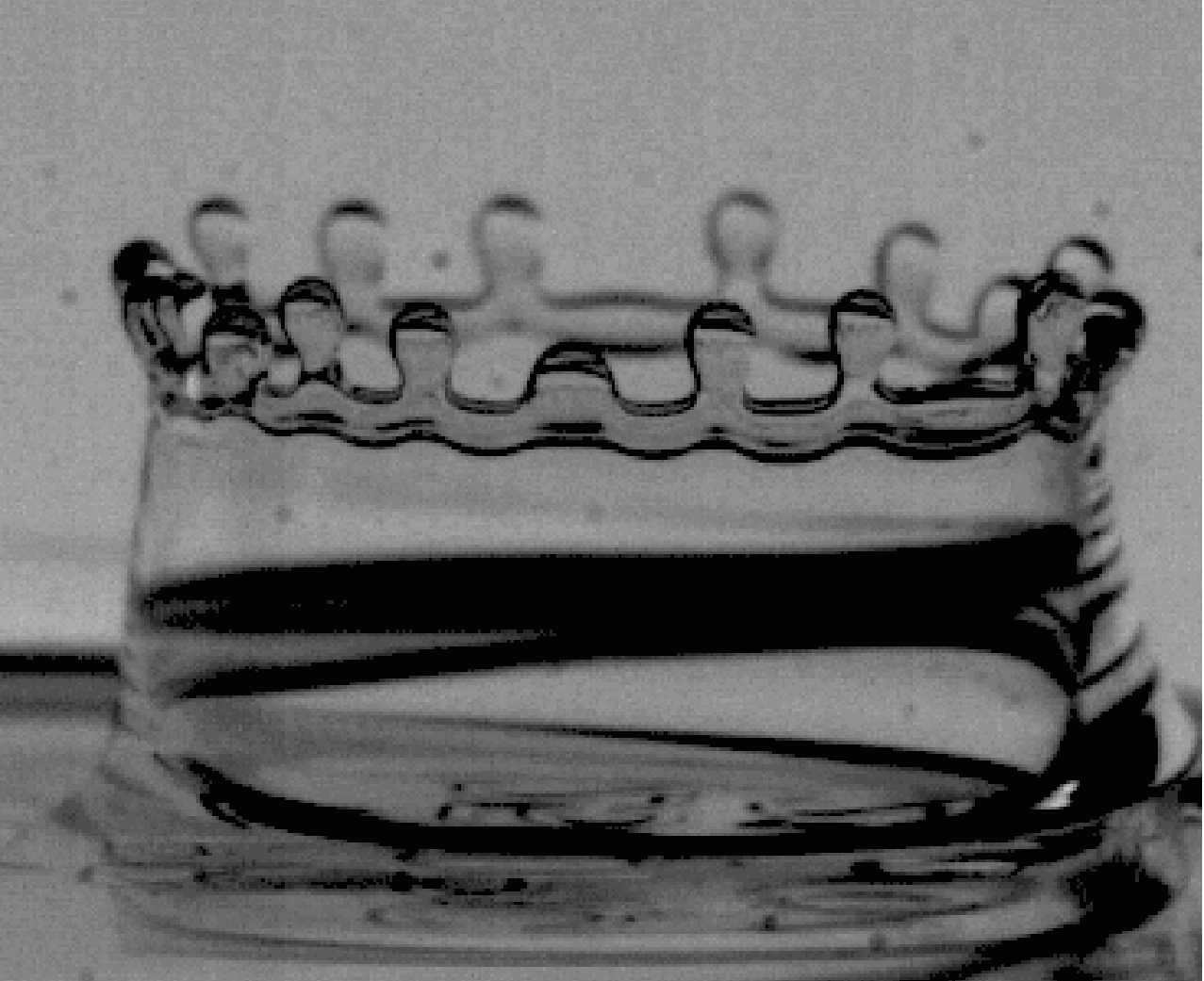
When a drop falls on a liquid film, its impact drives a thin liquid sheet called the ejecta upward and outward from the point of impact. Within milliseconds, tiny perturbations develop in the ejecta and begin growing exponentially. These become the distinctive spikes of the crown. The momentum from the impact drives the ejecta and spikes further outward until it overcomes surface tension’s ability to hold the liquid crown together. Tiny droplets escape the crown before the ejecta comes crashing down. The whole process takes only a few hundred milliseconds from start to finish. (Photo credit: S. Jung et al.)

Kelvin-Helmholtz Clouds
When differing layers of fluid move past one another, friction between them causes shear. This shear quickly transforms a simple flat interface between fluid layers into a wavy unstable boundary that resembles a series of breaking ocean waves. This effect is known as the Kelvin-Helmholtz (KH) instability. In the atmosphere, this instability causes air layers with differing temperatures and moisture content to form wave-like clouds where the two layers meet. Other examples of the effect are widespread. On earth, many ocean waves are generated by wind shearing the water; elsewhere in our solar system, the cloud bands of Jupiter are lined with spinning eddies from the KH instability. (Photo credit: H. Bondo)

Shooting Droplets
This animation shows high-speed video of a polystyrene particle striking a falling water droplet. Under the right conditions, the particle rips through the droplet, stretching the water into a bell-shaped lamella extending from a thicker rim. When the particle detaches, surface tension rapidly collapses the lamella into a ring which destabilizes. Thin ligaments and droplets fly off the crown-like ring as momentum overcomes surface tension’s ability to hold the droplet together. Be sure to check out the full video on YouTube or later next month at the APS Division of Fluid Dynamics meeting. (Yes, I will be there!) (Image credit: V. Sechenyh et al., source video)

Supernova Simulation
New research shows that supermassive first-generation stars may explode in supernovae without leaving behind remnants like black holes. The work is a result of modeling the life and death of stars 55,000 to 56,000 times more massive than our sun. When such stars reach the end of their lives, they become unstable due to relativistic effects and begin to collapse inward. The collapse reinvigorates fusion inside the star and it begins to rapidly fuse heavier elements like oxygen, magnesium, or even iron from the helium in its core. Eventually, the energy released overcomes the binding energy of the star and it explodes outward as a supernova. The image above is a slice through such a star approximately one day after its collapse is reversed. Hydrodynamic instabilities like the Rayleigh-Taylor instability produce mixing of the heavy elements throughout the expanding interior of the star. The mixing should produce a signature that can be observed in the aftermath as these stars seed their galaxies with the heavy elements needed to form planets. For more, see Science Daily and Chen et al. (Image credit: K. Chen et al., via Science Daily; submitted by mechanicoolest)

Beading Fluids
Adding just a few polymers to a liquid can substantially change its behavior. The presence of polymers turns otherwise Newtonian fluids like water into viscoelastic fluids. When deformed, viscoelastic fluids have a response that is part viscous–like other fluids–and part elastic–like a rubber band that regains its initial shape. The collage above shows what happens to a thinning column of a viscoelastic fluid. Instead of breaking into a stream of droplets, the liquid forms drop connected with a thin filament, like beads on a string. In a Newtonian fluid, surface tension would tend to break off the drops at their narrowest point, but stretching the polymers in the viscoelastic fluid provides just enough normal stress to keep the filament intact. If the effect looks familiar, it may be because you’ve seen it in the mirror. Human saliva is a viscoelastic liquid! (Image credit: A. Wagner et al.)

Crow Instability
Behind airplanes in flight, water vapor from the engine exhaust will sometimes condense in the wingtip vortices, thereby forming visible contrails. The two initially parallel vortex lines are unstable and any small perturbation to them–a slight crosswind, for example–will cause an instability known as the Crow instability. The contrails become wavy, with the amplitude of the wave growing exponentially in time due to interactions between the two vortices. Eventually, the vortex lines can touch and pinch off into vortex rings. The effect is also quite noticeable when smoke generators are used on a plane, and there are some great examples in this air show video between 3:41:00 and 3:44:00. (Video credit: M. Landy-Gyebnar; h/t to Urs)

Flames in Space
The jellyfish-like light show in the animations above shows the life and death of a flame in microgravity. The work is part of the Flame Extinguishment Experiment 2 (FLEX-2) currently flying aboard the International Space Station. When ignited, the fuel droplet creates a blue spherical shell of flame about 15 mm in diameter. The spherical shape is typical of flames in microgravity; on Earth, flames are shaped like teardrops due to the effects of buoyancy, which exists only in a gravitational field. The bright yellow spots and streaks that appear after ignition are soot, which consists mainly of hot-burning carbon. The uneven distribution of soot is what causes the pulsating bursts seen in the middle animation. When soot products drift back onto the fuel droplet, it causes uneven burning and flame pulses. The final burst of flame in the last animation is the soot igniting and extinguishing the flame. Fires are a major hazard in microgravity, where oxygen supplies are limited and evacuating is not always an option. Scientists hope that experiments like FLEX-2 will shed light on how fires spread and can be fought aboard spacecraft. For more, check out NASA’s ScienceCast on microgravity flames. (Image credits: NASA, source video; submitted by jshoer)