Fluid phenomena can show up in unexpected places. The collage above shows patterns formed when an aluminum block is lifted during wet sanding, a polishing technique. The dendritic fingers are formed from oil and the slurry of sanded particles being polished away. They are an example of the Saffman-Taylor instability, which forms when less viscous fluids (oil) protrude into a more viscous one (the slurry). Each image contains a different concentration of oil, resulting in very different fingering patterns. (Image credit: D. Lopez)
Tag: instability

Dripping, Frozen
The simple drip of a faucet is more complicated when frozen in time. Any elongated strand of water tends to break up into droplets due to surface tension and the Plateau-Rayleigh instability. Whenever the radius of the water column shrinks, surface tension tends to drive water away from the narrow region and toward a wider point. This exaggerates the profile, making narrow regions skinnier and wider regions fatter. Eventually, the neck connecting the droplets becomes so thin that it pinches off completely, leaving a string of falling droplets. (Image credit: N. Sharp)

Inside a Supernova
During a supernova, shock waves moving outward push denser material into less dense plasma and gas. This causes what is known as a Richtmyer–Meshkov instability, where the interface between the two fluids first becomes wavy and then develops finger-like intrusions. Those too break down, as seen in the simulation above, causing large-scale mixing between the different fluids.
Here on Earth this instability shows up in the process of inertial confinement fusion. In that case, the outer shell material is denser than the fuel core and the instability is triggered during the implosion process. As the fusion material is suddenly compressed, waviness and mixing occurs along the interface between the shell and the fuel. That’s undesirable because it reduces the efficiency of the fusion reaction. (Image credit: E. Evangelista et al.)

Shark Tooth Instability
Imagine that you partially fill a horizontal cylinder with a viscous fluid, like corn syrup or honey. If that cylinder is still, the fluid will simply pool along the bottom. On the opposite extreme, if you spin it very fast, that cylinder will become coated in an even layer of fluid that rotates along with the cylinder thanks to centrifugal force. Between those two extremes in rotational velocity, some interesting fluid behaviors occur. Start spinning the cylinder and some of the pooled fluid will be pulled up the sides, eventually forming a thicker film with a straight front along the bottom of the cylinder. Spin faster and that straight front starts to break down, forming sharper cusp-like waves known as shark teeth. (Image credit: S. Morris et al., source; research credit: S. Thoroddsen and L. Mahadevan)

Shear Across the Water
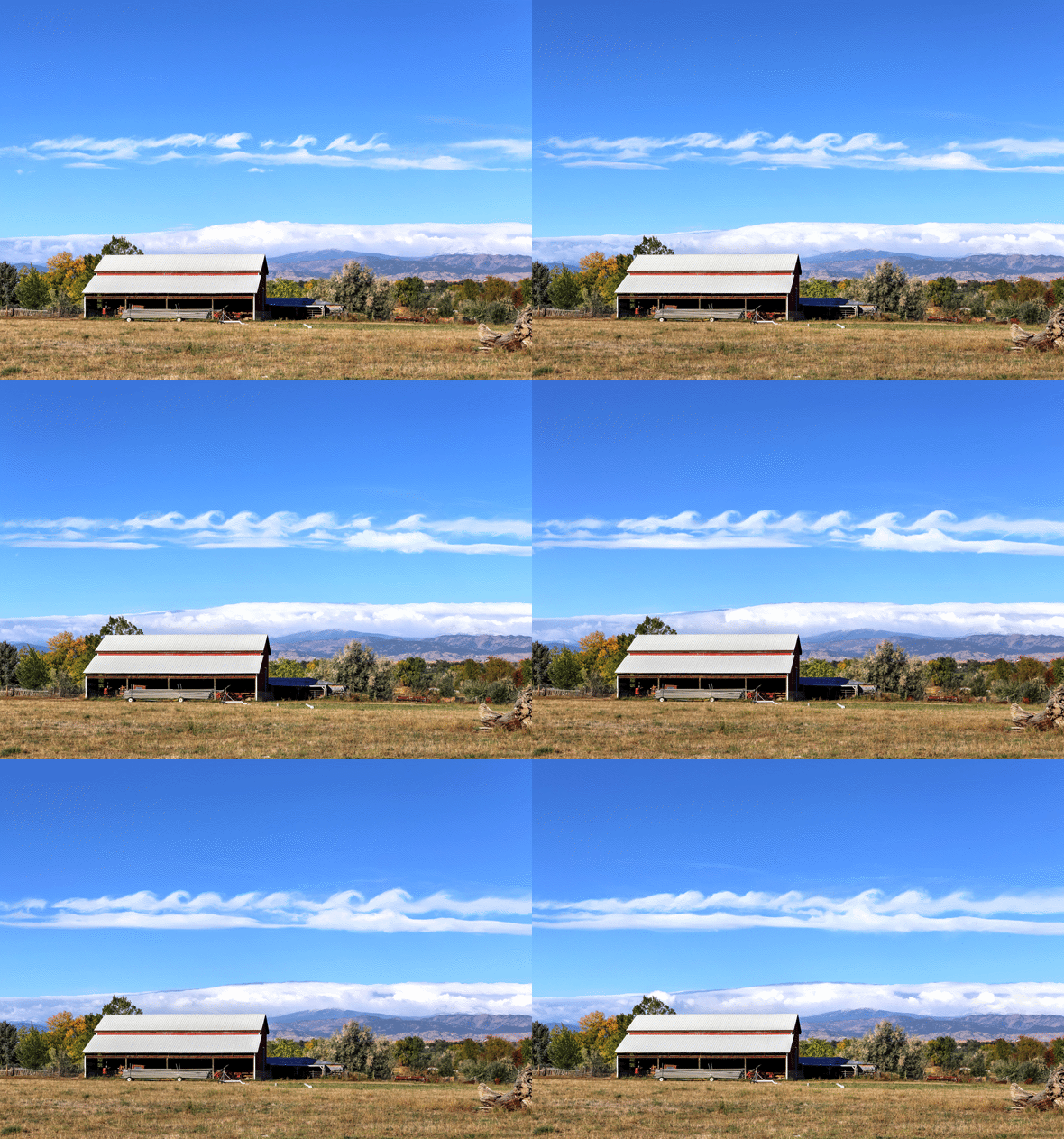
This photo series shows the development of a Kelvin-Helmholtz instability. It’s formed when two layers of fluid move past one another at different speeds. In this case, the two fluids meet off the back of a flat plate (seen at the left of the top image) when fast-moving flow from the top of the plate encounters slower fluid beneath. Friction and shear between the fluid layers causes billows to rise up and form waves very similar to those on the ocean (wind across the water works the same way!). Those waves turn over into vortex-like spirals and keep mixing until they break down into turbulence. This pattern crops up pretty frequently, especially in clouds. (Image credit: G. Lawrence)

Spillway Waves
Earlier this summer, the spillway of the Banja Dam was opened for the first time, releasing a stream of excess water from the reservoir. As you can see above, waves quickly formed at the surface of the falling water. You’ve likely noticed this yourself in the run-off along the street after a storm. It turns out that shallow water running down an incline is unstable. A disturbance to the flow – from surface roughness, vibration, or a change in curvature – will grow, just like a ball sitting at the top of a hill will roll down as soon as it’s prodded. For more about this kind of instability, check out this post or my video about boundary layer stability and the Space Shuttle. (Image credit: Guillaume TYTECA, source; via Gizmodo)

Rayleigh-Taylor Waves
Here on Earth, placing a denser fluid over a lighter one creates an unstable equilibrium. Thanks to gravity, the heavier, denser fluid wants to sink and the lighter fluid wants to rise. Any small disturbance will kick this into action, just like a tiny nudge can send a ball rolling down the hill. For the fluid, that nudge manifests as waviness in the interface between the two fluids. That waviness will quickly grow into billows like those shown above as the Rayleigh-Taylor instability takes over and the heavy (clear) fluid trades places with the lighter (green) fluid. You’ve probably witnessed this effect yourself when pouring milk into iced coffee. To see it in action, check out the video of this experiment or my FYFD video on the Rayleigh-Taylor instability. (Image credit: M. Davies Wykes)

HIFiRE
Earlier this month, an international team launched a successful hypersonic flight test in Australia. The Hypersonic International Research Experimentation (HIFiRE) Flight 5b was launched atop a two-stage rocket and reached its maximum speed of Mach 7.5, well above Mach 5, which defines the start of the hypersonic regime. The purpose of this particular flight test was not to test new propulsion technologies – there was no scramjet engine on this flight. Instead, researchers wanted to study aerodynamics at high Mach number, specifically the behavior of the air very close to the vehicle, its boundary layer.
The payload being tested was an elliptical cone mounted on the front of the vehicle and shown in images above. The shape of the payload is such that flow will curve around the cone rather than following straight lines. The image on the lower right contains black streamlines that show how air twists around the cone. This complex flowfield complicates the physics of the boundary layer near the cone’s surface and increases the likelihood that the boundary layer will transition from laminar flow to turbulent flow, thereby increasing heating on the payload. Ideally, the data from the test flight will let engineers test their ability to understand and predict this boundary layer transition in the future. For more on boundary layer transition and its effects at hypersonic speeds, check out my latest FYFD video. (Image credit: Australia Department of Defense, R. Kimmel et al., F. Li et al.; topic requested by Guido)

Viscous Fingers
Viscous fingers form between air and titanium dioxide sol-gel in this photograph. The two fluids are trapped in a thin gap between glass plates – a set-up known as a Hele-Shaw cell. The dendritic fingers we see form when the less viscous air pushes into the more viscous sol-gel. This is an example of the Saffman-Taylor instability. The psychedelic colors are a result of thin-film interference and the way light interacts with very thin materials. The same effect is responsible for the colors on soap bubbles. (Image credit: C. Trease)