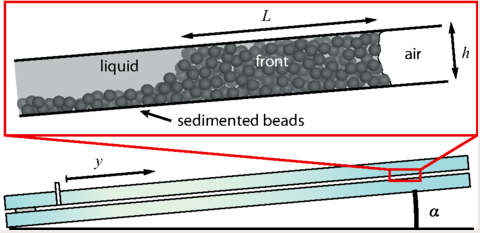
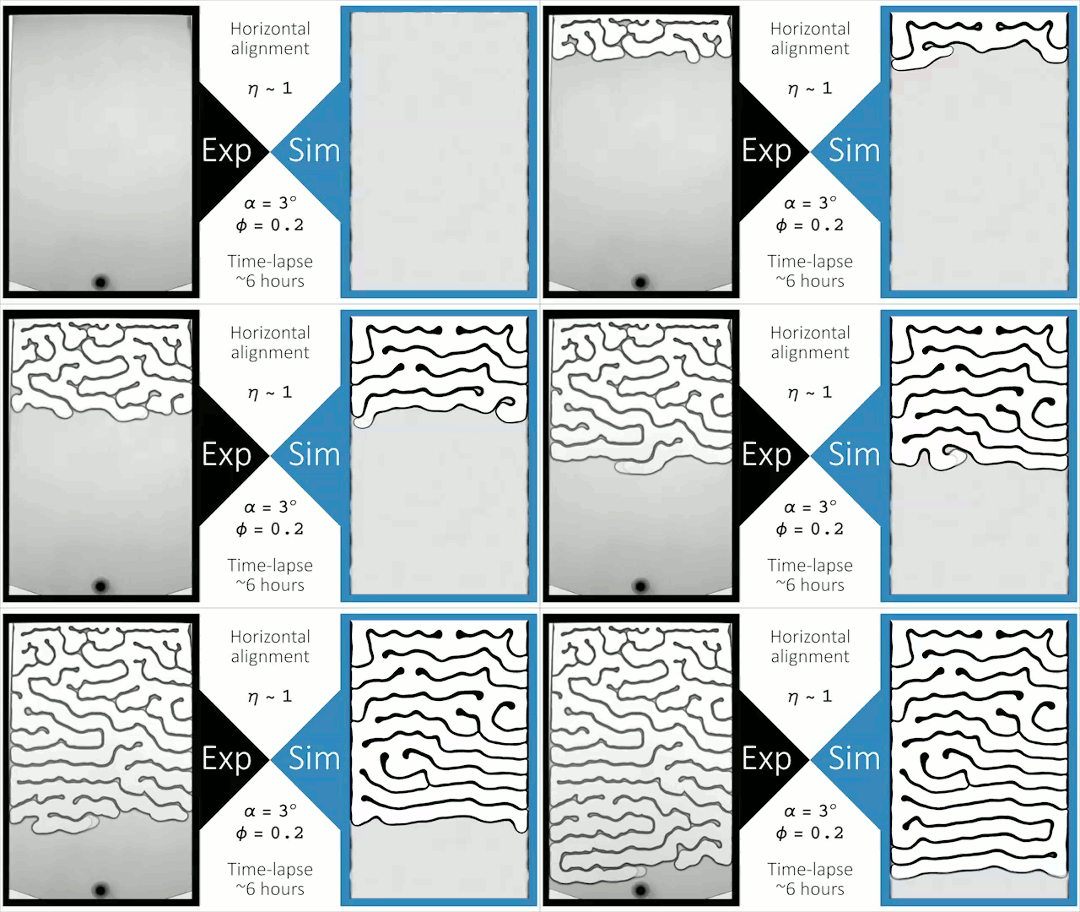
Fluid flow through porous media inside confined spaces can be tough to predict but is key to many geological and industrial processes. Here researchers examine a mixture of glass beads and water-glycerol trapped between two slightly tilted plates. As liquid is drained from the bottom of the cell, air intrudes. Loose grains pile up along the meniscus and get slowly bulldozed as the air continues forcing its way in. The result is a labyrinthine maze formed by air fingers of a characteristic width. The final pattern depends on a competition between hydrostatic pressure and the frictional forces between grains. Despite the visual similarity to phenomena like the Saffman-Taylor instability, the authors found that viscosity does not play a major role. For more, check out the video abstract here. (Image and research credit: J. Erikson et al., source)
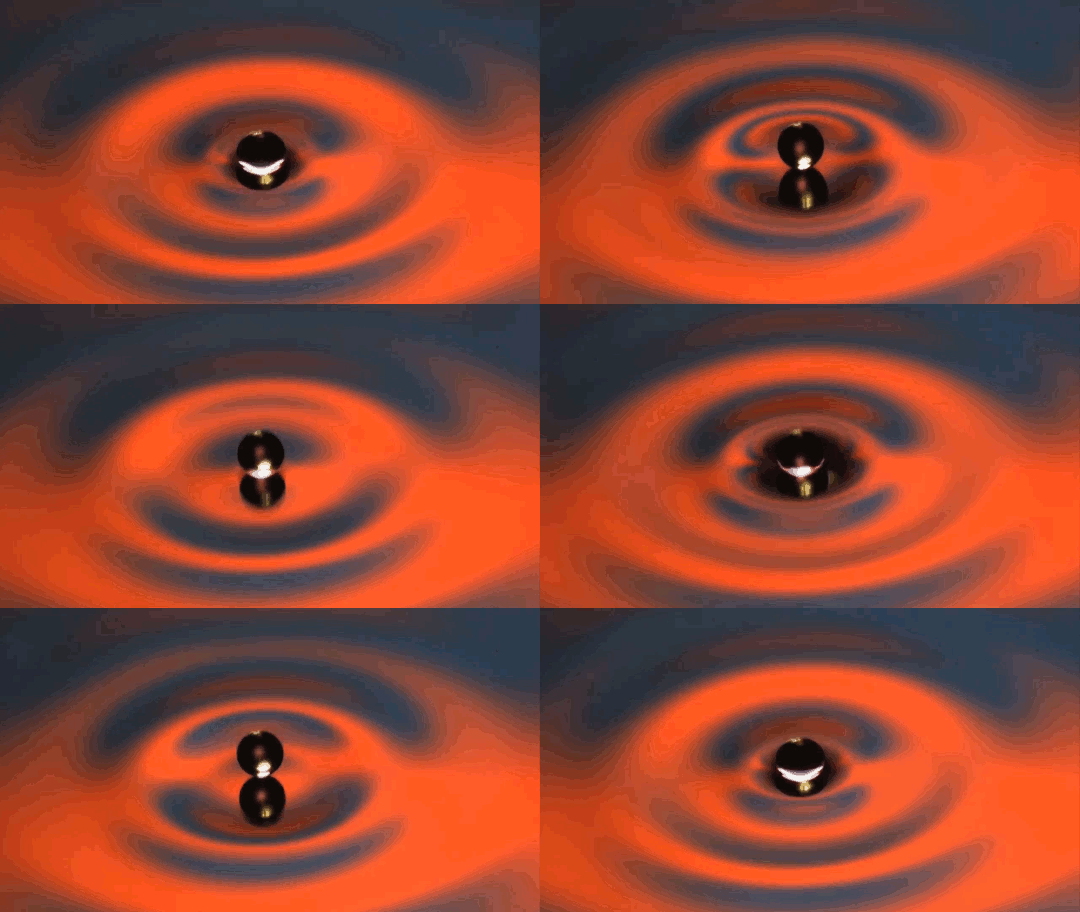
If you place a small droplet atop a vibrating pool, it will happily bounce like a kid on a trampoline. On the surface, this seems quite counterintuitive: why doesn’t the droplet coalesce with the pool? The answer: there’s a thin layer of air trapped between the droplet and the pool. If that air were squeezed out, the droplet would coalesce. But it takes a finite amount of time to drain that air layer away, even with the weight of the droplet bearing down on it. Before that drainage can happen, the vibration of the pool sends the droplet aloft again, refreshing the air layer beneath it. The droplet falls, gets caught on its air cushion, and then sent bouncing again before the air can squeeze out. If nothing disturbs the droplet, it can bounce almost indefinitely.
Droplets don’t always bounce in place, though. When forced with the right frequency and acceleration, a bouncing droplet can transition to walking. In this state, the droplet falls and strikes the pool such that it interacts with the ripple from its previous bounce. That sends the droplet aloft again but with a horizontal velocity component in addition to its vertical one. In this state, the droplet can wander about its container in a way that depends on its history or “memory” in the form of waves from its previous bounces. And this is where things start to get a bit weird – as in quantum weirdness – because now our walker consists of both a particle (droplet) and wave (ripples). The similarities between quantum behaviors and the walking droplets, the collective behavior of which is commonly referred to as “pilot-wave hydrodynamics,” are rather remarkable. In the next couple posts, we’ll take a look at some important quantum mechanical experiments and their hydrodynamic counterparts.
The simple collision of two liquid jets can form striking and beautiful patterns. Here the two jets strike one another diagonally near the top of the animation. One is slanted into the screen; the other slants outward. At their point of contact, the liquid spreads into a sheet and forms what’s known as a fishbone pattern. The water forms a thicker rim at the edge of the sheet, and this rim destabilizes when surface tension can no longer balance the momentum of the fluid. Fingers of liquid form along the edge, stretching outward until they break apart into droplets. Ultimately, this instability tears the liquid sheet apart. Under the right conditions, all kinds of beautiful shapes form in a system like this. (Image credit: V. Sanjay et al., source)
These beautiful Kelvin-Helmholtz clouds were spotted over Lincolnshire on December 19th. They form between two layers of air, one of which is moving faster than the other. Although that situation is not very unusual, the conditions have to be just right for visible clouds to form at that interface between layers, and the clouds themselves are typically short-lived. This set is particularly lovely with its smooth curves and breaking wave form. If you, like me, love these clouds but never manage to see them yourself, you can always try wearing some instead! (Image credit: A. Towriss; via BBC News; submitted by Vince D.)
Branching, tree-like structures are found throughout nature. Take a thin layer of a viscous fluid pressed between two glass plates and inject a less viscous fluid like air and you’ll get branch-like structures. These are the result of the Saffman-Taylor instability and usually result in a fairly random outcome because of the instability’s sensitivity to small variations. In a new study, researchers use multiple air injection ports to finely control the formation and growth of air fingers, allowing them to build well-ordered branching structures like the one above. By placing the air ports in an array, the same technique can be used to create fluid meshes. The authors suggest this new technique could have wide-ranging applications including the design of heat exchangers and the growth of artificial tissues. (Image and research credit: T. ul Islam and P. Gandhi, source)
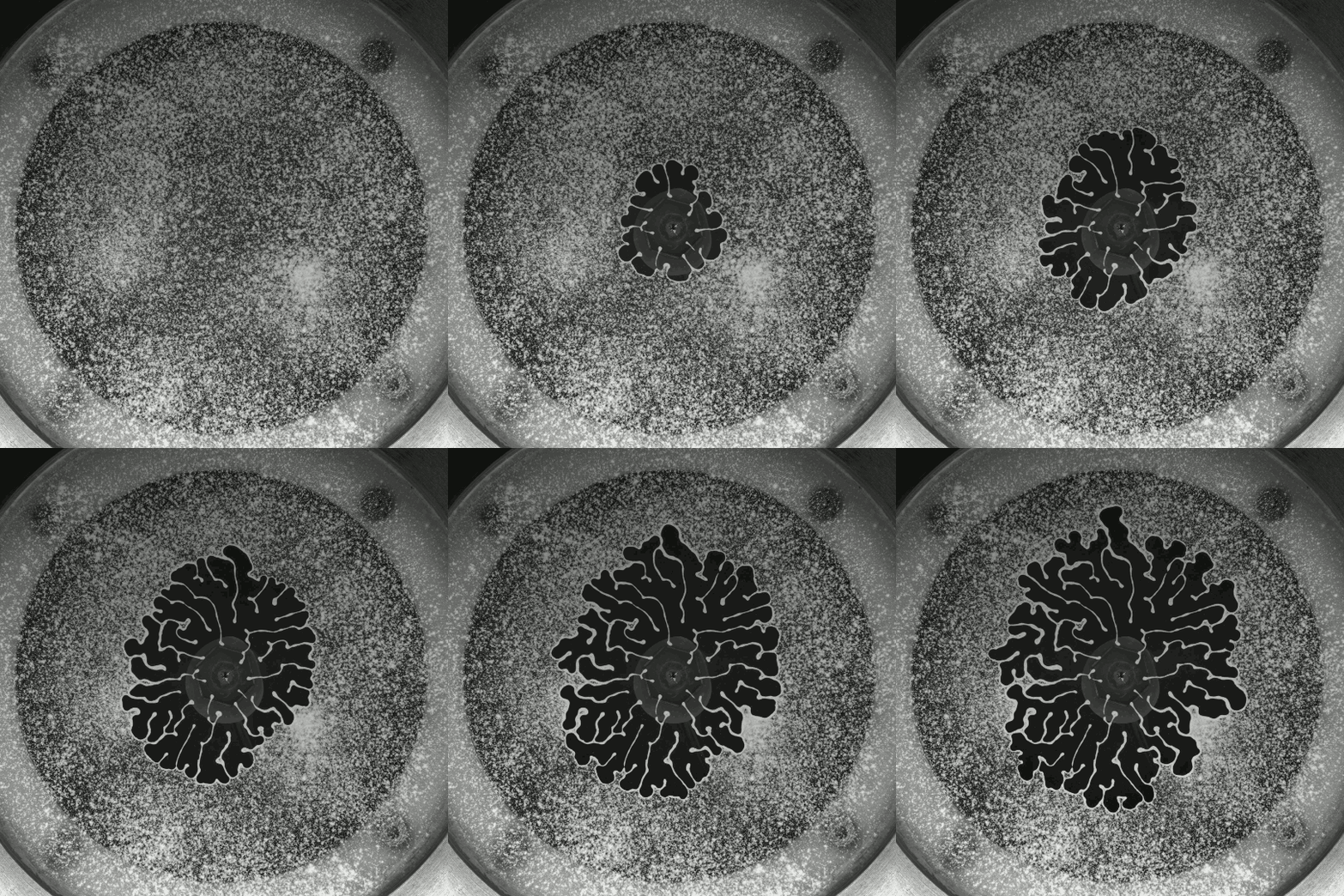
If you inject a less viscous fluid, like air, into a narrow gap between two glass plates filled with a more viscous fluid, you’ll get a finger-like instability known as the Saffman-Taylor instability. If you invert the situation – injecting something viscous like water into air – the water will simply expand radially; you’ll get no fingers. But that situation doesn’t hold if there are wettable particles in the air-filled gap. Inject water into a particle-strewn air gap and you get a pattern like the one above. In this case, as the water expands, it collects particles on the meniscus between it and the air. Once the concentration of particles on the meniscus is too high for more particles to fit there, the flow starts to branch into fingers. This creates a greater surface area for interface so that more particles can get swept up as the water expands. (Image and research credit: I. Bihi et al., source)
This polygonal pattern is known as the rose-window instability. It’s formed between two electrodes – one a needle-like point, the other flat – separated by a layer of oil. The pointed electrode’s voltage ionizes the air nearby, creating a stream of ions that travel toward the flat electrode below. Oil is a poor conductor, however, so the ions build up on its surface until they’re concentrated enough to form a dimple that lets them reach the lower electrode. At higher voltages, the electrical forces driving the ions and the gravitational force trying to flatten the oil reach a balance in the form of the polygonal cell pattern seen above. Smaller cells form near the needle electrode, where the electrical field is strongest and the temperature is highest, as revealed in thermal and schlieren imaging (lower images) that shows a warm stream of gas impacting there.
As a final note, I’ll add that the latest in this research comes from a paper by a Pakastani teenager. It’s never too early to start contributing to research! (Image and research credit: M. Niazi; via NYTimes; submitted by Kam-Yung Soh)
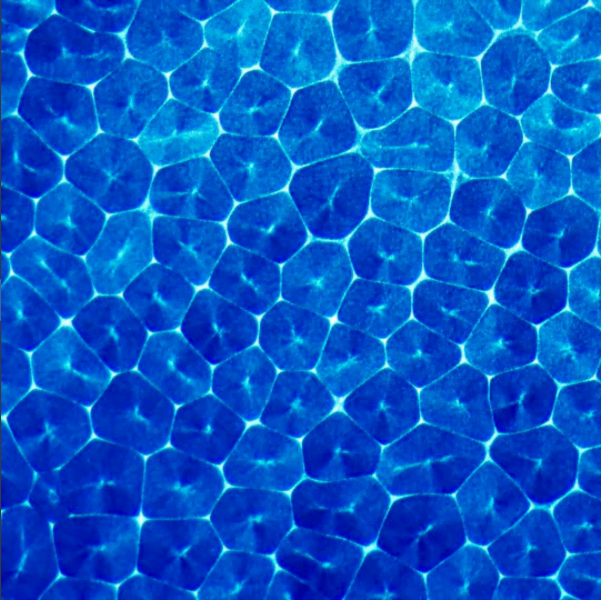
Blue paint in alcohol forms an array of polygonal convection cells. We’re accustomed to associating convection with temperature differences; patterns like the one above are seen in hot cooking oil, cocoa, and even on Pluto. In all of those cases, temperature differences are a defining feature, but they are not the fundamental driver of the fluid behavior. The most important factors – both in those cases and the present one – are density and surface tension variations. Changing temperature affects both of these factors, which is why its so often seen in Benard-Marangoni convection.
For the paint-in-alcohol, density and surface tension differences are inherent to the two fluids. Because alcohol is volatile and evaporates quickly, its concentration is constantly changing, which in turn changes the local surface tension. Areas of higher surface tension pull on those of lower surface tension; this draws fluid from the center of each cell toward the perimeter. At the same time, alcohol evaporating at the surface changes the density of the fluid. As it loses alcohol and becomes denser, it sinks at the edges of the cell. Below the surface, it will absorb more alcohol, become lighter, and eventually rise at the cell center, continuing the convective process. (Image credit: Beauty of Science, source)
Jupiter’s atmosphere is fascinatingly complex and stunningly beautiful. This close-up from the Juno spacecraft shows a region called STB Spectre, located in Jupiter’s South Temperate Belt. The bluish area to the right is a long-lived storm that’s bordering on very different atmospheric conditions to the left. Shear from these storms moving past one another creates many of the curling waves we see in the image. These are examples of the Kelvin-Helmholtz instability, which generates ocean waves here on Earth, creates spectacular clouds in our atmosphere, and is even responsible for waves in galaxy clusters. Check out some of the other amazing images Juno has sent back of our solar system’s largest planet. (Image credit: NASA/JPL-Caltech/SwRI/MSSS/R. Tkachenko; via Gizmodo)
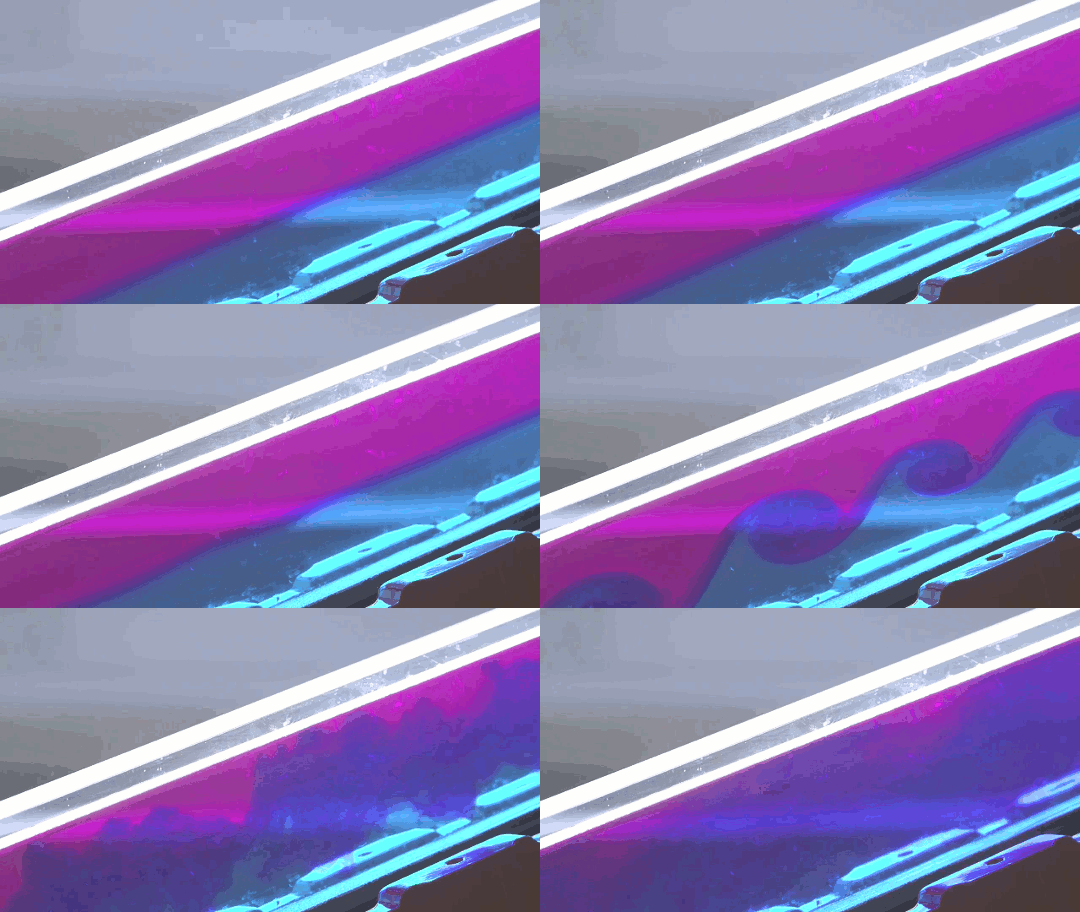
Sixty Symbols has a great new video explaining the laboratory set-up for demoing a Kelvin-Helmholtz instability. You can see a close-up from the demo above. Here the pink liquid is fresh water and the blue is slightly denser salt water. When the tank holding them is tipped, the lighter fresh water flows upward while the salt water flows down. This creates a big velocity gradient and lots of shear at the interface between them. The situation is unstable, meaning that any slight waviness that forms between the two layers will grow (exponentially, in this case). Note that for several long seconds, it seems like nothing is happening. That’s when any perturbations in the system are too small for us to see. But because the instability causes those perturbations to grow at an exponential rate, we see the interface go from a slight waviness to a complete mess in only a couple of seconds. The Kelvin-Helmholtz instability is incredibly common in nature, appearing in clouds, ocean waves, other planets’ atmospheres, and even in galaxy clusters! (Image and video credit: Sixty Symbols)