On its face, the idea that sand and wind can come together to form massive mountainous dunes seems bizarre. But dunes — and their smaller cousins, ripples — are everywhere, not just on Earth but on other planetary bodies where fine particles and atmospheres interact. In this video, Joe Hanson gives a great overview of sand dynamics, beginning with what sand is, how it moves, and what it can ultimately form. It’s well worth a watch, even if you know a little about dunes already; I know I learned a thing or two! (Image and video credit: Be Smart)
Tag: granular material

Rifts in Rafts
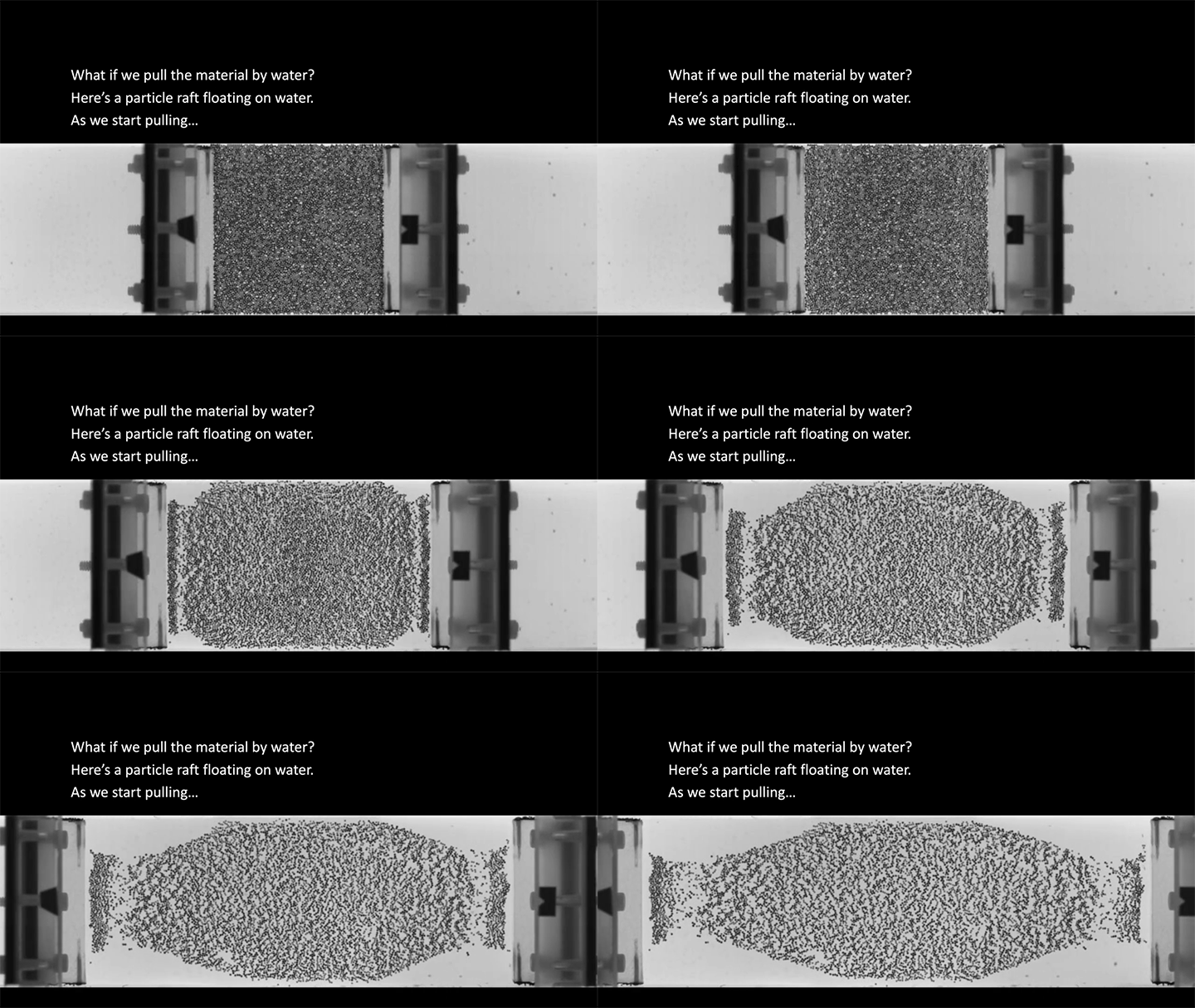
A raft of particles floating on water has some natural cohesion from particle attraction and capillary action. But when the raft is pulled apart, what happens? Does it break cleanly in one spot? Does it stretch and deform? That’s what this video explores. It turns out that the speed you pull the raft at determines how it holds together. Every particle cluster has a preferred relaxation rate, and by choosing the pulling speed, you determine which relaxation rate — and therefore cluster size — can survive most effectively. (Image and video credit: K. Tô and S. Nagel)

Stably Jammed
Granular materials like sand, gravel, and medications can become a rigid mass when squeezed or sheared. Even with a relatively loose packing, these materials can jam together to act like a solid if the contacts between grains no longer allow particles to shift or rotate. In this video, researchers explore how stable these jammed states are by repeatedly shearing the mixture and observing how it changes.
Most of the videos are set up as a triptych, where all three panels show the same material. On the left, you see a simple view showing the position of each particle. In the middle, the disks are viewed through polarized filters, so that the material looks brightest where it is stressed. This view lets us see the force chains that run through the material. On the right, UV-sensitive ink on each marker glows to show any rotation particles experience.
In the first sample, repeated shearing slowly unjams the mixture and allows it to shift and flow once more. We see this from the decreasing brightness in the middle panel. The slow fade to black means that the force chain network has disappeared entirely. In contrast, the second sample ultimately reaches an “ultra-stable” jammed state, in which further shear cycles cause no change to the network. Once again, this is easiest to observe in the middle image, where the bright force network stops changing after 2,000 cycles or so. (Image and video credit: Y. Zhao et al., research pre-print)

How Wells and Aquifers Work
When rain falls, some of that water turns into run-off in storm systems but much of it seeps into the ground. What happens to that water? In most places, it joins the local aquifer, infusing the spaces between soil particles underground. In this video, Grady takes us through some of the interactions between surface water, aquifers, and the wells we use to access water underground. He’s even built some great demonstrations to show how aquifers and surface water like rivers pass water back and forth. (Image and video credit: Practical Engineering)

Recreating Flocks
Birds, fish, and other creatures form amazing, undulating swarms of individuals. How these collectives comes together and move continues to fascinate scientists. Here, researchers look at simple particles with two “instructions,” if you will. One causes the particle to self-navigate toward a target; the other causes short-range repulsion if the particle gets too close to another one. With only these two simple guidelines, a flock of these particles forms complex, ever-changing flows! (Image and video credit: M. Casiulis and D. Levine)

Mimicking Asteroids
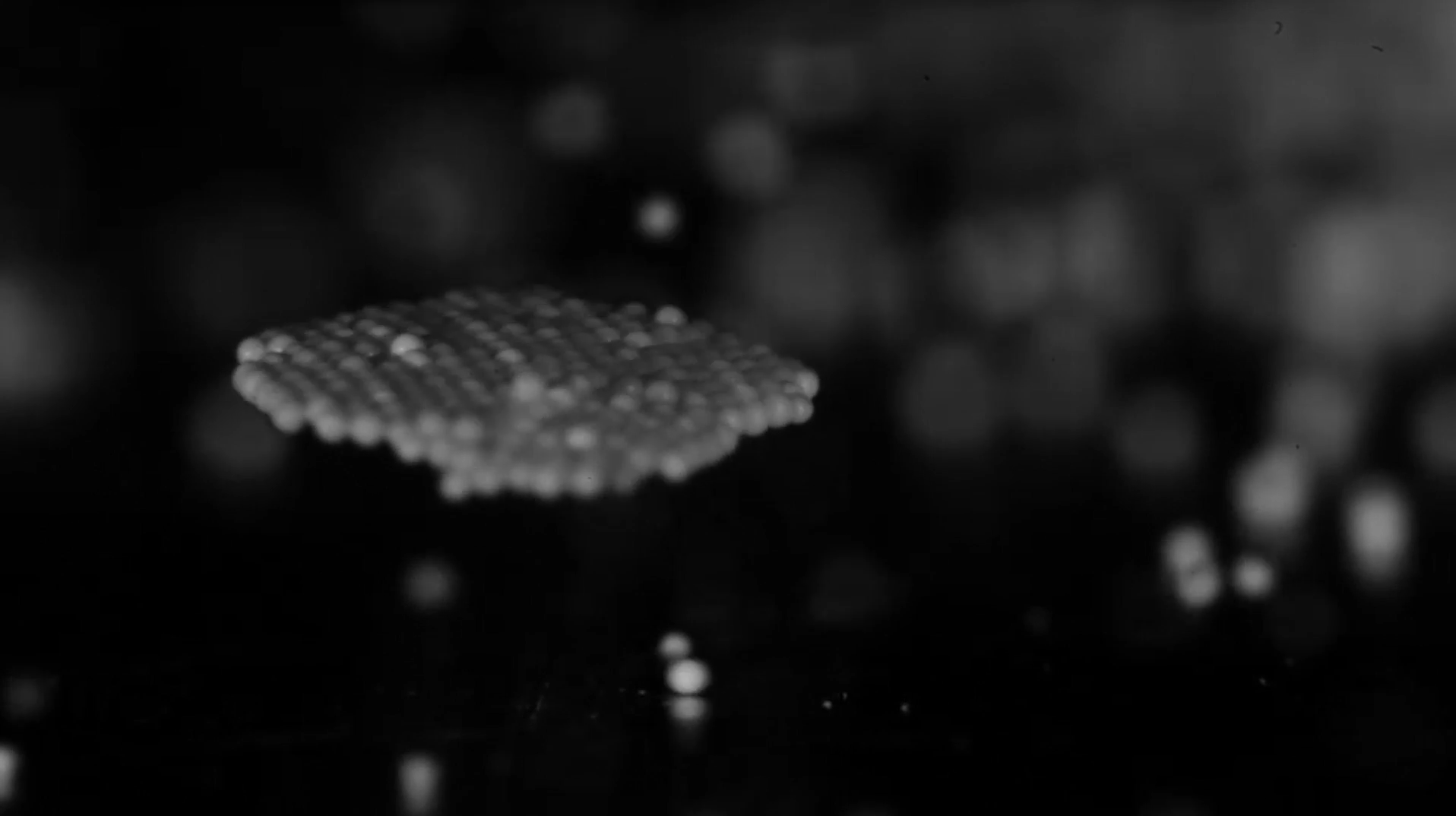
In nature, objects like asteroids, black holes, and atomic nuclei can get distorted when spinning rapidly. Researchers are exploring these objects using a new model platform: particle rafts levitated by sound. The individual particles are less than a millimeter wide and tend to clump together due to the scattering of sound waves off neighboring particles. This effect provides a cohesive force — similar to surface tension or the effects of gravity — that draws the particles together. With the right frequency, the sound waves can also make the granular rafts spin, setting up a tug-of-war between cohesion and centrifugal force.
Using sound waves for levitation, particles slowly rise and clump together. Particles are approximately 190 micrometers each, and the video is drastically slowed down from real-time. As the rafts spin, they distort, pull apart, and come back together. Interestingly, the cohesive force a raft experiences increases with the raft’s size. That makes the attractive force unlike surface tension (which is the same whether you have a bucket of water or a lake) and more like gravity (which is stronger with more material.) Because of this size dependence, the team hopes their granular rafts could be a new way to study the formation of rubble-pile asteroids and similarly granular systems.
As the raft’s rotation increases, it’s pulled apart by centrifugal forces, but the pieces later reconnect. Video is slowed down by a factor of 60. (Video, image, and research credit: M. Lim et al.; via APS Physics)

Everlasting Bubbles
Soap bubbles are delicate and ephemeral, always a breath away from collapse due to thinning driven by gravity or evaporation. But that frailty can be countered. Adding microparticles to the bubble’s shell in place of surfactants counters drainage and makes bubbles last for tens of minutes (left). Adding glycerol to the mix takes things a step further (right). The glycerol, which absorbs water from the surrounding air, counteracts the evaporation, allowing bubbles to remain intact — with no discernible change to their radius — almost indefinitely. So far the researchers have made such a bubble last for 465 days! (Image and research credit: A. Roux et al.; via APS Physics)

Frozen Wind-Sculpted Sands
On the cold, wind-swept beaches of Lake Michigan, the sands sometimes turn into a landscape of miniature hoodoos. Strong winds erode the frozen sand into these shapes, which last only days before wearing away or falling over. This photographic series by Joshua Nowicki immortalizes the ephemeral winter sculptures. You can see more of his photography on his Instagram. (Image credit: J. Nowicki; via Colossal; see also)

Ice and Dunes
Although dunes are usually associated with scorching climates, they can form in any desert, including in the frozen steppes of western Mongolia. This sunrise photo, taken by an astronaut aboard the ISS, shows Ulaagchinii Khar Nuur. The ice-covered Khar Nuur Lake surrounds two islands, Big and Small Avgash, and cold dunes form textured streaks on either side. The low sun angle accentuates the dunes, making every rippling crest clear. (Image credit: NASA; via NASA Earth Observatory)

Dune Invasion
Migrating sand dunes can encounter obstacles both natural and manmade as they move. Dunes — both above ground and under water — have been known to bury roads, pipelines, and even buildings. A recent experimental study looks at which obstacles a dune will cross and which will trap it in place. Their set-up consists of a narrow channel built in a ring, essentially a racetrack for dunes. Flow is driven by a series of paddles that rotate opposite the tank’s rotation.
The team studied obstacles of different shapes and sizes relative to their dunes, and they found that dunes were generally able to cross obstacles that were smaller than the dune. Obstacles larger than the dune would trap it in place, and, for obstacles close to the same size as the dune, round obstacles were easier to cross whereas sharp-angled ones tended to trap the dune.
The idealized nature of their experiment means that their results aren’t immediately applicable to the complex dunes of the outside world, but the study will be an important touchstone for those predicting dune behavior through numerical simulation. Studies like those require experimental cases to validate their baseline simulations. (Image credit: top – J. Bezanger, figure – K. Bacik et al.; research credit: K. Bacik et al.; via APS Physics)