Tag: granular material

  • Featured Video Play Icon

    Digging Droplets

    A droplet on a surface much hotter than its boiling point will skate on a layer of its own vapor, thanks to the Leidenfrost effect. But if that surface is, instead, a granular mixture like this glass powder, the droplet will dig itself a hole.

    As in the usual Leidenfrost situation, the heat of the powder causes part of the drop to vaporize. But as that vapor flows away, it carries powder with it. At the same time, the vaporization process causes the droplet to vibrate violently, which frees more powder and helps the drop dig deeper. Eventually, the drop will vaporize completely, leaving a volcano-like crater in the powder. (Image and video credit: C. Kalelkar and H. Sai)

    A water droplet falls on heated glass powder, which it then digs its way into.
  • Scaling High-Speed Impacts

    Scaling High-Speed Impacts

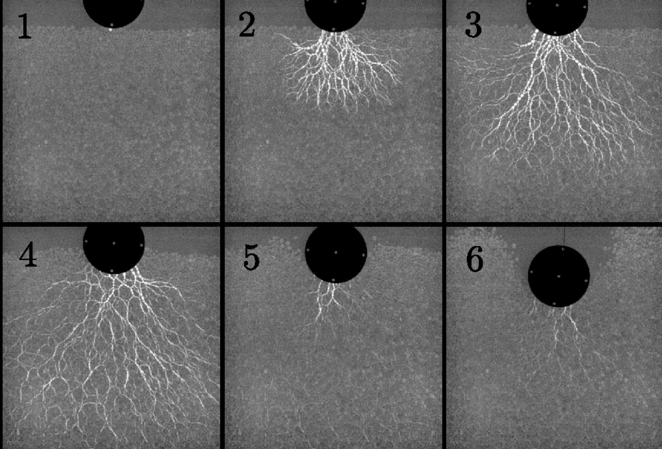
    The impact of a solid object into a bed of grains is a major topic in many fields from ballistics to astronomy. Researchers study these impacts experimentally using photoelastic disks, which display visible stress patterns when placed between polarizers. The lightning-like patterns you see above reveal how forces propagate inside the grains as the object hits.

    Researchers focused on the peak forces generated during high-speed impacts, an area that hasn’t been well-captured by existing impact models. They found that this peak force obeys its own scaling laws that depend on factors like impact speed, impacter size, grain stiffness, and grain density. (Image and research credit: N. Krizou and A. Clark)

  • Colorful Tides

    Colorful Tides

    This false-color satellite image — the recent winner of NASA Earth Observatory’s Tournament Earth 2020 — shows sands and seaweed off the coast of the Bahamas. Ocean currents and tides eroded these elaborate fluted designs in much the same way that winds sculpt desert dunes. The overlap in form is no accident; as seen in recent work, researchers are finding that both air and water move granular materials like sand according to the same rules. (Image credit: S. Andrefouet; via NASA Earth Observatory)

  • Unifying Sediment Transport Theory

    Unifying Sediment Transport Theory

    On windy days, streaks of snowflakes snake in the air above a mountaintop snowfield. And when snorkeling in the surf, you can watch the inbound waves sculpt underwater ripples in the sand. Both are examples of sediment transport, and scientists have struggled to understand why the physics of these grains seems to differ between air and water. We observe certain behaviors, like saltation, in air and very different behaviors for grains underwater.

    One of the key differences is how much erosion occurs for a given amount of shear. In air, the relationship is linear; double the shear stress and you double the sediment transport rate. But in water, the relationship is nonlinear, meaning a small change in the shear stress can have a much larger effect on the rate of transport.

    A new study suggests that these differences are really only skin deep. Through detailed simulations, the researchers showed that what really matters is the energy dissipation caused by collisions between grains. Whether the medium is air or water, there are two important regions in the flow: the bed region where particles experience little movement, and the overlying region where grains are energized and lifted by the flow. In this framework, the researchers found no difference in how energy is dissipated, regardless of the medium.

    So why do measured sediment transport rates vary between air and water? The authors concluded that the relationship between shear and transport rate is, indeed, nonlinear. It’s just that the wind here on Earth is too weak to reach that nonlinearity. (Image credit: snow – wisconsinpictures, sand – J. Chavez; research credit: T. Pähtz and O. Durán; via APS Physics; submitted by Kam-Yung Soh)

  • Breaking Up Granular Rafts

    Breaking Up Granular Rafts

    Particles at a fluid interface will often gather into a collection known as a granular raft. The geometry of the interface where it meets individual particles, combined with the surface tension, creates the capillary forces that attract these particles to one another. Colloquially, this is called the Cheerio’s effect; it’s the same physics that draws those cereal chunks together in your bowl.

    Once together, these granular rafts can be surprisingly difficult to break up. That’s the focus of a new study on erosion in granular rafts. As seen in the top image, the raft has to be moving quite quickly before individual beads get pulled away. The experimental set-up here is pretty neat, and it’s not apparent from the video, so I’ll take a moment to explain it. The particles you see are gathered at an interface between water and oil. To generate the movement we see, researchers take the metal cylinder seen at the left of the image and pull it downward. That curves the oil-water interface, effectively creating a hill for the raft to accelerate down.

    To focus in on the forces necessary to separate individual particles, the researchers also looked at a pair of particles (bottom image). With this set-up, they could more easily track the geometry of the contact line where the oil, water, and bead meet. What they found is that the attractive forces generated between the beads are two orders of magnitude larger than predicted by classical theory. To correctly capture the effect, they needed a far more precise description of the contact line geometry around a sphere than is typically used. (Image and research credit: A. Lagarde and S. Protière)

  • Dunes Avoid Collisions

    Dunes Avoid Collisions

    The speed at which a dune migrates depends on its size; smaller dunes move faster than larger ones. That speed differential implies that small dunes should frequently collide into and merge with larger dunes, eventually forming one giant dune rather than a field of smaller separate ones. But that’s not what we observe in nature.

    To figure out why dunes aren’t colliding that often, researchers built a dune field of their own in the form of a rotating water tank. Inside the tank, their two artificial dunes can chase one another indefinitely while the researchers observe their interactions. What they found is that the dunes “communicate” with one another through the flow.

    As flow moves over the upstream dune, it generates turbulence in its wake, which the downstream dune then encounters. All that extra turbulence affects how sediment is picked up and transported for the downstream dune, ultimately changing its migration speed. For two dunes of initially equal size and close spacing, these interactions push the downstream dune further away until the separation between the dunes is large enough that they both migrate at the same speed. Even between dunes of unequal sizes, the researchers found that these repulsive interactions force the dunes away from collision and into migration at the same speed. (Image credit: dune field – G. Montani, others – K. Bacik et al.; research credit: K. Bacik et al.; via Cosmos; submitted by Kam-Yung Soh)

  • The Sand Sea’s End

    The Sand Sea’s End

    The northern extent of Africa’s Namib Sand Sea ends where the reddish dunes meet the Kuiseb River and the hard, rocky land on its other side. Within the sand sea, dunes stretch as high as 300 meters while the prevailing winds create and march them across the desert. Although dunes rarely occur in isolation, the mechanisms that regulate dune-dune interactions are still poorly understood, though new experiments are beginning to shed light on the processes. (Image credit: USGS/NASA Earth Observatory)

  • In Search of a Better Espresso

    In Search of a Better Espresso

    Of specialty coffee drinks, espresso has the most cup-to-cup variation in quality. For those who are not coffee aficionados — such as yours truly — espresso is made by forcing hot water through a packed bed of coffee grains. Many factors can affect the final output, including the amount of dry coffee used, the fineness of the grind, water temperature and pressure, and how tightly packed the granular bed is.

    Conventional wisdom suggests that a fine grind is best since it increases the exposed surface area of coffee, but researchers found this is not, in fact, ideal. At very fine grinds, the bed of coffee becomes so tightly packed that water cannot pass through some sections, meaning that the coffee there is completely wasted since nothing is extracted.

    Instead, a slightly coarser grind provided better and more consistent extraction because water passed through the entire bed of grains. The researchers point out that this not only produces a good, consistent cup of espresso, but it does so with less waste, something that is becoming more and more important as the climate crisis affects coffee growers. (Image credit: K. Butz; research credit: M. Cameron et al.; via Cosmos; submitted by Kam-Yung Soh)

  • Self-Assembly Under Stratification

    Self-Assembly Under Stratification

    Sometimes mistakes lead to great discoveries. After leaving a failed outreach demo overnight, researchers discovered a new mechanism for self-assembling particles. In the initial set-up, a layer of fresh water is poured atop a layer of denser, saltier water. This creates what’s known as a stably stratified fluid, with progressively denser mixtures of salt water as one moves downward. If you pour in particles of an intermediate density (heavier than fresh water and lighter than salt water), they’ll form a layer at one height, and, if you wait overnight, those particles will slowly form a disk-like raft.

    A spheroidal particle causes attractive flow at its equator and repulsive flow at its poles.

    This self-assembly is driven by fluid dynamics — not by any attraction between the particles. Because the particles are unable to absorb salt, their boundaries distort the concentration gradients in the surrounding fluid. This generates subtle currents at the particle boundaries, like in the picture above, where flow moves toward the particle at the equator and away at the poles. Larger particle clusters generate stronger flows, allowing them to attract even more particles.

    Although the speeds involved are quite slow, this mechanism may play an important role in nature, where stratified flows are common. The researchers speculate, for example, that the effect could be important in the clustering of microplastics in the ocean. (Image and research credit: R. Camassa et al.; see also R. McLaughlin; submitted by Kam-Yung Soh)

  • Recreating Volcanic Lightning

    Recreating Volcanic Lightning

    Some natural phenomena, like volcanic eruptions or tornado formation, don’t lend themselves to fieldwork — at least not at the height of the action. The danger, unpredictability, and destructiveness of these environments is more than our equipment can survive. And so researchers find clever ways to recreate these phenomena in controllable ways. The latest example comes from a lab in Germany, where researchers are recreating volcanic lightning.

    To do so, they heat and pressurize actual volcanic ash in an argon environment and let the mixture decompress into a jet, like a miniature eruption. The lightning that accompanies the jet is thought to depend on friction between ash particles, which build up electric charges when rubbed, just like a balloon rubbed against one’s hair. When the charges get large enough, lightning discharges the build-up.

    Small-scale experiments like this one allow researchers to vary the temperature and water content of the ash and observe how this changes the lightning. Drier ash generates more lightning, but it’s hard to distinguish whether this is inherent to the ash or the result of the denser jets that form without the added eruptive force of steam. (Image credit: eruption – M. Szeglat, lab lightning – Sönke Stern/Ludwig-Maximilians-Universität München/Gizmodo; research credit: S. Stern et al.; via Gizmodo)