Tag: force chain

  • Featured Video Play Icon

    Stably Jammed

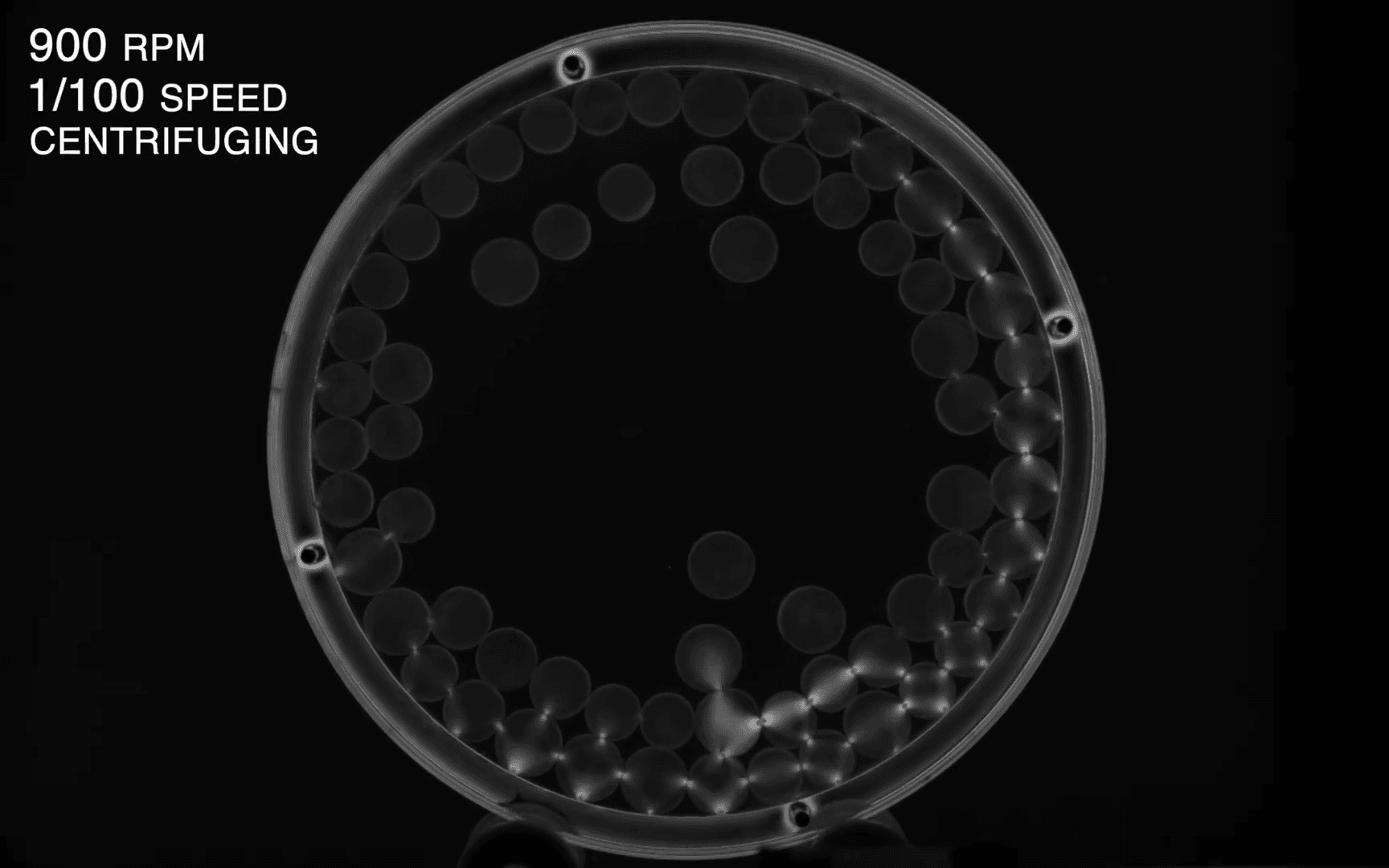
    Granular materials like sand, gravel, and medications can become a rigid mass when squeezed or sheared. Even with a relatively loose packing, these materials can jam together to act like a solid if the contacts between grains no longer allow particles to shift or rotate. In this video, researchers explore how stable these jammed states are by repeatedly shearing the mixture and observing how it changes.

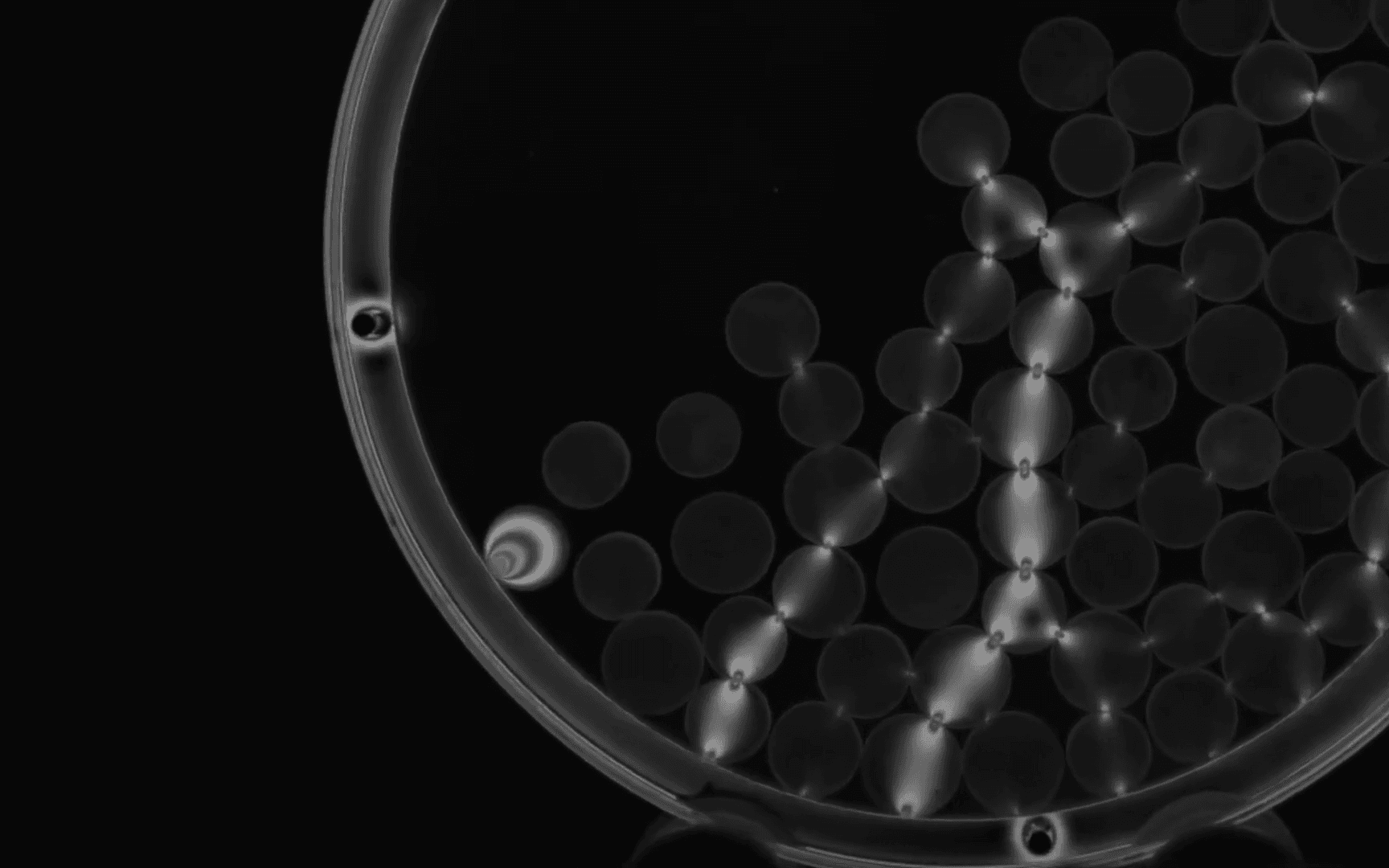
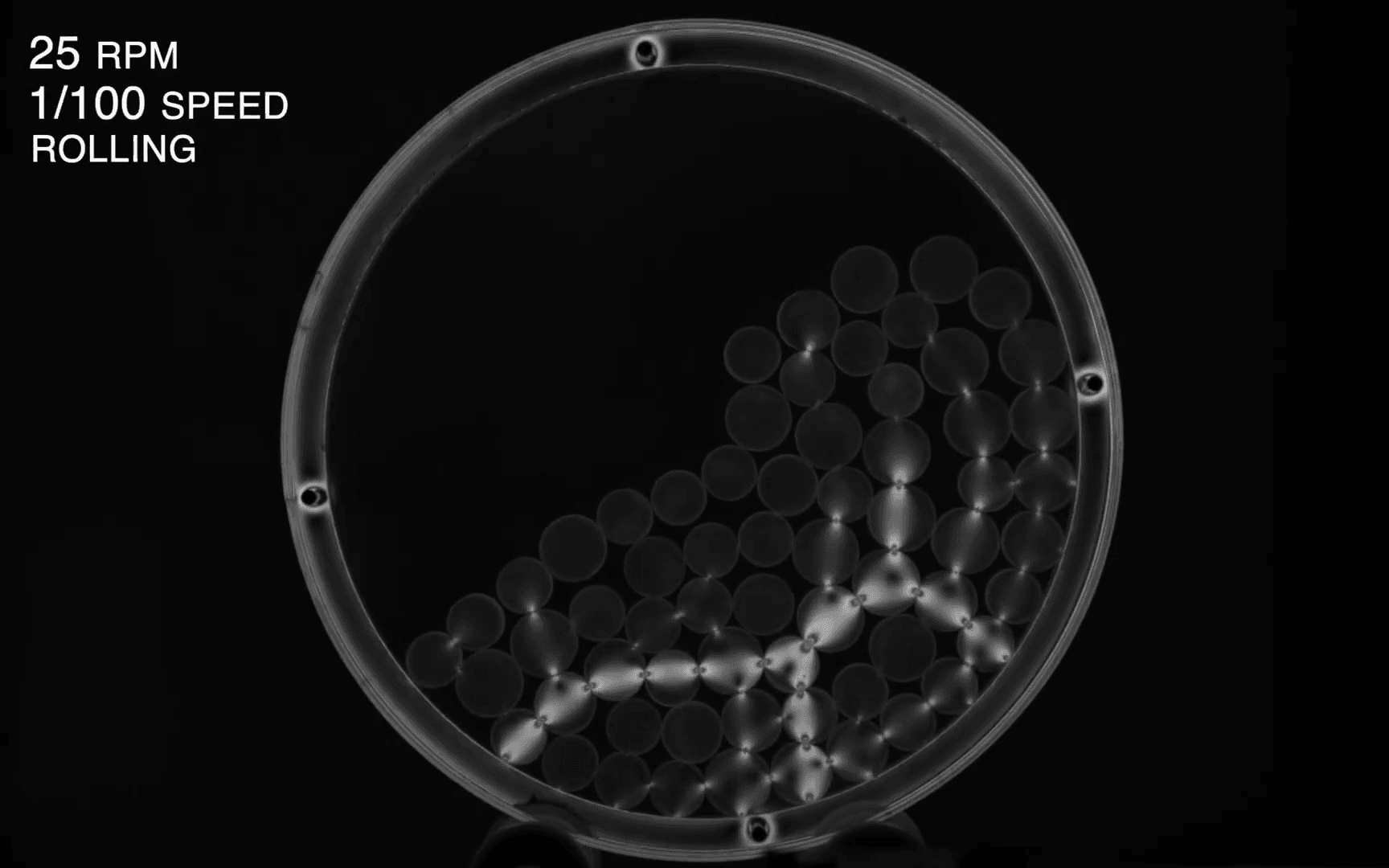
    Most of the videos are set up as a triptych, where all three panels show the same material. On the left, you see a simple view showing the position of each particle. In the middle, the disks are viewed through polarized filters, so that the material looks brightest where it is stressed. This view lets us see the force chains that run through the material. On the right, UV-sensitive ink on each marker glows to show any rotation particles experience.

    In the first sample, repeated shearing slowly unjams the mixture and allows it to shift and flow once more. We see this from the decreasing brightness in the middle panel. The slow fade to black means that the force chain network has disappeared entirely. In contrast, the second sample ultimately reaches an “ultra-stable” jammed state, in which further shear cycles cause no change to the network. Once again, this is easiest to observe in the middle image, where the bright force network stops changing after 2,000 cycles or so. (Image and video credit: Y. Zhao et al., research pre-print)

  • Featured Video Play Icon

    Fun From the Beach

    Here’s a neat bit of fluid dynamics derived from a day at the beach! Our experiment begins with well-mixed (and likely compacted) sand grains and sea water in a bottle. When flipped, the sand layer sits at the top of the bottle with the water layer beneath.

    Very quickly new layers establish themselves in the bottle. The lower half of the bottle turns into a turbulent churn of water and sand, topped by a thin air bubble, then the thick sand layer, and finally, a layer of filtered water. That air bubble beneath the sand means that the sand layer is compacted enough that surface tension keeps the air from being able to squeeze through the grains. On the other hand, water is able to filter through, eventually making it into that upper region. The compact layer of sand is supported in the bottle by force chains running through the largest grains, which is why only fine sediment settles down through the turbulent layer at this point.

    Eventually, the top sand layer erodes enough that it can no longer support its weight, and the sand collapses. As the grains settle out, we end up with fine sediment on the bottom (as previously discussed), followed by a layer of coarse sand from the erosion and collapse of the sand layer, topped with a layer of very fine grains that — due to their light weight — are the very last to settle out of the water. I love that such a simple seaside experiment contains such scientific depth! (Video and submission credit: M. Schich; special thanks to Nathalie V. for helpful input)

  • Featured Video Play Icon

    The Strangeness of Sand

    Sand and other granular materials can flow, jam, and transmit forces in counterintuitive ways. This Lutetium Project video gives a nice overview of some of these bizarre properties.

    Many of sand’s odd characteristics come from the way forces move through grains that touch. Around 5:20 there’s a demo of one of these effects: the Janssen effect. Using a scale, the video shows the mass of a bunch of grains. Then, the host pours those grains into a narrow cylinder. If you watch the scale, you’ll see that it shows a smaller mass than before. That’s not because of a difference in mass between the bowl and the cylinder; the scale is calibrated to only measure the mass of the grains. In the narrow cylinder the grains appear to weigh less because part of their weight is being supported by force chains that run to the container’s walls. (Image and video credit: The Lutetium Project)

  • Scaling High-Speed Impacts

    Scaling High-Speed Impacts

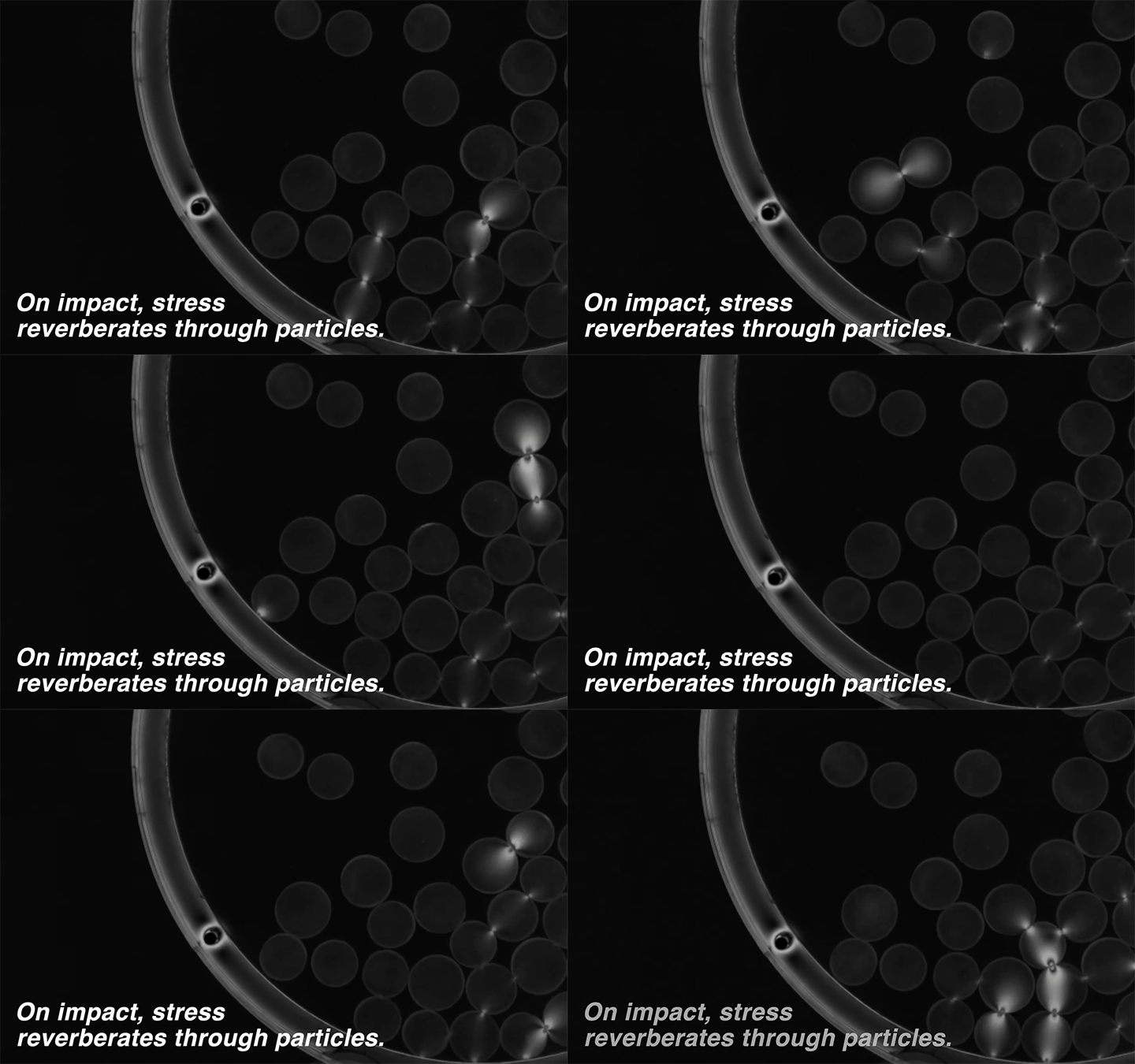
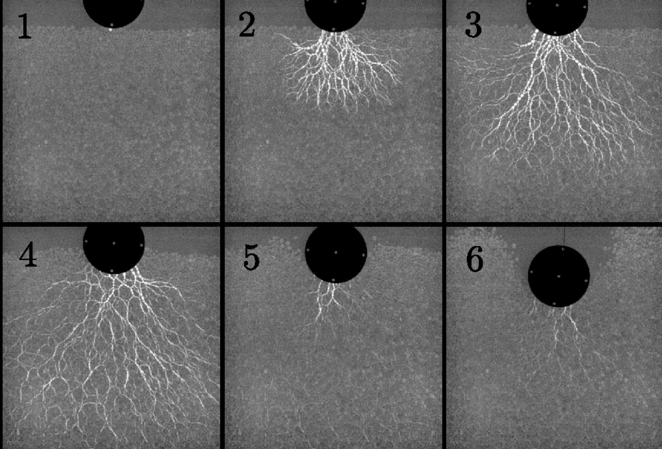
    The impact of a solid object into a bed of grains is a major topic in many fields from ballistics to astronomy. Researchers study these impacts experimentally using photoelastic disks, which display visible stress patterns when placed between polarizers. The lightning-like patterns you see above reveal how forces propagate inside the grains as the object hits.

    Researchers focused on the peak forces generated during high-speed impacts, an area that hasn’t been well-captured by existing impact models. They found that this peak force obeys its own scaling laws that depend on factors like impact speed, impacter size, grain stiffness, and grain density. (Image and research credit: N. Krizou and A. Clark)

  • Stress Between Grains

    Stress Between Grains

    Granular materials like sand and beads can shift and flow in fluid-like ways, but they’re much harder to predict. Part of this is due to the way friction between individual grains transmits force through the network. Here, we see photoelastic beads responding to the intrusion of a narrow rod. The lightning-like flashes show how stress is traveling between neighboring grains. Notice how the lower grains are essentially frozen into a state of high stress, but the movable upper grains shift and readjust themselves to try and relieve stress.

    This experiment took place under lunar gravitational conditions. Lower gravity means that it takes a larger pile of grains on top to create a given stress. But it also means it’s easier for those movable top grains to shift or even get thrown up by a hastily applied force.  The purpose of experiments like this is to better understand how rovers and probes should dig in low-gravity environments without kicking up a cloud of regolith and dust. (Image credit: K. Daniels et al., source)

  • Revealing Stress

    Revealing Stress

    What goes on inside of a granular material like sand when an object moves through it? Individual grains will shift and may impact one another or simply slide past. Researchers use special photoelastic materials to see these forces in action. A photoelastic material responds to changes in stress by polarizing light, revealing areas of stress concentration. For an entire network of photoelastic beads, forces between the grains appear like a web of lightning. Individual strands are known as force chains. Bright lines indicate areas where grains are jammed against one another in opposition to the object’s movement. As the intruder is pulled against the force chain network, grains shift and new force chains form. (Image credit: Y. Zhang and R. Behringer, source)