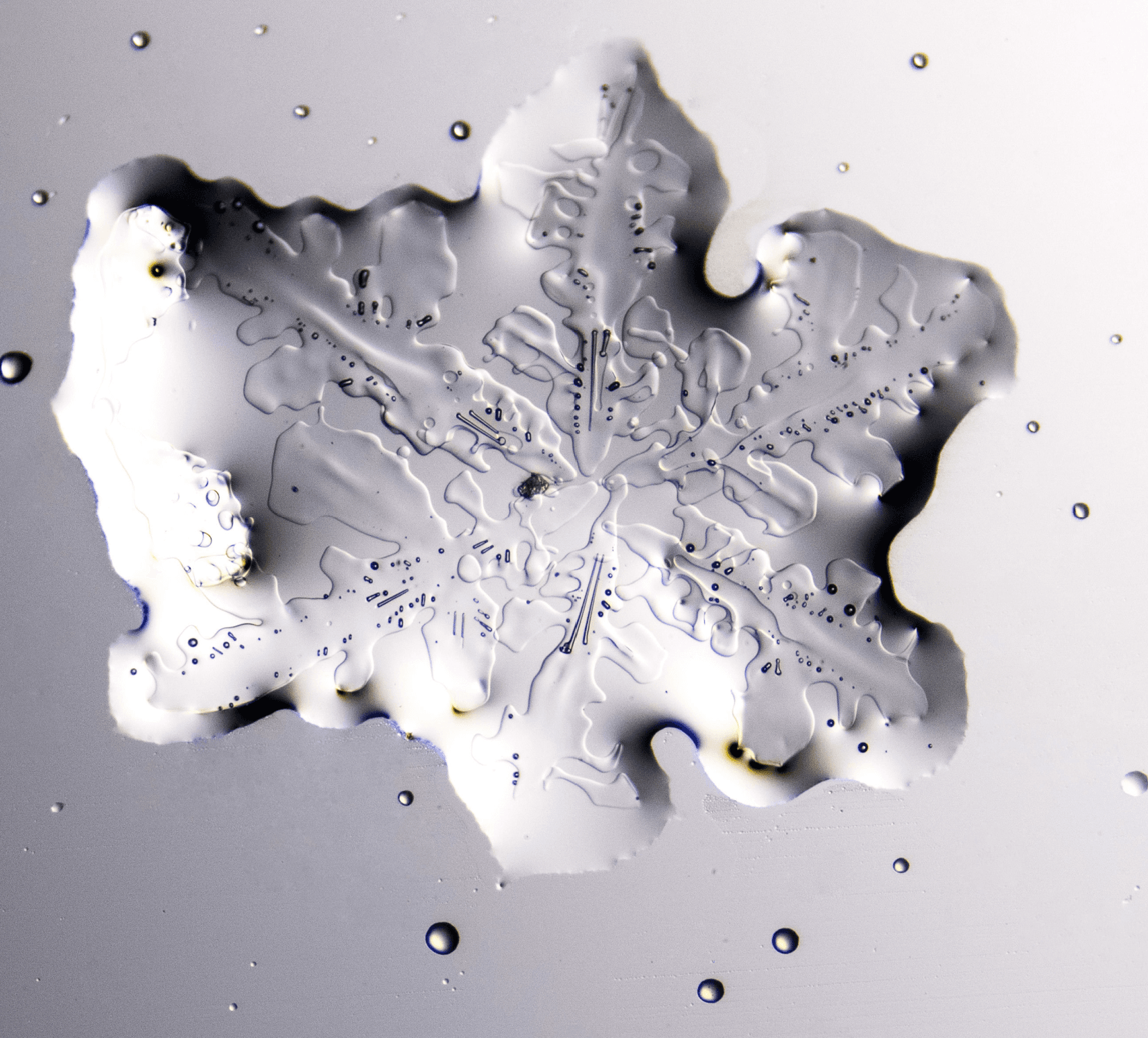
It’s hard to preserve something as ephemeral as a snowflake, as seen in this microphotograph by Michael Robert Peres. Despite the old adage, it is possible to make identical snowflakes, but it requires mirroring the freezing conditions exactly, including both temperature and humidity. Here, the snowflake’s crystalline structure survives as a ghost in a melting droplet. (Image credit: M. Peres; via Ars Technica)
Tag: fluids as art

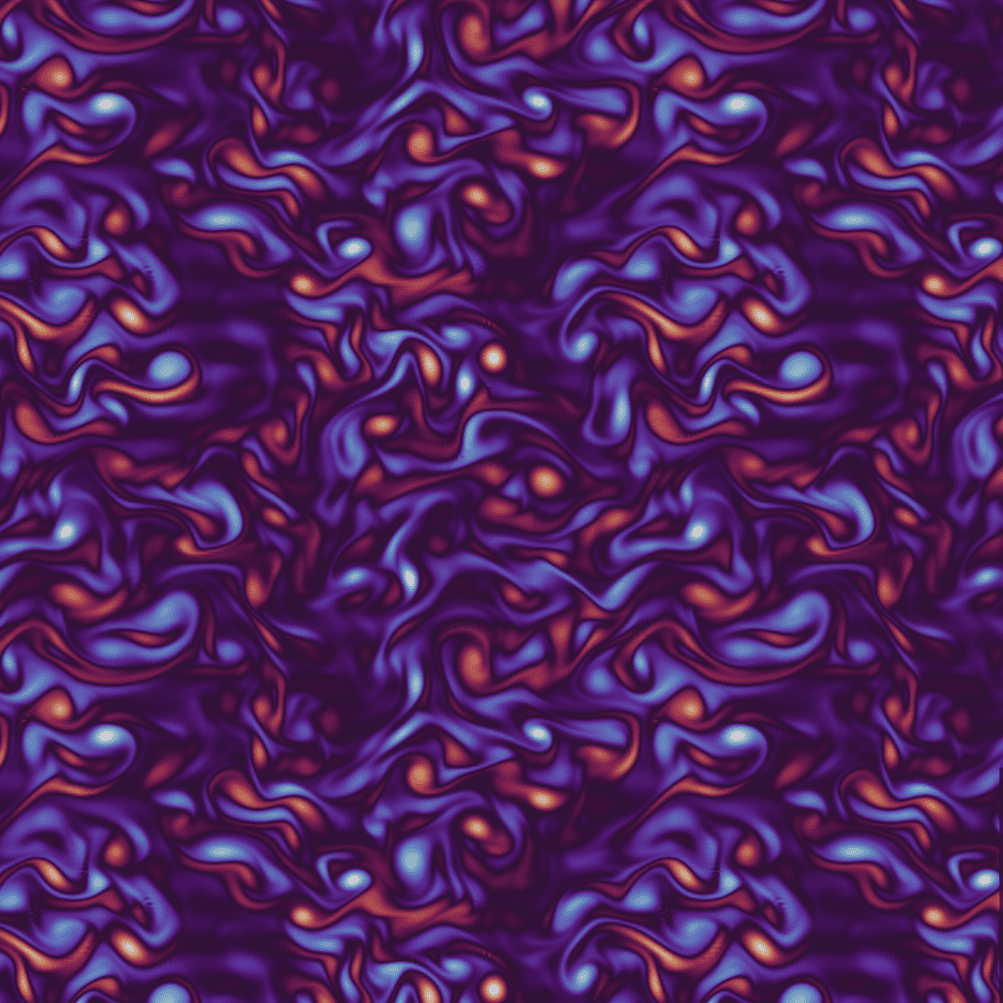
“Magnetic Vortex”
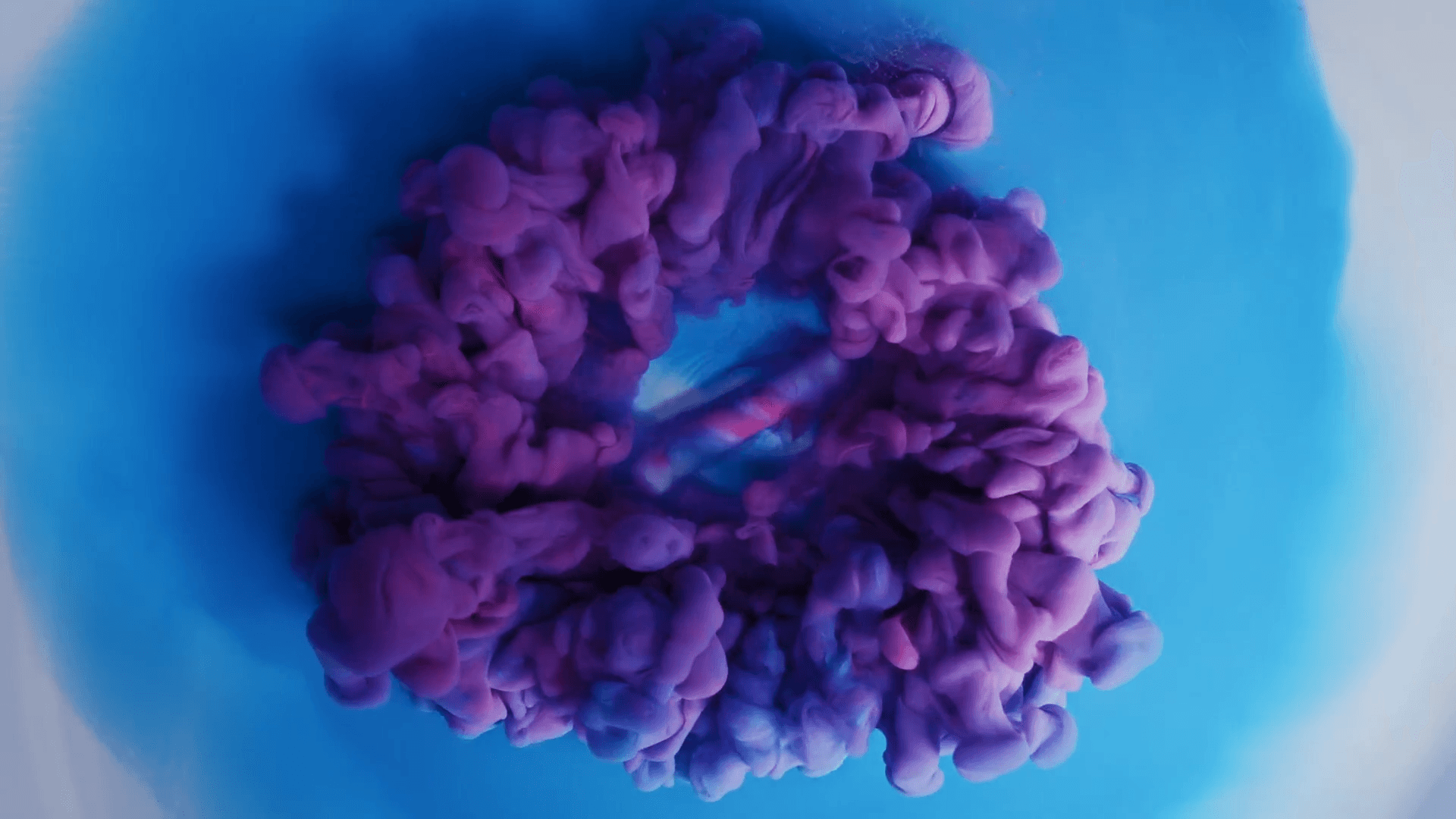
The Macro room team is back with a video featuring their signature colorful cleverness. This time they’re using a magnetic stirrer to swirl up some mesmerizing flows. It’s well worth a watch. (Video and image credit: Macro Room)
“500,000-km Solar Prominence Eruption”
It’s difficult at times to fathom the scale and power of fluid dynamics beyond our day-to-day lives. Here, twists of the Sun‘s magnetic field propel a jet of plasma more than 500,000 kilometers out from its surface in an enormous solar prominence eruption. To give you a sense of scale for this random solar burp, that’s bigger than ten times the distance to satellites in geostationary orbit. (Image credit: P. Chou; via Colossal)

The Balvenie
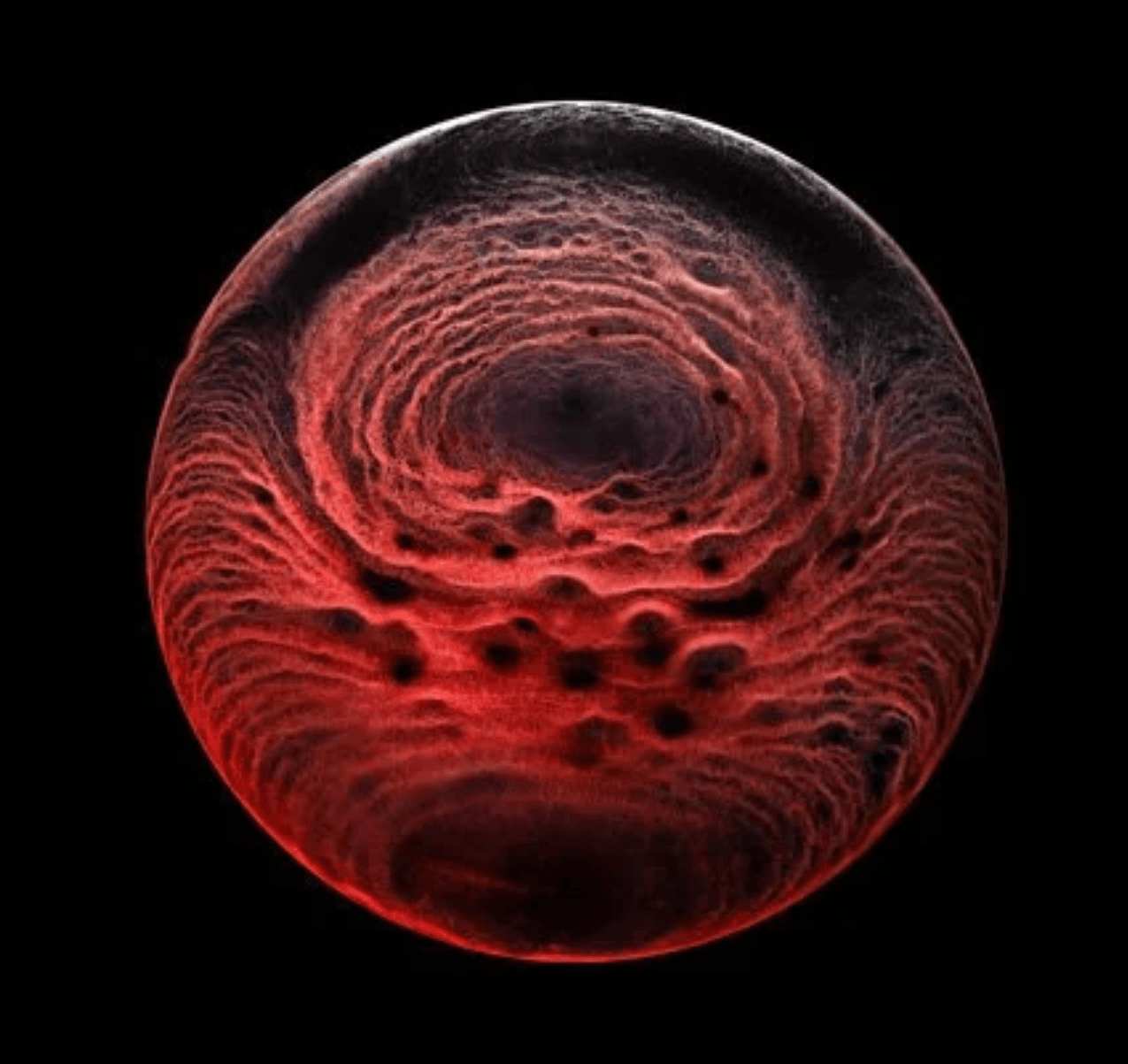
Photographer Ernie Button explores the stains left behind when various liquors evaporate. This one comes from a single malt scotch whisky by The Balvenie. The stain itself is made up of particles left behind when the alcohol and water in the whisky evaporate. The pattern itself depends on a careful interplay between surface tension, evaporation, pinning forces, and internal convection as the whisky puddle dries out. (Image credit: E. Button/CUPOTY; via Colossal)

Spores Get a Lift
Mushrooms have the challenging task of dispersing spores, typically from heights no more than a few centimeters above the ground. At that altitude, viscosity and friction with the ground mean that air barely moves, if it does at all. And mushrooms rely on a wide range of methods, from explosive launches to rain assistance to making their own weather. Every one of these methods gives spores a lift in altitude to reach higher winds and greater dispersal. (Image credit: A. Bejczi/CUPOTY; via Colossal)

A Rough Day
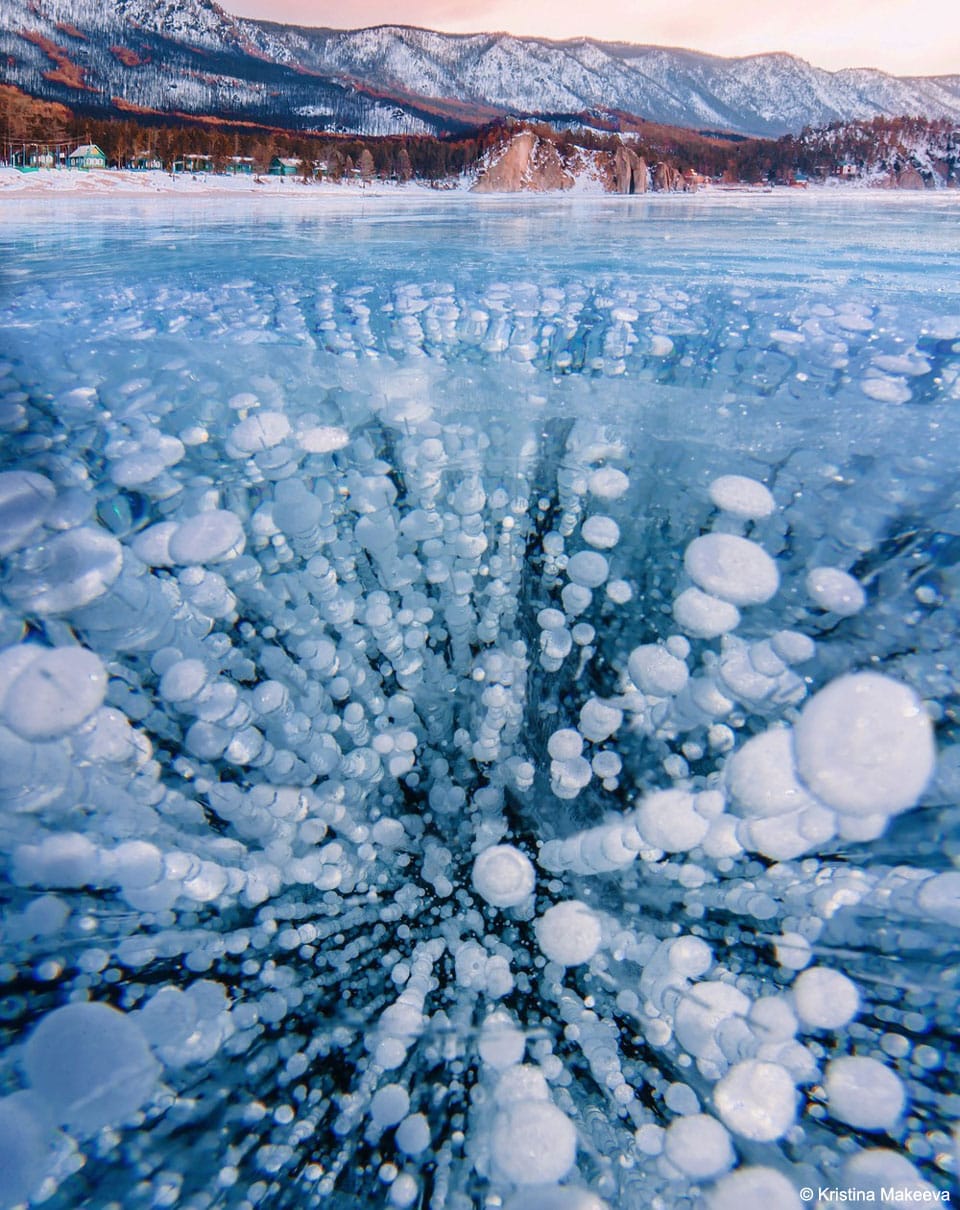
Winds from the north made for wild conditions at Nazaré in Portugal. Photographer Ben Thouard caught these crashing waves in the late afternoon, when the low sun angle illuminated the spray of the surf. Every year teratons of salt and biomass move from the ocean to the atmosphere, much of it through turbulent wave action driven by the wind. Here, the wind rips droplets off of wave crests, but smaller droplets reach the atmosphere when bubbles–trapped underwater by crashing waves–reach the surface and burst. (Image credit: B. Thouard/OPOTY; via Colossal)

A Gentoo Flotilla
If you’re used to seeing penguins on land, their speed and grace in the water can surprise. Penguins are even capable of extra bursts of speed through supercavitation. They trap air beneath their feathers and then release it underwater when they need to move faster. Their coating of bubbles reduces their drag and gives them the extra speed to help escape predators like leopard seals. (Image credit: R. Barats/OPOTY; via Colossal)

Frosted
Frost forms hexagonal columns on a wooden rail in this microphotograph by Gregory B. Murray. Like in snowflakes, when water molecules freeze they position themselves to form six-sided crystals. From this perspective, it looks like a miniature version of the Giant’s Causeway. (Image credit: G. Murray; via Ars Technica)

Our Best Look Yet at a Solar Flare
Scientists have unveiled the sharpest images ever captured of a solar flare. Taken by the Inouye Solar Telescope, the image includes coronal loop strands as small as 48 kilometers wide and 21 kilometers thick–the smallest ones ever imaged. The width of the overall image is about 4 Earth diameters. The captured flare belongs to the most powerful class of flares, the X class. Catching such a strong flare under the perfect observation conditions is a wonderful stroke of luck.
Although astronomers had theorized that coronal loops included this fine-scale structure, the Inouye Solar Telescope is the first instrument with the resolution to directly observe structures of this size. Confirming their existence is a big step forward for those working to understand the details of our Sun. (Video and image credit: NSF/NSO/AURA; research credit: C. Tamburri et al.; via Gizmodo)

“Orion, the Horsehead and the Flame in H-alpha”
Photographer Daniele Borsari captured this gorgeous composite image of nebulas in black and white, emphasizing the motion underlying the gas and dust. In the upper right, the Orion Nebula shines, bright with new stars. In the lower left, you can pick out the distinctive shape of the Horsehead Nebula and, further to the left, the Flame Nebula. We often see nebulas in bright colors, but I love the way black and white highlights the turbulence surrounding them. (Image credit: D. Borsari/ZWOAPOTY; via Colossal)