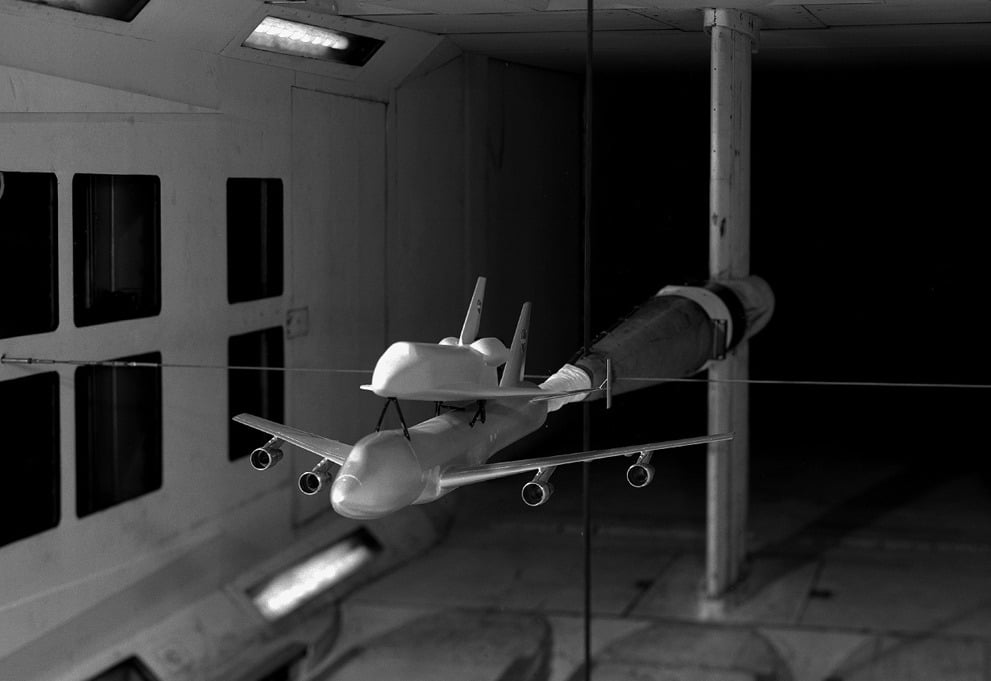
A scale model of the Space Shuttle attached to its modified 747 carrier hangs in a NASA wind tunnel. Wind tunnel tests can be used for flow visualization, lift and drag measurements, control system checks and so forth, but mounting models correctly and safely in the tunnel is crucial. Many models use sting mounts that project forward, as this one does, in order to expose the model to freestream flow unimpeded by the mounting mechanism. Any mounts and models must also be sturdy enough that all or part of them does not break off mid-test and fly into the wind tunnel’s fans. #
Tag: fluid dynamics

High-Res Rayleigh-Taylor Instability
When a heavy fluid sits atop a lighter fluid, the interface between the two breaks down through the Rayleigh-Taylor instability. This computation of a 2D interface shows the near fractal behavior of this instability as whorls and eddies of all different scales form and mix the fluids. (submitted by @markjstock)

Whipping Instability
A droplet of glycerol coalescing in silicone oil while subjected to strong electric fields exhibits a whip-like instability reminiscent of fireworks. Check out videos of the phenomenon or see the paper for more information. Happy Independence Day to our American readers!
For more fun, holiday-themed high-speed video, check out PopSci’s fireworks videos.
Triggering Avalanches
Humans often trigger avalanches purposefully before natural ones can occur. Either way, avalanches begin when external stresses on the snow pack exceed the strength within the snow pack or at the contact between the snow and the ground. Acceleration of the snow is gravity-driven. If the snow mixes with air, powder clouds can form that carry snow even further than the main slab. Although the snow itself is not a fluid, once an avalanche gets moving, its behavior can be better modeled as a fluid than as a solid.

Evolving Flight
Flapping wings while running may have helped the evolutionary ancestors of birds develop flight. Experiments with modern birds show that flapping wings while running helps even flight-capable birds ascend slopes and uses only 10% as much power as actual flight along a 65-degree incline. #

Rocket Diamonds
The exhaust of a Pratt and Whitney J58 shines with Mach diamonds, a series of shock waves and expansion fans that form to equalize the exhaust and ambient pressures. This pattern can occur any time an engine nozzle operates at its non-ideal altitude.
Propeller Cavitation
Cavitation occurs in moving liquids when the local pressure–in this case, at the tip of the propeller–drops below the vapor pressure. The fast-moving fluid transitions to a gas phase, creating a tip vortex of water vapor even though the propeller is completely submerged.
Tank Shock Waves
High-speed video of a tank firing at 18000 fps shows shock waves made visible due to light distortion. When the air density changes (due to temperature or compression), it’s index of refraction changes, causing the background to appear distorted. Most of the video shows the subsonic development of the turbulent exhaust plume. Note the speed at which the exhaust moves relative to the airborne shrapnel. (submitted by Stephan)
Shear-Thinning at Home
Shear-thinning isn’t just confined to canned whipped cream. It’s also a feature of such non-Newtonian fluids as ketchup, shampoo, latex paint, and blood. The NASA research on shear-thinning the video author refers to is here and comes from the Critical Viscosity of Xenon-2 (CVX-2) experiment flown on the final mission of Columbia. Surprisingly, almost all of the experimental data was recovered from the crash. #
Liquid Rope Coiling
Some liquids, when falling in a stream into a pool, tend to coil into a liquid rope. This video shows honey, but the effect can also be observed in syrups and silicone oil. The rate of coiling is dependent on the height from which the liquid falls. Other factors governing coiling include viscosity, density, and flow rate.


