One of the most commonly observed fluid instabilities is the Rayleigh-Taylor instability, which occurs between fluids of differing densities. It’s most often seen when a denser fluid sits over a lower density fluid. In the video above, this is demonstrated experimentally: a lower density green fluid mixes in with the clear, higher density fluid. This is the classical case in which each initial region of fluid is uniform in density prior to the removal of the barrier. But what happens when each zone has its own variation in density? This is the second case. Before the barrier is removed, each region of the tank has a varying–or stratified–fluid density. In this case, the unmixed fluids are stably stratified, meaning that the fluid density increases with depth. At the barrier interface, the two separate fluids are still unstably stratified–with the denser fluid on top–so when the barrier is removed, the Rayleigh-Taylor instability still drives their mixing. Because of the stable stratification within the original unmixed fluids, the mixing region after the barrier’s removal is more limited. (Video credit: M. D. Wykes and S. B. Dalziel; via PhysicsCentral by APS)
Tag: fluid dynamics

Sloshing in a Bouncing Sphere
The sloshing of liquids inside solids is usually presented as a difficulty to overcome, as with the transport of tanks, the motion of fuel in satellites, or even the problem of walking with a full cup of coffee. But liquids also make a very effective damper, as in the case of a bouncing ball partially filled with liquid. Here we see high-speed video of the liquid’s motion inside the ball as it bounces and rebounds. Part of the ball’s kinetic energy at rebound is transferred into the fluid jet, reducing that available for the ball to transfer into potential energy. (Video credit: BYU Splash Lab)

Antarctic Ice Flows

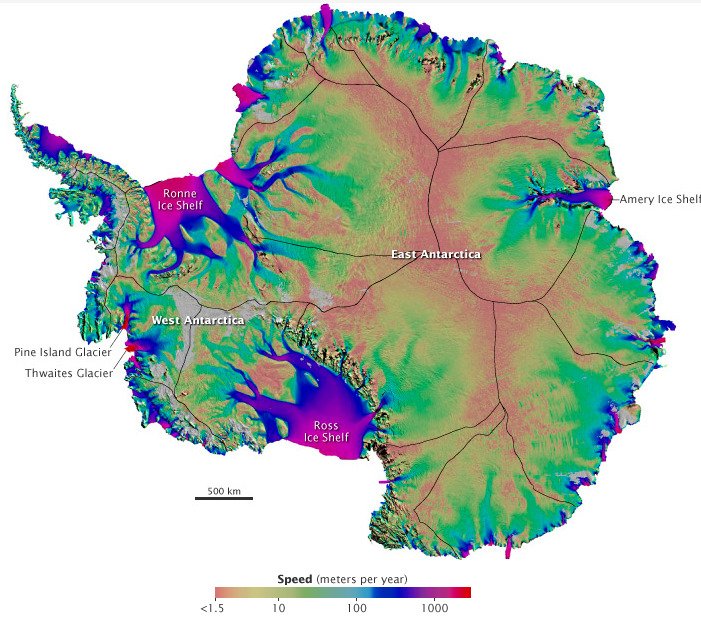
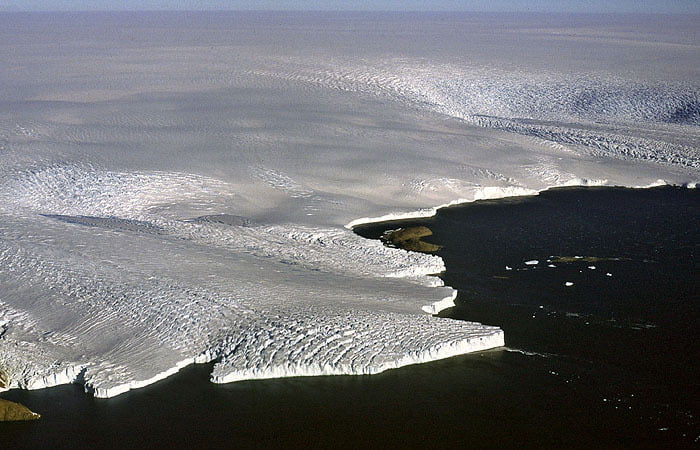
Even frozen ice moves and flows, though too slowly to see with the naked eye. By combining satellite imagery from NASA, JAXA, CSA, and ESA, researchers were able to map the flow of ice across Antarctica, discovering ice streams (shown in blue and purple above) that can move hundreds of meters a year. The dynamics of this motion are still poorly understood, with theoretical advances underway. These ice sheets sit atop bedrock that is itself below sea level. A thin layer of water exists between the ice sheet and the bedrock, acting as a lubricant and allowing the ice to slide against the bedrock. To see animations of Antarctic ice flow, see this compilation film. (Photo credits: E. Rignot/NASA JPL/UC Irvine #; M. J. Hambrey #)
Countertop Fliers
In this video, researcher Leif Ristroph and his colleagues have used a clever way to simulate flapping flight, not by actuating their fliers but by oscillating the flow. The flow is driven by a speaker, which causes the air above it to move up and down. Using straws to simulate the honeycomb flow conditioners often used in wind tunnels helps smooth flow. The end result is a great table-top set-up for testing and refining miniature flier designs. The best fliers stay aloft thanks to asymmetry in the streamwise direction; when the air moves upward, the flier catches the air, maximizing drag so that it is carried upward. When the flow reverses, however, the shape of the flier is more streamlined, so the drag is reduced, helping the flier stay aloft. (Video credit: Science Friday/Leif Ristroph et al.)

Ocean Waves in the Sky
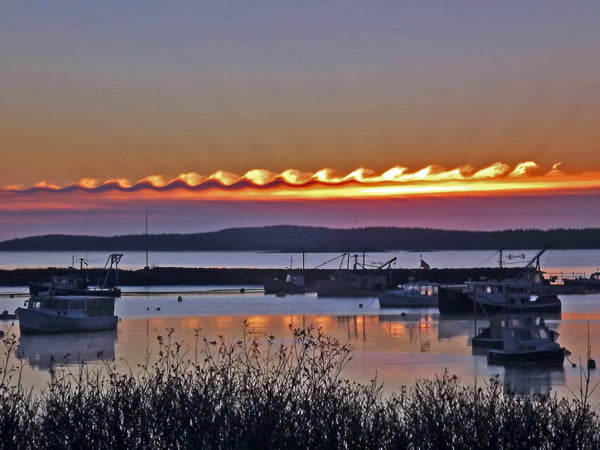
These wave-like Kelvin-Helmholtz clouds can form due to shear between different layers of air in the atmosphere. When one region of air has a higher velocity than the other, their interface forms a shear layer, which can break down in this wavy pattern. In this case, the lower layer of air was moist enough to form condensation and clouds, making the pattern visible to the naked eye. (Photo credit: Gene Hart; via Flow Visualization)
The Water Bridge
This short film offers an artistic look at the phenomenon of the water bridge. When subjected to a large voltage difference, such as the 30 kV used in the film, flow can be induced between water in two separated beakers. This creates a water bridge seemingly floating on air. There are two main forces opposing the bridge: gravity, which causes it to sag, and capillary action, which tries to thin the bridge to the point where it will break into droplets. These forces are countered by polarization forces induced at the liquid interface due to the electrical field separating the water’s positive and negative charges. This separation of charges creates normal stresses along the water surface, which counteracts the gravitational and capillary forces on the bridge. The artist has done a beautiful job of capturing the unsteadiness and delicacy of the phenomenon. (Video credit: Lariontsev Nick)
The Kaye Effect
The Kaye effect is an instability particular to a falling stream of non-Newtonian fluids with shear-thinning properties. When these fluids are deformed, their viscosity decreases; this, for example, is why ketchup flows out of a bottle more easily once it’s moving. Like most fluids, the falling shampoo creates a heap on the surface. The Kaye effect is kicked off when the incoming jet creates enough shear on part of the heap that the local viscosity decreases, causing the streamer–or outgoing jet–to slip off the side of the heap. As the incoming jet continues, a dimple forms in the heap where the streamer originates. As the dimple deepens, the streamer will rise until it strikes the incoming jet. This perturbation to the system collapses the streamer and ends the Kaye effect. This video also has a good explanation of the physics, along with demonstrations of a stable form of the Kaye effect in which the streamer cascades down an incline. (Video credit: Minute Laboratory; inspired by infplusplus)

Bouncing and Break-Up
In the collage above, successive frames showing the bouncing and break-up of liquid droplets impacting a solid inclined surface coated with a thin layer of high-viscosity fluid have been superposed. This allows one to see the trajectory and deformation of the original droplet as well as its daughter droplets. The impacts vary by Weber number, a dimensionless parameter used to compare the effects of a droplet’s inertia to its surface tension. A larger Weber number indicates inertial dominance, and the Weber number increases from 1.7 in (a) to 15.3 in (d). In the case of (a), the impact of the droplet is such that the droplet does not merge with the layer of fluid on the surface, so the complete droplet rebounds. In cases (b)-(d), there is partial merger between the initial droplet and the fluid layer. The impact flattens the original droplet into a pancake-like layer, which rebounds in a Worthington jet before ejecting several smaller droplets. For more, see Gilet and Bush 2012. (Photo credit: T. Gilet and J. W. M. Bush)
Saffman-Taylor Demo
In this video, a thin film of viscous glycerin sits between two glass plates. As the plates are forced apart, air gets entrained from either side, causing finger-like instabilities to form between the two fluids. This is a result of the Saffman-Taylor mechanism. The final dendritic pattern depends on the fluid viscosities, surface tension, and any non-uniformities in the apparatus. (Video credit and submission by M. Goodman)

Ripples
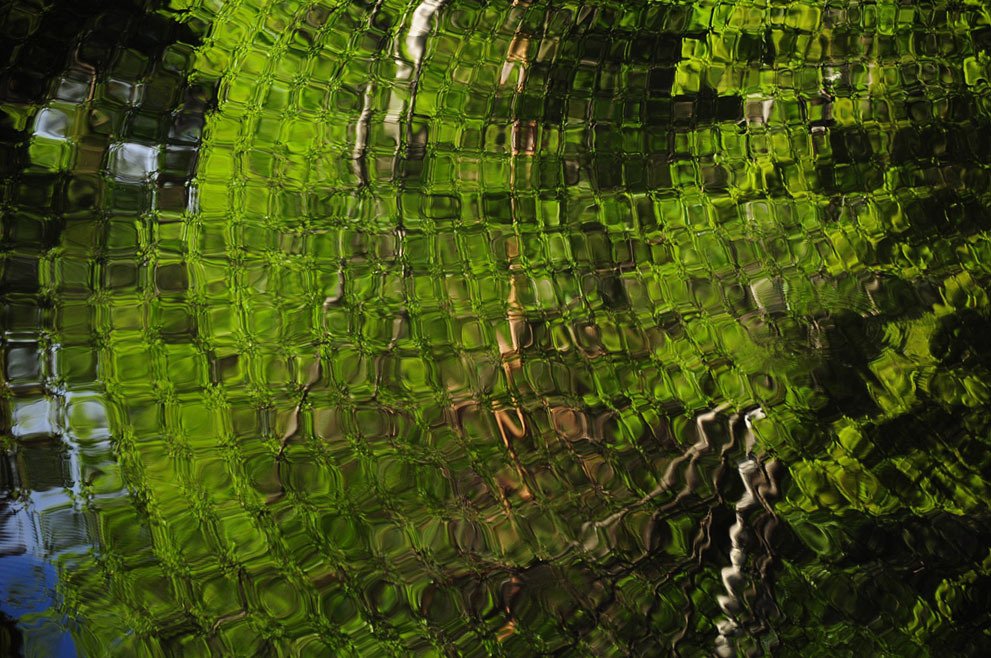
Capillary waves–ripples–interfere with one another after the photographer throws objects into a narrow point in a small lake. The reflections of these waves off the lake’s boundaries and against one another creates a mosaic-like geometric effect on the liquid surface. (Photo credit: Jorgen Tharaldsen/National Geographic Photo Contest)