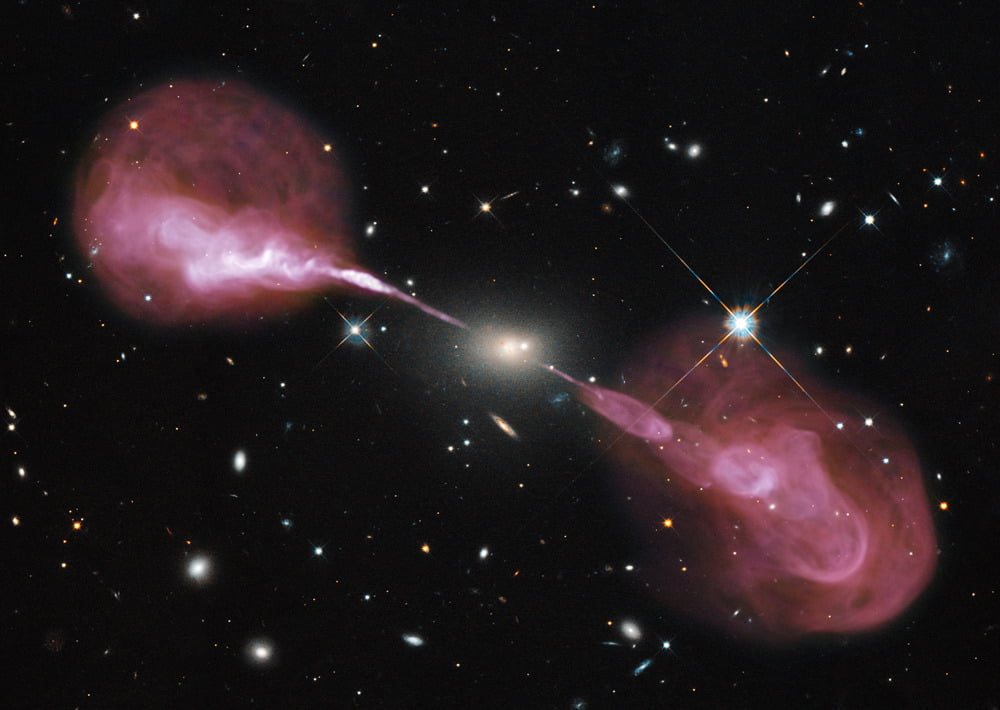
Jets of high-energy plasma and sub-atomic particles explode outward from the Hercules A elliptical galaxy at the center of this photo. The jets are driven to speeds close to that of light due to the gravitation of the supermassive black hole at the center of the elliptical galaxy. Relativistic effects mask the innermost portions of the jets from our view, but, as the jets slow, they become unstable, billowing out into rings and wisps whose turbulent shapes suggest multiple outbursts originating from Hercules A. (Photo credit:NASA, ESA, S. Baum and C. O’Dea (RIT), R. Perley and W. Cotton (NRAO/AUI/NSF), and the Hubble HeritageTeam (STScI/AURA); via Discovery)
Tag: fluid dynamics

Surface Explosions
Underwater explosions often behave non-intuitively. Here researchers explore the effects of surface explosions by setting off charges at the air/water interface. Initially, an unconfined explosion’s blast wave expands a cavity radially into the water. This cavity collapses back toward the surface from the bottom up, ultimately resulting in a free jet that rebounds above the water level. Confined explosions behave very differently, expanding down the glass tube containing them in a one-dimensional fashion. The cavity never extends beyond the end of the glass tube, likely due to hydrostatic pressure. (Video credit: Adrien Benusiglio, David Quéré, Christophe Clanet)

Phytoplankton and Sediments
Pale sediments are carried out to sea by the rivers of the Mergui Archipelago of Myanmar. Dark blue ocean waters mix with the sediment, creating turbulent swirls in this natural color satellite image. With the sediment comes valuable nutrients for plant life in the ocean, which can prompt the formation of phytoplankton blooms. (Photo credit: Michael Taylor/Landsat/NASA)
Flapping Elastic Straws
One of the interesting challenges in fluid dynamics is the coupling of aerodynamic forces with structural forces. This could be the result of external flow, as with aeroelastic flutter on aircraft or architecture, or internal flow, as with the video above. Here researchers blow air through compliant cylindrical shells–think of a straw made of an elastic solid like latex–and observe the vibrations that result. Depending on the flow rate and material properties, different vibrational modes can be activated. The first mode behaves much like a garden hose that’s not being held; it vibrates wildly back-and-forth. The second mode wobbles the mouth of the shell open and closed, whereas the third mode forms three “flaps” that vibrate inward and outward. Each of these modes behaves very differently, and, for practical applications, it’s important for engineers to be able to predict, control, and account for these kinds of structural behaviors under aerodynamic loading. (Video credit: P. Zimoch et al.)

Slapping Sheets
Here fluid is ejected as two flat plates collide, creating a sheet of silicone oil. The initially smooth sheet forms a thicker ligament about the edge. Gravity causes the sheet to bend downward like a curtain, and growing instabilities along the ligament cause the development of a wavy edge. The points of the waves develop droplets that eject outward. Not long after this photograph, the entire liquid sheet will collapse into ligaments and flying droplets. (Photo credit: B. Chang, B. Slama, and S. Jung)
The Evolution of Icicles
The time-lapse video above shows the growth of icicles of various compositions under laboratory conditions. Many icicles in nature exhibit a rippling effect in their shape, which some theories attribute to an effect of lower surface tension in some liquids. Here researchers show the icicle growth of three liquids: pure distilled water, and water with two concentrations of dissolved salt. They found that lowering the surface tension of the freezing liquid with non-ionic surfactants (i.e. not salt) did not produce ripples, but that dissolved ionic impurities like salt strongly affected the growth of ripples. They posit that this may be due to constitutional supercooling, in which growth of the solid-liquid interface is destabilized by the preferential concentration of impurities near the interface. (Video credit: A. S. Chen and S. Morris)
Hot Items Sink Faster
This combined video shows the fall of a heated centimeter-sized steel sphere through water. From left to right, the sphere is at 25 degrees C (left), 110 degrees C (middle), and 180 degrees C, demonstrating how the Leidenfrost effect–which vaporizes the water in immediate contact with the sphere–can substantially reduce the drag on a submerged object. In the middle video, the vaporization of the water around the sphere is sporadic and incomplete, only slightly reducing the sphere’s drag relative to the room temperature case. The much hotter sphere on the right, however, has a complete layer of vapor surrounding it, allowing it to travel through a gas rather than the denser liquid. (Video credit: I. Vakarelski and S. Thoroddsen; from a review by D. Quere)

A Colorful Rinse
In this image a jet of water (clear/white) is rinsing a solution of polyacrylamide (PAM; blue) off a silicon surface. In the center, a hydraulic jump marks the interface where fast-moving laminar flow changes to a slower turbulent one. At the same time, the water, which is less viscous than the PAM, creates viscous finger-like protrusions into the blue liquid as it rinses the surface clean. (Photo credit: T. Walker, T. Hsu, and G. Fuller)
Inksplosion
Artist Pery Burge utilizes surface tension driven flows created with inks and water for much of her work. As mesmerizing as this is in still-life, it is more lovely still to see it develop and evolve in motion. The explosive outward motion of the ink is driven by the addition of a liquid with a lower surface tension than the ink/water mixtures. This is known as the Marangoni effect. You can observe it yourself using a plate of milk and food coloring into which you drop a tiny bit of dish soap. (The experiment works best with milk with some fat content.) Or, like the artist herself, you can experiment with other fluids you have on-hand! For more of Bruge’s work, see her website. (Video credit: Pery Bruge)

Shedding Vortices
The von Karman vortex street of shed vortices that form the wake of a stationary cylinder are a classic image of fluid dynamics. Here we see a very different wake structure, also made up of vortices shed from a cylindrical body. This wake is formed by two identical cylinders, each rotating at the same rotational rate. Their directions of rotation are such that the cylinder surfaces in between the two cylinders move opposite the flow direction (i.e. top cylinder clockwise, bottom anti-clockwise). This results in a symmetric wake, but the symmetry can easily be broken by shifting the rotation rates out of phase. (Photo credit: S. Kumar and B. Gonzalez)


