Pressure is a critical concept in fluid dynamics – a driving force behind everything from weather patterns to lift on a wing. But where does pressure come from? Like many macroscopic forces dealt with in fluid dynamics, pressure can be traced to the effects of individual molecules within a fluid. Kinetic theory describes gases as a collection of small particles which are all in constant, random motion. These particles’ collisions with each other and with their container create a multitude of tiny forces, as in the demonstration in the video above. When all of these collisions are summed together, their net effect is expressed as pressure, a force per area. (Video credit: Sixty Symbols)
Tag: fluid dynamics

Beads on a String
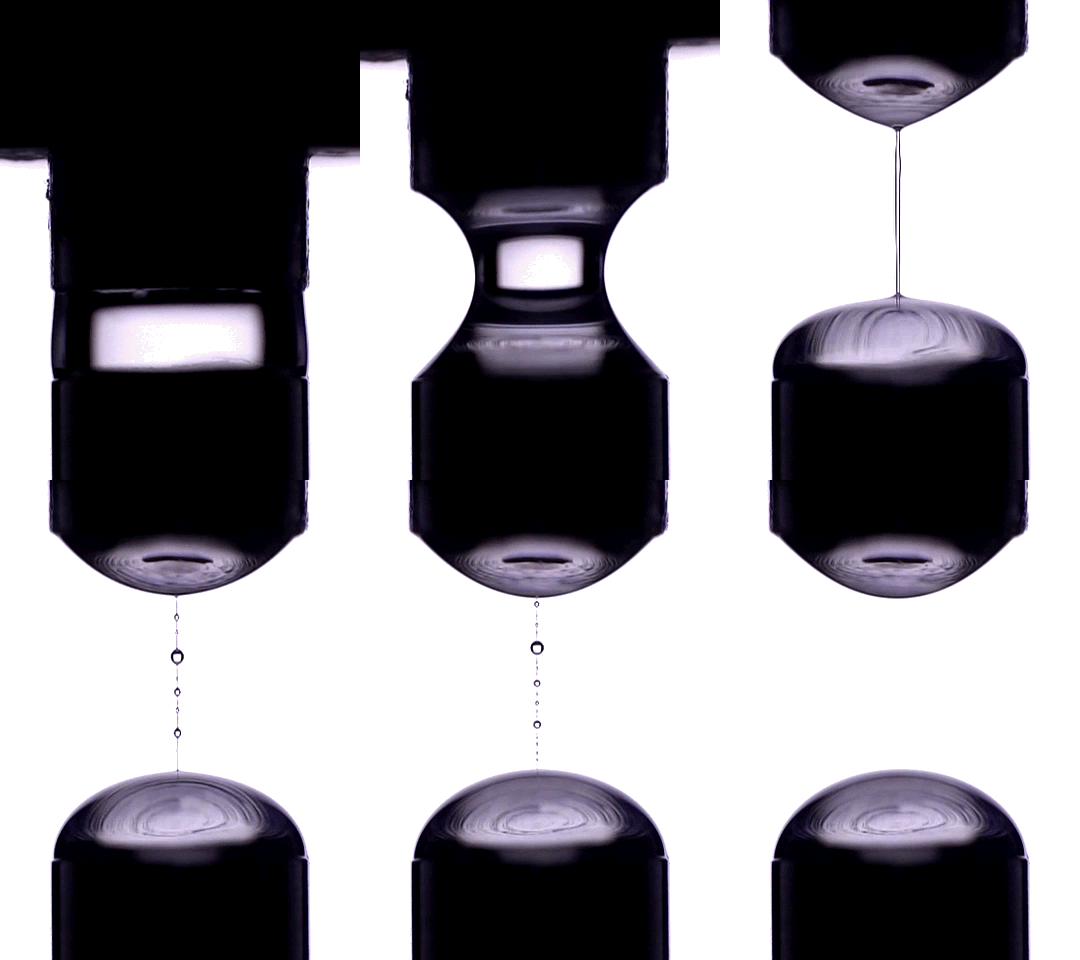
Adding just a small amount of polymers to a liquid can drastically change its behavior. The polymers make the liquid viscoelastic, meaning that, under deformation, the liquid shows behaviors that are both viscous (like all fluids) and elastic (i.e. able to resume its original shape, like a rubber band). These properties are particularly identifiable under extensional loading, like in the animation above. Under these loads, the polymers in the fluid stretch and rearrange, creating an internal compressive stress that acts opposite the imposed tensile stress. It’s this balance of forces, along with ever-present surface tension that creates the beads-on-a-string effect seen above. (Image credit: B. Keshavarz)
ETA: As usual, Tumblr gave me issues with an animated GIF. It should be fixed now. Sorry!

H Booms
Holidays involving fireworks deserve high-speed videos of hydrogen explosions. Although Periodic Table of Videos focuses on the chemistry involved in setting hydrogen on fire, there are some lovely fluid dynamics on display, too. There’s turbulence, combustion (obviously), and, if you watch closely, you can even see the initial vorticity caused by the rubber’s burst twisting the growing flames. (Video credit: Periodic Table of Videos)
Self-Siphoning Stream of Beads
Pull a bit of a long chain out of a container, and you’ll quickly find the beads take on a life of their own, siphoning out of the jar while leaping and looping in the air. Some of the dynamics are clear – the ever-growing free end of the chain has weight enough to pull the rest of the chain out, much like the pressure difference that drives a siphon. But a lot of the rest of the dynamics are unclear and have generated a lot of discussion. It turns out that the same behavior is observed for chain laid out on a horizontal surface (video links on the right of that page) and even the dynamics of that simpler version of the problem are complex. All part of the beauty inherent in Newton’s second law. (Video credit: Steve Mould/Earth Unplugged; Research credit: J. A. Hanna et al.; submitted by Elin R)

Dancing Jets
Vibrating a gas-liquid interface produces some exciting instability behaviors. The photo above shows air and silicone oil vibrated vertically within a prism. For the right frequencies and amplitudes, the vibrations produce liquid jets that shoot up and eject droplets as well as gas cavities and bubble transport below the interface. To see a similar experiment in action, check out this post. (Photo credit: T. J. O’Hern et al./Sandia National Laboratories)
Hydrophobia
Hydrophobic literally means water-fearing, and, once a surface is treated with a hydrophobic coating, the effect on water droplets is stark. The tendency of the non-polar hydrophobic molecules to repel the polar water molecules leads to high contact angles – which make the droplets almost spherical as they glide along the surface. The droplets dance across the surface, colliding and bouncing and coalescing. (Video and submission credit: M. Bell)

How Flames Expand
Combustion is a remarkably complicated phenomenon fluid dynamically. The schlieren images above illustrate a couple of the variables that affect flame propagation. The top image shows an idealized, essentially spherical flame expanding in a quiescent hydrogen-air mixture at atmospheric pressure. The middle flame is expanding in a high-pressure environment, similar to an internal combustion engine. The lowest image shows a flame in a highly turbulent environment, which is also typical of internal combustion engines in order to promote mixing of the air and fuel. (Photo credit: C.K. Law, S. Chaudhuri, and F. Wu)
Studying Coughs
Bioaerosols–tiny airborne fluid droplets generated by coughing or sneezing–are a major concern for the spread of contagions like influenza. It may be possible, however, to mitigate some of these effects by manipulating biological fluid properties. The video above shows an experimental model of a cough, complete with the generation of bioaerosols from some fake human lung mucus. Contrast this with a cough where the model’s mucus has been treated to increase its viscoelasticity. The treated mucus generates substantially fewer droplets during a cough. The results suggest that drugs that increase viscoselasticity of biofluids may help stem the spread of disease. (Video credit: K. Argue et al.; research credit: M. D. A. Hasan et al.)

Hanging Liquids
A horizontal filament of viscous liquid hanging between two plates stretches under gravity. The photo above is a composite showing the stretching of a single thread over several time steps. The fluid forms a catenary, the same shape as a hanging chain or cable when supported only at its ends. This behavior is confined to viscous filaments of sufficient length and diameter. Short and thin filaments instead form a U-shape with a thin horizontal filament joined to two thicker vertical threads. This difference in shape occurs due to the drainage of the liquid along the filament’s length. If the viscous thread begins to fall before surface tension drains the fluid from the center toward the ends, then a catenary of essentially uniform diameter forms. If instead the liquid drains before falling, the non-uniform U-shape is observed. (Photo credit: M. Le Merrer et al.)