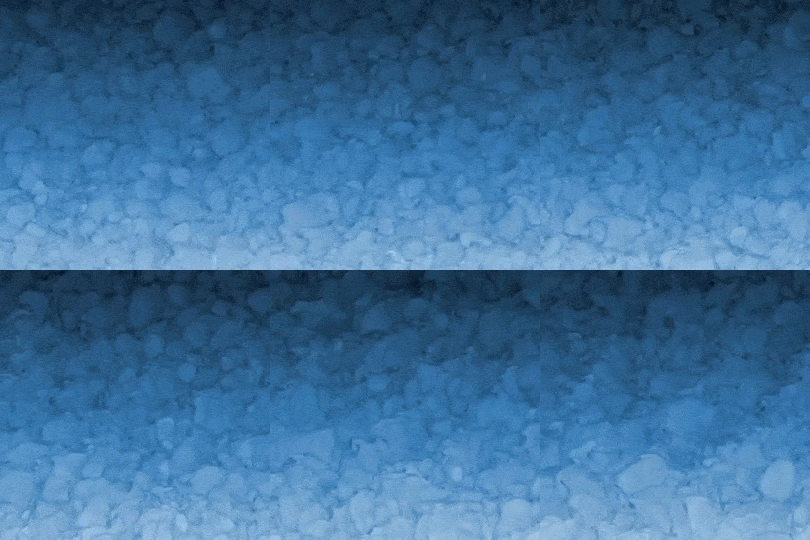
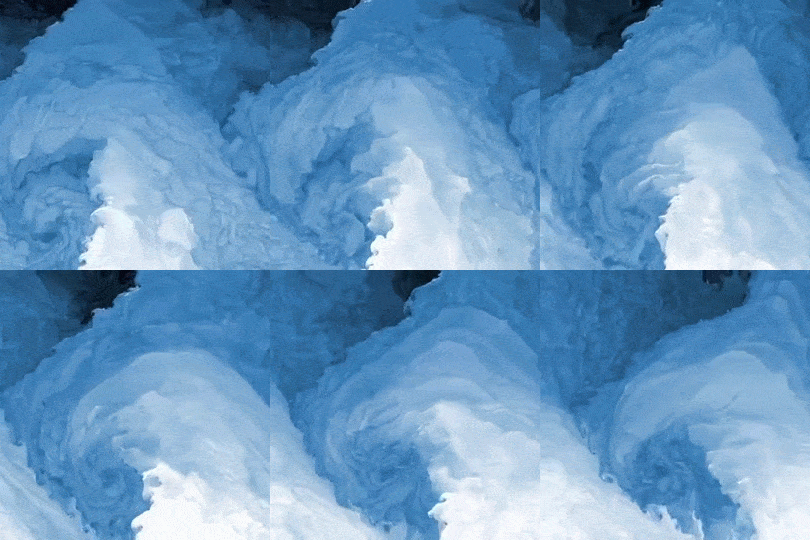
Vortex rings are endlessly fascinating, and they appear throughout nature from dolphins to volcanoes and from splashes to falling drops. One way to form them is to inject a jet into a stationary fluid. Viscosity between the fast-moving jet and the quiescent surrounding fluid slows down fluid at the jet’s edge. That slower fluid slips to the rear, only to get sucked into the faster -moving flow and pushed forward again. The result is a spinning toroid, or ring. A similar method generates vortex rings by pushing a fluid out a round orifice. In this case, interaction between the fluid and the wall provides some of the force necessary to form the vortex ring. (Image credit: Irvine Lab, source)
Tag: fluid dynamics

“Bubble Circus”
The “Bubble Circus” is a delightful outreach device equipped for all manner of physics demos, as seen in the video above. Many of its exercises explore surface tension, a force observed at the interface of a fluid. Surface tension is what provides bubbles with their surface-minimizing spherical shape. That same property determines the minimal distance between the four vertices of a pyramid (0:54). Changing the surface tension causes fluid at the interface to move. At 1:16 adding a lower surface tension fluid makes the water and black pepper pull away; the same physics drives the boat away at 2:09. For more on the Bubble Circus, see here. (Video credit: A. Echasseriau et al.; via J. Ouellette)

Flying with Large Ears
Evolution often requires compromise between competing effects. Large-eared bats, for example, rely on the size of their ears to aid their echolocation, but such large ears can hurt them aerodynamically, thus limiting their flight. Results from a recent experiment, however, suggest that large ears are not a total loss aerodynamically speaking. Researchers used particle image velocimetry to study the wakes behind free-flying, large-eared bats and found significant downward flow behind the bats’ bodies. This indicates that the bats generate some lift with their ears, body, and/or tail. The position and tilt of the ears in flight is similar to forward swept wings, which the authors suggest could help contract the wake behind the ears and reduce its negative influence on flow over the wings. Although the evidence is not yet conclusive, the study does suggest that large ears may be more aerodynamically beneficial than they appear. (Image credit: L. Johansson et al./Lund University, source; via Jalopnik)

The next FYFD webcast will be this Saturday, May 21st at 1pm EDT. My guests will be Professor Jean Hertzberg of the University of Colorado at Boulder and Professor Kate Goodman of the University of Colorado at Denver. Dr. Hertzberg is the creator of the course Flow Visualization, an interdisciplinary course combining engineering, art, and fluid dynamics. It’s a class (and website) that’s been an inspiration for me and FYFD since the early days! Dr. Goodman, an expert in engineering education, earned her PhD studying the Flow Viz course and its impact. This will be wide-ranging discussion – with everything from experimental fluid dynamics and engineering education to art, photography, and hopefully even cardiac fluid dynamics!
(Original images: P. Davis et al.; B. Moore; L. Swift et al.)

Foggy Flows
The transparency of air makes it easy to overlook its fluid nature. In this National Geographic Travel Photographer of the Year entry, photographer Thierry Bornier captures the early morning view from China’s Yellow Mountain. Foggy clouds flow around and over nearby mountain peaks, like water flowing over rocks in a stream. To see other, similar effects, check out these timelapse videos of fog in the Grand Canyon and clouds around San Francisco. (Image credit: T. Bornier; via Colossal)

Bioluminescent Plankton

The blue-outlined dolphins you see above get their glow from microorganisms called dinoflagellates. They are a type of bioluminescent plankton, shown in the lower image, that can be found in oceans around the world. Their glow comes from combining two chemicals: luciferase and luciferin. The dinoflagellates suspended in the ocean do this when they are disturbed–specifically, when the water around them transmits a shear stress above a certain threshold. Typically, this is caused by something larger–a potential predator–moving past, although it can also be stimulated by breaking waves. The higher the shear stress, the more intense the glow, but the dinoflagellates only use their bioluminescence sparingly. If you apply shear stress and keep applying it, their glow fades away without reactivating. After all, they can only produce so much chemical fuel. (Image credit: BBC from Attenborough’s Life That Glows; h/t to Gizmodo; research credit: E. Maldonado and M. Latz)

The Blue Whirl
Researchers studying the use of fire whirls to burn off oil spills have discovered a new type of fire whirl – the blue whirl. Their results are currently reported in a pre-print paper on arXiv and await peer-review. In their experiment, the scientists ignited a puddle of fuel floating atop water. Compared to a typical flame, they observed that a tightly-spinning fire whirl burns hotter and produces less soot by burning more of the fuel. To the researchers’ surprise, their lab-scale yellow fire whirl evolved into a compact, bright blue whirl. The blue whirl has a laminar flame and makes little to no noise. Its bright blue color indicates even more efficient combustion than the yellow fire whirl. The lack of yellow color means the whirl is burning without producing any soot, a by-product of incomplete combustion. The authors hope a better understanding of blue whirls will lead to better methods for responding to oil spills. (Image credit: H. Xiao et al.)
Pearls of Mezcal
Mezcal is a traditional Mexican liquor distilled from agave. (The more commonly known tequila is actually a special type of mezcal.) As a part of the production process, distillers pour a stream of mezcal into a bowl, creating a flotilla of small bubbles called pearls. Strange as it sounds, these pearls let the distiller judge the alcohol content of the liquor! When the ratio of alcohol and water in the mixture is just right, the bubbles will have a longer lifetime before they coalesce. If there’s too little or too much alcohol, the bubbles won’t last as long. The effect depends on both the viscosity and the surface tension of the liquor, but it’s the odd way that viscosity changes in water/alcohol mixtures that creates this Goldilocks behavior. It’s a fascinating demonstration of how traditional techniques often have true scientific underpinnings. (Video credit: M. Wilhelmus et al.)

Ocean Mixing
Movement in Earth’s oceans is driven by a complicated interplay of many factors like temperature, salinity, and Earth’s rotation. Above are results from a numerical simulation of the top 100 meters of ocean contained within a 1 km x 1 km box. The colors indicate surface temperature. Two major processes create the motion we see. The first is convection, in which water at the surface releases heat to the atmosphere and cools, causing it to then sink due to its greater density. Warmer water rises to replace it. This process happens quickly and dominates the early part of the simulation where we see the puffy convection cells shown on the left animation.
A slower process is in effect as well. Because of variations in the water temperature, the density of the fluid at a given depth is not constant. We can already see that at the water surface, where the temperature (and thus density) is varying significantly. Those variations in density at the same depth combined with gravity’s tendency to shift fluids create what is known as a baroclinic instability. Put simply, this instability will cause warmer water to slide horizontally past colder water. The result is the large, spinning eddy motion seen in the animation on the right. To see how the whole system develops, check out the full video below. (Image/video credit: J. Callies)

Viscous Fingers
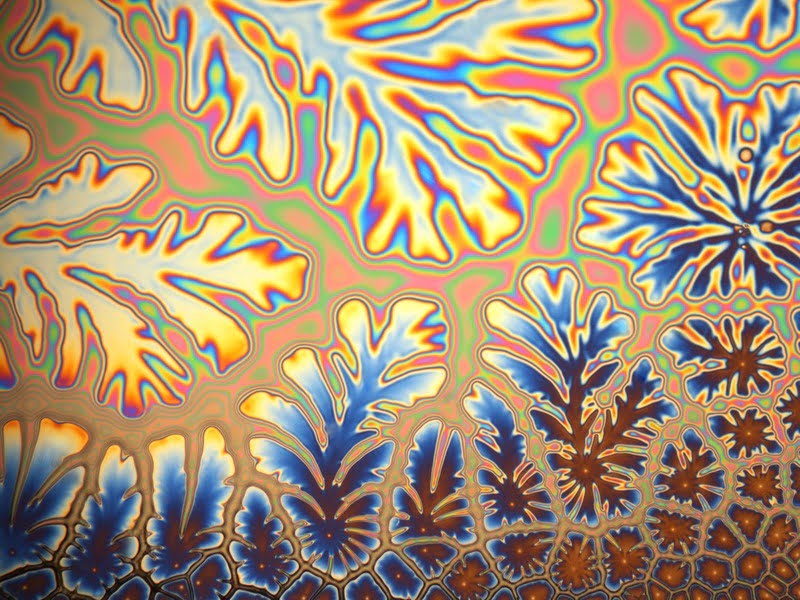
Viscous fingers form between air and titanium dioxide sol-gel in this photograph. The two fluids are trapped in a thin gap between glass plates – a set-up known as a Hele-Shaw cell. The dendritic fingers we see form when the less viscous air pushes into the more viscous sol-gel. This is an example of the Saffman-Taylor instability. The psychedelic colors are a result of thin-film interference and the way light interacts with very thin materials. The same effect is responsible for the colors on soap bubbles. (Image credit: C. Trease)
Fluids Round-Up
Time for another fluids round-up! Here are some of the best fluids-related links I’ve seen around:
– Above The Brain Scoop tells us about beetles that spend their whole lives underwater. They carry a little bubble of air with them in order to breathe!
– Microfluidics are helping reveal how cancer cells metastasize and spread through the bloodstream.
– It’s official! NASA’s going to build X-planes again.
– See how snake venom kills by changing the fluid properties of a victim’s blood. (via Gizmodo)
– Metallic foams can stop bullets and radiation, spawning many potential future uses here on Earth or in space.
– Why nature prefers hexagons, especially in honeycomb, bubbles, and foam.
– Earth has beautiful auroras, but if you could look at Jupiter with x-ray vision, you’d see something even more spectacular – a non-stop aurora that brightens on a regular schedule.
– SciShow asks where the water goes in Minnesota’s Devil’s Kettle Falls. Conservation of mass says it has to go somewhere!
And, in case you missed it, you can check out the latest FYFD video and learn more about the Brazil Nut effect over at Gizmodo.
(Video credit: The Brain Scoop)