Tag: fluid dynamics

  • Phytoplankton Flows

    Phytoplankton Flows

    Phytoplankton, tiny plant-like organisms that live in ocean waters, act like nature’s tracer particles, making visible flows that would otherwise go unnoticed. In this satellite imagery, a phytoplankton bloom in the Southern Ocean off the coast of Antarctica highlights the turbulence of this region. Strong, steady winds and currents are typical for this area, which helps drive heat exchange between the ocean and atmosphere. The swirling eddies we see – many of them 100 km across! – are evidence of that turbulence. They’re also a sign of nitrogen and other nutrients getting mixed up in the action; it’s these nutrients that help generate the bloom in the first place.  (Image credit: N. Kuring/NASA Earth Observatory)

  • Skipping Squishy Spheres

    Skipping Squishy Spheres

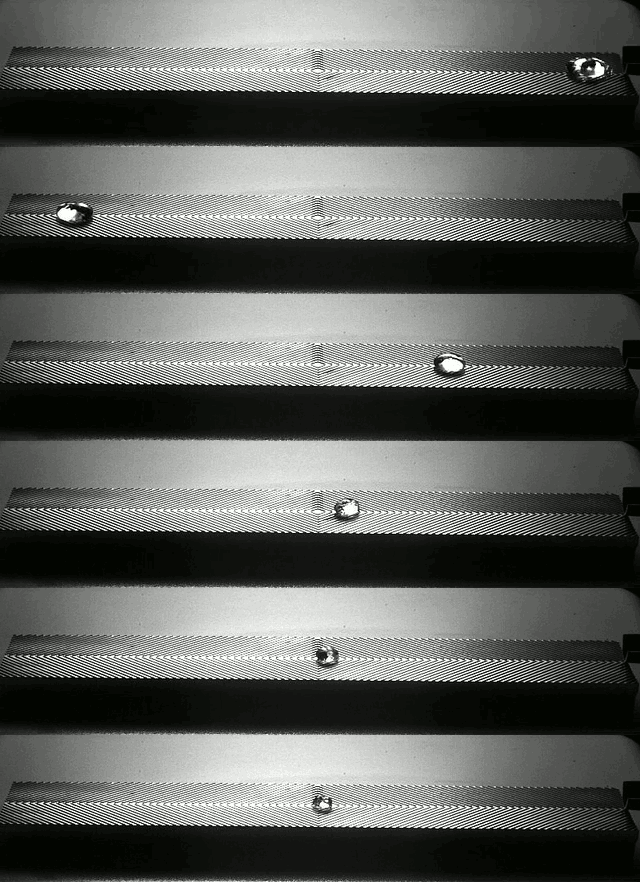
    Skipping a stone on water requires a flat, disk-like stone thrown at a shallow angle, but elastic spheres are remarkable skippers, too, even at higher impact angles. Researchers at the Splash Lab have just published their work on why these balls skip so well. As seen in the top animation, the elastic spheres deform on impact, flattening to a more disk-like shape that rides at an angle of attack relative to the air-water interface. Both features are important to the spheres’ enhanced skipping. By flattening, the sphere comes into greater contact with the water and by orienting at a larger angle of attack, the sphere increases the vertical component of force the water generates on the sphere. It’s this vertical force that lifts the sphere up and lets it keep bouncing.

    Because the ball is soft, it keeps deforming after its impact and bounce (see top animation). For some skips, the timescale of the sphere’s elastic waves is smaller than the length of time the sphere is in contact with the water. When this is the case, the sphere’s elastic waves will affect the impact cavity in the water, forming what the researchers call a

    matryoshka cavity, after the Russian nesting dolls. An example is shown in the second animation. For more, check out the USU press releasethe original paper, or the award-winning video they made a few years ago.  (Image credits: J. Belden et al./The Splash Lab)

    If you enjoy FYFD and want to help support it, please consider becoming a patron!

  • Featured Video Play Icon

    Fluids Round-up

    Here’s to another fluids round-up, our look at some of the interesting fluids-related stories around the web:

    – Above is a music video by Roman Hill that relies on mixing and merging different fluids and perturbing ferrofluids for its visuals as it re-imagines the genesis of life.

    – GoPro takes viewers inside a Category 5 typhoon with 112 mph (180 kph; 50 m/s) winds.

    – Astronaut Scott Kelly demonstrates playing ping pong with a ball of water in space. (via Gizmodo)

    – See fluid dynamics on a global scale with Glittering Blue. (via The Atlantic)

    – To make a taller siphon, you have to find a way to avoid cavitation.

    – Speaking of siphons, Randall Munroe tackles the question of siphoning water from Europa over at What If? (submitted by jshoer)

    – The Mythbusters make a giant tanker implode using air pressure.

    – Sixty Symbols explores how tiny things swim.

    – What happens when you bathe in 500 pounds of putty? Let’s just say that bathing in an extremely viscous non-Newtonian fluid is not recommended. (via Gizmodo)

    (Video credit and submission: R. Hill et al.)

    Don’t forget to check out our Patreon page. Please help support FYFD by becoming a patron. 

  • Featured Video Play Icon

    Ode to Bubbles

    Boiling water plays a major role in the steam cycles we use to generate power. One of the challenges in these systems is that it’s hard to control the rate of bubble formation when boiling. In this video, researchers demonstrate their new method for bubble control in a clever and amusing fashion. The twin keys to their success are surfactants and electricity. Surfactant molecules, like soap, have both a polar (hydrophilic) end and a non-polar (hydrophobic) end. By applying an electric field at the metal surface, the researchers can attract or repel surfactant molecules from the wall, making it either hydrophobic or hydrophilic depending on the field’s polarity. Since hydrophobic surfaces have a high rate of bubble formation, this lets the scientists essentially turn nucleation on and off with the flip of a switch! (Video credit: MIT Device Research Lab; see also: research paperMIT News Video, press release)

    Do you enjoy FYFD and want to help support it? Then please consider becoming a patron!

  • Pancake Ice in the Sea

    Pancake Ice in the Sea

    Sea ice forms in patterns that depend on local ocean conditions. Pancake ice, like that shown in the above photo from the Antarctic Ross Sea, is formed in rough ocean conditions. Each individual pancake has a raised ridge along its edge, due to wave-induced collisions with other pieces of ice. Over time the smaller pieces of ice will merge together, forming large sheets. Evidence of its turbulent formation will persist, however, in the rough surface of the ice’s underside. For more, check out the National Snow and Ice Data Center. (Image credit: S. Edmonds; via Flow Visualization)

    Do you enjoy FYFD and want to help support it? Then please consider becoming a patron!

    Reminder: If you’re at the University of Illinois at Urbana-Champaign, I’m giving a seminar this afternoon. Not in Illinois? I’ve got other events coming up, too!

  • Featured Video Play Icon

    Wave Clouds

    In this video, Sixty Symbols tackles the physics of wave clouds. When air flows over an obstacle like a mountain, the air can begin to oscillate downstream, forming what is known as a lee wave. As the air bobs up and down, it will cool or warm according to its altitude. At cooler conditions, if the air is moist, it can condense into a cloud at the peak of its oscillation. If you observe this behavior over time, you get what appear to be regularly-spaced stripes of clouds. This is actually a pretty common phenomenon to see, depending on where you live. It’s an example of internal waves in the atmosphere.  (Video credit: Sixty Symbols)

    Do you enjoy FYFD and want to help support it? Then please considering becoming a patron!

    Reminder: If you’re at the University of Illinois at Urbana-Champaign, I’m giving a seminar tomorrow afternoon. Not in Illinois? I’ve got other events coming up, too!

  • Pouring Molten Aluminum on Dry Ice

    Pouring Molten Aluminum on Dry Ice

    What happens when you pour molten aluminum on dry ice? As the Backyard Scientist shows, you get what looks like slippery, sliding, boiling metal. In fact, what you see may remind you of the Leidenfrost effect, where a liquid can slide around over an extremely hot surface on a thin film of its own vapor. Despite the opposite temperature extremes–this is a very cold surface rather than a very hot one–a very similar thing is happening here. The molten aluminum is so much hotter than the dry ice that it causes the dry ice to sublimate, releasing gaseous carbon dioxide that the aluminum slides around on. For the same reason, the aluminum appears to boil in the bottom animation. What we’re really seeing is carbon dioxide gas rising and escaping the aluminum so violently that it carries some of the metal with it. Be sure to check out the full video for more awesome physics!  (Image credit: The Backyard Scientist, source; via Gizmodo)

    Do you enjoy FYFD and want to help support it? Then please consider becoming a patron!

  • Meander from Above

    Meander from Above

    This photo of the Amazon River taken by Astronaut Tim Kopra reveals the many meandering changes of the river’s course. Left untouched by human intervention, rivers tend to get more curvy, or sinuous, over time, simply due to fluid dynamics. Imagine a single bend in a river. Due to conservation of angular momentum, water flows faster around the inside curve of the bend than the outside – just like an ice skater spins faster with her arms pulled in. From Bernoulli’s principle, we know there is an accompanying pressure gradient caused by this velocity difference – with higher pressure near the outer bank and lower pressure on the inner one. This pressure gradient is what guides the water around the bend, keeping the bulk of the fluid moving downstream rather than bending toward either bank.

    At the bottom of the river, though, viscosity slows the water down due to the influence of the ground. This slower water, still subject to the same pressure gradient as the rest of the river, cannot maintain its course going downstream. Instead, it gets pushed from the outer bank toward the inner bank in what’s known as a secondary flow. This secondary flow carries sediment away from the outer bank and deposits it on the inner bank, which, over time, makes the river bend more and more pronounced. (Image credit: T. Kopra/NASA; submitted by jshoer)

    Do you enjoy FYFD and want to help support it? Then please consider becoming a patron!

  • Underwater Landslides

    Underwater Landslides

    Turbidity currents are a gravity-driven, sediment-laden flow, like a landslide or avalanche that occurs underwater. They are extremely turbulent flows with a well-defined leading edge, called a head. Turbidity currents are often triggered by earthquakes, which shake loose sediments previously deposited in underwater mountains and canyons. Once suspended, these sediments make the fluid denser than surrounding water, causing the turbidity current to flow downhill until its energy is expended and its sediment settles to form a turbidite deposit. By sampling cores from the seafloor, scientists studying turbidites can determine when and where magnitude 8+ earthquakes have occurred over the past 12,000+ years!  (Video credit: A. Teijen et al.; submitted by Simon H.)

    Do you enjoy FYFD and want to help support it? Then please consider becoming a patron!

  • Featured Video Play Icon

    Help Support FYFD on Patreon

    tl;dr version: FYFD is launching a Patreon campaign. If you enjoy FYFD and want to help support its continued growth, please become a patron today!

    And the longer version: At the start of the year, I hinted that there were big things ahead for FYFD. Today’s announcement is part of that. In the past five years, FYFD has grown beyond my wildest dreams. I’m so excited, grateful, and happy to share my love for science with all of you. As FYFD’s audience has grown, so have my plans and dreams for expanding the site and what it does. I want to bring you more: videos that take you behind-the-scenes to see the scientific process firsthand, interviews that let you meet the people behind the work, and articles that explore new and exciting fluid phenomena.

    All of the research, filming, writing, and editing necessary to bring those dreams to life takes time and money. I can provide the first: from now on, I’ll be dedicating my full-time attention to FYFD. But I need your help and support to make this possible. That’s why I’m launching a campaign on Patreon. If you enjoy FYFD and want to help it continue and grow, please consider becoming a patron. Your monthly support will enable me to dedicate my full energy to FYFD and will provide funding for materials, equipment, and travel so that I can bring the science back to you.

    There are also some pretty cool rewards available to patrons! All patrons will have access to a patrons-only activity feed where I post behind-the-scenes content and extras like video outtakes. It’s also a place where I’ll look for feedback on new ideas. Think of it as an extra dose of FYFD. Other rewards include getting your name added to the FYFD supporter page, getting a handwritten postcard from me, and access to a monthly webcast where I’ll chat with guest scientists and patrons. (I’m really excited about that last one!)

    Whether you become a patron or not, I want to thank you for your support. None of those would be possible without you and your enthusiasm. As always, the best thing you can do to support FYFD is to tell others how much you like it. Thank you!

    If you have any questions, I’ll be online all day. You can reach me via Tumblr, Twitter, or email.