Tag: experimental fluid dynamics

  • Robotic Research Facilities

    Robotic Research Facilities

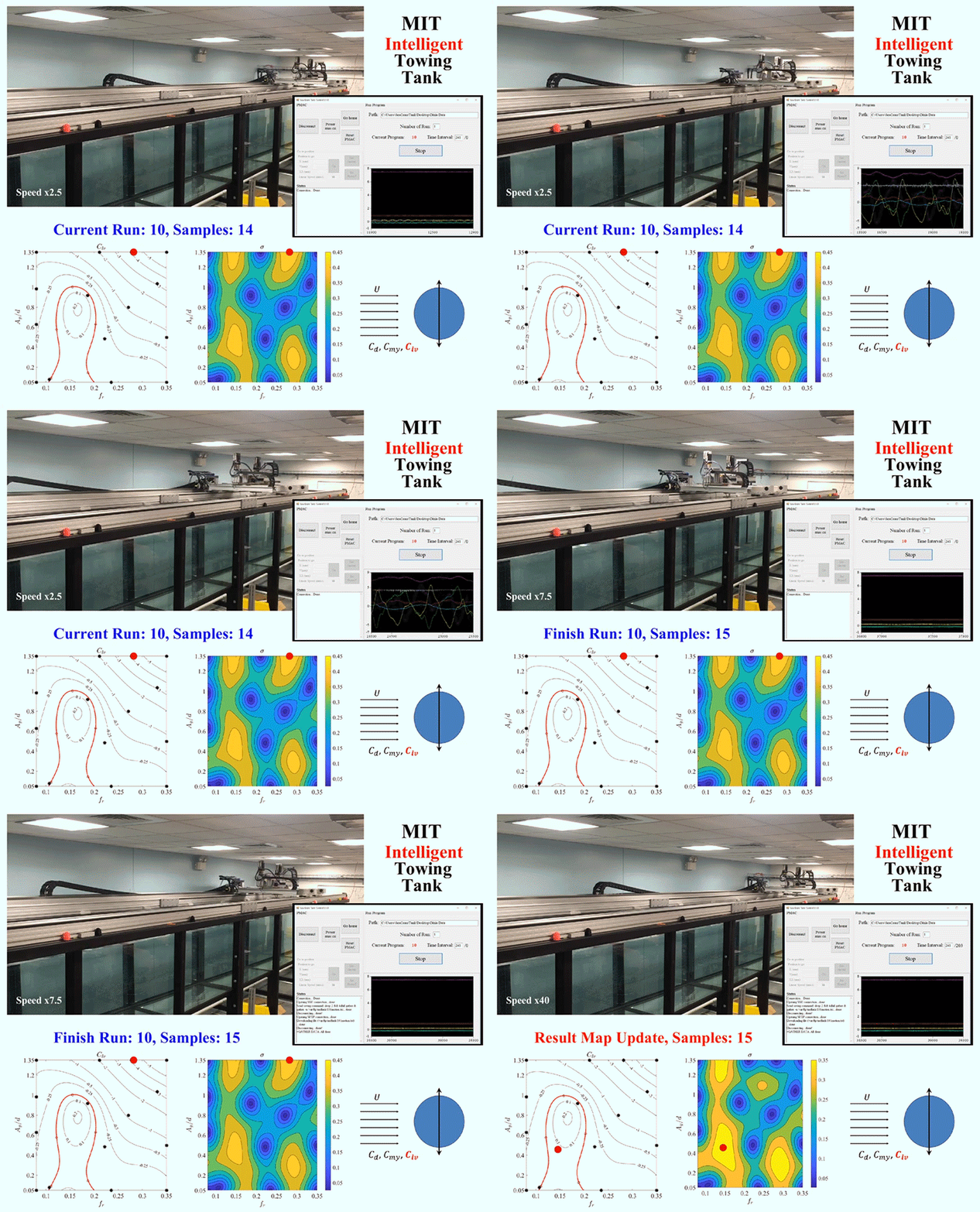
    One of the major challenges in fluid dynamics is the size of the parameter spaces we have to explore. Because many problems in fluid dynamics are non-linear, making small changes in the initial set-up can result in large differences in the results. Consider, for example, a simple cylinder towed through a water tank. As the cylinder moves, vortices will form around it and shed off the back, causing the cylinder to vibrate. The details of what will happen will depend on variables like the cylinder’s size and flexibility, the speed it’s being towed at, and which directions it’s allowed to vibrate in. Mapping out the parameter space, even sparsely, could take a graduate student hundreds of experiments.

    To speed up this process, engineers are now building robotic facilities like the Intelligent Towing Tank (ITT) shown above. Like graduate students, the ITT can work into the wee hours of the night, but, unlike graduate students, it never needs to eat, sleep, or stop experimenting. Now, one could use a facility like this to brute-force the answers by testing every possible combination of parameters, but even working 24 hours a day, that would take a long time. Instead, researchers use machine learning to guide the robotic facility into choosing test parameters in a way that optimizes the factors the researchers define as important.

    Essentially, the system starts with experiments chosen at random within the parameter space, and then uses those results to select areas of interest until it’s gathered enough data to satisfy the limits specified by human researchers. In theory, a well-designed algorithm can dramatically reduce the number of experiments needed to explore a parameter space. (Image and research credit: D. Fan et al.; submitted by Kam-Yung Soh)

  • Flow on Commercial Wings

    Flow on Commercial Wings

    Even in an era of supercomputers, there is a place for quick and dirty methods of flow visualization. Here we see a model of a swept wing like those seen on many commercial airliners. It was painted with a layer of fluorescent oil, then placed in a wind tunnel and subjected to flow. As air blows across the model, it moves the oil, leaving behind streaks that show how air near the surface moves. 

    We can see, for example, that near the fuselage, the air flows mostly front to back across the wing. That’s what we expect, especially for a wing generating lift. But further out on the wing, the flow moves mostly along the wing, not across it. There’s also a distinctive line running just a short ways behind the leading edge on this outer section of wing. It looks as though air flowing over the wing separated at this point, leaving disordered and unhelpful flow behind. It’s likely that the model was tested at an angle of attack where the outer section of the wing was beginning to stall. (Image credit: ARA)

  • Featured Video Play Icon

    Driving Instabilities with a Twist

    Imagine that you want to study how two fluids mix when a lighter fluid is pushed into a denser one. Conceptually, it’s a straightforward situation. It would be like having a layer of oil under a layer of water and watching what happens. But how do you do that experimentally? Oil won’t naturally stay under water. If you flip the container over to start the experiment, you’ve added a bunch of extra motion from the rotation. And if you use a barrier to separate the two layers and then pull it out, you’ve added extra shear where they meet.

    To deal with challenges like these, researchers at Lehigh University spent five years designing and building the rotating wheel apparatus you see in the video above. Instead of relying on gravity to force the lighter fluid into a denser one, this set-up uses centrifugal force. The test fluids start out on the loading wheel, spinning in their naturally stable configuration. Then once both sides are rotating at the desired speed, the track flips, transferring the experiment onto the other wheel, which rotates in the opposite sense. This gives the fluids a sudden change in the direction of the centrifugal force and, once the apparatus completes shake-down, should give us new insight into the sort of mixing seen in fusion. (Video credit: Lehigh University; see also Turbulent Flow Design Group)

  • Featured Video Play Icon

    Calimero’s Uprising!

    Here on FYFD posts often focus on research results, with animations and images showing only a tiny portion of the apparatus necessary to conduct that work. But in this timelapse, we get to see a glimpse of what it takes to make the research happen. The video covers a 12-week period in which student Sietze Oostveen sets up, modifies, and takes measurements with a rotating tank apparatus called Calimero. 

    The video captions give you a sense of all the little tasks that go into experimental work, from installing thermal control and measurement systems (in this case, laser Doppler velocimetry, or LDV) to making sure that the rotating table is balanced correctly. In experimental work, it’s worth remembering that you’ll likely spend as much or more time preparing to take data than you will actually doing measurements! (Video credit: S. Oostveen/UCLA Spinlab)

  • Astrophysical Turbulence

    Astrophysical Turbulence

    Subsonic turbulence – like the random and chaotic motions of air and water in our everyday lives – is something we have only a limited understanding of. Our knowledge of supersonic turbulence, where shock waves and compressibility rule, is even more tenuous. In part this is because, although we can observe snapshots of supersonic turbulence in astronomical settings like the Orion Nebula shown above, we cannot watch it evolve. On these scales, features simply don’t change appreciably on human timescales.

    This has limited scientists to mostly numerical and theoretical studies of supersonic turbulence, but that is starting to change. Researchers are now building experimental set-ups that collide laser-driven plasma jets to generate boundary-free turbulence at Mach 6. Thus far, the observations are consistent with what’s been seen in nature: at low speeds, the turbulence is consistent with Kolmogorov’s theories, with energy cascading from large scales to smaller ones predictably. But as the Mach number increases, the nature of the turbulence shifts, moving toward the large density fluctuations seen in nebulae and other astrophysical realms. (Image credit: F. Battistella; research credit: T. White et al.; see also Nature Astronomy; submitted by Kam-Yung Soh)

  • Featured Video Play Icon

    Mimicking Hurricanes

    Hurricanes are a frequent and potentially deadly occurrence for many parts of the world. Although forecasting models have improved, there is still a lot about the physics of these storms that we don’t fully understand, in part because getting direct measurements from the real thing is so difficult and hazardous. Researchers at the University of Miami have instead built their own hurricane generator, capable of sustained 200 mph winds – strong enough to create Category 5 hurricane conditions. In this facility, they can study details of the storm up close, allowing them to distinguish effects from the scale of large waves down to the physics of the sea spray. Learn more and see the facility in action in the Science Friday video below. (Video credit: L. Groskin/Science Friday; image credits: L. Groskin/Science Friday, University of Miami, SUSTAIN Lab; submitted by Guillaume D.)

  • Mixing Fresh and Salty

    Mixing Fresh and Salty

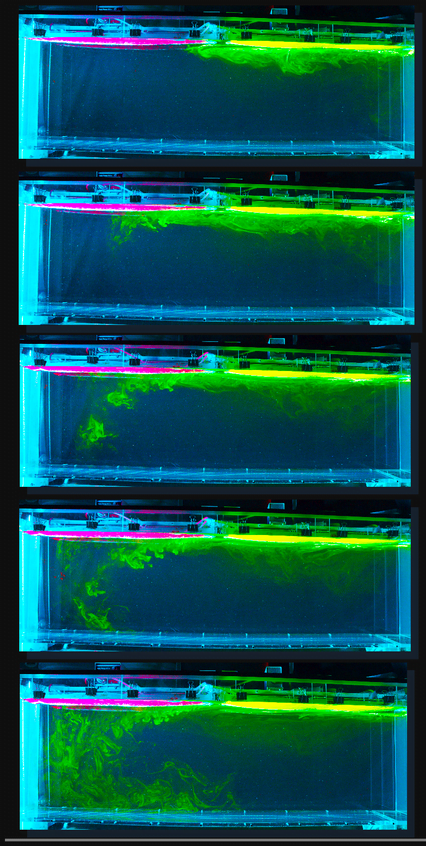
    Earth’s oceans are a complex and dynamic environment, but fortunately, we can simulate some of their physics on a smaller scale in the laboratory. The time series of images above show how fresh and salty waters mix. On the right side of the image is fresh water with its top layer dyed green. On the left is salty water dyed pink. Initially, the fresh water spreads horizontally toward the salty region in a smooth and laminar fashion. As the fresh water picks up salt, it gets denser and starts sinking, ultimately forming a turbulent plume that will push all the way back across the tank. For more images, check out the full poster. (Image credit: P. Passaggia et al.)

  • Featured Video Play Icon

    Researching Wind Turbines

    Two of the most awesome things (in my admittedly biased opinion) about fluid dynamics are the amazing facilities we build for experiments and the tests they allow us to do. In this video, you get a behind-the-scenes look at one such facility, used for wind turbine research at Princeton.

    One challenge of wind turbine research is accurately capturing the aerodynamic effects of full-scale wind turbines in the controlled-environment of a laboratory. At Princeton, they match conditions between their model turbines and the real ones by drastically raising the density in their wind tunnel. This means that running the tunnel requires a series of compressors and storage tanks full of compressed air, and it also means that the wind tunnel itself has to be quite hefty to handle the pressure difference inside and out. Definitely check out the full video for more on their wind tunnel and what it can help them learn about wind turbines. (Video credit: M. Miller and J. Keifer; submitted by M. Miller)

  • Featured Video Play Icon

    Quantum Droplets

    Over the past decade, fluid dynamicists have been investigating tiny droplets bouncing on a vibrating fluid. This seemingly simple experiment has remarkable depth, including the ability to recreate quantum behaviors in a classical system. In this video, some of the researchers demonstrate their experimental techniques, including how they vary the frame rate relative to the bouncing of the drops. At the right frame rate, this sampling makes the droplets appear to glide along with their ripples, giving us a look at a system that is simultaneously a particle (drop) and wave (ripple). (Video credit: D. Harris et al.)

  • Rio 2016: Whitewater Sports

    Rio 2016: Whitewater Sports

    The whitewater rapids of canoe slalom have their origins in mountain streams. Today the sport’s Olympic venues are artificial rivers, specially designed to provide world-class rapids whatever the geography of the host city. Rio’s course, like London’s, is reconfigurable; its features are controlled by the placement of Lego-like plastic blocks.

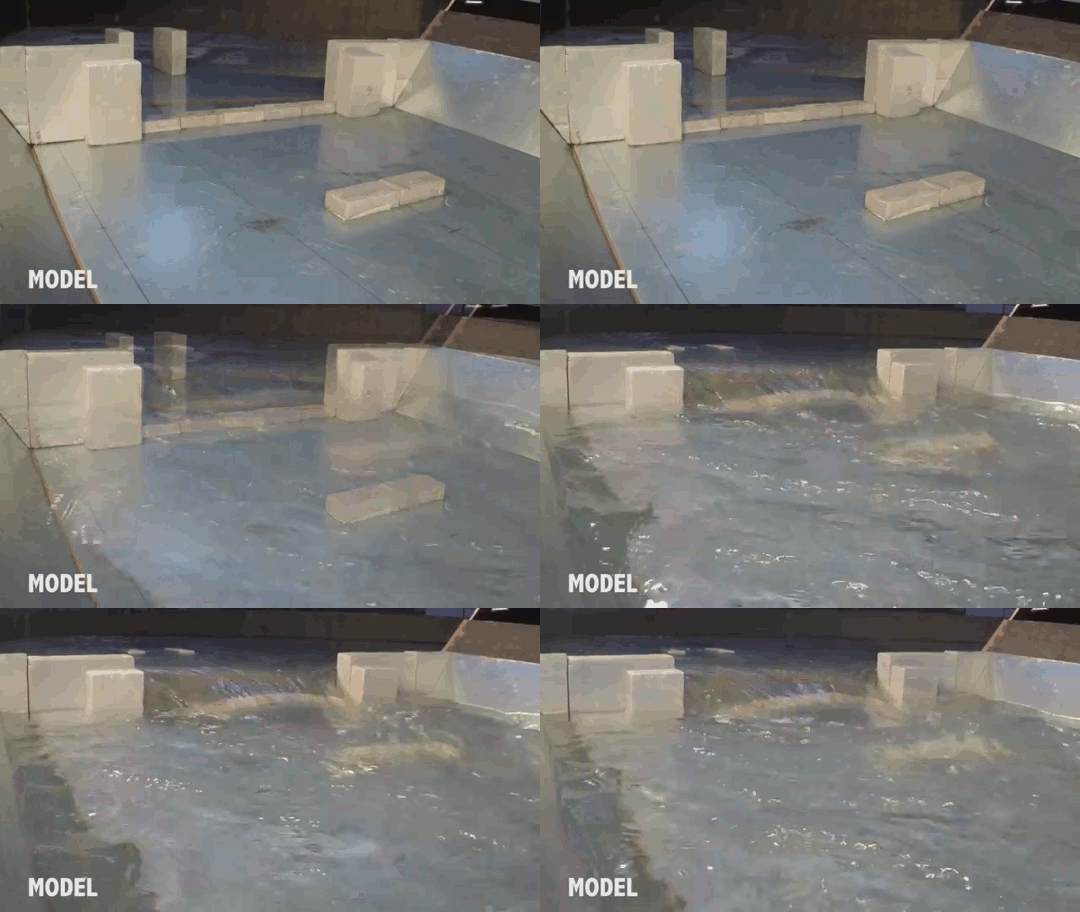
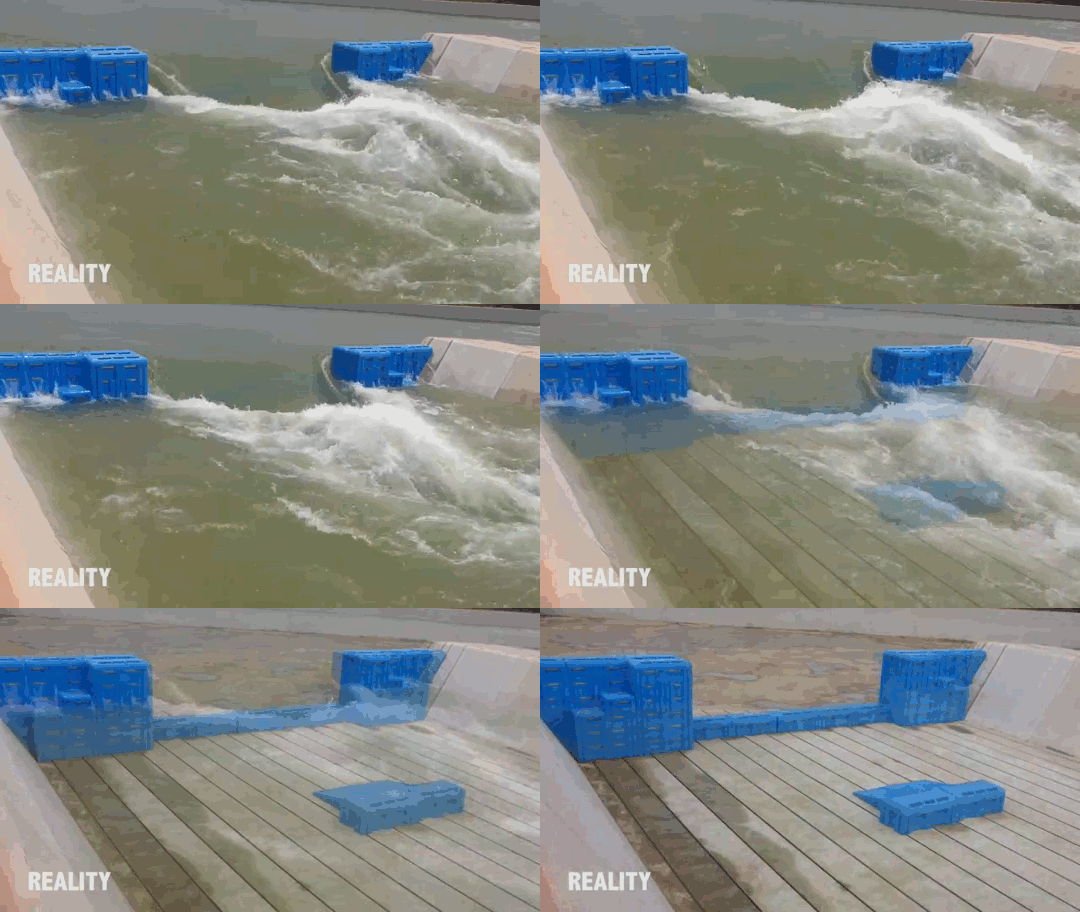
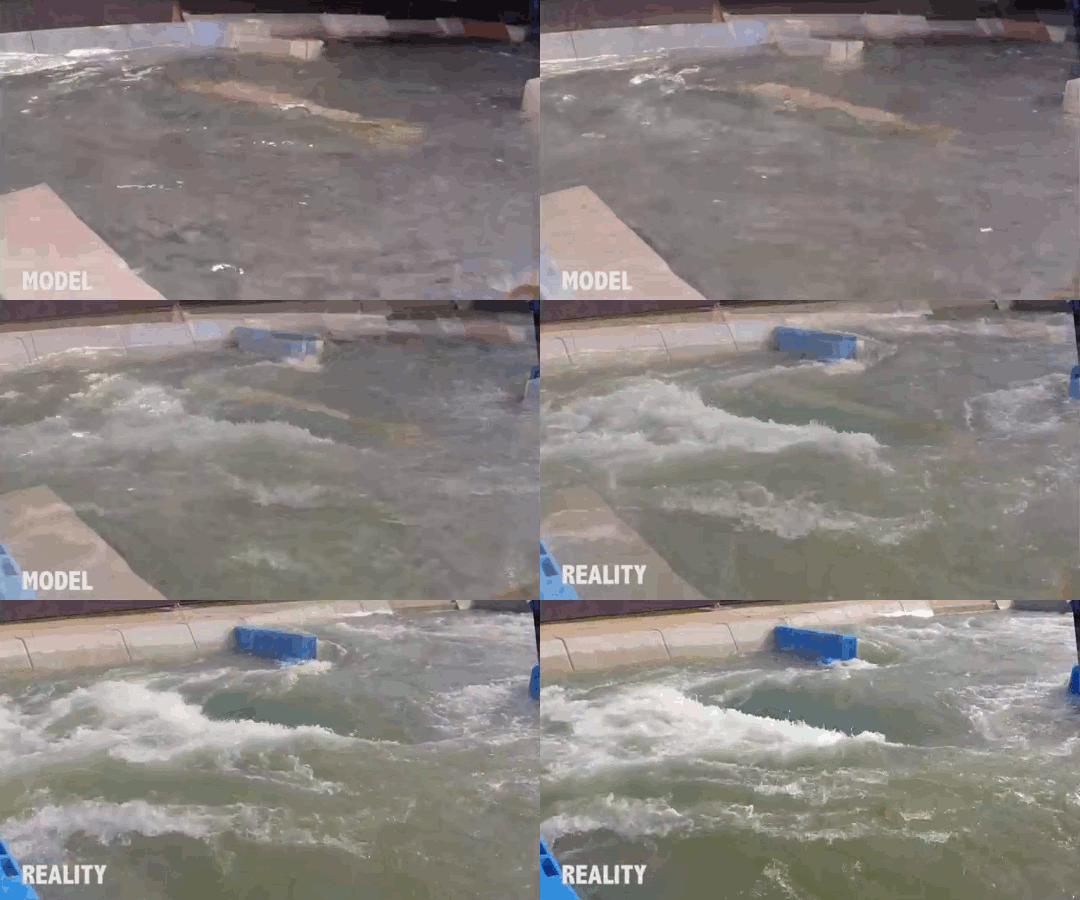
    A key part of the course’s design process was building a small-scale physical model of the course. To maintain the dynamics of the rapids at a smaller physical scale, engineers used a concept called similitude. Surface waves like rapids are a function of the flow’s inertia and the effects of gravity, a ratio that’s captured in the dimensionless Froude number. To match the small-scale model to the real flow, engineers scaled the features of the real course down such that the Froude number stayed the same between the model and the full-scale course. As seen in the animations above, this meant that the model had the same general flow features as the final course, letting engineers and designers test and fine-tune features before construction. Learn more about the model and its construction in these two videos. (Image credits: kayaker – Getty Images; model comparisons – J. Pollert, source)

    Previously: Physics of rowingwhy that octopus kite looks so real

    Join us throughout the Rio Olympics for more fluid dynamics in sports. If you love FYFD, please help support the site!