A river’s flow constantly changes its underlying bed. The rocks and particulates beneath a flowing river can typically be divided into two zones: an upper layer called the bed-load zone where the flow moves particles with it and a lower layer where particles are mostly trapped but may creep over long periods. In gravelly river-beds this upper bed-load zone tends to accumulate more large particles, a phenomenon known as armoring. Experiments show that, in this region, large particles have a net vertical velocity moving upward, while smaller particles tend to move downward. Exactly why large particles are more prevalent in the bed-load zone in unknown; several theories have been offered. One suggests that the size segregation is similar to the Brazil nut effect and that smaller particles have a tendency to fall into gaps and sink more easily than larger ones. (Image and research credit: B. Ferdowsi et al., source)
Tag: erosion

Plate Tectonics
We don’t typically think of the ground beneath our feet as anything but solid, but over geologically long time scales, even mountains can flow. Buoyant convection inside the Earth’s mantle is thought to drive the plate tectonics that have shaped the Earth as we know it. The video above explains some of the major processes and events that shaped the modern North American continent, including collisions, subduction, volcanism, and erosion. (Video credit: Ted-Ed)

Surge Flows
Sandy beaches can be a great place to play with neat flows. In a recent video, Frank Howarth describes playing with beach rivers on the Oregon coast and observing a surge flow there. Under the right conditions, a current flowing over sand will build up sand ripples large enough that they form miniature dams in the flow. This traps additional water, which eventually collapses the sand ripples, releasing a surge of water. The surge tends to smooth out the sand and cause the ripple-making process to start over. It’s a fairly unusual phenomenon, but it’s one known to happen seasonally in a few specific places, like at Medano Creek in Colorado’s Great Sand Dunes National Park. There the snowmelt-fed creek surges during the late spring and early summer, releasing a fresh wave every 20 seconds or so. (Image credit: F. Howarth, source; h/t to Sebastian E.)

Flow Around a Cylinder
A cylinder standing upright in a flow creates a complicated system of vortices and recirculation. In the photo above, the flow is left to right. The cylinder itself is somewhat hard to see but is located in the center of the image; we see it from above. The colored streaks of dye show the flow path around the cylinder. In yellow, we see a spiraling vortex that forms just ahead of the cylinder and stretches downstream on either side. Because of its shape, this is called a horseshoe vortex. Its sense of rotation is such that it tends to pick up loose material in front of the cylinder; in other words, it can erode that area. This is often seen around the pilings of bridge supports and must be accounted for in designs. You also see the effects of this horseshoe vortex digging out material at the base of trees after snowfalls in areas with a dominant wind direction, and here’s an example with a snow roller. (Image credit: H. Werlé; via eFluids)

Glacial Remains
The high walls of this alpine canyon were cut by flowing glacial ice. This type of amphitheater-shaped valley is known as a cirque. The photo shows one of the Chicago Lakes on Mount Evans in the Colorado Rockies. The glacier that once sat here carved the steep walls you see in the background but also hollowed out a series of depressions like the ones shown in the figure below. When temperatures warmed and the glacier melted, it left behind a series of three small lakes, or tarns, like the one in the photo above. Cirques are found throughout the mountain ranges of the world. (Image credit: Mt. Evans – J. Shoer; cirque formation – DooFi)


The Japanese Pufferfish
[original media no longer available]
If you’ve ever dived or snorkeled over a sandy lake or ocean bottom, you’ve probably seen some neat patterns there. But it’s hard to compete with the Japanese pufferfish for pure artistry. This small fish creates enormous and elaborate designs in the sand in order to attract a mate. The male fish moves the sand into place by flapping his fins very close to the surface. Above a critical flapping velocity, his fins generate vortices capable of picking up sand, as seen below. With repeated passes, the fish is able to excavate the trough that is key to his creation. It’s a constant fight against the current, though.
Puffers aren’t the only ones who flap their fins to move the sands. Rays and flounders use this technique to bury themselves and hide (Video credit: BBC Earth; image credit: A. Sauret, source; research credit: A. Sauret et al.)

Eroding Candy


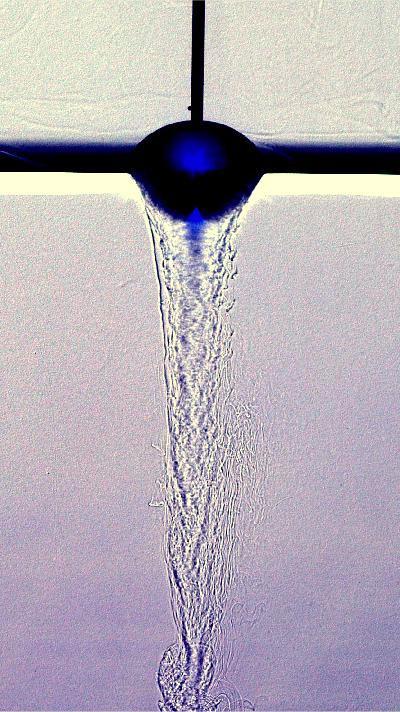
When you pop a hard candy in your mouth, you probably don’t give much thought to the fluid dynamics involved in dissolving it. The series above shows a hard candy suspended in water being slowly eaten away. As sugars in the candy dissolve into the water, the fluid becomes denser and falls away. This creates the downward flow visible in the center of the image. As sugar-laden water sinks, fresher water is pulled in alongside the walls of the candy. That flow helps erode the candy, creating a rougher surface. Since rough surfaces have a greater surface area exposed (than a smooth surface), they prompt further and faster dissolution. That strengthens the downward flow, pulls in more ambient water, and keeps the whole process going. (Image credit: M. Wykes)

Beach Cusps
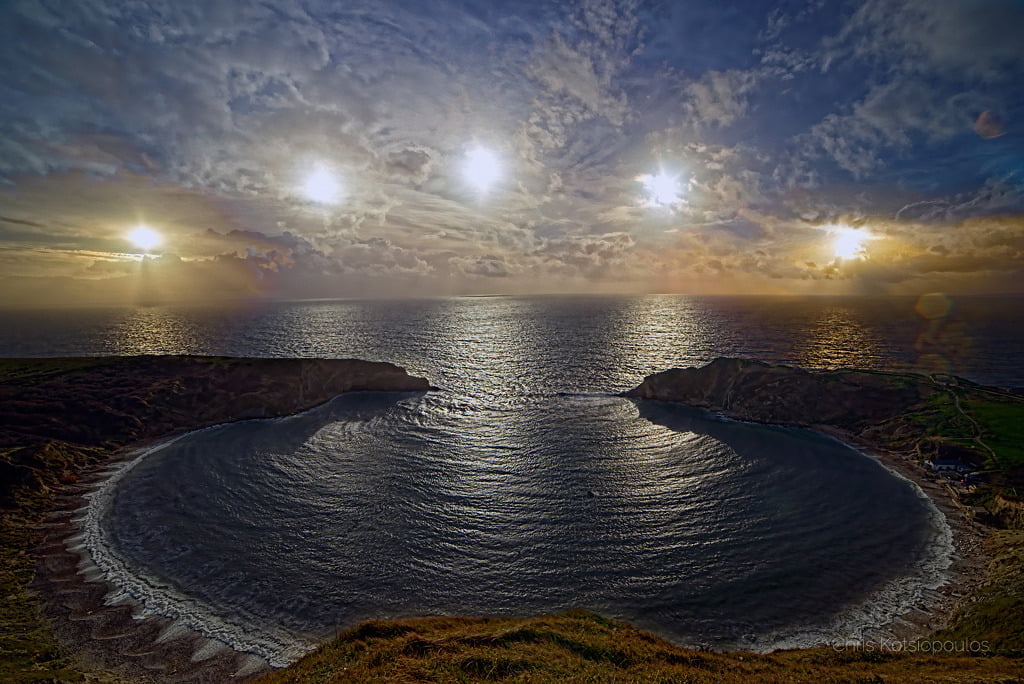
This composite photo shows the arc of the sun over Lulworth Cove in England during the December solstice. The low sun angle reveals a distinctive circular diffraction pattern of waves inside the cove. Along the shoreline, the beach has eroded into a regular, arc-like pattern known as beach cusps. Although there are multiple theories about how cusps form, their pattern is self-sustaining. They consist of a horn of coarse materials that projects into the water and an arc of finer sediments called an embayment. When incoming waves hit the horn, they slow down, depositing heavier coarse sediment on the horn while lighter, fine particles are carried further ashore. (Image credit: C. Kotsiopoulos; via APOD; submitted by jshoer)
Hiding in the Sand
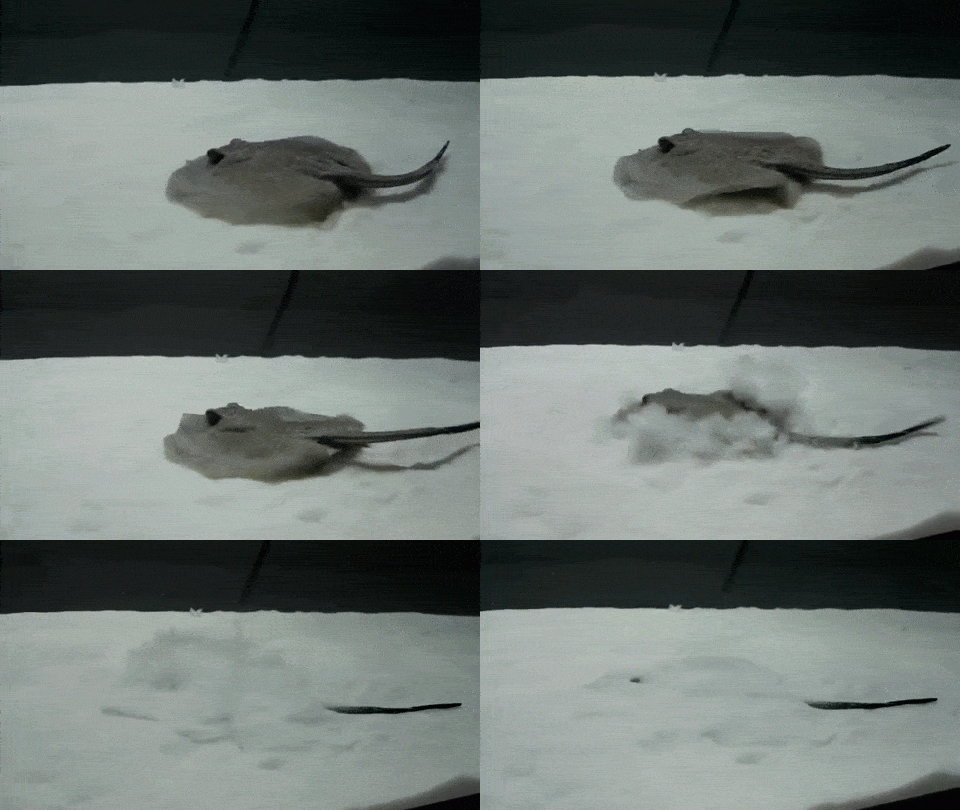


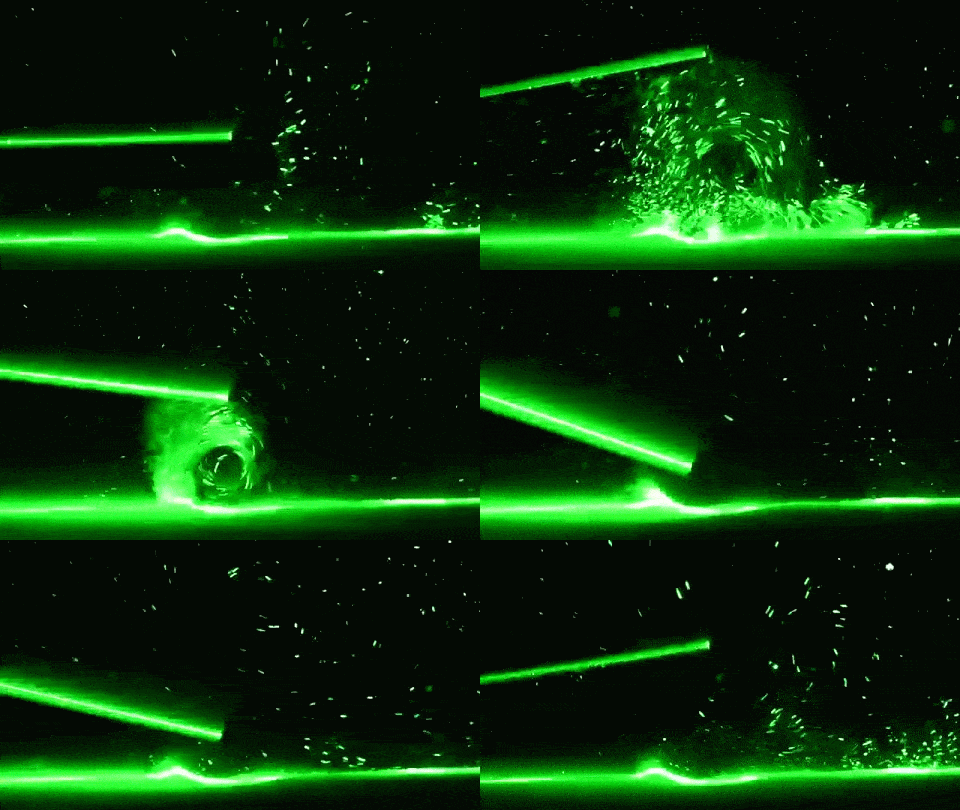
Flounders, stingrays, and other flat, bottom-dwelling fish often hide under sand for protection. These fish move by oscillating their fins or the edge of their bodies. They use a similar mechanism to bury themselves–quickly flapping to resuspend a cloud of particles, then hitting the ground so that the sand settles down to cover them. Researchers have been investigating this process by oscillating rigid and flexible plates and observing the resulting flow. When the flapping motion exceeds a critical velocity, the vortex that forms at the plate’s edge is strong enough to pick up sand particles. Understanding and controlling how and when these vortex motions kick up particles is useful beyond the ocean floor, too. Helicopters are often unable to land safely in sandy environments because of the particles their rotors lift up, and this work could help mitigate that problem. (Image credits: TylersAquariums, source; Richmondreefer, source; A. Sauret, source; research credit: A. Sauret et al.)

Icebergs and Caramel
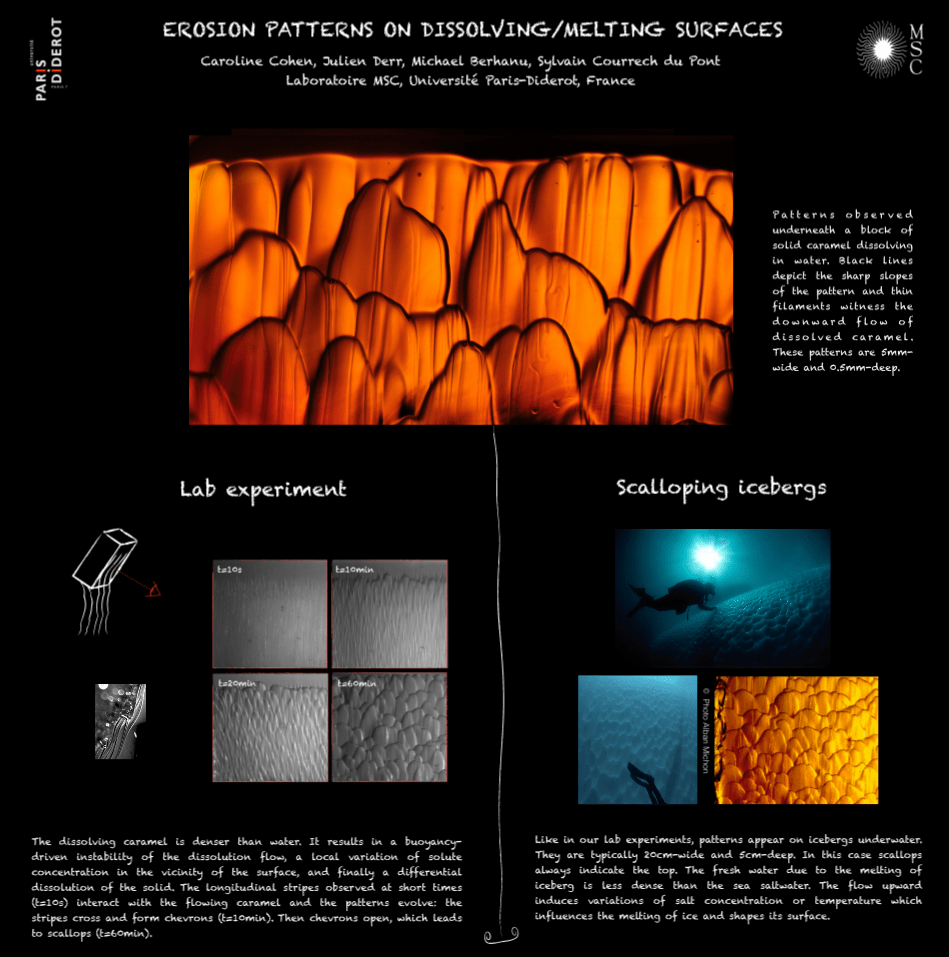
What do icebergs and caramel have in common? Both have similar scalloped erosion patterns as they dissolve. When caramel dissolves in water, the denser caramel sinks in the buoyant water. An initially smooth surface will first form lines, then the flowing caramel and the uneven surface interact, forming chevrons, followed by larger scallops. A similar process happens with melting icebergs. The meltwater from an iceberg is less dense than the surrounding seawater, so it will rise as it melts. This causes variations in the salt concentration and temperature near the iceberg, which cause it to melt differently in different spots, ultimately leading to the same scallop shapes observed in the caramel. Check out the full-size PDF of the poster here. (Image credit: C. Cohen et al.)