The Grand Canyon is a monument to the power of water, air, and time. In this video from It’s Okay To Be Smart, Joe Hanson describes the formation of the Grand Canyon – from the ancient oceans that created its many layers to the tectonic upthrusts that eventually created the Colorado River that continues to cut through the Canyon’s rocks today. Fluid dynamics play a major role in the geology of the Grand Canyon, whether it’s in the mantle convection that helps drive plate tectonics or the sedimentation that builds and erodes rock layers. (Video credit: It’s Okay To Be Smart)
Tag: erosion

Martian Barchans
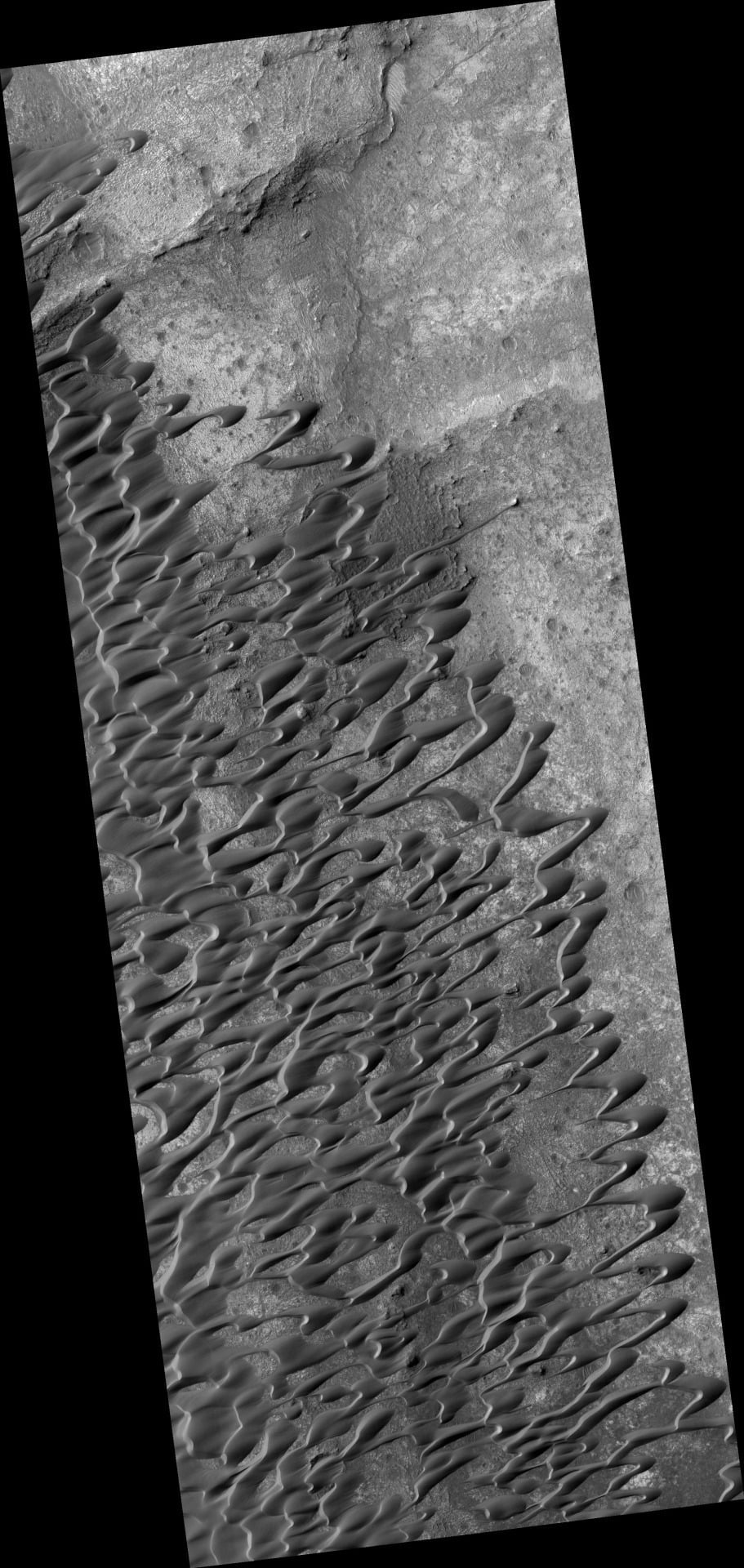
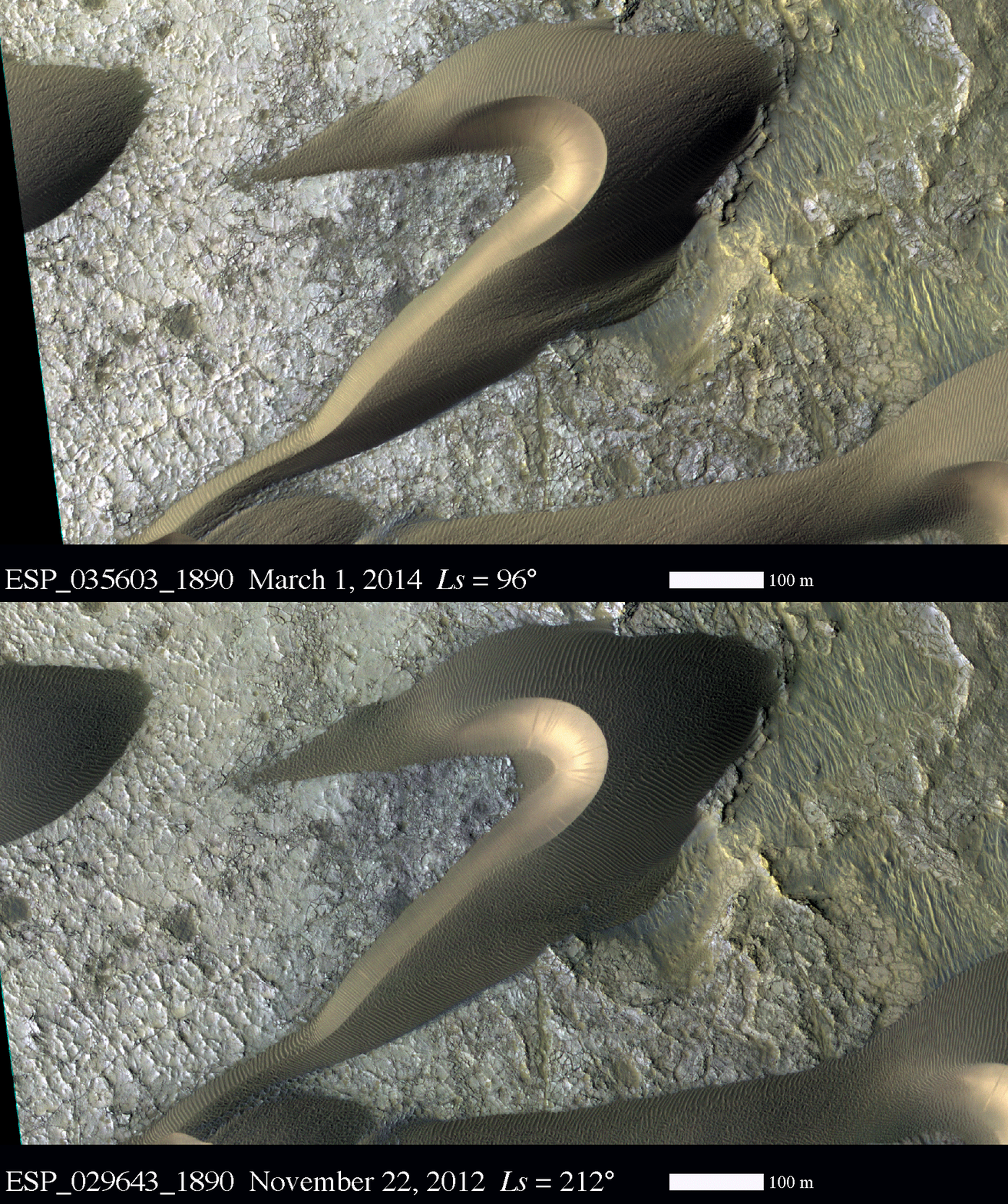
Dunes are a fascinating interplay between fluid and granular flow. This satellite photo shows a dune field on Mars, Nili Patera. The dominant direction of wind flow is from the upper right, pushing the dunes themselves slowly toward the left. Many of the dunes along the edge are barchans, crescent-shaped dunes with a long, gradual slope facing the wind and a steeper leeward side. As the wind blows, it erodes the sand on the windward slope and deposits it on the leeward side. This is how the dune migrates. Check out this close-up of a barchan to see the changes in its ripples and shape over the past couple months. (Photo credit: NASA/JPL/Univ. of Arizona)

How Erosion Shapes a Flow
Erosion creates all manner of strange shapes as wind and water cut away at solids. But why does the interaction of the fluid and solid result in the geometries we observe? Above is a collage from an experiment in which a soft clay sphere was immersed in a water tunnel. After 70 minutes, the sphere had worn into a roughly conical body (Image A) reminiscent of a re-entry capsule. Images B and C show instantaneous streaklines around the clay at 10 minutes and 70 minutes, respectively. Images D and E show diagrams of the flowfield seen in B and C. Fast-moving flow above and below the stagnation point (SP) wears the front of the body into a conical shape, whereas the recirculating vortices aft of the separation point (SL) create a sloped shoulder and flattened back in the clay. The results are consistent with a model in which erosion tries to create uniform shear stress at the solid surface – essentially the process is keeping the frictional force between the fluid and air constant along the surface. This makes sense. If a region’s shear stress is higher, it will be worn more quickly than the surrounding solid, causing it to recede and experience decreased shear stress (relative to the surrounding area) as a result. (Image credit: L. Ristroph et al.)