Without our magnetic field, life as we know it could not exist on Earth. Instead, our atmosphere would be stripped away and the surface would be bombarded by charged particles in the solar wind. Relatively little is known about the dynamo process that governs our magnetic field, though it’s thought to be the result of liquid iron moving in the Earth’s outer core. The video above shows a slice of a recent 3D simulation of this liquid iron segment of our core. The colors show variations in the temperature, revealing vigorous convection in the core. This motion, combined with the spinning of the Earth, is the likely source of our magnetic field. Researchers hope that simulations like these can help us understand features we observe in our magnetic field – like local variations in field strength and the pole reversals in our geological record. (Video credit: N. Schaeffer et al.; CNRS via Gizmodo)
Tag: convection

Creating Clouds
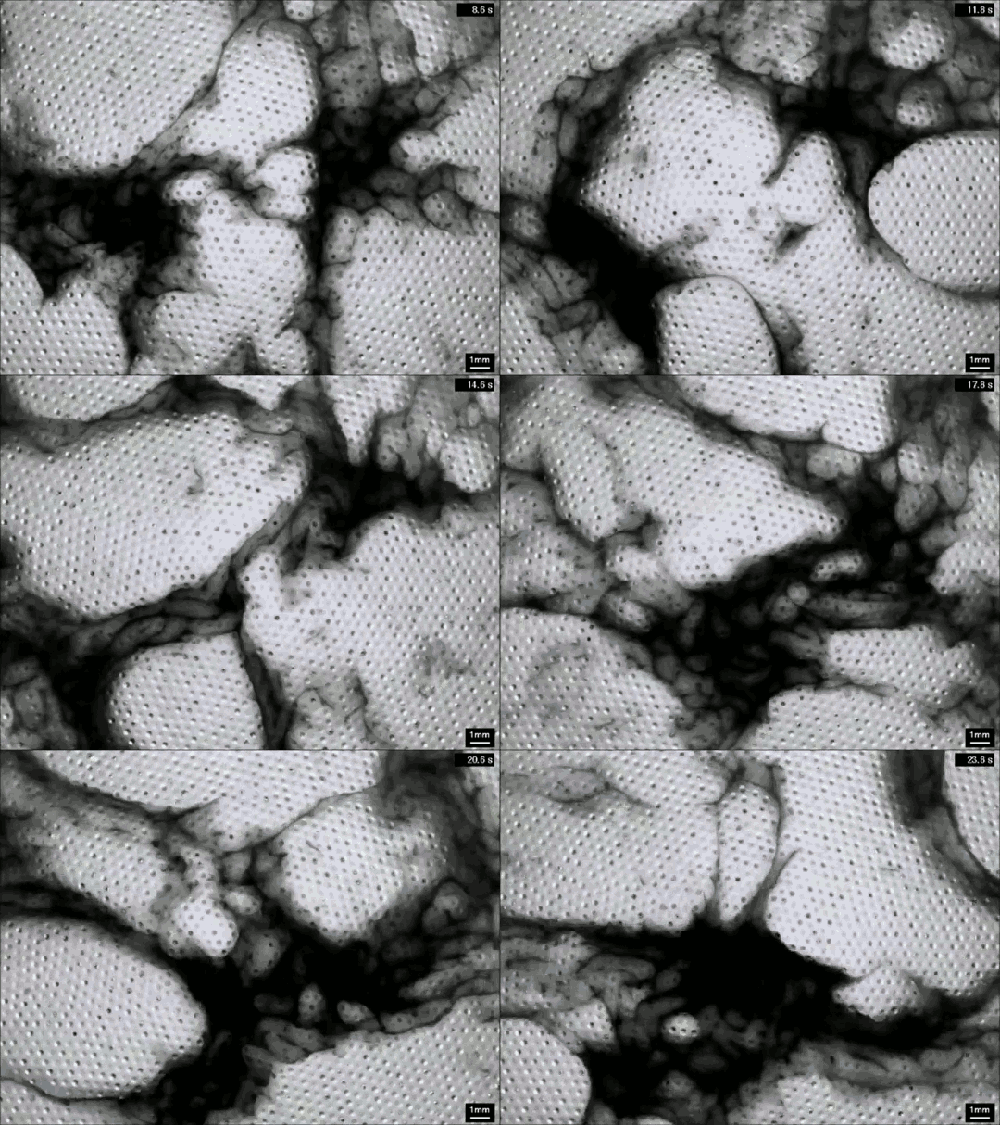
What you see here is the formation of clouds and rain – but it’s not quite what you’re used to seeing outside. This is an experiment using a mixture of sulfur hexafluoride and helium to create clouds in a laboratory. Everything is contained in a cell between two transparent plates. Liquid sulfur hexafluoride takes up about half of the cell, and when the lower plate is heated, that liquid begins evaporating and rising in the bright regions. When it reaches the cooled top plate, the liquid condenses into droplets inside the dimples on the plate, eventually growing large enough to fall back as rain. The dark wisps you see are areas where cold sulfur hexafluoride is sinking, much like in the water clouds we are used to. Setups like this one allow scientists to study the effects of turbulence on cloud physics and the formation of droplets. (Image credit: E. Bodenschatz et al., source)
Boston-area folks! I’ll be taking part in the Improbable Research show Saturday evening at 8 pm at the Sheraton Boston. Come hear about the Boston Molasses Flood and other bizarre research!

“Pulse”
Photographer Mike Olbinski returns with another incredible storm-chasing timelapse video, this time all in black-and-white. To me, that choice helps “Pulse” emphasize the ominous majesty of these supercells and tornadoes by highlighting the textures that make up the clouds. Watching clouds in timelapse, they seem to materialize from nowhere as moisture drawn up from the land cools and condenses. Sped up, suddenly the convective rotation and the roiling turbulence inside clouds is perfectly clear. I especially love the sequence beginning at 2:25, where a distant black line slowly transforms into an incredible landscape marked with successive waves of rolling, turbulent clouds. Watch this one on a large screen at a high resolution, if you can. You won’t regret it! (Video credit: M. Olbinski)
Coarsening in a Soap Film
Flow in a soap film is driven by gravity’s efforts to thin the film and surface tension’s attempts to stabilize variations in thickness. Because evaporation guarantees that the soap film will eventually dry out, gravity typically wins the battle and causes a soap film to rupture. This video takes a close look at what happens in the film just before it ruptures. Black dots form in the thinnest region of the flow. These areas are not holes, but they appear black because they are thinner than any wavelength of visible light. Before rupture, the black dots begin coalescing with one another, first due to diffusion and later more rapidly due to convection in the soap film. Ultimately, the black dots are the harbingers of doom for the fragile bubble. (Video credit: L. Shen et al.)
Living Fluid Dynamics
This short film for the 2016 Gallery of Fluid Motion features Montana State University students experiencing fluid dynamics in the classroom and in their daily lives. As in her previous film (which we deconstructed), Shanon Reckinger aims to illustrate some of our everyday interactions with fluids. This time identifying individual phenomena is left as an exercise for the viewer, but there are hints hidden in the classroom scenes. How many can you catch? I’ve labeled some of the ones I noticed in the tags. (Video credit: S. Reckinger et al.)
“Vorticity”
Photographer Mike Olbinski is back with another storm-chasing timelapse entitled “Vorticity”. Like his previous work, this film is a breath-taking example of physics in action. It is well worth taking a few minutes to watch in fullscreen, at high resolution, and with headphones. Olbinski’s timelapses beautifully capture the incredible dynamic motion of our atmosphere. Fittingly, “Vorticity” is all about the swirling, roiling motion of supercell thunderstorms and the tornadoes they can spawn, but the film also captures many other great phenomena from the convection that builds clouds to unusual formations like undulatus asperatus and mammatus clouds. (Video credit: M. Olbinski; submitted by Paul vdB)

Ocean Mixing
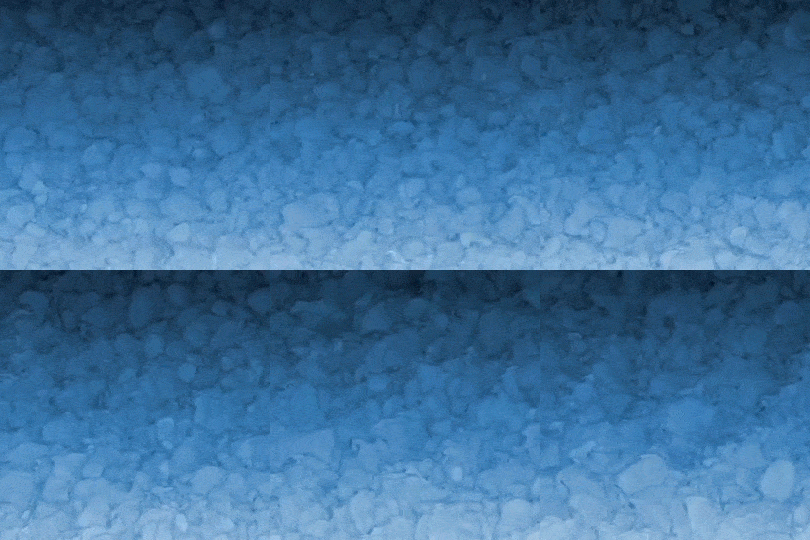
Movement in Earth’s oceans is driven by a complicated interplay of many factors like temperature, salinity, and Earth’s rotation. Above are results from a numerical simulation of the top 100 meters of ocean contained within a 1 km x 1 km box. The colors indicate surface temperature. Two major processes create the motion we see. The first is convection, in which water at the surface releases heat to the atmosphere and cools, causing it to then sink due to its greater density. Warmer water rises to replace it. This process happens quickly and dominates the early part of the simulation where we see the puffy convection cells shown on the left animation.
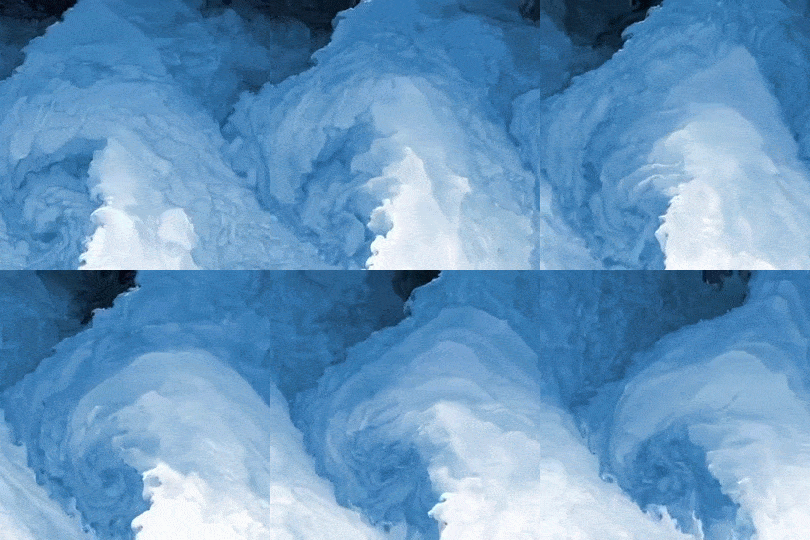
A slower process is in effect as well. Because of variations in the water temperature, the density of the fluid at a given depth is not constant. We can already see that at the water surface, where the temperature (and thus density) is varying significantly. Those variations in density at the same depth combined with gravity’s tendency to shift fluids create what is known as a baroclinic instability. Put simply, this instability will cause warmer water to slide horizontally past colder water. The result is the large, spinning eddy motion seen in the animation on the right. To see how the whole system develops, check out the full video below. (Image/video credit: J. Callies)

Turbulent Convection
These golden lines reveal the complexity of turbulent convective flow. They come from a numerical simulation of turbulent Rayleigh-Benard convection, a situation in which fluid trapped between two plates is heated from below and cooled from above. This situation would typically create convection cells similar to those seen in clouds or when cooking. Inside these cells, warm fluid rises to the top, cools, and sinks down along the sides. With large enough temperature differences, instabilities will occur and cause the flow to become turbulent so that the clear structure of convection cells breaks down into something more chaotic. Such is the case in this simulation. This visualization shows skin friction on the bottom (heated) plate in a flow of turbulently convecting liquid mercury. The bright lines are areas with large velocity changes at the wall, an indication of high shear stress and vigorous convective flow. (Image credit: J. Scheel et al.; via Gizmodo)
Freezing Soap Bubbles
I’m not a winter person, but there’s something almost magical about the way water freezes. From instant snow to snow rollers and weird ice formations to slushy waves, winter brings all kinds of bizarre and unexpected sights. The video above is an artistic look at one of my favorites – freezing soap bubbles. Normally, the thin film of a soap bubble is in wild motion, convecting due to gravity, surface tension differences, and the surrounding air. Such a thin layer of liquid loses its heat quickly, though, and, as ice crystals form, the bubble’s convection and rotation slow dramatically, often breaking the thin membrane. Happily photographer Paweł Załuska had the patience to capture the beautiful ones that didn’t break! (Video credit: P. Załuska; via Gizmodo)
If you enjoy FYFD and want to help support it, please consider becoming a patron!
Pluto: Subsurface Convection
Pluto’s rich and unexpected surface features indicate the dwarf planet is still geologically active. This is one of the largest surprises of the New Horizons mission because it was assumed that Pluto was too small, too isolated, and too old for such activity. Instead, its cryovolcanoes and surface convection cells point to significant and vigorous convection in Pluto’s mantle, likely heated by the decay of radioactive elements in its core. The simulation above shows a representation of mantle convection on Earth, simulated over billions of years.
Mantle convection is described by the dimensionless Rayleigh number, which compares the effects of thermal conduction to those of convection. Above a fluid’s critical Rayleigh number, convection is the driving process in heat transfer. In Pluto’s case, if one assumes a mantle of pure water ice, the Rayleigh number is about 1600, barely enough to surpass the critical point where convection dominates. If, instead, one assumes a mantle containing 5% ammonia, the resulting composition has a Rayleigh number of more than 10,000–well past the critical point and large enough to support the vigorous convection necessary to explain Pluto’s surface features. (Video credit: W. Bangerth and T. Heister; Pluto research credit: A. Trowbridge et al.; via Purdue University)
This concludes FYFD’s week of exploring Pluto’s fluid dynamics. You can see previous posts in the series here.