Tag: convection

  • Featured Video Play Icon

    Sunlight Is Older Than You Think

    Joe Hanson over at “It’s Okay to Be Smart” has a great video on the random walk photons have to make to escape the core of the sun and other stars. Because the high-energy photons born in the star’s core have to bounce their way out rather than flying in a straight line, those photons can spend thousands of years escaping the sun. After that, the eight-and-a-half minute trip to Earth is nothing.

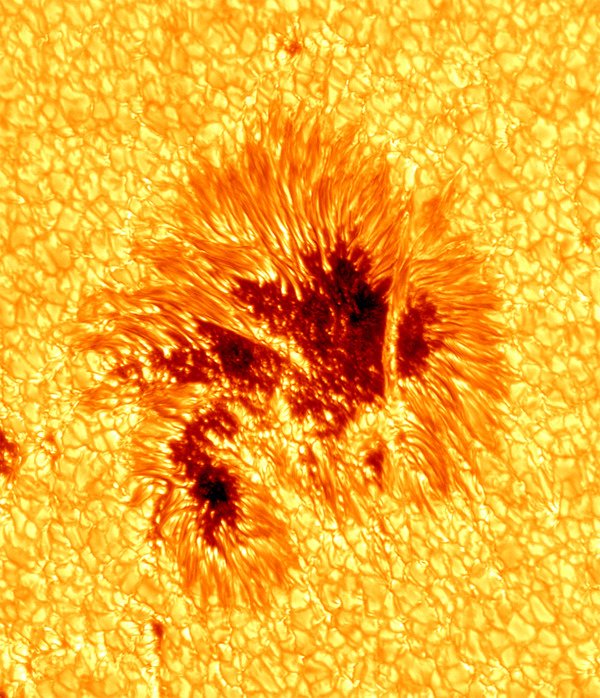
    But there’s a key element missing in this explanation: convection! That radiative random walk photons do doesn’t last all the way from the core of the sun to its surface. From a depth of about 200,000 km onward, the dominant mode of transport in the sun is convection, actual fluid motion that carries heat and light much faster than simple molecular diffusion, or Brownian motion, does. That’s why the surface of the sun shines with convection cells similar to the ones you’ll see in your skillet when heating a layer of oil.

    Fluid motion beyond molecular diffusion is also a big part of the other flows Joe describes in the video. If you had to wait on Brownian motion in order to smell your morning coffee, it would be cold long before you knew it was there! (Video and image credit: It’s Okay to Be Smart; sun surface image credit: Big Bear Solar Observatory/NJIT)

  • Levitation Without Boiling

    Levitation Without Boiling

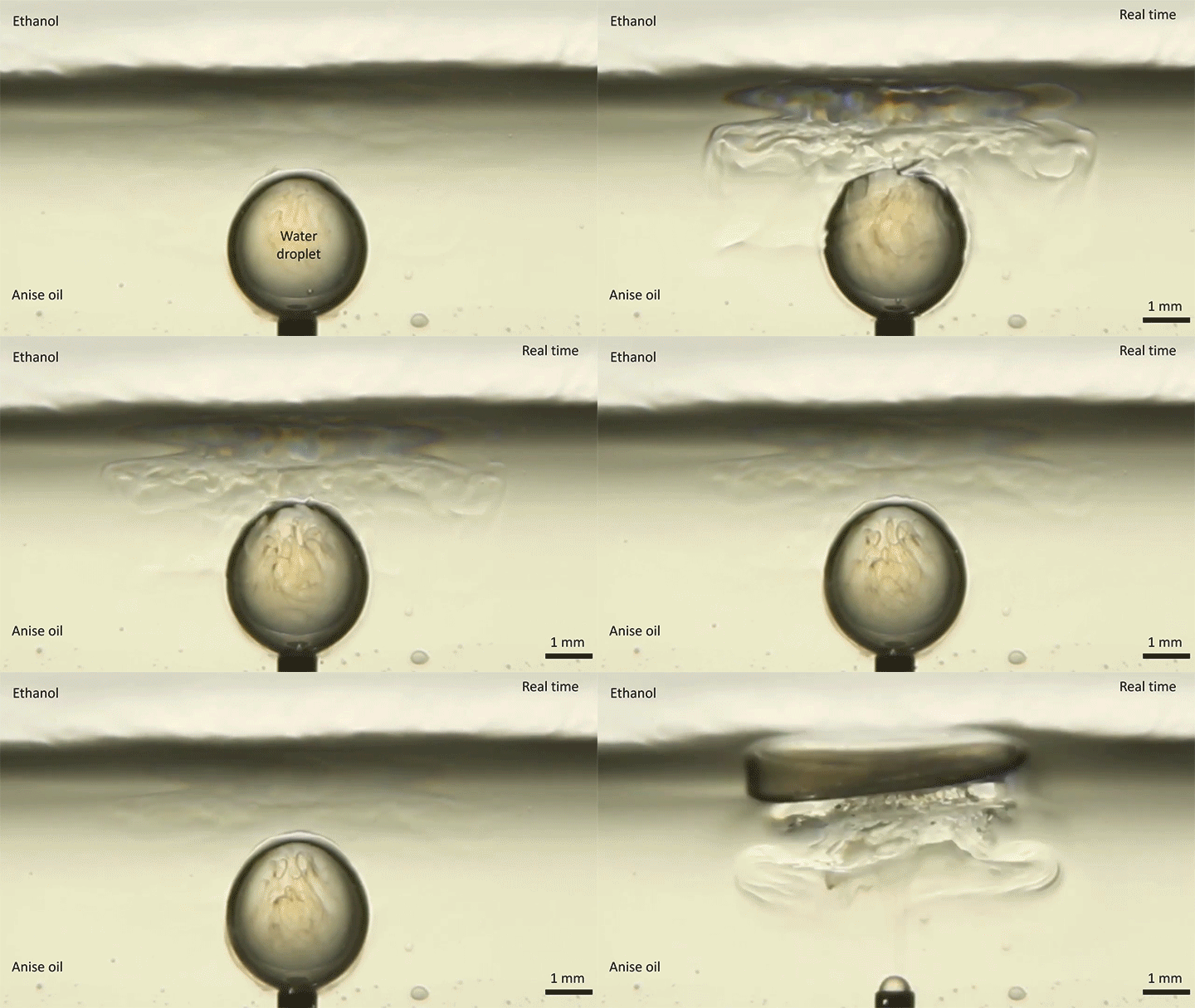
    One way to levitate droplets is to place them on a surface heated much higher than the droplet’s boiling point. This creates the Leidenfrost effect, where a droplet levitates on a thin layer of its own evaporating vapor. In this study, the situation is quite different.

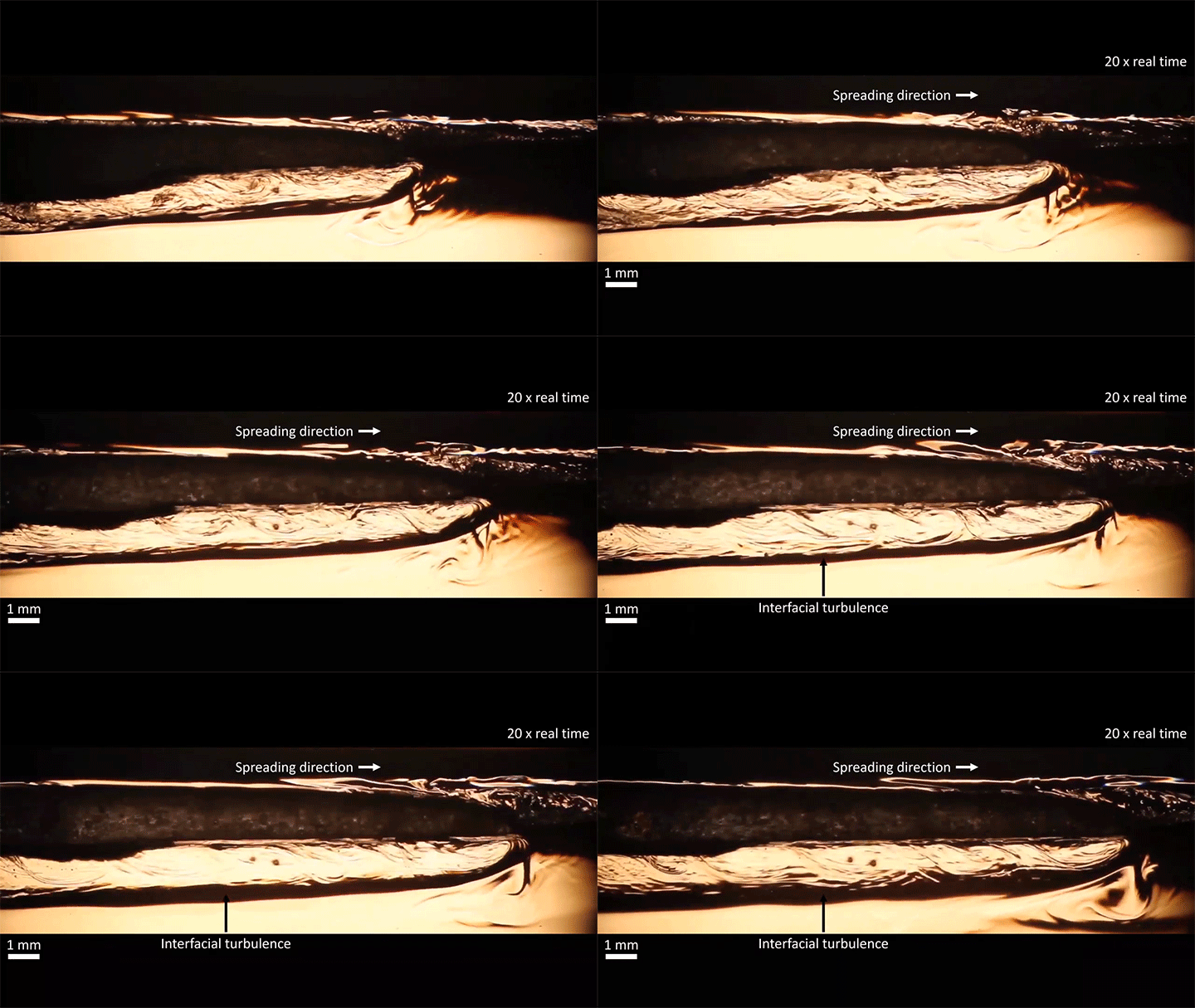
    Although the underlying pool of liquid — here, silicone oil — is heated, its temperature is well below the boiling point of the water droplet. But the droplet still levitates over the pool, thanks to an air layer fed by convection. Aluminum powder in the oil reveals large-scale convection in the pool; note how the oil moves radially toward the droplet. That movement drags the air in contact with the oil with it, which forms the vapor layer keeping the droplet aloft.

    One side effect of this convection-driven levitation is that the droplet hovers over the coldest point in the oil. That fact suggests that users can manipulate the droplet’s motion by tuning the underlying heating. (Image and research credit: E. Mogilevskiy)

  • Featured Video Play Icon

    Collective Catfish Convection

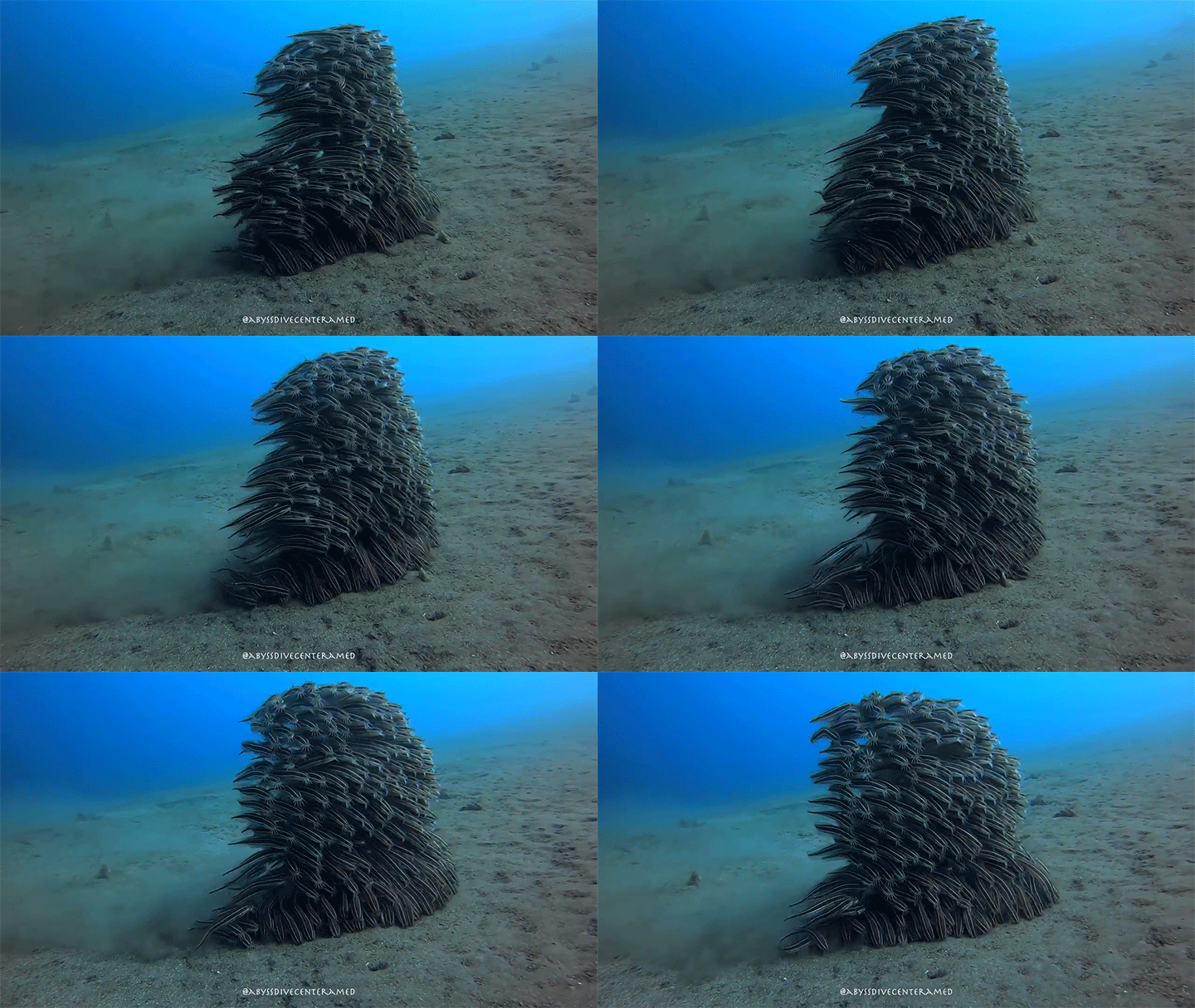
    Gather many birds, fish, or humans together and you often get collective motion that’s remarkably fluid-like in appearance. This video shows a group of juvenile striped eel catfish, an (eventually) venomous species that uses strength in numbers for protection while young. Their movement is rather mesmerizing, and if you watch individual catfish, you’ll see a sort of convective motion inside the blob. There’s a general downward trend near the front of the school and a rising one on the backside. Perhaps they’re taking turns feeding near the bottom of the pack? (Image and video credit: Abyss Dive Center; via Colossal)

  • The Snowy Salt of the Dead Sea

    The Snowy Salt of the Dead Sea

    At nearly 10 times saltier than the ocean, the Dead Sea is one of the saltiest places on Earth, and since 1979, scientists have observed it growing even saltier as snow-like salt precipitates to the bottom of the lake. Numerical simulations have now confirmed that this salt-fall is the result of double-diffusive salt fingers.

    Here’s how the mechanism works: the upper layer of the lake is made up of warmer, saltier water covering deeper, colder waters. As the sun evaporates water near the surface, what’s left behind becomes saltier and heavier. Tiny pockets of this warm, salty water sink into colder regions and rapidly cool. The heat can move a lot more quickly than the salt, though, and since cold water cannot hold as much salt as warmer water, some of the salt precipitates out. That forms the falling crystals scientists observe sinking to the bottom of the lake. (Image and research credit: R. Ouillon et al.source; via Physics World; submitted by Kam-Yung Soh)

  • Striped Clouds

    Striped Clouds

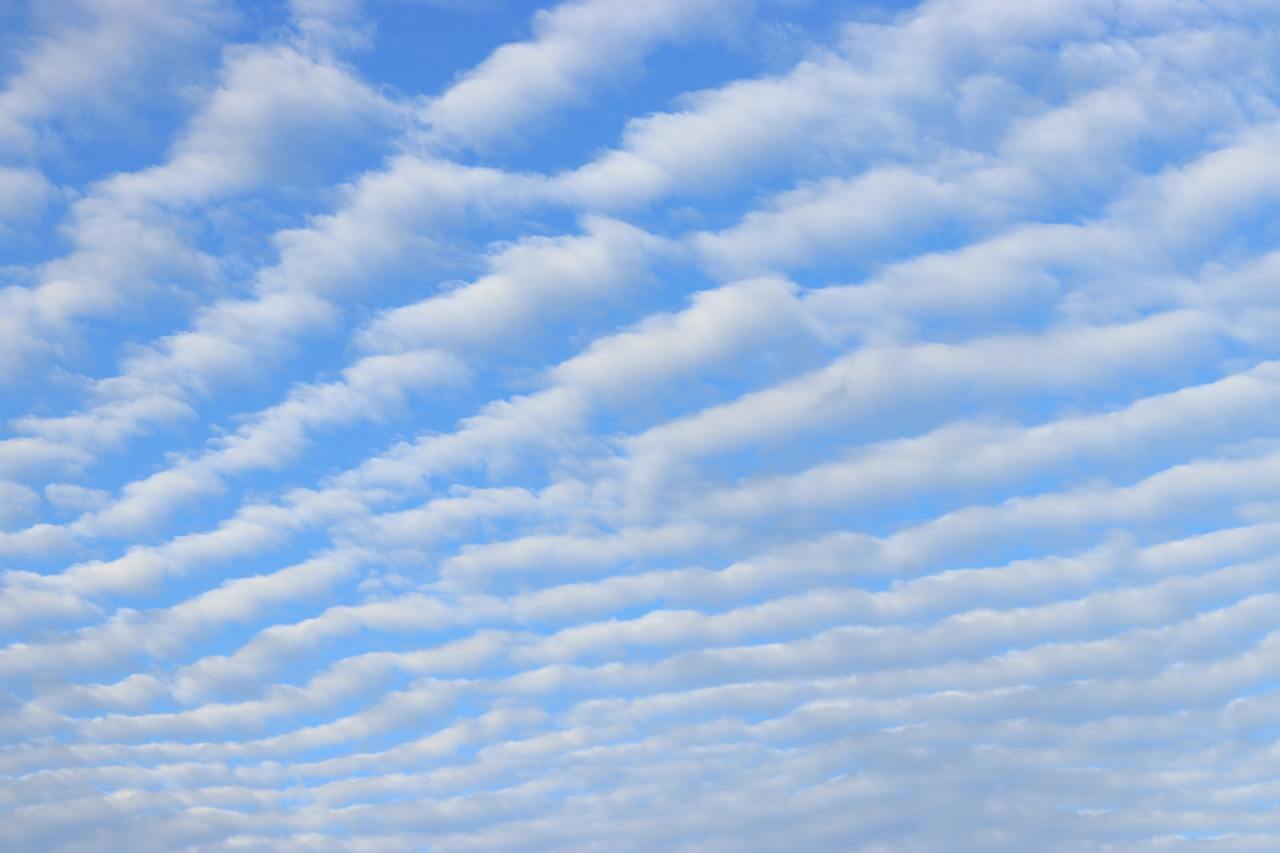
    Living near the Rocky Mountains, it’s not unusual to look up and find the sky striped with lines of clouds. Such wave clouds are often formed on the lee side of mountains and other topography. But even in the flattest plains, you can find clouds like these at times. That’s because the internal waves necessary to create the clouds can be generated by weather fronts, too.

    Imagine a bit of atmosphere sitting between a low-pressure zone and a high-pressure zone. This will be an area of convergence, where winds flow inward and squeeze the fluid parcel in one direction before turning 90 degrees and stretching it in the perpendicular direction. The result is a sharpening of any temperature gradient along the interface. This is the weather front that moves in and causes massive and sudden shifts in temperature. 

    On one side of the front, warm air rises. Then, as it loses heat and cools, it sinks down the cold side of the front. The sharper the temperature differences become, the stronger this circulation gets. If the air is vertically displaced quickly enough, it will spontaneously generate waves in the atmosphere. With the right moisture conditions, those waves create visible clouds at their crests, as seen here. For more on the process, check out this article over at Physics Today. (Image credit: W. Velasquez; via Physics Today)

  • Featured Video Play Icon

    Ink Explosion

    Sometimes beautiful flows come from simple combinations. Here the artists of Chemical Bouillon combine ink and hydrocarbons to create lovely explosions of color. Eschewing quick cuts between views, they allow us to linger and explore the flow ourselves as it changes. Differences in surface tension drive streaming flows along the surface, but there seem to be some chemical reactions contributing as well. Watch along the edges and you may even see convection pulling ink down and back. The whole video is only 2 minutes long and worth a full watch. (Image and video credit: Chemical Bouillon)

  • Evaporative Convection

    Evaporative Convection

    Since we spend so much of our lives around transparent fluids like air and water, we often miss seeing some of their coolest-looking flows. Here, we see a layer of water only 3 centimeters deep but a full meter wide. It’s seeded with tiny crystals that reflect light depending on their orientation, which allows us to see the flow. Initially, the tank is spun up, then left stationary for 2 hours while evaporation cools the water.

    Normally, the resulting flow would be too slow to notice, but that’s where the magic of timelapse comes in. With it, we can see the wriggling dark lines marking areas where cool, dense water sinks and brighter regions where warm fluid rises. What begins as an array of polygonal convection cells quickly merges into a couple of large, rounded cells. Check out the full video below, where you can see the streaming patterns far better than in animation. (Image and video credit: UCLA Spinlab)

  • Turbulent Skies

    Turbulent Skies

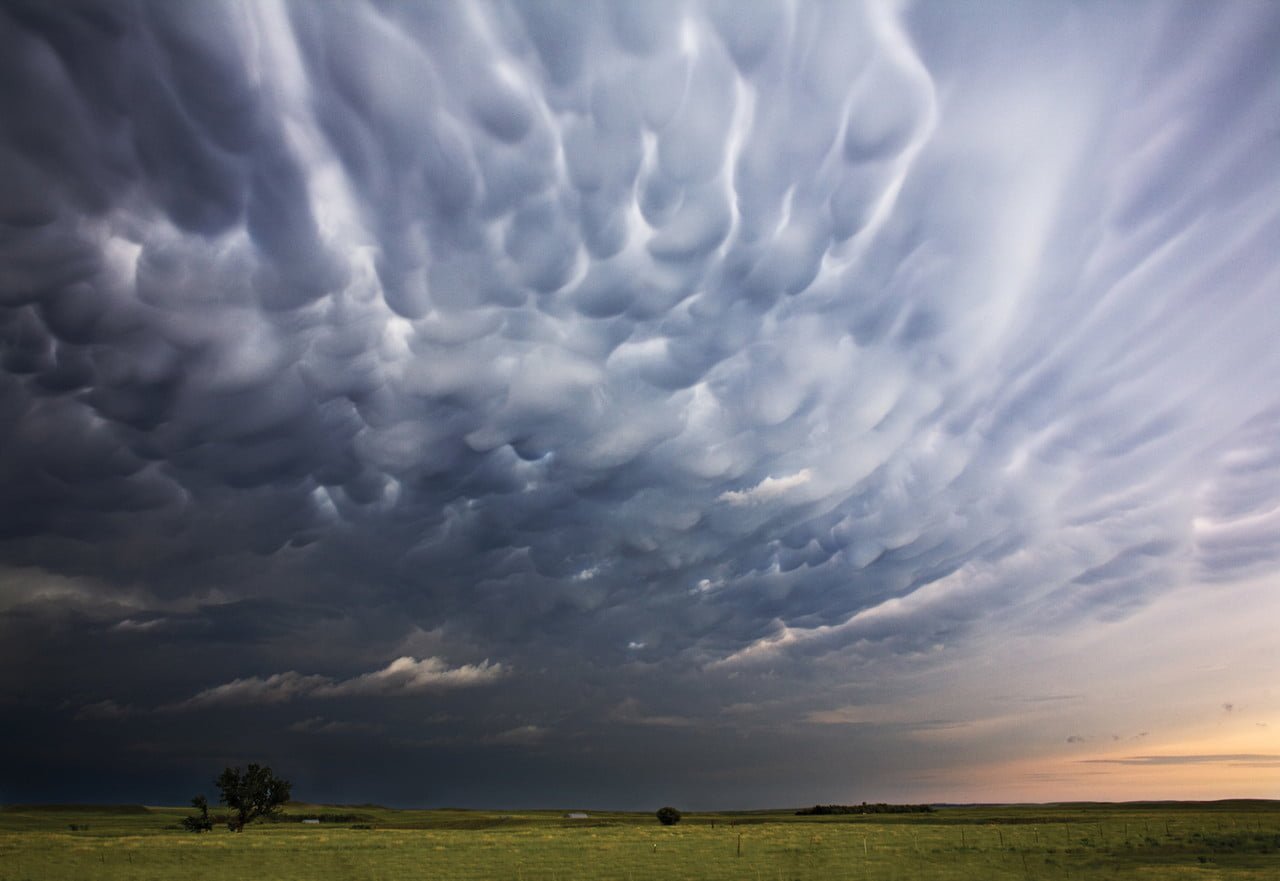
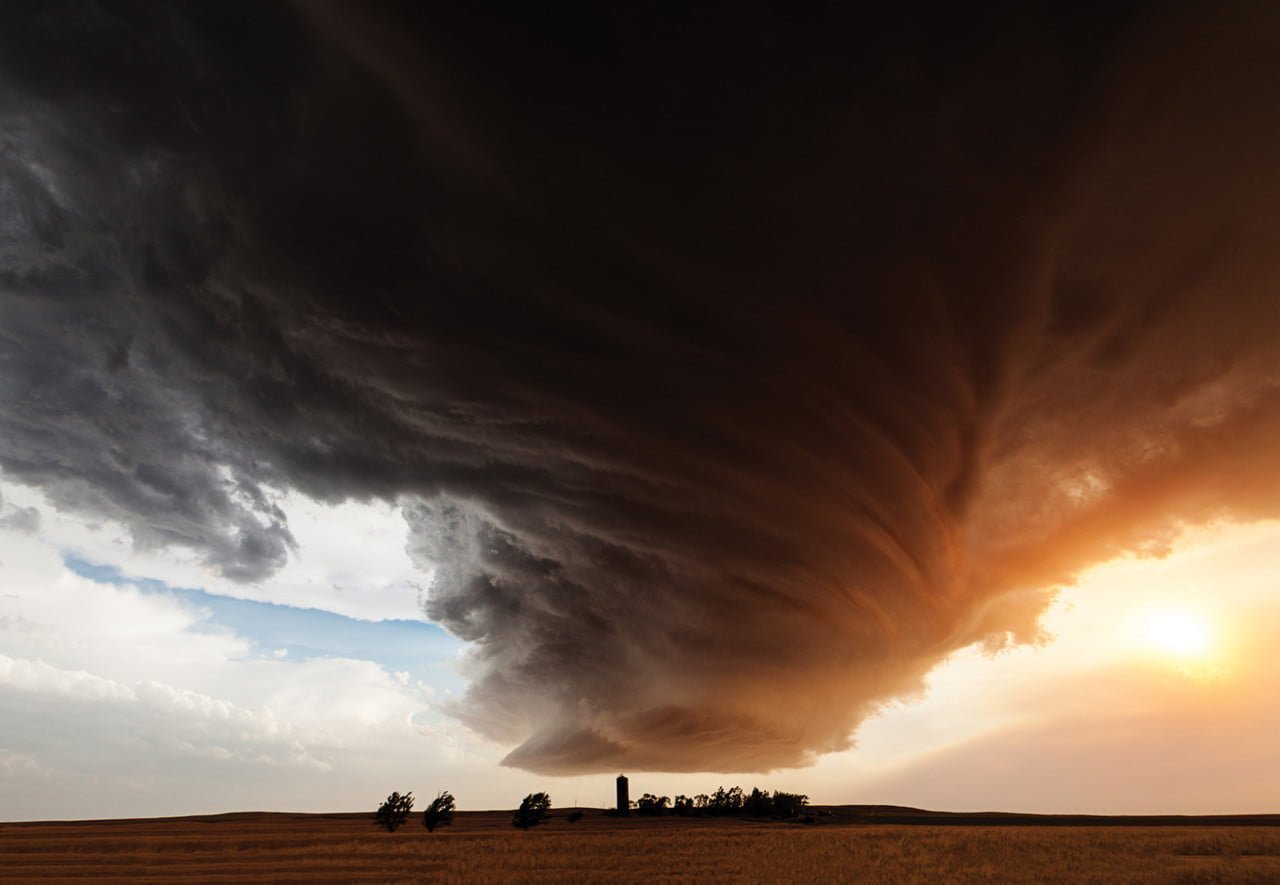
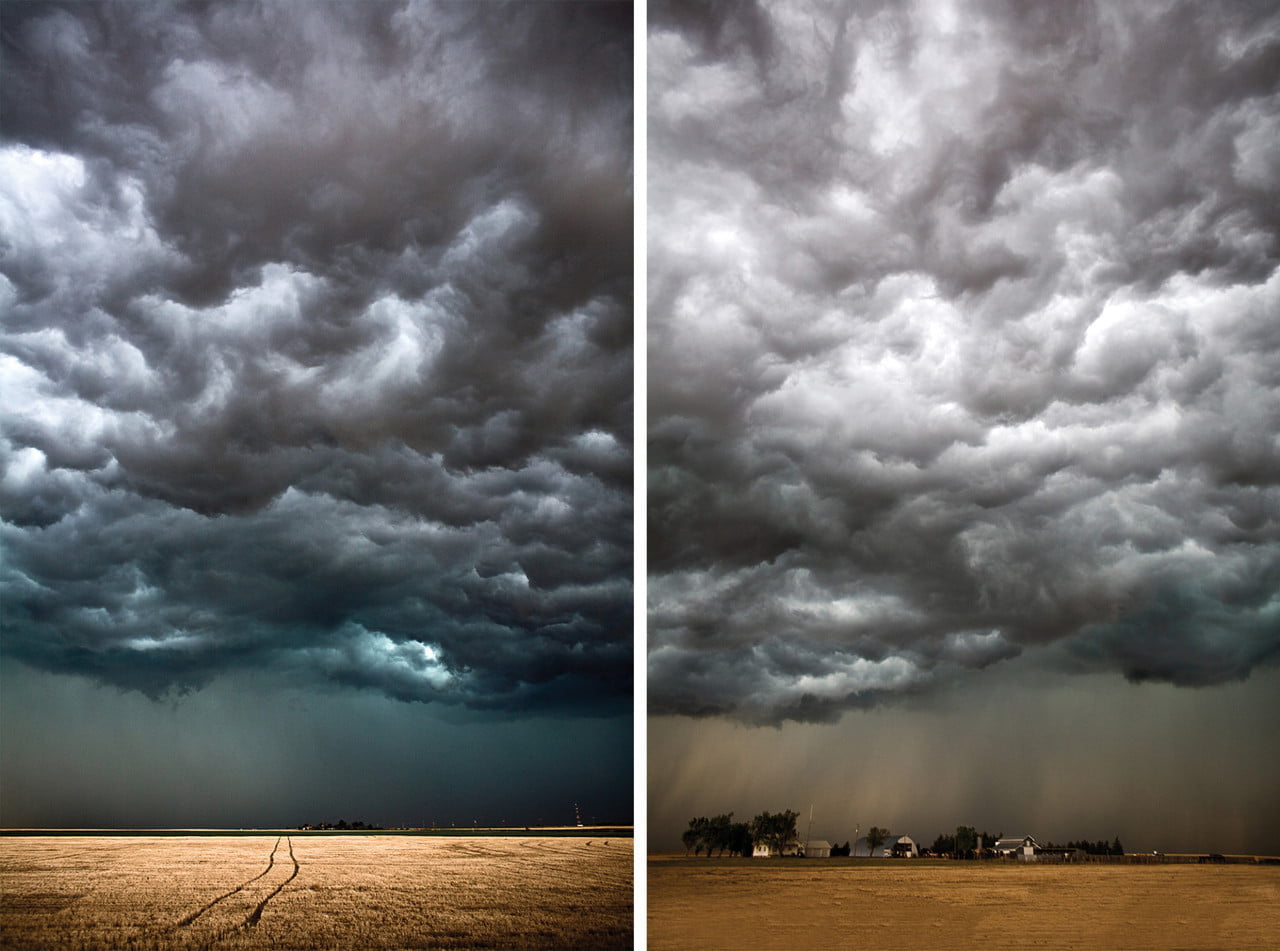
    The atmosphere above us is a thin layer enclosing our planet, but it roils with activity and energy. Photographer Camille Seamon captures the grandeur of our turbulent skies in her storm shots. These dramatic atmospheric vistas – including mammatus clouds (top), swirling supercells (middle), and turbulent storm clouds (bottom) – are all driven by the flow of heat and moisture. (Image credit: C. Seaman; via Colossal)

  • Featured Video Play Icon

    The Show in the Sky

    There is a constant drama playing out overhead, though most of us do not take the time to watch. Fortunately, a few, like Blaž Šter, do and make timelapse videos that allow us to enjoy hours of atmospheric drama in only a few minutes. This timelapse shows a cloudy and rainy mid-July day in Slovenia, where an unstable atmosphere leads to turbulent and dramatic clouds. In an unstable atmosphere, it’s easier for vertical motion to take place between altitudes. For example, a parcel of warm air displaced upward will continue to rise because it will be lighter and more buoyant than the surrounding air. This is key to the strong convection that can generate thunderstorms. (Image and video credit: B. Šter, source)

  • Featured Video Play Icon

    Why Fish Don’t Freeze

    Have you ever wondered why it is that fish in a pond or lake don’t freeze during the winter? The secret is due to a peculiarity of water that’s vital for life here on Earth. In general, cold things are denser than warmer ones. This is why, for the most part, cold fluids tend to sink and warmer ones rise here on Earth. So as fall moves into winter and water near the surface of a pond cools, it sinks. But only to a point.

    Water is at its densest at 4 degrees Celsius. Any colder and the water will actually expand and become less dense. This is why you can’t fill ice cube trays to the very top before putting them in the freezer. In the pond it means that buoyant convection shuts down at 4 degrees Celsius. When the water at the top keeps cooling down to the freezing point, it doesn’t sink. Instead, the fish and other pond life get to spend the winter at a chill – but not freezing – 4 degrees. (Video credit: A. Fillo)