Tag: chemistry

  • Featured Video Play Icon

    “Flowers and Colors”

    Many children have done the simple experiment of placing a cut flower in dyed water and watching as it changed color. The latest video from Beauty of Science relies on some related physics. Since the color of flowers typically depends on acidity, immersing a flower in dilute acid will change its color from pinks and purples to yellows and greens. Watching this transformation, we can learn about how fluids get transported through flowers.

    Like the leaves on a tree, flowers are covered in tiny cells called stomata that can open and close. In the daytime, stomata are typically open to allow carbon dioxide to diffuse into the plant. (At the same time, water pulled up from the roots is evaporating out the stomata, as seen previously.) Once immersed in acid, the open stomata are no longer bringing in carbon dioxide; instead, the acid is diffusing in and slowly spreading through the petals. In the timelapse video, some areas of the petal change faster than others. This could indicate more open stomata in the regions that change first or even that some areas inside the petal transport water (and acid) better than others. (Video and image credit: Beauty of Science; see also Making Of)

  • Chemistry in Infrared

    Chemistry in Infrared

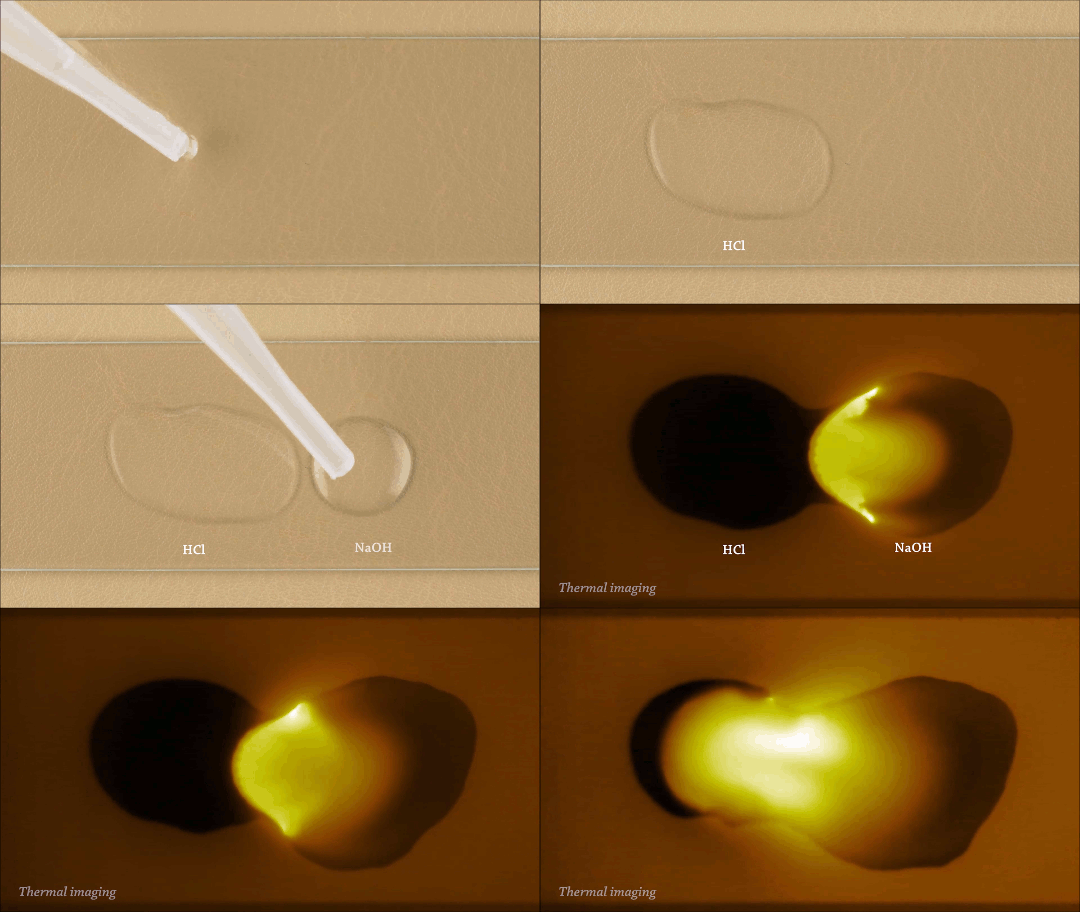
    Many chemical reactions, and the flows that accompany them, are invisible to the human eye. But in infrared wavelengths those same events are vibrant and energetic. In this video from the Beauty of Science group, various chemical reactions are shown in visible and IR wavelengths, revealing very different perspectives on the same thing. Many of the reactions are exothermic, meaning that they produce heat as they occur. Because of this the thermal imaging shows where the most intense reaction is occurring at a given time. Other areas gradually darken as diffusion and flow move and dilute the heat energy released. (Video and image credit: Beauty of Science, source)

  • PyeongChang 2018: Ice’s Watery Sublayer

    PyeongChang 2018: Ice’s Watery Sublayer

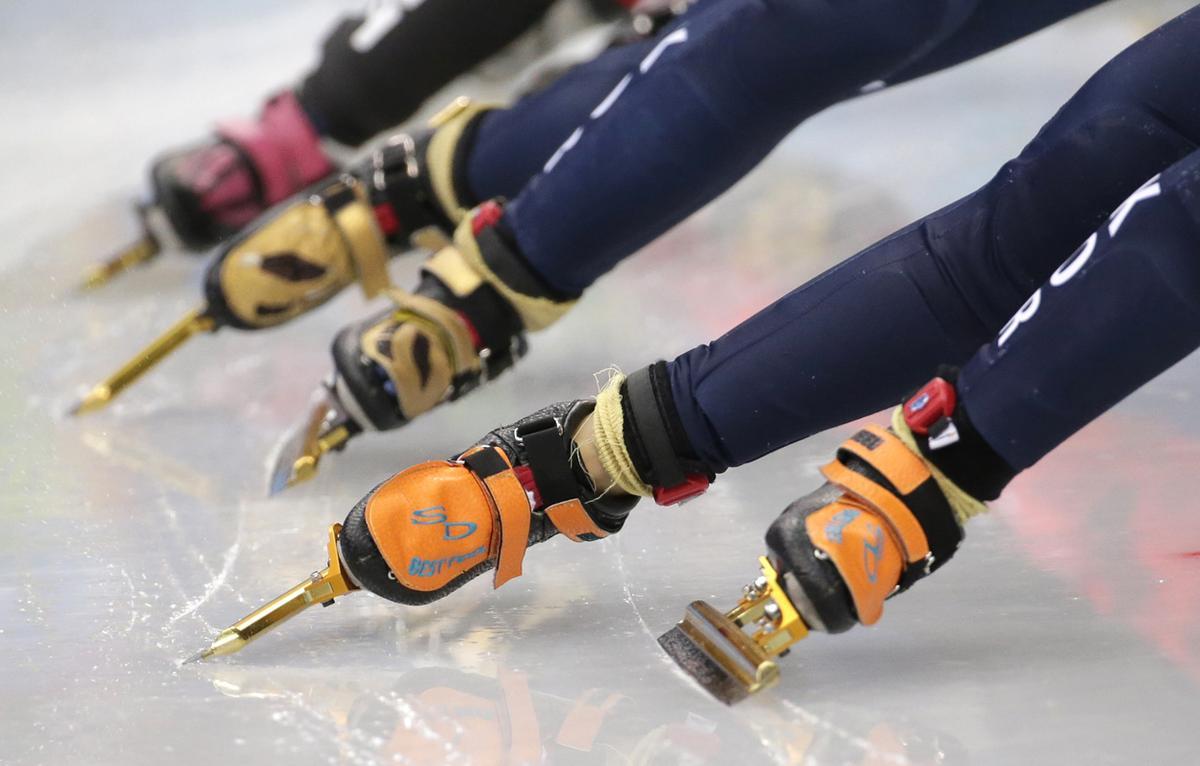
    The Olympic Charter declares that winter sports must be practiced on snow or ice. Both are frozen forms of water, which despite its ubiquity, is one of the strangest substances around. In addition to its tendency to expand as it freezes, ice is inherently slippery, and no one’s quite certain yet why.

    Most people have heard the theory that ice skating is possible due to high pressure melting the ice beneath the narrow blade. But realistically, pressure melting should only work for ice down to about -3.5 degrees Celsius. By contrast, the ideal temperatures for figure skating and ice hockey are -5.5 and -9 degrees Celsius, respectively. Melting due to friction might account for slipperiness a few more degrees below freezing, but it doesn’t explain why ice can be slippery when you’re just standing on it.

    When physicist Michael Faraday suggested in 1850 that ice has a thin liquid-like layer at its surface, many discounted the theory. But modern experimental techniques and computer simulations have shown that Faraday was right. Ice has a liquid-like layer some 1 to 100 nanometers thick at its surface, and this layer persists to temperatures below -30 degrees Celsius. The process is known as surface pre-melting and what causes it is an area of active research for physical chemists. Current theories include hydrogen bonding and even quantum mechanical effects. (Image credit: AP Photo/B. Armangue; research credit: R. Rosenberg; Y. Li and G. Somorjai; F. Paesani and G. Voth)

    This opens FYFD’s two-week series on the physics and fluid dynamics of the Winter Olympics. Stay tuned! – Nicole

  • Featured Video Play Icon

    Unboiling an Egg

    Cooking is something we think of as a one-way process. You add heat to food, it changes forms, and there’s undoing that. But that process is less one-directional than we thought, at least in some cases. Take boiling an egg. When you add heat to egg whites, it breaks down bonds between the folded proteins and lets those proteins build more bonds with other sections of proteins, eventually solidifying into a seemingly unbreakable mess. You can’t break those bonds by adding or removing thermal energy, but you can shake the proteins apart and refold them into their original shapes.

    Researchers accomplish this by putting the boiled egg whites in a solution of water and urea and spinning them. When they spin the fluid mixture, the fluid near the wall spins faster than the fluid in the center of the vial, which creates shear stress. That shear stress helps untangle the proteins and reform them into their original shape–thereby unboiling the egg white. Now you definitely don’t want to eat the results – urea is, of course, a component of urine – but it does demonstrate that fluid dynamics can be used to reverse chemical processes we thought were irreversible. And that surprising discovery nabbed the researchers an Ig Nobel Prize in 2015. (Video credit: TedEd/E. Nelson; research credit: T. Yuan et al.)

  • Featured Video Play Icon

    “Chemical Poetry”

    In “Chemical Poetry” artists Roman Hill and Paul Mignot use fluid dynamics to create incredible and engaging visuals. With a stunningly close eye to fluids mixing and chemicals reacting, their imagery feels like gazing on primordial acts of creation or destruction. There’s even a sequence that feels like you’re watching an explosion in slow-motion, but there’s no CGI in any of it. This is just the beauty of physics laid bare, revealing the dances driven by surface tension, the undulations of a fluid’s surface, and the dendritic spread of one fluid into another – all cleverly lit and filmed for maximum effect. It is well worth taking the time to watch the whole video and check out more of their work. (Image/video credit and submission: NANO; GIFs via freshphotons)

  • Microscale Rockets

    Microscale Rockets

    Shown above are a trio of microscale rockets, each about 10 microns in length. These tiny rockets are roughly cylindrical in shape, with a narrower diameter at the front than the back. Like their space-faring brethren, these microrockets are chemically propelled. They draw in fuel from their surroundings, which reacts with the catalysts coating the interior of the microrocket to produce gases. Those gases bubble out the back end of the microrocket, creating thrust capable of propelling the rockets more than 1000 body lengths/second. Researchers have already demonstrated that these tiny rockets can haul cargo along with them. Scientists hope one day to use these self-propelled microrockets to help deliver drugs or isolate cancer cells. (Image credit: J. Li et al., source)

  • Whiskey Stains

    Whiskey Stains

    Photographer Ernie Button discovered that whiskey left behind intriguing patterns after it evaporated. Unlike coffee rings, the whiskey leaves behind a more uniform residue. Curious, he contacted researchers at Princeton, who were eventually able to explain why whiskey and coffee dry so differently. They observed three major effects in drying whiskey mixtures. Firstly, the alcohol in whiskey evaporates faster than other components, creating differences in concentration and, therefore, surface tension along the droplet. These variations in surface tension create Marangoni flow, which tends to mix the droplet. Coffee, being non-alcoholic, does not do this.

    Whiskey also contains surfactants, low surface tension chemicals, which help pull particulates away from the edge of the droplet so they aren’t trapped there like in coffee. And finally, they found that the polymers in whiskey helped glue particles to the glass so that they were less likely to be carried by the flow. Taken together, these three ingredients – alcohol, surfactants, and polymers – all help make the whiskey stain more uniform. For more, watch the video below, see Button’s website, or check out the research paper. (Image credit: E. Button; research credit: H. Kim et al.; video credit: C&EN; submitted by @tommyjwilson)


  • Molten Salt in Water

    Molten Salt in Water

    In his latest video, The Backyard Scientist explores what happens when molten salt (sodium chloride) gets poured into water. As you can see, the results are quite dramatic! He demonstrates pretty convincingly that the effect is physical – not chemical. The extreme difference in temperature between the liquid water (< 100 degrees Celsius) and the molten salt (> 800 degrees Celsius) causes the water to instantly vaporize due to the Leidenfrost effect. This vapor layer protects the liquid water from the molten salt – until it doesn’t. When some driving force causes a drop of water to touch the salt without that protective vapor layer, the extreme temperature difference superheats the water, causing it to expand violently, which drives more water into salt and feeds the explosion.

    But why don’t the other molten salts he tests explode? Sodium carbonate, the third salt he tests, has a melting point of 851 degrees Celsius, 50 degrees hotter than sodium chloride. Yet for that test, the Leidenfrost effect prevents any contact between the two liquids. The key in this case, I hypothesize, is not simply the temperature difference between the water and salt, but the difference in fluid properties between sodium chloride and sodium carbonate. The breakdown of the vapor layer and subsequent contact between the water and the molten salt depends in part on instabilities in the fluids. A cavity where instabilities can grow more easily is one where the Leidenfrost effect is less likely to protect and separate the two fluids. And, in fact, it turns out that the surface tension of molten sodium chloride is significantly lower than that of molten sodium carbonate! A lower surface tension value means that the molten sodium chloride breaks into droplets more easily and its vapor cavity will respond more strongly to fluid instabilities, making it more likely to come in contact with liquid water and, thus, cause explosions. (Image/video credit: The Backyard Scientist; submitted by Simon H)

  • Melted Polymers

    Melted Polymers

    What you see here, despite appearances, is not a soap film. On the contrary, this is a thin vertical film made up of melted polymers. Like a soap film, it is extremely thin, varying from a few nanometers at its thinnest to several hundred nanometers at the thickest point. But unlike a freestanding soap film, this polymer film can last for more than a day before the film breaks. Researchers attribute the long life of the films to structural forces inside the fluid.

    They observed that the films remain highly stratified, varying smoothly in thickness from their thinnest point at the top to the thickest point at the bottom. They hypothesize that the geometry of the film preferentially traps the polymer’s molecules in preferred orientations, which reinforces the stratification and helps stabilize the film. For more, check out the research paper. (Image credit: T. Gaillard et. al., source; via KeSimpulan)

  • “Aurora”

    “Aurora”

    This bulbous, ethereal shape is a spreading flame front captured by artist Fabian Oefner in his new “Aurora” series. Oefner used a few alcohol droplets in a glass vessel and ignited the volatile vapors, capturing the propagating flame. Take a look at it in action. Because the air inside the vessel is mostly still, the chemical reactions in the combustion occur much faster than the air’s motion. As a result, the flame spreads as a thin sheet instead of a uniform, widespread flame. The wrinkled and corrugated look of the flame front is due local turbulence distorting the flame. (Photo credit: F. Oefner)