Tag: chemistry

  • Featured Video Play Icon

    The Birth of a Liquor

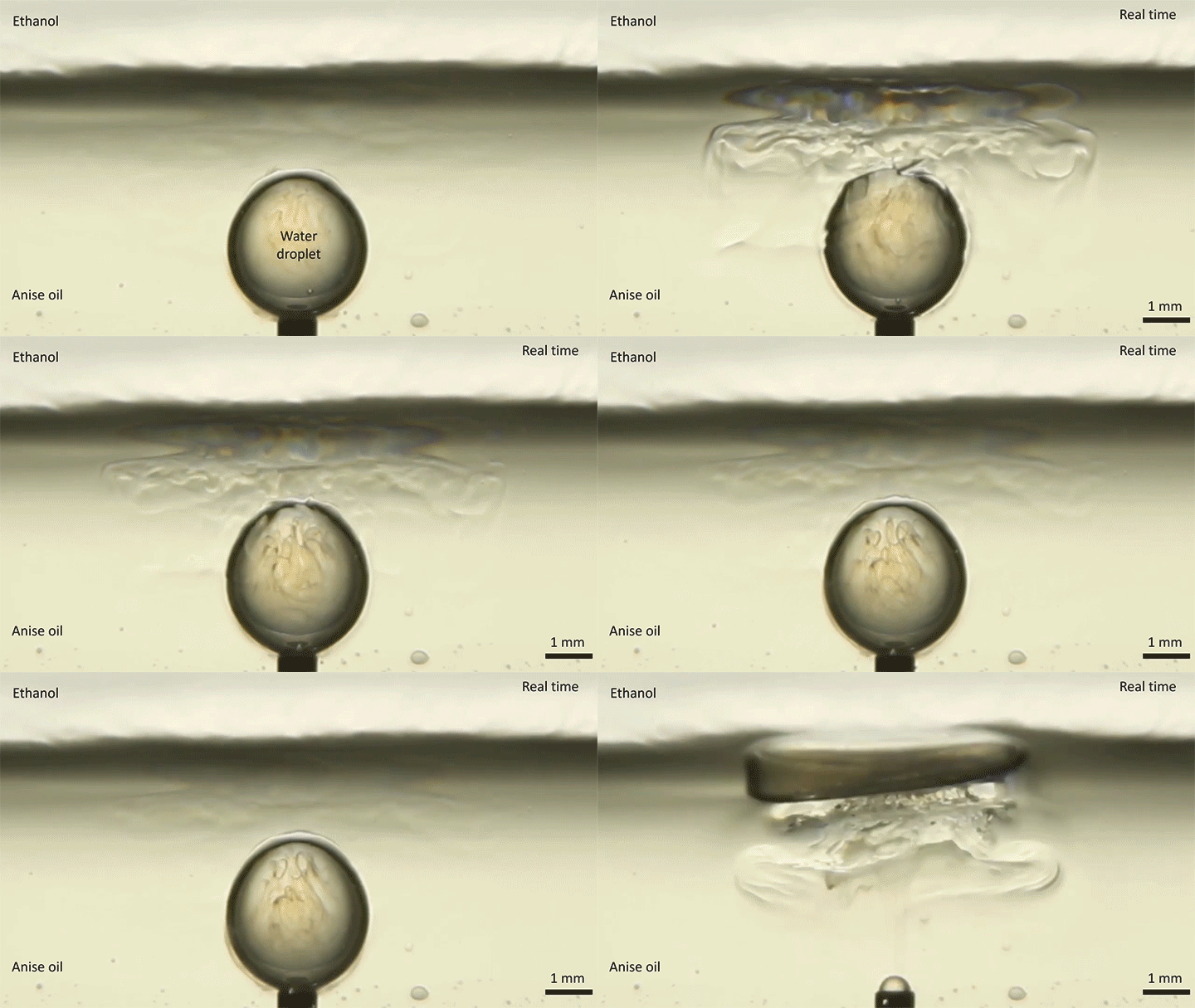
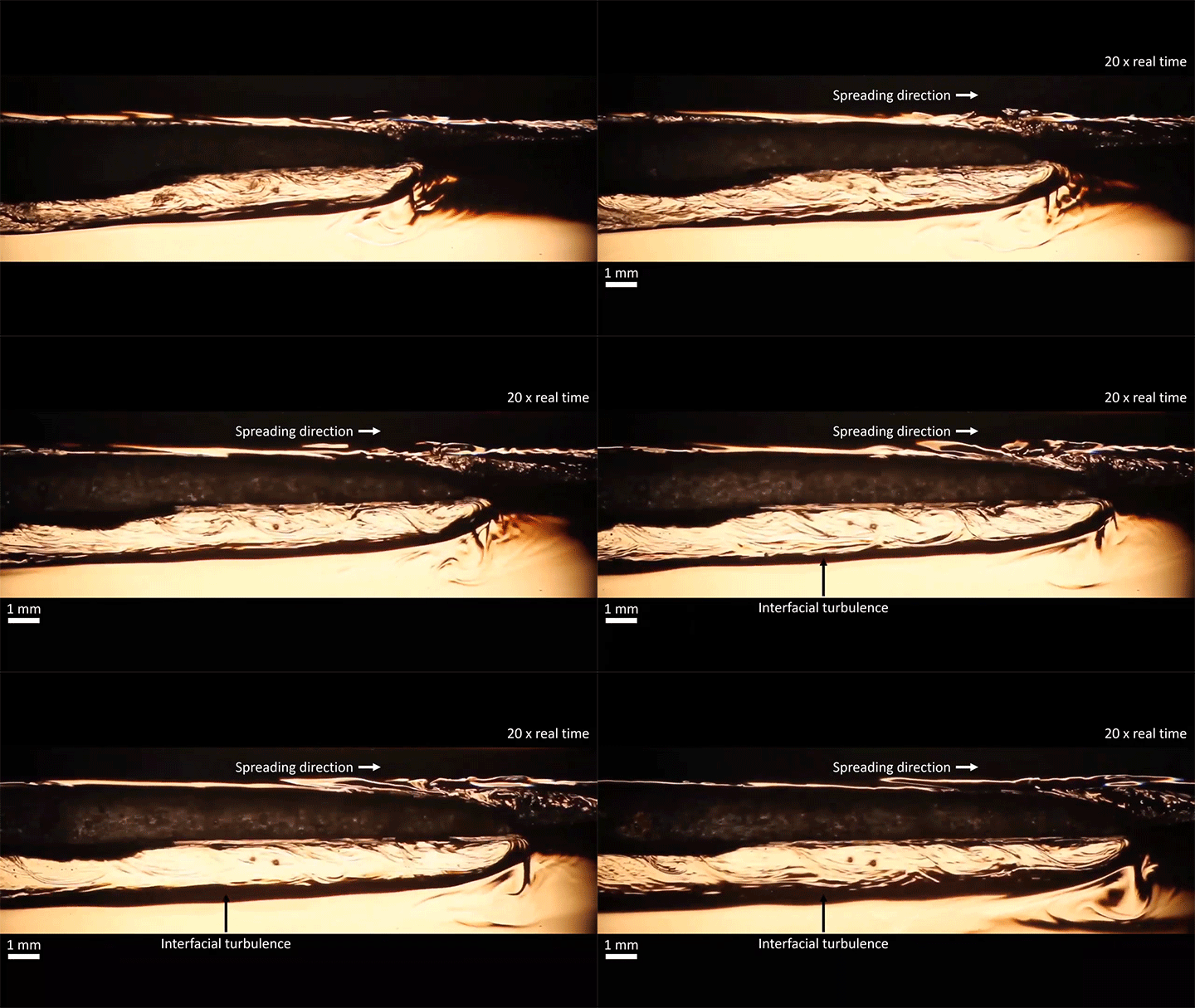
    A water droplet immersed in a mixture of anise oil and ethanol displays some pretty complicated dynamics. Its behavior is driven, in part, by the variable miscibility of the three liquids. Water and ethanol are fully miscible, anise oil and ethanol are only partially miscible, and anise oil and water are completely immiscible. These varying levels of miscibility set up a lot of variations in surface tension along and around the droplet, which drives its stretching and eventual jump.

    Once detached, the droplet takes on a flattened, lens-like shape that continues to spread. That spreading is driven by the mixing of ethanol and water, which generates heat and, thus, convection around the drop. This not only spreads the droplet, it causes turbulent behavior along the drop’s interface. (Image and video credit: S. Yamanidouzisorkhabi et al.)

  • Featured Video Play Icon

    A Dance of Hydrogen Bubbles

    Hydrogen bubbles rise off zinc submerged in hydrocholoric acid in this short film from the Beauty of Science team. In high-speed video, the rise of the bubbles is stately and mesmerizing. Notice how the smallest bubbles appear as perfect spheres; for them, surface tension is strong enough to maintain that spherical shape even against the viscous drag of their buoyant rise. Larger bubbles, formed from mergers both seen and unseen, have a harder time staying round. In them, surface tension must battle gravitational forces and drag from the surrounding fluid. (Image and video credit: Beauty of Science; via Laughing Squid)

  • The Physics of Al Dente

    The Physics of Al Dente

    It’s a simple weeknight routine: toss a handful of spaghetti noodles in boiling water, wait a few minutes, and enjoy with the sauce of your choice. But there’s a surprising amount of physics in the humble strand of spaghetti, and a new model focuses on the way spaghetti sags and curls as it cooks.

    Spaghetti, like most pastas, is made of semolina flour mixed with water, extruded (in commercially produced spaghetti), and then dried. Once immersed in water, the rod of pasta begins to swell and soften as water works its way slowly inward. At the same time, it will lose some of its starches to the surrounding water. If the water is hot enough, the pasta undergoes an additional process, starch gelatinization, which is responsible for cooked pasta’s characteristic texture. That perfect al dente condition occurs right as the hydration front reaches the pasta’s core.

    As all of this happens, the initially straight spaghetti strand sags, settles, and curls. Researchers found that, even with a relatively simple model that assumes spaghetti doesn’t stick to the pot, they could capture shape change of individual spaghetti strands, suggesting it’s possible to identify perfectly cooked pasta by shape alone. (Image credit: Pixabay; research credit: N. Goldberg and O. O’Reilly; via Ars Technica)

  • The Best of FYFD 2019

    The Best of FYFD 2019

    2019 was an even busier year than last year! I spent nearly two whole months traveling for business, gave 13 invited talks and workshops, and produced three FYFD videos. I also published more than 250 blog posts and migrated all 2400+ of them to a new site. And, according to you, here are the top 10 FYFD posts of the year:

    1. The perfect conditions make birdsong visible
    2. Pigeons are impressive fliers
    3. The water anole’s clever method of breathing underwater
    4. 100 years ago, Boston was flooded with molasses
    5. The BZ reaction is some of nature’s most beautiful chemistry
    6. The labyrinthine dance of ferrofluid
    7. 360-degree splashes
    8. The extraordinary flight of dandelion seeds
    9. Dye shows what happens beneath a wave
    10. Bees do the wave to frighten off predators

    Nature makes a strong showing in this year’s top posts with five biophysics topics. FYFD videos also had a good year: both my Boston Molasses Flood video and dandelion flight video made the top 10!

    If you’d like to see more great posts like these, please remember that FYFD is primarily supported by readers like you. You can help support the site by becoming a patronmaking a one-time donation, or buying some merch. Happy New Year!

    (Image credits: birdsong – K. Swoboda; pigeon take-off – BBC Earth; water anole – L. Swierk; Boston molasses flood – Boston Public Library; BZ reaction – Beauty of Science; ferrofluid – M. Zahn and C. Lorenz; splashes – Macro Room; dandelion – N. Sharp; dyed wave – S. Morris; bees – Beekeeping International)

  • Featured Video Play Icon

    Envisioning Chemical Patterns

    One of the most beautiful chemical reactions is the Belousov–Zhabotinsky reaction, and it’s the subject of the latest video from Beauty of Science. Known colloquially as the BZ reaction, it begins as growing spots of color that turn into rings and chaotic spirals as the chemical reaction progresses.

    Mathematically, the BZ reaction is a type of reaction-diffusion system, meaning that the patterns we see depend both on the speed of local chemical reactions and the time necessary for chemical reagents to move (or diffuse) throughout the dish. Although the diffusion in these systems can simply be the random wandering of molecules, fluid dynamics also plays a role. Variations in chemical concentration between different regions of the reaction drive fluid flows that continue to feed the pattern-making until all the reagents are consumed. (Image and video credit: Beauty of Science; via PetaPixel; submitted by clogwog)

  • Featured Video Play Icon

    Getting Cold

    Just as some chemical reactions produce heat, many chemical combinations absorb heat. In “Getting Cold,” the Beauty of Science team demonstrates this by showing endothermic processes in both visible and infrared light. Combinations that appear humdrum from our normal perspective suddenly become vibrant and interesting when we see the temperature variations accompanying them. 

    Evaporation is a good example. As humans, we sweat so that when our sweat evaporates off our skin, it takes heat away with it. Water (the main ingredient in sweat) isn’t the fastest evaporating liquid, however. Here it’s shown alongside ethyl acetate, a common ingredient in nail polish remover. And anyone who’s used nail polish remover is familiar with the chill it leaves behind as it evaporates. Just look how much colder and darker it is when evaporating! (Video and image credit: Beauty of Science)

  • Featured Video Play Icon

    Ink Explosion

    Sometimes beautiful flows come from simple combinations. Here the artists of Chemical Bouillon combine ink and hydrocarbons to create lovely explosions of color. Eschewing quick cuts between views, they allow us to linger and explore the flow ourselves as it changes. Differences in surface tension drive streaming flows along the surface, but there seem to be some chemical reactions contributing as well. Watch along the edges and you may even see convection pulling ink down and back. The whole video is only 2 minutes long and worth a full watch. (Image and video credit: Chemical Bouillon)

  • Featured Video Play Icon

    The Beauty of Flames

    The flickering yellow and orange flames most of us are used to thinking of are rather different from the flames researchers study. In this video, the Beauty of Science team offers a short primer on different flame shapes studied in combustion, including laminar, swirling, and jet flames. Each has its own distinctive character and may be advantageous or not, depending on the application for the flame. A laminar flame, for example, is steady, which might make it a good choice for something like a Bunsen burner, where consistency is needed. Whereas a turbulent flame is better capable of mixing fuel and oxidizer, which is key in applications like rocket engines, where that mixing can be a limiting factor in the engine’s efficiency. (Image and video credit: Beauty of Science)

  • Featured Video Play Icon

    Agnes Pockels: Surface Science Pioneer

    Today’s FYFD video tells a story I’ve wanted to share for a couple of years now. It’s about the life and work of Agnes Pockels, a woman born in the mid-nineteenth century who, despite a lack of formal scientific training, made major contributions to the understanding of surface tension and to the experimental apparatuses and methodologies used in surface chemistry in general. She accomplished all of this not in a scientific lab, but from her kitchen.

    Pockels’ story is one of curiosity, determination, and meticulous scientific inquiry. Chances are that you’ve never heard of her, but you really should. Check out the full video below to learn more! (Image and video credit: N. Sharp)

  • Bubbling

    Bubbling

    Many chemical reactions produce gases as a stream of bubbles out of a solution. Here we see the electrolysis of an aqueous sodium hydroxide solution (NaOH), which produces hydrogen gas on the cathode (left) and oxygen gas on the anode (right). In timelapse, the gas bubbles nucleate on the electrode, slowly growing larger. Once the the bubbles are large enough to detach, though, they rise so quickly they look like they disappear! The large buoyant forces on them drive that brief journey to the surface. By contrast, the smaller bubbles rise slowly, held back by their lesser buoyancy and the viscous drag they experience. (Video and image credit: Beauty of Science)