Tag: chemistry

  • Featured Video Play Icon

    Inksplosion

    Chemical Bouillon are a trio of artists who use the chemistry of surface reactions to create abstract videos full of exploding and imploding droplets and colors. As chemicals react, local concentrations at the interface vary, which changes the local surface tension. These gradients drive flow from areas of low surface tension to those of higher surface tension. This is called the Marangoni effect – the same behavior that drives tears in a glass of wine. Chemical Bouillon have a whole YouTube channel dedicated to these kinds of videos, with everything from inks to ferrofluids. Be sure to take a look at some of their other videos and, if you like them, subscribe. (Video credit: Chemical Bouillon)

  • Fluids Round-up – 24 August 2013

    Fluids Round-up – 24 August 2013

    Fluids round-up time! Here are your latest fluids links to check out:

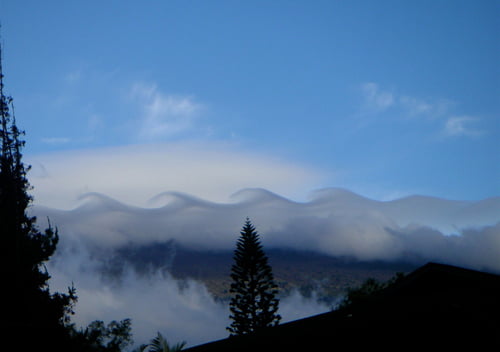
    (Photo credit: G. Pretor-Pinney)

  • Featured Video Play Icon

    Levitation By Sound

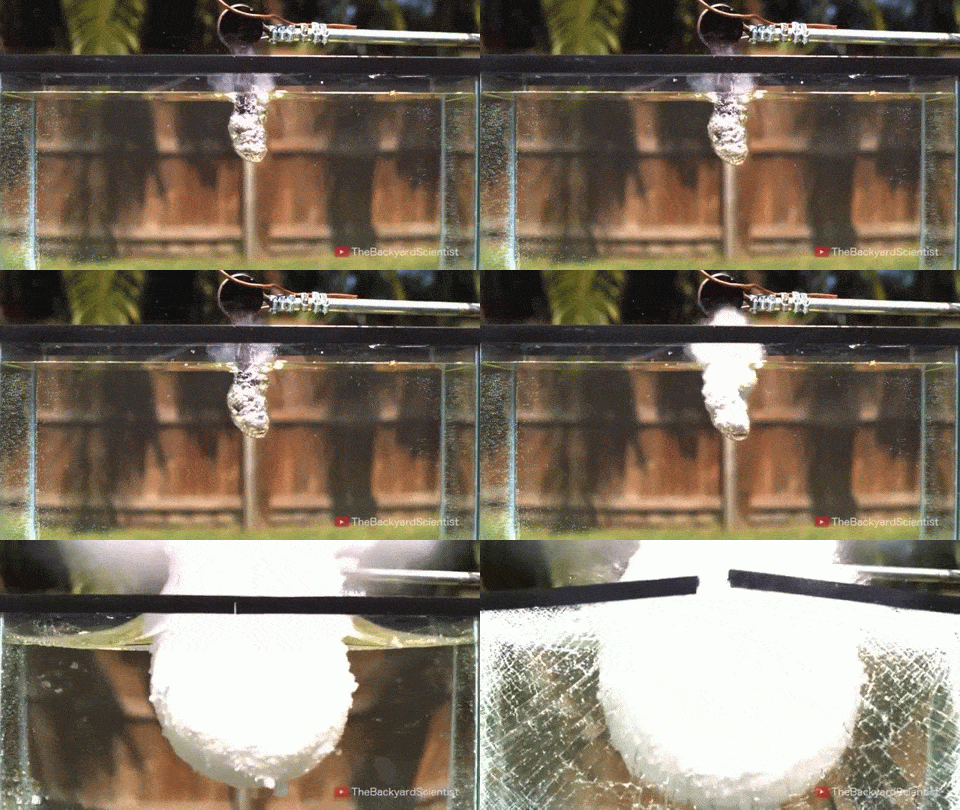
    Levitation is an effect usually associated with electromagnetic forces, but it’s possible with sound as well. This acoustic levitation is achieved by using the pressure from sound waves to balance gravity’s effect. By manipulating the sound, it’s possible to bring separate objects together while continuing to levitate them. The behavior is demonstrated in the video above by combining solid sodium with a drop of water for what any high school chemist will tell you is a spectacular reaction. (Though, if that’s too small-scale for you, there’s also this video.) (Video credit: D. Foresti et al; via SciAm)

  • Featured Video Play Icon

    Dribbling Droplets

    Ethanol droplets on a hot copper plate bounce under the influence of electrostatic forces from a charged rod. The temperature of the plate is high enough that the droplet is supported by a thin vapor film, which is what keeps it from wetting the plate.  Ethanol does not have the strong polarity that water does, but the hydroxyl group on one end does make it susceptible to the electrostatic charge built up on the teflon rod.  As a result, the droplets oscillate under electrostatic and gravitational forces, resulting in a dribbling effect. (Video credit: S. Wildeman et al.)

  • Featured Video Play Icon

    Turing Patterns

    Turing patterns form as a result of a particular kind of chemical reaction: a reaction-diffusion system. It consists of an activator chemical capable of making more of itself, and an inhibitor chemical which slows the production of the activator as well as a mechanism for diffusing the chemicals. Although Turing’s original work was theoretical in nature, scientists have since proven that Turing patterns do occur in nature, both in petri dishes and in the markings of animals. Here artist Jonathan McCabe explores multi-scale Turing patterns in a fluid-like environment. (Video credit: Jonathan McCabe and Jason Forrest; submitted by Stuart R)

  • Featured Video Play Icon

    Moving Droplets with Electric Fields

    Many microfluidic devices employ techniques that manipulate droplet motion for applications like sorting, manufacturing, or precisely controlling chemical reactions at a small scale. The video above shows the oscillations of a droplet on an inclined surface as it is perturbed with an electric field. (Video credit and submission: K. Nichols)

  • Featured Video Play Icon

    Supercritical Fluids

    supercritical fluid exists without a distinct liquid or gas phase and forms when temperatures and pressures exceed the substance’s critical point. Here supercritical transition is demonstrated with an ampule of liquid chlorine. When immersed in a hot bath, the temperature and pressure inside the ampule rises until around 0:20 when the meniscus marking the interface between liquid and gas disappears. The chlorine is now in its supercritical state. Around 0:43 the hot bath is removed and the chlorine begins to cool, reverting to distinct phases of matter around 0:55.

  • Feynman: The Universe in a Glass of Wine

    Some wisdom for you this Friday from the incomparable Richard Feynman:

    A poet I think it is who once said the whole universe is in a glass of wine. I don’t think we’ll ever know in what sense he meant that for the poets don’t write to be understood. But it is true that if you look at a glass of wine closely enough, you’ll see the entire universe.

    There are the things of physics: the twisting liquid, the reflections in the glass, and our imagination adds the atoms. It evaporates, depending on the wind and weather. The glass is a distillation of the earth’s rocks and in its composition, as we’ve seen, the secret of the universe’s age and the evolution of the stars. What strange array of chemicals are in a wine? How did they come to be? There are the ferments, the enzymes, the substrates and the products, and there in wine was found great generalization: all life is fermentation. Nor can you discover the chemistry of wine without discovering, as did Pasteur, the cause of much disease. How vivid is the claret, pressing its existence into the consciousness that watches it?

    And if our small minds for some convenience divides this glass of wine, this universe, into parts: to physics, biology, geology, astronomy, psychology and all, remember that nature doesn’t know it. So we should put it all back together and not forget at last what it’s for. Let it give us one final pleasure more: drink it up and forget about it all.

    (submitted by @jerrodh)

  • Featured Video Play Icon

    Carboy Combustion

    Lighting a thin layer of ethyl alcohol in a jug produces some beautiful pulse jets and a moving wall of flame that shifts and flows according to the changing pressures inside the jug. Like the video’s author, we do NOT recommend trying this combustion demo yourself.

    As for the video’s questions, firstly, blowing into the jar helps the flame because humans do not exhale pure CO2. With regard to the second question, the interior of the jug is initially thinly coated in ethyl alcohol vapor. Combustion starts at the top of the jug and the sheet of flame moves downward as the fuel at the top is spent. As that flame moves downward, however, it’s heating the air inside the jug, which expands and is forced out the opening. When the flame goes out in the upper part of the jug, that does not mean all of the fuel has combusted, simply that the ratio of air/fuel is insufficient for continued combustion. I suspect the flame persists at this opening because the air/fuel mixture is concentrated at that point. Any residual ethyl alcohol in the container is forced out through that narrow opening, and the resulting concentration of fuel there may be high enough to keep the flame burning there. (idea submitted by davidbenque #)

  • Featured Video Play Icon

    Gelatin

    Gelatins are actually colloidal gels, or a liquid dispersed inside a solid, cross-linked network. The crosslinks give the gelatin structure, but much of its dynamic behavior remains reminiscent of fluid motion.