In this video, artist Jesse Zanzinger experiments with the lens-like refractive properties of bubbles. Though focused on the bending of light, there’s plenty here in terms of coalescence, surface tension, and miscibility. He has a similar video that includes a shot of his set-up here. (Video credit: J. Zanzinger)
Tag: bubbles

Dendritic Designs
Imagine a thin layer of viscous liquid sandwiched between two horizontal glass plates. Then pull those plates apart at a constant velocity. What you see in the image above is the shape the viscous fluid takes for different speeds, with velocity increasing from left to right and from top to bottom. For lower velocities, the fluid forms tree-like fingers as air comes in from the edges. At higher velocities, though, there’s a transition from the finger-like pattern to a cell-like one. The cells are actually caused by cavitation within the fluid. When the plates are pulled apart fast enough, the local low pressure in the fluid causes cavitation bubbles to form just before the force required to remove the plate reaches its peak. (Photo credit: S. Poivet et al.)

Explosions Underwater
Underwater explosions are, in general, much more dangerous than those in air. This video shows an underwater blast at 30,000 fps. During the initial blast, a hot sphere of gas expands outward in a shock wave. In air, some of the energy of this pressure wave would be dissipated by compressing the air. Since water is incompressible, however, the blast instead moves water aside as the bubble expands. Eventually, the bubble expands to the point where its pressure is less than that of the water around it, which causes the bubble to collapse. But the collapse increases the gas pressure once more, kicking off a series of expansions and collapses. Each bubble contains less energy than the previous, thanks to the loss of pushing the water aside. (Video credit: K. Kitagawa)
Gravity’s Effect on Bursting Bubbles
In a gravitational field, the pressure in a fluid increases with depth. You can consider it due to the weight of the fluid above. Outside of scuba diving or hiking at altitude, this effect is not one typically given much thought. But what effect can it have at a smaller scale? This video shows the collapse and rebound of three initially spherical cavitation bubbles inside a liquid. Each bubble is created in a different gravitational field – one in microgravity, one in normal gravity, and one at 1.8x Earth gravity. The bubble in microgravity remains axisymmetric and spherical, but the two bubbles recorded in gravitational fields develop jets during rebound. Even at a scale of only a few millimeters, gravity causes an imbalance in pressure across the bubble that creates asymmetry. (Video credit: D. Obreschkow et al.)

Under the Waves

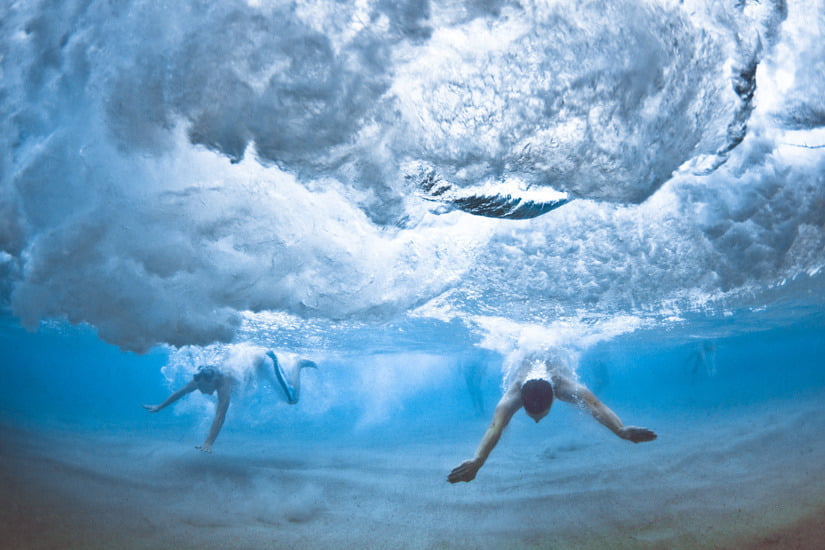


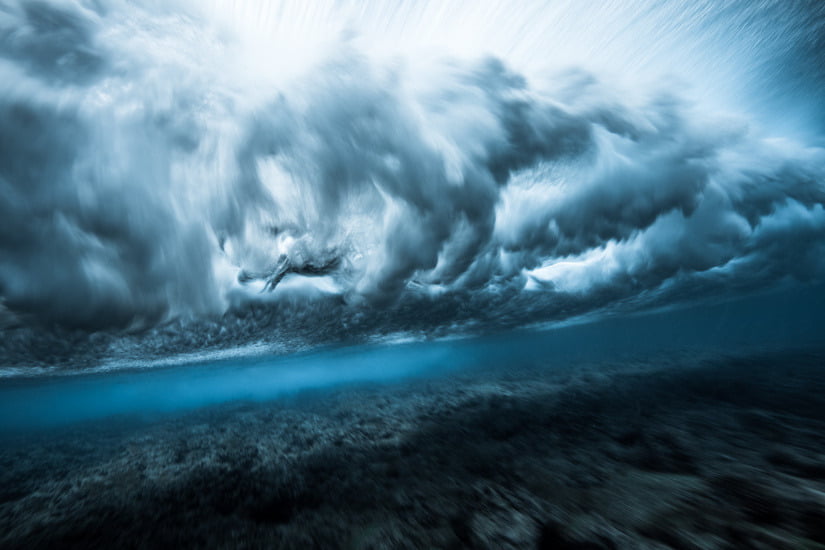
When I was a kid, I liked to dive underwater in the pool and sit at the bottom, looking up at the peculiar dancing sky the water made overhead. Photographer Mark Tipple takes it further, capturing images of the ocean from below the surface as waves roll in. His photos show swimmers and surfers diving to escape a roiling wave that, from below, bears a surreal similarity to the underside of a thundercloud in a summer storm. This is part of the beauty of fluid dynamics. Despite their differences, water and air obey the same physics. (Photo credits: Mark Tipple; via io9)

Frozen Methane Bubbles
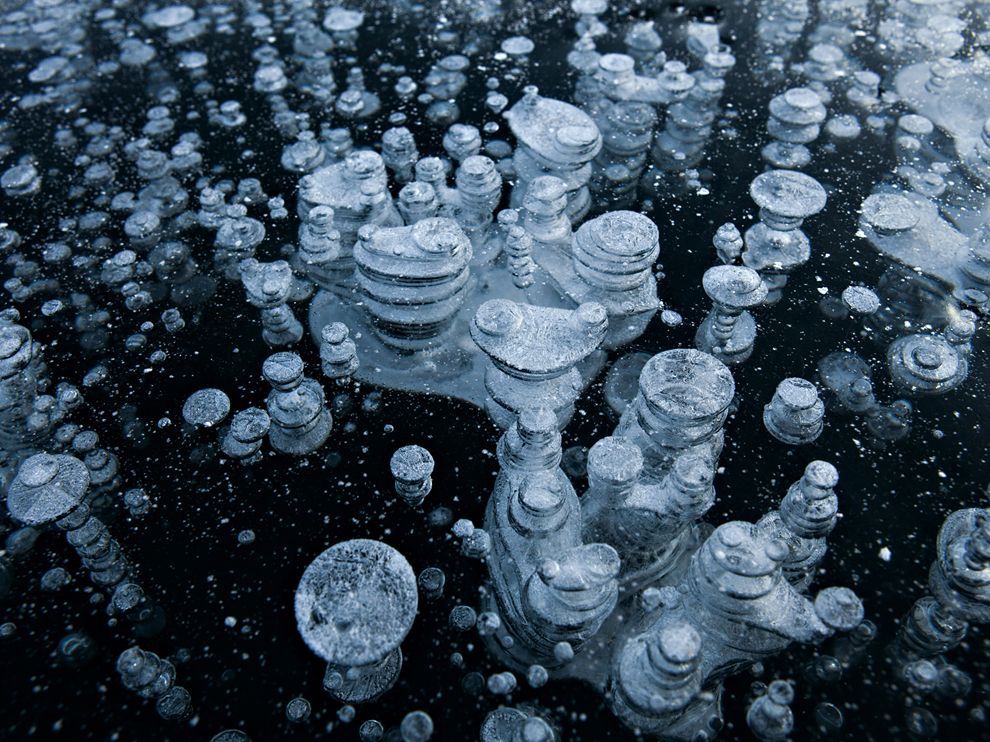
As the Arctic warms, methane that was previously trapped by permafrost rises from the muddy bottom of lakes to escape into the atmosphere. Here the first clear ice of the fall has trapped the rising methane bubbles, allowing scientists an opportunity to estimate the amount of methane being released. When spring arrives and the lakes melt, the methane will rise again. (Photo credit: M. Thiessen/National Geographic)
Champagne Science
Today many a glass of champagne will be raised in honor of the end of one year and the beginning of a new. This French wine, known for its bubbly effervescence, is full of fascinating physics. During secondary fermentation of champagne, yeast in the wine consume sugars and excrete carbon dioxide gas, which dissolves in the liquid. Since the bottle containing the wine is corked, this increases the pressure inside the bottle, and this pressure is released when the cork is popped. Once champagne is in the glass, the dissolved carbon dioxide will form bubbles on flaws in the glass, which may be due to dust, scratches, or even intentional marks from manufacturing. These bubbles rise to the surface, expanding as they do so because the hydrodynamic pressure of the surrounding wine decreases with decreasing depth. At the surface, the bubbles burst, creating tiny crowns that collapse into Worthington jets, which can propel droplets upward to be felt by the drinker. For more on the physics of champagne, check out Gerard Liger-Belair’s book Uncorked: The Science of Champagne and/or Patrick Hunt’s analysis. Happy New Year! (Video credit: AFP/Gerard Liger-Belair)
Freezing Bubbles
If you find yourself some place really cold this holiday season, may I suggest stepping outside and having some fun freezing soap bubbles? The crystal growth is quite lovely, as seen in this photograph. If you live in warmer climes, fear not, you can always experiment in your freezer. It would be particularly fun, I think, to see how a half-bubble sitting on a cold plate freezes in comparison to a droplet like this one. (Video credit: Mount Washington Observatory)
Supersonic Bubble Shock Waves
Supercomputing has been an enormous boon to fluid dynamics over the past few decades. Many problems, like the interaction between a supersonic shock wave and a bubble, are too complicated for analytical solutions and difficult to measure experimentally. Numerical simulation of the problem, combined with visualization of key variables, adds invaluable understanding. Here a shock wave strikes a helium bubble at Mach 3, and the subsequent interactions in terms of density and vorticity are shown. This situation is relevant to a number of applications, such as supersonic combustion and shockwave lithotripsy–a medical technique in which kidney stones are broken up inside the body using shock waves. After impact, an air jet forms and penetrates the center of the structure while the outer regions mix and form a persistent vortex ring. (Video credit: B. Hejazialhosseini et al.; via Physics Buzz)
Grooving Bubbles
Here bubbles in a microchannel are subjected to an external ultrasonic acoustic field. Under the influence of this vibration, the bubbles self-organize into crystal-like structures with a fixed finite separation distance. Some bubbles cluster and contact. Some bubbles also pulsate in star-shaped vibration modes. When the external sound is turned off, the bubble crystal loses form and drifts apart. For more, see Rabaud et al. 2011. (Video credit: P. Marmottant et al.)