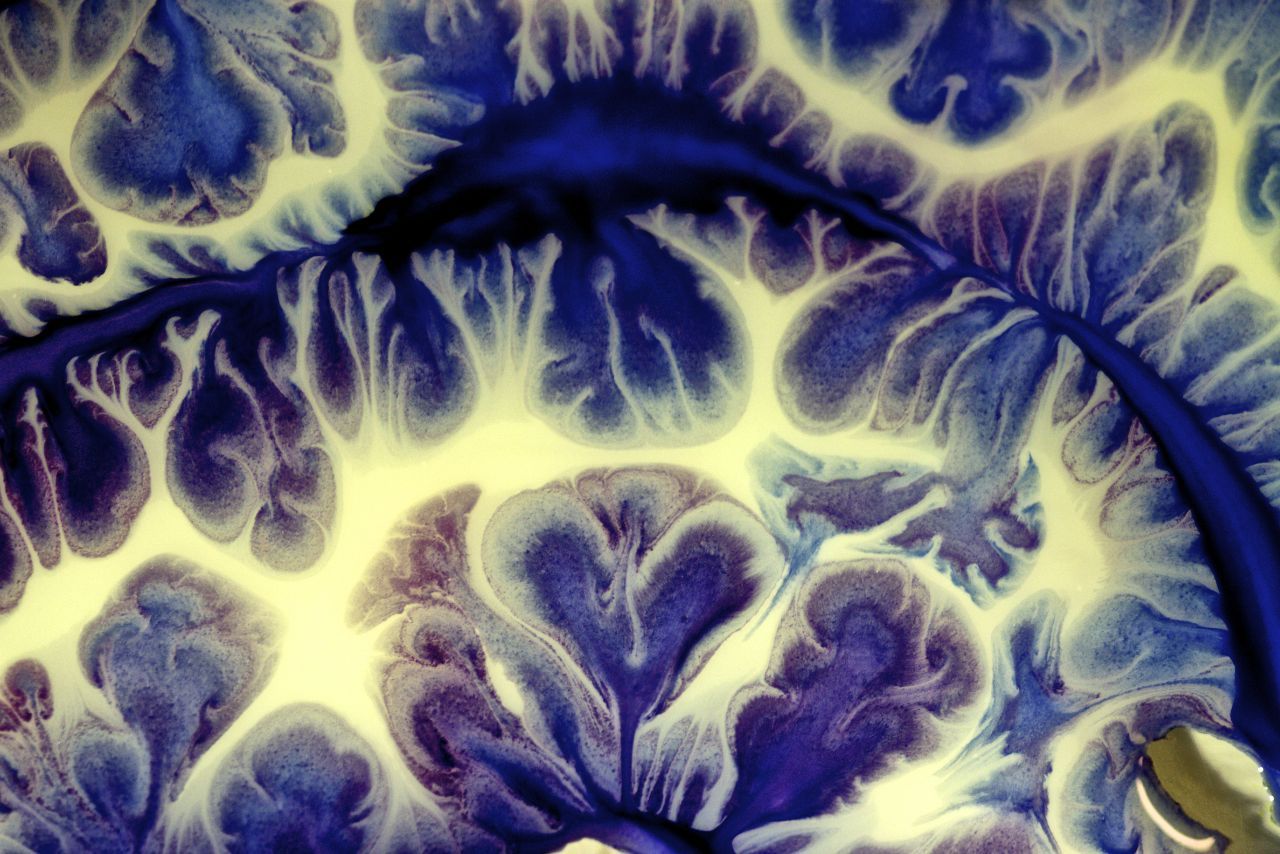
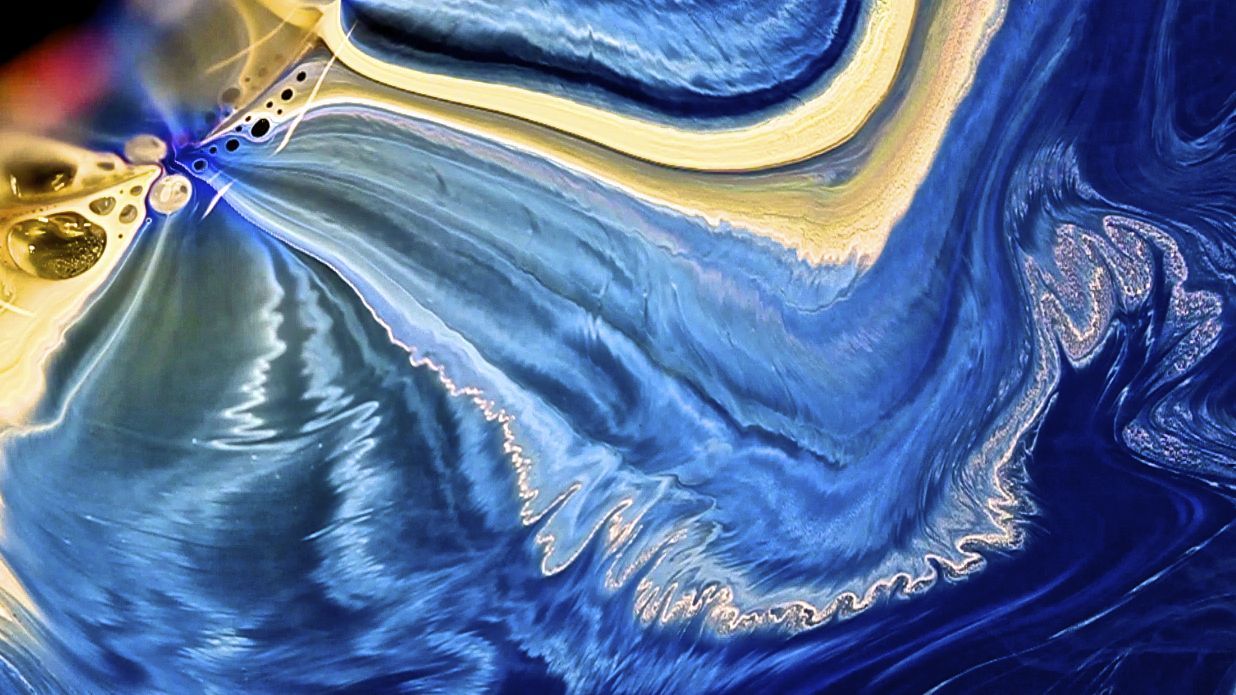
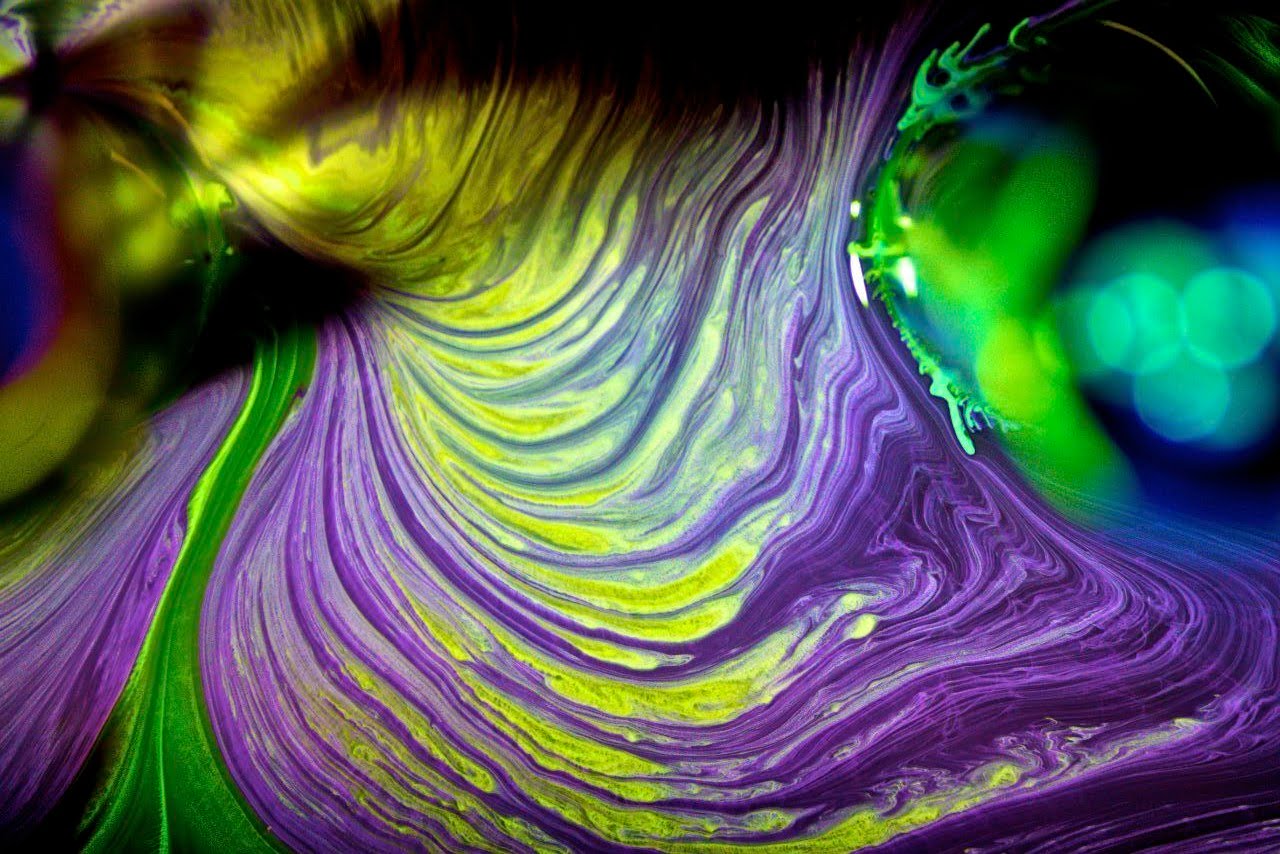
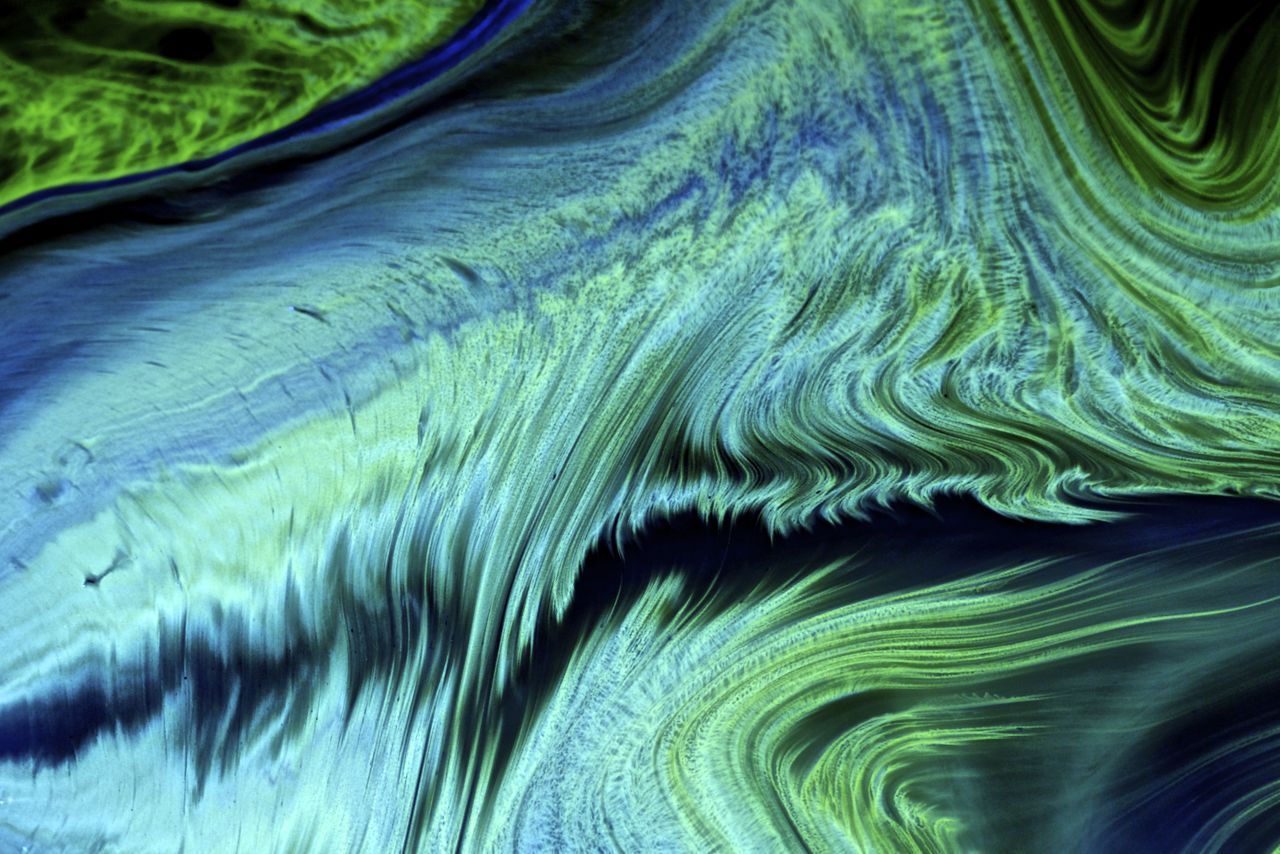
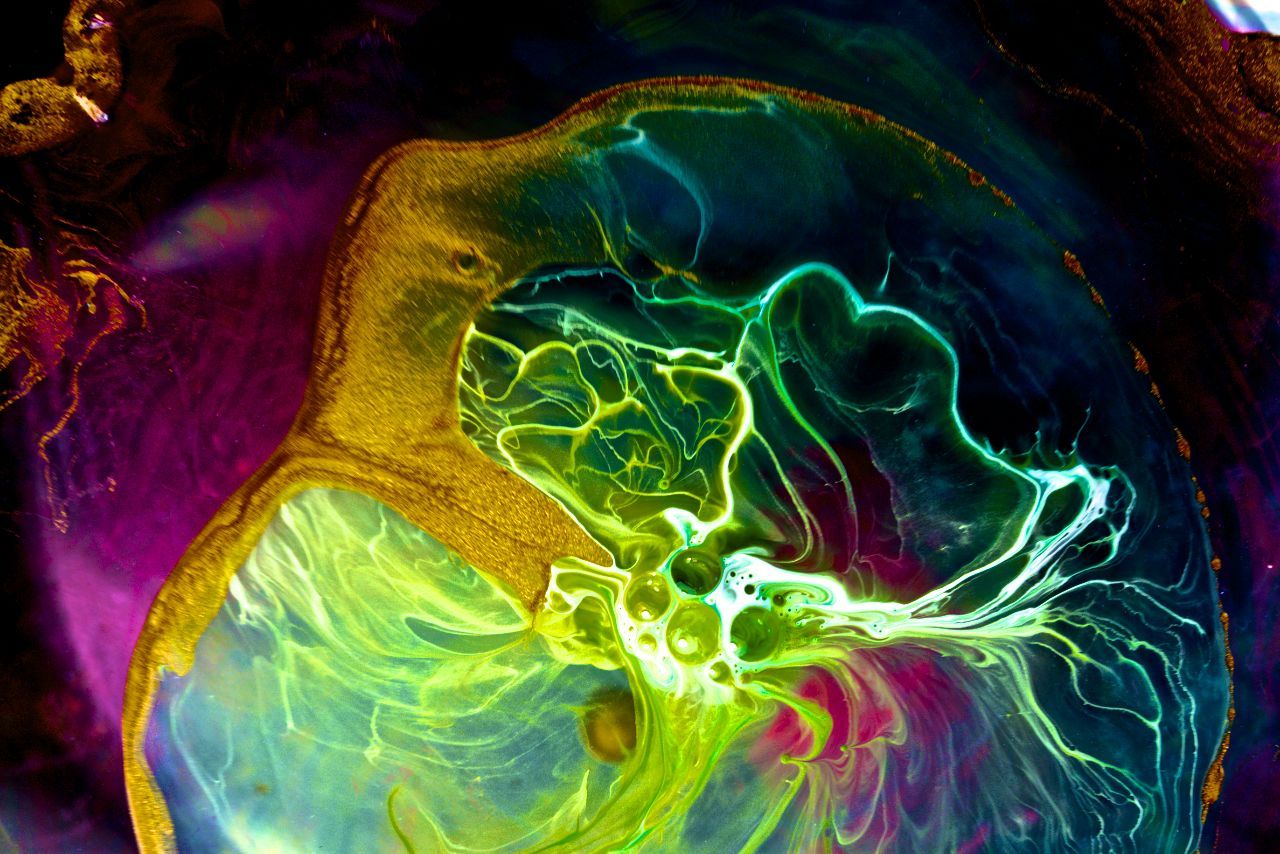
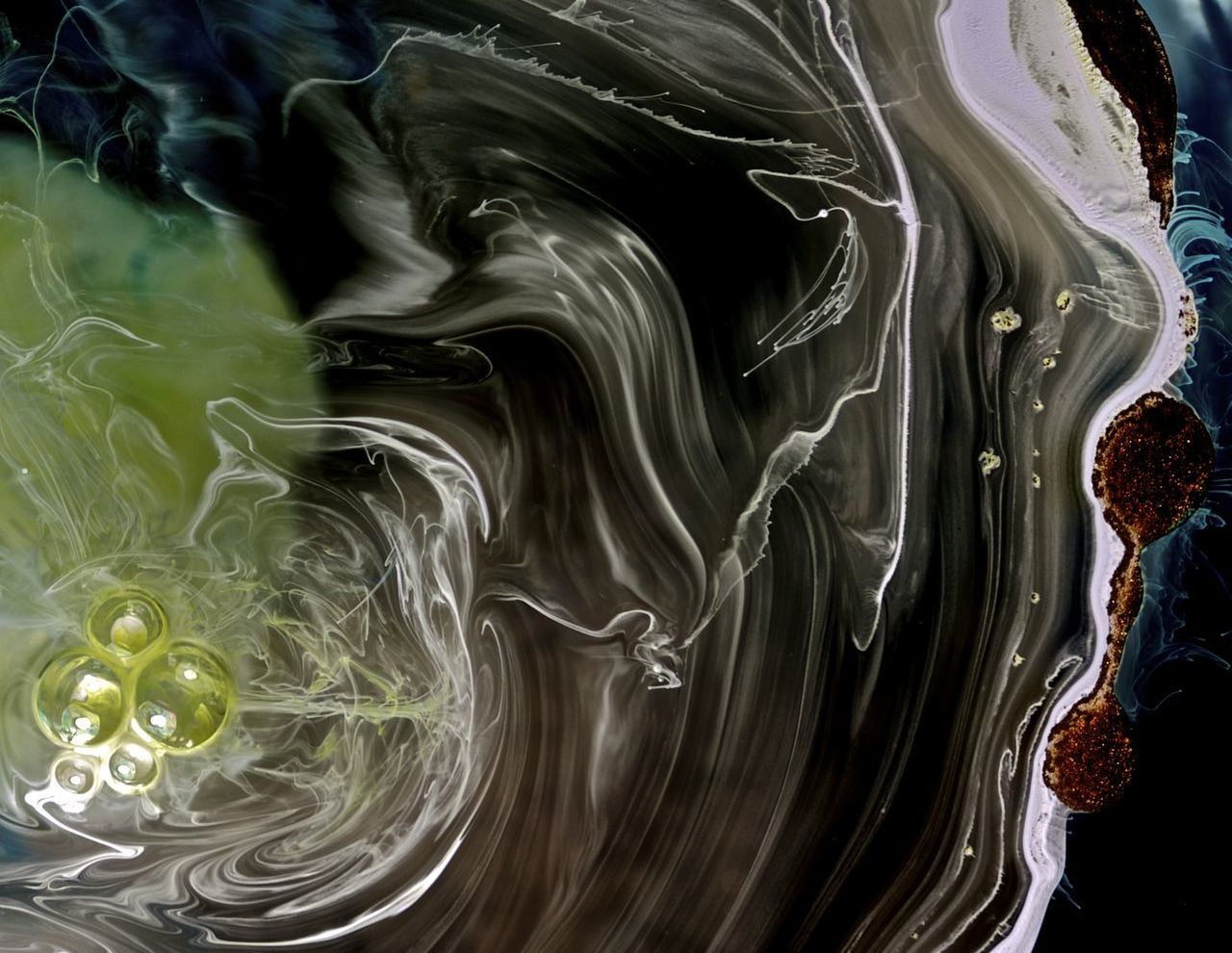
Exeter University artist-in-residence Pery Burge uses ink, water, soap films, and other fluids to create her spectacular “artistic flow visualization”. Looking closely, one sees the influence of bubbles, vortices, diffusion, and many fluid instabilities, all combined to create psychedelic and dream-like landscapes. For more on her work and additional galleries, see her website Chronoscapes. (Photo credit: Pery Burge)
Tag: bubbles

Bubbles and Jets

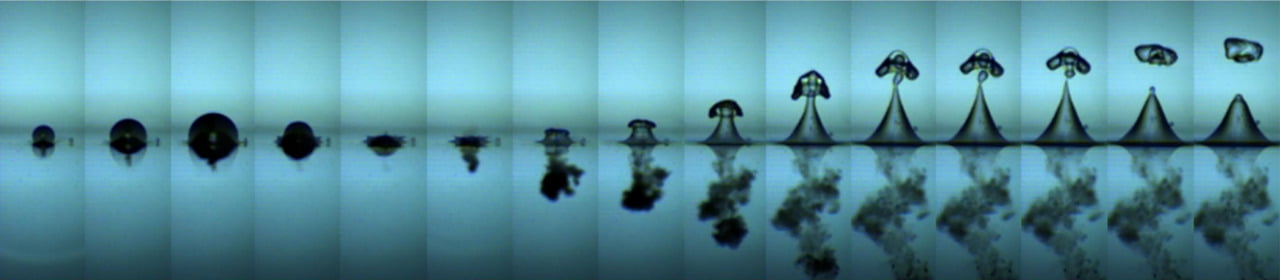
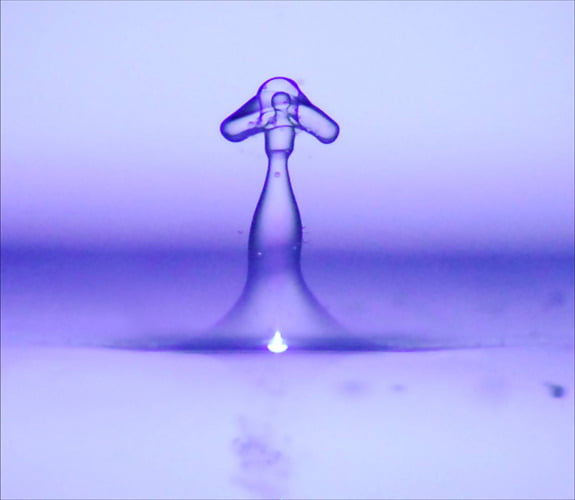
In the photo sequence above, a bubble is created at the interface between two immiscible liquids–water on top and denser hydrofluroether (HFE) below. Initially, the bubble expands explosively due to the vaporization of water generated by a short laser pulse. As the bubble collapses, a jet forms and accelerates into the HFE. After collapse, the bubble remnants injected in the HFE cause the formation of a jet that shoots back into the water above. Surface instabilities make the jet assume a mushroom or crown-like structure that detaches from the jet. Eventually gravity will return the system to its initial undisturbed fluid-fluid interface. (Photo credit: S. Avila et al. 1,2)

Bubble Art
Photographer Janet Waters uses liquids and bubbles to create her fascinating abstract macro art. Check out this interview with the artist and her portfolio for more. (Photo credits: Janet Waters)

“Compressed” Outtakes
Bubbles, viscosity, diffusion, capillary action, and ferrofluids all feature in the artistic experiments of Kim Pimmel. Be sure to check out his previous film featured here. (Video credit: Kim Pimmel)
Supercavitating Penguins
[original media no longer available]
Penguins, already fluid dynamicists by nature, have developed clever methods of increasing their speed to escape from the leopard seals that prey on them. In the clip above, notice from 1:55 onward as the penguins swim for the surface and leap onto the ice – they leave a trail of bubbles in their wake. The penguins are using supercavitation to decrease their drag. When the penguins first dive in to the water, they splay their feathers out in the air and then lock them closed in the water, trapping pockets of air beneath them. When the need for a burst of speed arises, the penguin shifts its feathers to release the air, coating most of its body in a layer of bubbles. Because the drag in air is much less than the drag in water, this enables the bird to achieve much higher speeds than they normally do when swimming.
Bursting Bubbles
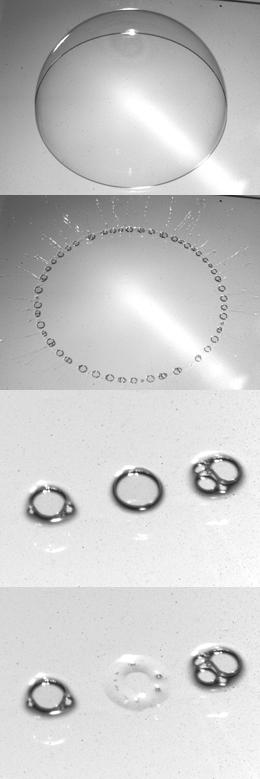
Sometimes bursting one bubble just leads to more bubbles. This high-speed video shows how popping a bubble sitting on a fluid surface can lead to a ring of daughter bubbles. When the surface of the bubble is ruptured, filaments of the liquid that made up the surface are drawn back toward the pool by surface tension, trapping small pockets of the air that had been inside the bubble. A dimple forms on the surface and rebounds as a jet that lacks the kinetic energy to eject droplets. Watch as the jet returns to the interface, and you will notice the tiny bubbles around it. At 56 ms, one of the daughter bubbles on the left bursts. See Nature for more. (Video credit: J. Bird et al)

“Oil in Water”
There’s beauty even in something as simple as two immiscible fluids–oil and water–colliding. (Video credit: Shawn Knol)

Bullet Shock Wave and Cavitation
A 9mm bullet impacts a falling jet of water. High-speed video reveals the formation of a shock wave inside the jet. Because this shock wave is confined inside the jet, it causes strong secondary cavitation–the bubble that seems to explode in front of the bullet.

Soap Bubble Burst
High-speed video of a soap bubble being popped reveals the directionality of the process. Like a the rubber of a bursting balloon, the soap film rushes away from the point of rupture, disintegrating as the information about a sudden lack of surface tension is propagated across the remaining film surface. In this regard, it is much like what happens when you drop a slinky toy.

Microgravity Water Spheres
Here astronaut Don Pettit demonstrates the effects of rotation on a sphere of water in microgravity. Bubbles, being less dense than water, congregate in the middle of the sphere along its axis of rotation. Tea leaves, which are denser than the water, are thrown to the outside; this is the same concept used in a centrifuge for separating samples.