This fantastic music video by Kim Pimmel is a beautiful merger of art and fluid dynamics. Using household goods (and some slightly more exotic ferrofluid), the video shows how mesmerizing diffusion, buoyancy, Marangoni flow, and other fluid effects can be up close. It may also be the first time I’ve ever seen fluid dynamics–specifically bubbles–used as characters! Also be sure to check out some of his previous videos, many of which also feature cool fluid dynamics. (Video credit and submission: K. Pimmel)
Tag: bubbles

How Rain Gets Its Smell
Light rain after a dry spell often produces a distinctive earthy scent called petrichor that is associated with plant oils and bacteria products. How these chemicals get into the air has been unclear, but new research suggests that the mechanism may come from the rain itself. When water falls on a porous surface like soil, tiny air bubbles get trapped beneath the drop. These bubbles rise rapidly due to buoyancy and, upon reaching the surface, burst and release tiny droplets known as aerosols. Depending on the surface properties and the drop’s impact speed, a single drop can produce a cloud of aerosol droplets. The research team is now investigating how readily bacteria or pathogens in the soil can spread through this mechanism. Other human-focused research has already shown that these tiny aerosol droplets can persist in the air for remarkably long periods and may help spread diseases. (Video credit: Massachusetts Institute of Technology; research credit: Y. Joung and C. Buie; submitted by Daniel B and entropy-perturbation)

A Toast!
When you lift a glass of champagne or sparkling wine at midnight tonight, your nose and mouth will be greeted by a plethora of aromas, flavors, and sensations propagated by the tiny bubbles in the drink. Carbon dioxide dissolved in the wine gathers in a stream of tiny bubbles that rise at the center of the glass. (The bubbles form at the center because champagne glasses are often etched in a ring there to provide nucleation points where the bubbles can grow.) This stream of rising bubbles generates vortical motion in the glass that helps carry the carbon dioxide to the surface, where it is released when the bubbles burst. In the tall, thin champagne flute these vortices mix the entire contents of the glass, but, in a wider coupe, the vortices are confined to the center, leaving a stiller region along the glass’s edges. For those who find that a freshly poured flute of champagne stings their noses–a side effect of the high gaseous carbon dioxide concentration just after decanting–the wider coupe lowers the concentration at the glass’s lip and may provide a more pleasant experience for toasting the new year. (Image credit: F. Beaumont et al.)
Cavitation
[original media no longer available]
Cavitation–the formation and collapse of vapor-filled cavities within a liquid–occurs in a variety of natural and manmade applications. It can shatter bottles, wreak havoc with boat impellers, is used as a hunting mechanism by several shrimp species, and can even generate light and sound. It is the collapse of the cavitation bubble that can be so damaging, and this video shows how. In the experiment, researchers generate a cavitation bubble near the free surface–or, in other words, near the air-water interface. Pressure in the bubble is much lower than the pressure of the surrounding liquid, so the bubble collapses after the momentum from its initial generation is spent. Interaction with the surface generates a jet that projects downward and pierces the cavitation bubble as it collapses. As seen from 0:54 onward, the bubble’s collapse generates a shock wave that propagates outward from the bubble site. It’s this shock wave that so effectively damages materials and stuns underwater prey. (Video credit: O. Supponen et al.)

Beverage Bubbles Bursting
Fizzy drinks like soda and champagne have many bubbles which rise to the surface before bursting. When the film separating the bubble and the air drains and bursts, it leaves a millimeter-sized cavity that collapses on itself. That collapse creates an upward jet of fluid which can break into tiny aerosol droplets that disperse the aroma and flavor of the drink. Similar bubble-bursting events occur in sea spray and industrial applications, too. Researchers find that droplet ejection depends on bubble geometry and fluid properties such as viscosity. More viscous liquids, for example, generate smaller and faster droplets. Learn more and see videos of bubble-bursts at Newswise. (Image credit: E. Ghabache et al.)

Hydrofoil Cavitation
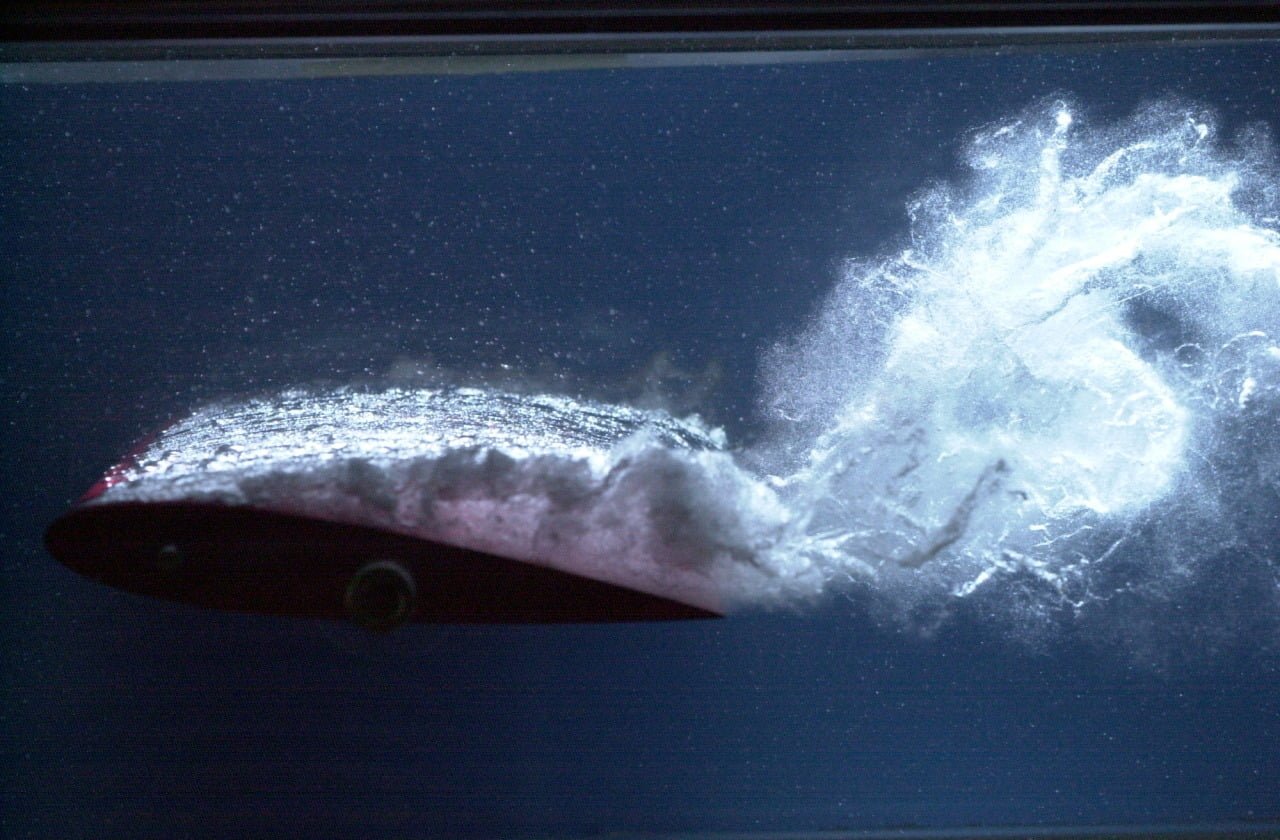
A cavitation-induced bubbly sheet flows over the upper surface of a hydrofoil in the image above. Cavitation can occur when local pressure in a liquid drops below the vapor pressure, causing a cavity to form. Due to its angle of attack, water flowing over the upper surface of the hydrofoil is accelerated. The high flow velocities and accompanying low pressures over the top of the hydrofoil produce cavitation bubbles which continue to flow over and off the surface. Because cavitation bubbles implode when the pressure again increases, they can cause serious damage to solid surfaces. This is why generating cavitation can damage propellers or shatter a bottle. (Photo credit: R. Arndt et al.)
Antibubble Vortex Rings
Bubbles are familiar, but antibubbles are a bit more unusual. An antibubble typically has a liquid-air-liquid interface, with a thin shell of air separating a liquid droplet from the surrounding fluid. Although they look rather like bubbles, antibubbles behave differently. Antibubbles are, for example, very sensitive to pressure changes. A sinking antibubble like the one in the video above, experiences a higher pressure on its lower face. This pressure compresses the gas shell and thins it on the bottom. The air shell bursts at the thin point and the antibubble collapses, generating two vortex rings and a small, buoyantly rising bubble. (Video credit: S. Dorbolo et al.)
P.S. – Hello, new followers! Where did you all come from?!

Champagne Bubble Physics
Champagne is well-known for its effervescence, but its tiny bubbles do more than affect your sensation when sipping. Champagne bubbles form when carbon dioxide dissolved in the wine nucleates along imperfections in the glass. Buoyancy causes them to flow upwards, growing as they pull more carbon dioxide from the surrounding champagne. When the bubbles reach the surface, they pop, sending an almost imperceptible fountain of tiny droplets into the air, as seen in the photo above. You can sometimes feel the droplets if you hold a glass near your face. The droplets released from the bursting champagne bubbles spread the aroma of the wine, imparting additional flavor through our olfactory sense. (Photo credit: F. Beaumont et al.)
Cavitation in a Bottle
This high-speed video shows the cavitation that occurs when a bottle of water is struck. The impact accelerates the bottle downward, generating localized vacuums between the glass and the liquid. These are cavitation bubbles, which expand until the pressure of the water surrounding them is too great. This outside pressure triggers an implosion of the bubble, which collapses until the pressure within the bubble makes it expand again. These rapid oscillations in pressure can often shatter the glass bottle. Cavitation can also generate extremely high temperatures and even trigger luminescence. It’s used by both pistol shrimp and mantis shrimp to hunt their prey. (Video credit: P. Taylor)

Bubble Vortices
Vortices appear in scales both large and small, from your shower and the flap of an insect’s wing to cyclones and massive storms on other planets. Especially with these large-scale vortices, it can be difficult to understand the factors that affect their trajectories and intensities over time. Here researchers have studied the vortices produced on a heated half bubble for clues as to their long-term behavior. Heating the base of the bubble creates large thermal plumes which rise and generate large vortices, like the one seen above, on the bubble’s surface. Researchers observed the behavior of the vortices with and without rotation of the bubble. They found that rotating bubbles favored vortices near the polar latitudes of the bubble, just as planets like the Earth and Saturn have long-lived polar vortices. They also found that the intensification of both bubble vortices and hurricanes was reasonably captured by a single time constant, which may lead to better predictions of storm behaviors. Their latest paper is freely available here. (Image credit: H. Kellay et al.; research credit: T. Meuel et al.; via io9)