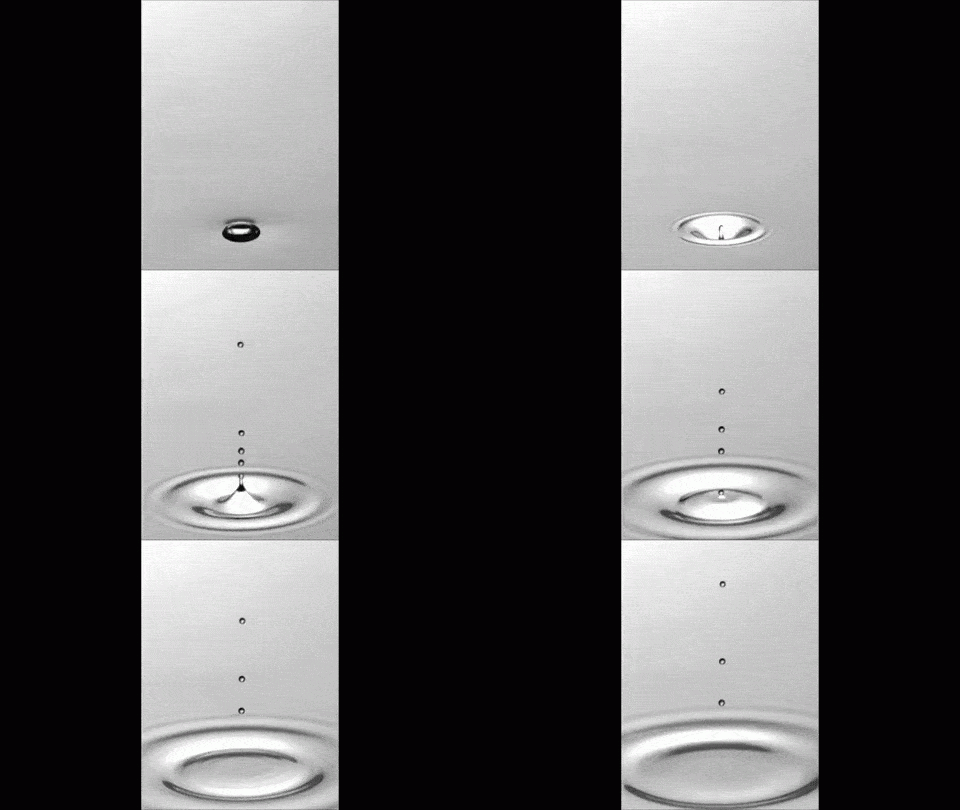
Our atmosphere is full of aerosols – extremely tiny particles and droplets of salt, dust, pollutants, and other substances. Wind’s effects alone cannot account for the sizes and quantities of aerosols we measure. Another potential source is the bursting of bubbles; more specifically, the bubbles that form at the oceans’ surface. Frothy, crashing waves often capture pockets of air. When these bubbles burst, the thin film of their surface ruptures into long filaments that break into tiny droplets. Such droplets can be small enough to get carried on the breeze, eventually evaporating and leaving the particulates that were once in the water to ride the winds. (Image credit: H. Lhuissier & E. Villermaux; see also: Y. Couder)
Tag: bubbles

“Bubble Circus”
The “Bubble Circus” is a delightful outreach device equipped for all manner of physics demos, as seen in the video above. Many of its exercises explore surface tension, a force observed at the interface of a fluid. Surface tension is what provides bubbles with their surface-minimizing spherical shape. That same property determines the minimal distance between the four vertices of a pyramid (0:54). Changing the surface tension causes fluid at the interface to move. At 1:16 adding a lower surface tension fluid makes the water and black pepper pull away; the same physics drives the boat away at 2:09. For more on the Bubble Circus, see here. (Video credit: A. Echasseriau et al.; via J. Ouellette)
Pearls of Mezcal
Mezcal is a traditional Mexican liquor distilled from agave. (The more commonly known tequila is actually a special type of mezcal.) As a part of the production process, distillers pour a stream of mezcal into a bowl, creating a flotilla of small bubbles called pearls. Strange as it sounds, these pearls let the distiller judge the alcohol content of the liquor! When the ratio of alcohol and water in the mixture is just right, the bubbles will have a longer lifetime before they coalesce. If there’s too little or too much alcohol, the bubbles won’t last as long. The effect depends on both the viscosity and the surface tension of the liquor, but it’s the odd way that viscosity changes in water/alcohol mixtures that creates this Goldilocks behavior. It’s a fascinating demonstration of how traditional techniques often have true scientific underpinnings. (Video credit: M. Wilhelmus et al.)

The Bubble Nebula
This spectacular Hubble image shows the Bubble Nebula. The source of this nebula is the star seen toward the upper left side of the bubble. This massive, super-hot star has ceased to fuse hydrogen and is now fusing helium, powering its way to a likely end as a supernova. As it burns, the star emits a stellar wind of gas moving at over 6.4 million kilometers an hour. As the flow moves outward, it encounters colder dense gases that it pushes along as it expands; this is the blue bubble surface that we see. The asymmetry of the bubble with respect to its source star is caused by the variation in the surrounding gas’s density. The bubble’s front moves more slowly in areas with more gas, thus making the bubble appear lop-sided. (Image credit: NASA; via Gizmodo)
Ode to Bubbles
Boiling water plays a major role in the steam cycles we use to generate power. One of the challenges in these systems is that it’s hard to control the rate of bubble formation when boiling. In this video, researchers demonstrate their new method for bubble control in a clever and amusing fashion. The twin keys to their success are surfactants and electricity. Surfactant molecules, like soap, have both a polar (hydrophilic) end and a non-polar (hydrophobic) end. By applying an electric field at the metal surface, the researchers can attract or repel surfactant molecules from the wall, making it either hydrophobic or hydrophilic depending on the field’s polarity. Since hydrophobic surfaces have a high rate of bubble formation, this lets the scientists essentially turn nucleation on and off with the flip of a switch! (Video credit: MIT Device Research Lab; see also: research paper, MIT News Video, press release)
Do you enjoy FYFD and want to help support it? Then please consider becoming a patron!

Miniature Bursting Bubbles
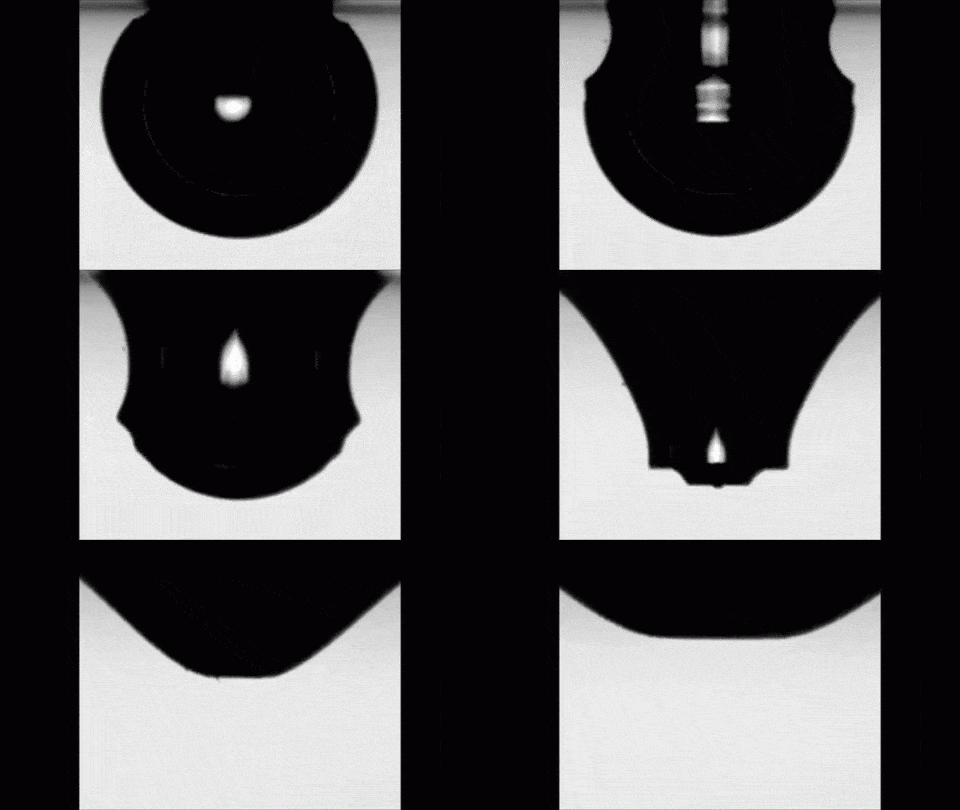
Fizzy drinks like soda or champagne contain dissolved carbon dioxide which forms bubbles when the pressure inside its container is released. The tiny bubbles rise to the surface where the liquid film covering them can rupture, creating a small cavity at the surface. The cavity collapses in a matter of milliseconds (bottom animation). Above the surface, the cavity reverses its curvature to create a liquid jet (top animation) which can expel multiple tiny droplets. These droplets can tickle a drinker who hovers too close, but they also carry and distribute the aroma molecules that are part of the experience of a drink like champagne. (Image credit: E. Ghabache et al., source)
(Today’s topic brought to you by my impending nuptials to my favorite physicist/spacecraft engineer.)
Bubbles and Hurricanes
You may think of soap bubbles as a childhood plaything, but there’s a lot to be learned from them. In her newest video, Dianna of Physics Girl explores some of the fascinating research scientists use soap bubbles for and how you can recreate some of their experiments at home. Scientists have used bubbles to explore how atmospheric vortices behave, how to tie knots in fluids, how grass waves in the wind, and even how explosive detonations occur. Just modeling bubbles and foams can be incredibly complex. It turns out the humble bubble has quite a lot to teach us. (Video credit: Physics Girl/PBS Digital Studios)
Carbonation in Space
Astronauts don’t typically drink soda or other carbonated beverages while in space. The reason is probably apparent if you watch this new video of an effervescent tablet in water on the space station (or, you could watch the older classic one from Don Pettit). Unlike on Earth, where the carbon dioxide bubbles are buoyant and rise to the surface, the bubbles in a fluid in microgravity are randomly distributed. Those few bubbles that happen to be located along the edge of the water sphere will sometimes burst, creating the halo of tiny droplets you see in the video. In the case of sodas, though, the bubbles’ behavior creates a foamy mess, and, after ingestion, the bubbles are stuck travelling through the astronaut’s digestive system instead of getting burped out. Sounds rather unpleasant to me. (Video credit: NASA; submitted by entropy-perturbation and buckitdrop)
——————
LAST CALL: Help us do some science! I’ve teamed up with researcher Paige Brown Jarreau to create a survey of FYFD readers. By participating, you’ll be helping me improve FYFD and contributing to novel academic research on the readers of science blogs. It should only take 10-15 minutes to complete. You can find the survey here.

Bubble Rupture
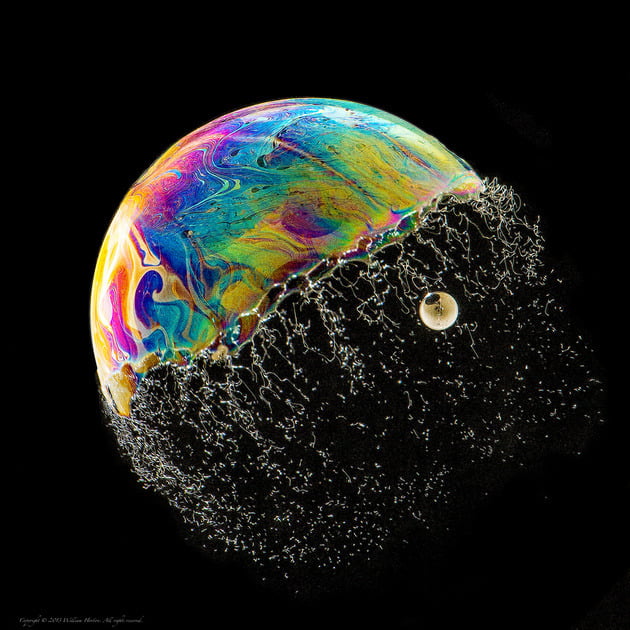
Surface tension draws bubbles into spheres, but the balance of forces holding the sphere together is delicate. When pierced by a projectile, sometimes soap films can heal themselves, but often the film ruptures. Once a hole forms in the bubble, the film’s integrity is lost. Instead of holding the bubble together, surface tension pulls the soap film apart in a spray of thread-like ligaments that break into droplets. In the blink of an eye, the bubble is gone. (Image credit: W. Horton)

Why Joints Pop
Joints like our knuckles are lubricated with liquid called the synovial fluid. When manipulated, these joints can pop or crack audibly. For half a century, researchers have thought the cracking sound joints under tension make was the result of bubbles in the synovial fluid collapsing. But a new cine magnetic resonance imaging (MRI) study shows that the sound is generated during bubble inception and that the cavity persists after the sound. When the bones of the joint are pulled, viscous forces resist their separation. With enough force, the joints separate suddenly, causing a pressure drop in the synovial fluid that forms a vapor-filled cavity in the joint. According to the real-time MRI observations, this is when the sound is generated. The cavity does eventually dissipate, they found, but only well after the pop. The whole joint-cracking process is consistent with the tribonucleation mechanism seen in machinery. (Image credit: G. Kawchuk et al.; GIF via skunkbear, source video)