
Being hot isn’t always enough to make water boil. To form vapor bubbles, water and other liquids need imperfections that serve as seeds. In the absence of these, the liquid can become superheated, reaching temperatures higher than its boiling point without forming bubbles. Superheated water can be quite dangerous because it appears to be cooler, but once it’s disturbed – thereby breaking its surface tension – vapor bubbles form rapidly and explosively. You can see in the animation above just how quickly and unsteadily a sudden vapor bubble expands as it rises to the surface. (Image credit: C. Kalelkar and K. Raj, source)
Tag: boiling

Exploding a Drop
Leidenfrost drops levitate over a hot substrate on a thin layer of their own vapor, constantly replenished as the drop evaporates. For the most part, previous studies have focused on pure droplets, but a new one looks at what happens when you add surfactants – and the results are, well, explosive.
Surfactants are a type of chemical that like to gather at the surface of a drop, and, unlike water, they’re nonvolatile – they don’t evaporate easily. So as the Leidenfrost drop evaporates and shrinks, the surface of the drop becomes more and more crowded with surfactant molecules. Eventually, they form an elastic shell around the remaining water, making evaporation more difficult.
Inside the droplet, the temperature continues to rise, eventually reaching a point where bubbles of vapor can nucleate inside. When that happens, the bubbles expand almost instantaneously and the internal pressure spike bursts the shell, causing the entire droplet to explode. (Image and research credit: F. Moreau et al.)

Boiling with Sound
Ultrasonic vibrations can boil nanoscale liquid layers, according to a new simulation-based study. Above you see a layer of water initially about 2 nm thick. When the surface it’s on vibrates at frequencies in the 100 GHz range – about a billion times faster than a hummingbird flaps – it superheats the thin layer of water. In this case, the film undergoes nucleate boiling, forming the same kinds of bubbles you see when boiling a pot of water. When the water layer gets too thin to support nucleate boiling, it stops boiling but evaporation continues. The transition occurs when van der Waals forces become significant. The technique only works with ultrathin layers of a liquid, but the authors envision broad application possibilities in industry as well as in micro- and nano-scale fluid systems. (Image and research credit, and submission: R. Pillai et al.)

Different Kinds of Boiling

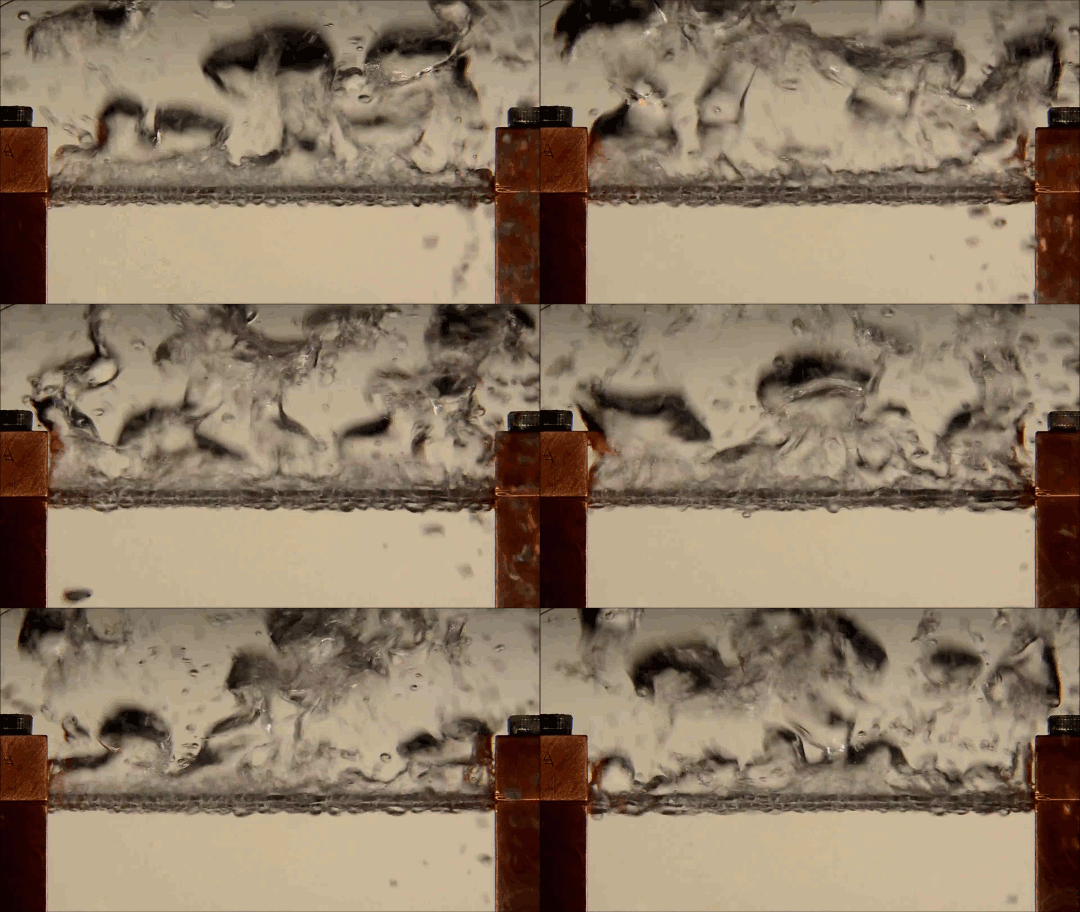

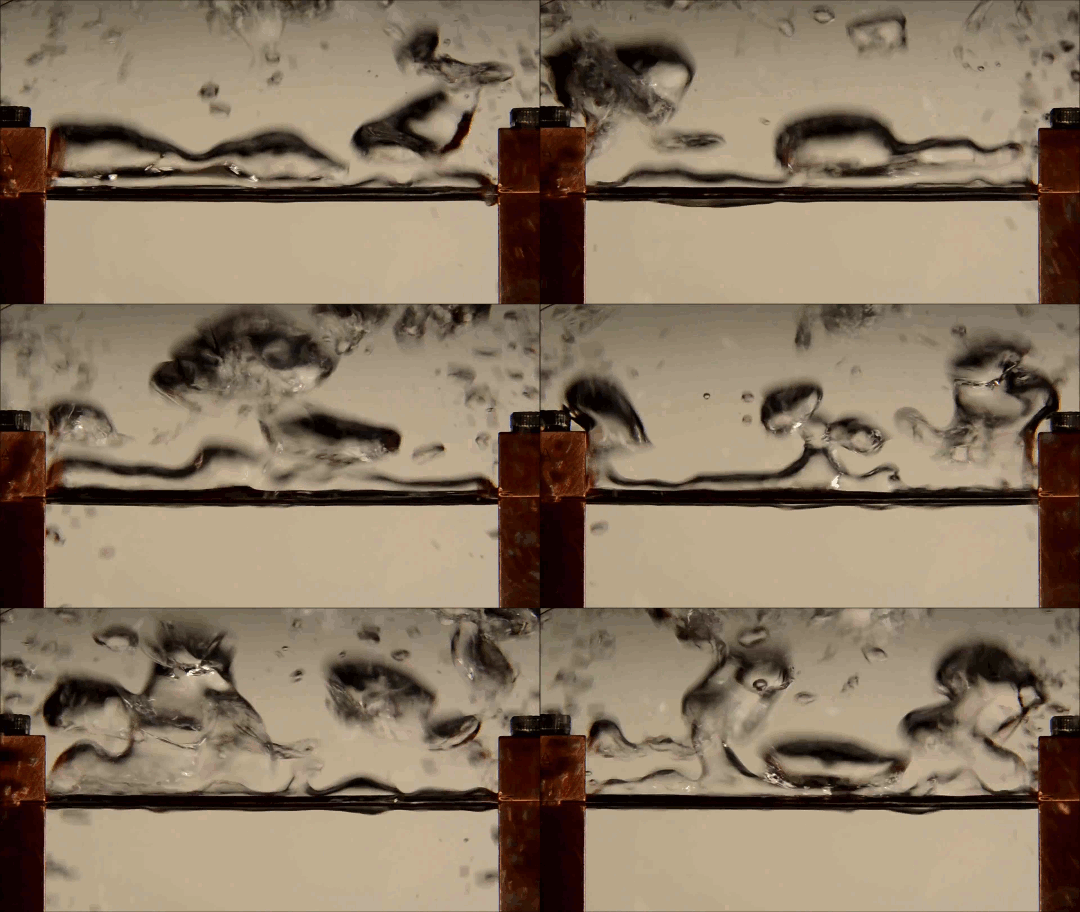
When you put a pot of water on to boil, you probably don’t give much thought to the process. In our daily lives, we pretty much only see one kind of boiling: the sort where lots of small bubbles form on a hot surface and then rise. That’s nucleate boiling (top image), and it’s typical when you have a surface close to the boiling point of a liquid.
But when you continue raising the temperature of the surface, you get a transition to a different boiling regime (middle image). In this final regime (bottom image), a film of vapor envelopes the heated surface; hence its name: film boiling. Because vapor is less efficient for heat transfer than a liquid, a surface undergoing film boiling can become much, much hotter because it cannot transfer its heat away efficiently. In this experiment, the tube starts at 375K during nucleate boiling and rises to a temperature nearly three times higher during film boiling. (Image credit: TSL, source)

Water on Mars
Recurring slope lineae (RSL) are seasonal features on Mars that leave behind gullies similar to those left by running water on Earth. Their discovery a few years ago has prompted many experiments at Martian conditions to determine how these features form. At Martian surface pressures and temperatures, it’s not unusual for water to boil. And that boiling, as some experiments have shown, introduces opportunities for new transport mechanisms.
Researchers found that water in “warm” (T = 288 K) sand boils vigorously, ejecting sand particles and creating larger pellets of saturated sand. Water continues boiling out of the pellets once they form, creating a layer of vapor that helps levitate them as they flow downslope. The effect is similar to the Leidenfrost effect with drops of water sliding on a hot skillet; there’s little friction between the pellet and the surface, allowing it to travel farther.
The mechanism is quite efficient in experiments under Earth gravity and would be even more so under Mars’ lower gravity. It also requires less water than alternative explanations. The pellets that form are too small to be seen by the satellites we have imaging Mars, but the tracks they leave behind are similar to the RSL seen above. (Image credit: NASA; research credit: J. Raack et al., 1, 2; via R. Anderson; submitted by jpshoer)

A Molecular View of Boiling
All matter is made up of molecules. But most of the time we treat fluids as materials with given properties – like density, viscosity, and surface tension – without worrying about the individual molecules responsible for those material characteristics. Now that we have much more powerful computers, though, we can begin to simulate fluid behavior in terms of molecules.
The animations above show some examples of this. In the top animation, we see a gas condensing into a liquid. As the temperature decreases, molecules start clumping together, and eventually settle into a droplet on the solid surface. The lower animation shows the opposite situation – boiling – in which bubbles of vapor nucleate next to the solid surface and grow as more liquid changes phase. To see more examples, including droplets pinching off, check out the full video. (Image credit: E. Smith et al., source; submitted by O. Matar)
Daily Fluids, Part 3
A lot of the fluid dynamics in our daily lives centers around the preparation and consumption of food. (And in its digestion afterward, but that’s another story!) Here are a few examples of fluid dynamics you might not have realized you’re an expert on:
Low Reynolds Number Flows
This is a fancy way of discussing the motion of syrup, honey, and other thick and viscous fluids we interact with in our lives. These flows are typically slow moving and exhibit some neat properties like coiling or being possible to unstir.Immiscible Fluids
Oil and water don’t mix, a fact anyone familiar with salad dressings or marinades is well aware of. The way around this is to shake them up! This disperses droplets of the oil within the water (or vinegar or whatever) to create an emulsion. While not truly mixed, it does make for more pleasant eating.Multiphase Flows
Multiphase flows are ones containing both liquid and gaseous states. Boiling is an example we often see in our daily lives, though carbonated beverages, water sprayers, and sneezes are other common ones.Leidenfrost Effect
The Leidenfrost effect occurs when liquid is introduced to a surface that is much, much hotter than its boiling point. Part of the liquid instantly vaporizes, leaving droplets to skitter around on a thin vapor layer. This is most often seen around the stove and in skillets. (And, yes, it does qualify as a multiphase flow!)Tune in all week for more examples of fluid dynamics in daily life. (Image credit: S. Reckinger et al., source)
P.S. – I’m at VidCon (@vidconblr) this year! If you are, too, come say hi and get an FYFD sticker 😀

Boiling on Mars
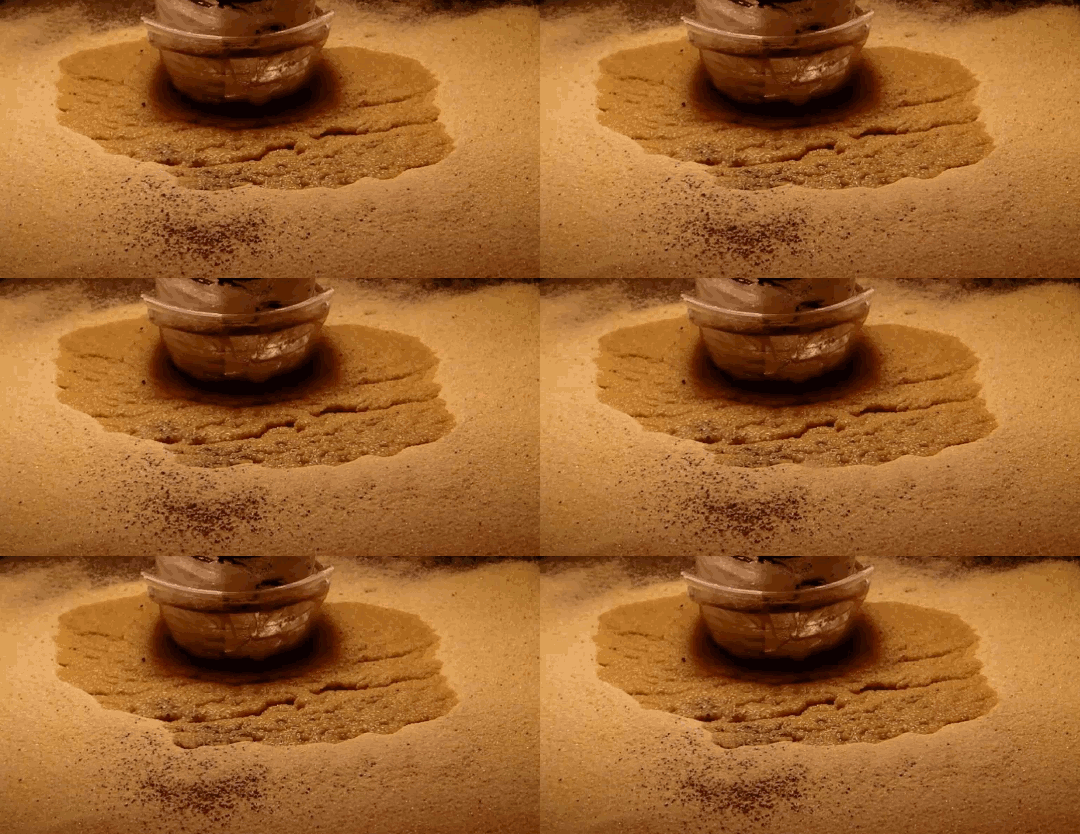
Today’s Mars is cold and dry, with a thin and insubstantial atmosphere. One of the challenges facing planetary scientists is unraveling the processes behind the complex terrain we can observe on the surface. Without flowing water, how do we explain these features? A new experiment suggests that the answer lies in boiling.
Surface conditions on Mars include atmospheric pressures low enough to be below the triple point of water* – the critical temperature and pressure where water vapor, liquid water, and ice can all exist simultaneously. This means that liquid water is unstable under Martian conditions; any water that seeped up to the surface would immediately begin to boil. That explosive boiling ejects sand particles, as seen in the animation above. The authors suggest that this hybrid process of wet percolation combined with vaporous ejection of sediment may better explain the Martian surface features we observe. (Image credit: M. Masse et al., source: Supplementary Movie 3; via Gizmodo; submitted by Paul vdB)
* The evidence we’ve seen so far on Mars points to briny water flowing near the surface. Although brines have lower freezing temperatures than pure water, the authors’ argument holds for them, as well. The boiling is simply not as vigorous.

Ode to Bubbles
Boiling water plays a major role in the steam cycles we use to generate power. One of the challenges in these systems is that it’s hard to control the rate of bubble formation when boiling. In this video, researchers demonstrate their new method for bubble control in a clever and amusing fashion. The twin keys to their success are surfactants and electricity. Surfactant molecules, like soap, have both a polar (hydrophilic) end and a non-polar (hydrophobic) end. By applying an electric field at the metal surface, the researchers can attract or repel surfactant molecules from the wall, making it either hydrophobic or hydrophilic depending on the field’s polarity. Since hydrophobic surfaces have a high rate of bubble formation, this lets the scientists essentially turn nucleation on and off with the flip of a switch! (Video credit: MIT Device Research Lab; see also: research paper, MIT News Video, press release)
Do you enjoy FYFD and want to help support it? Then please consider becoming a patron!

Pouring Molten Aluminum on Dry Ice
What happens when you pour molten aluminum on dry ice? As the Backyard Scientist shows, you get what looks like slippery, sliding, boiling metal. In fact, what you see may remind you of the Leidenfrost effect, where a liquid can slide around over an extremely hot surface on a thin film of its own vapor. Despite the opposite temperature extremes–this is a very cold surface rather than a very hot one–a very similar thing is happening here. The molten aluminum is so much hotter than the dry ice that it causes the dry ice to sublimate, releasing gaseous carbon dioxide that the aluminum slides around on. For the same reason, the aluminum appears to boil in the bottom animation. What we’re really seeing is carbon dioxide gas rising and escaping the aluminum so violently that it carries some of the metal with it. Be sure to check out the full video for more awesome physics! (Image credit: The Backyard Scientist, source; via Gizmodo)
Do you enjoy FYFD and want to help support it? Then please consider becoming a patron!




.gif)