Tag: biology

  • Universal Wingbeats

    Universal Wingbeats

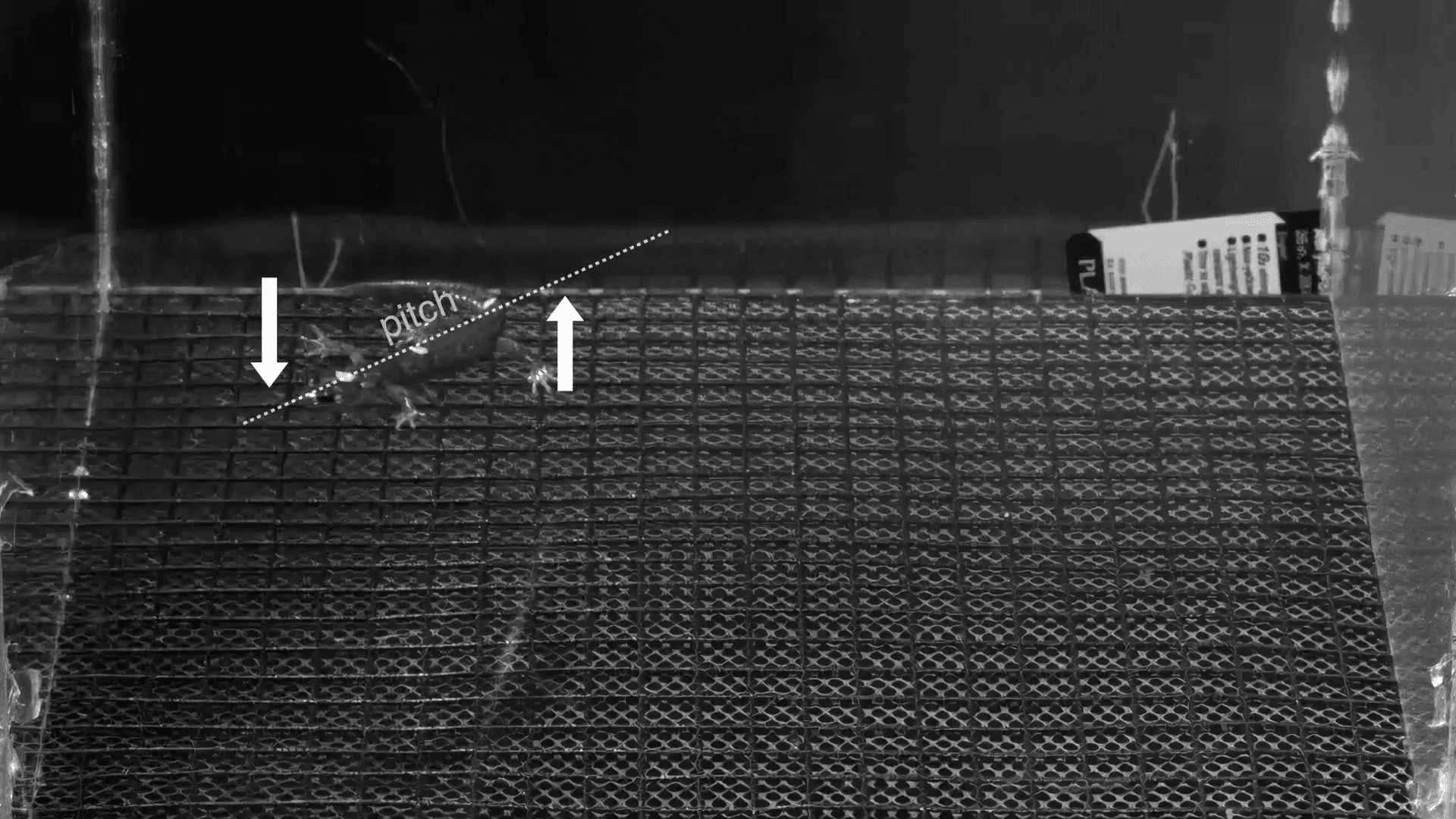
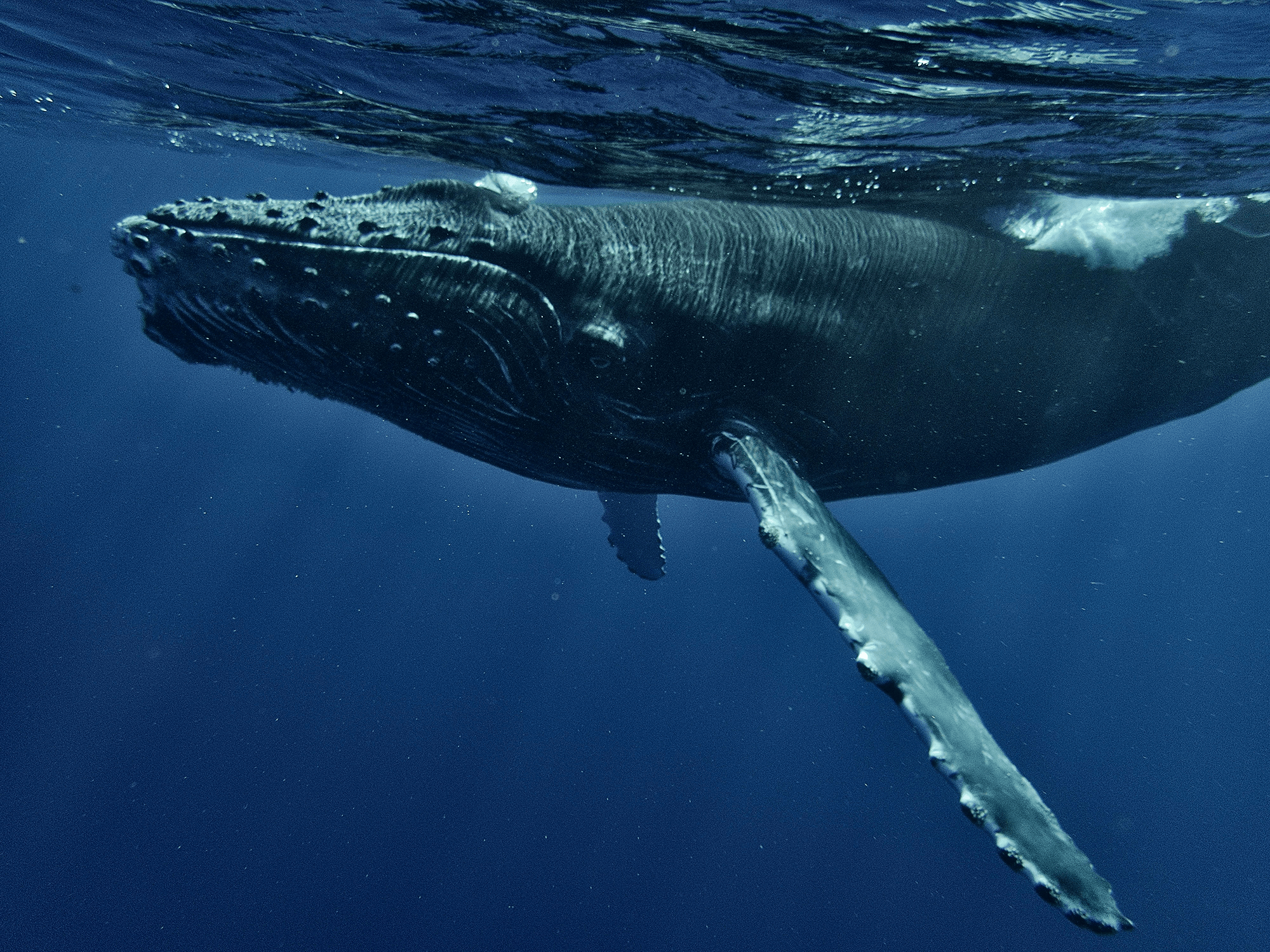
    Eagles, butterflies, and whales don’t appear to have much in common, but a new study shows that they — along with over 400 other flying and swimming animals of all sizes — flap with a frequency determined by a simple equation. Their beat frequency is proportional to the square root of their mass divided by their wing area. As you can see in the graph below, this scaling collapses pretty much all of the data onto a single line:

    Illustration of the predicted relationship between size and wing freequency (black line) shown alongside various insects, birds, bats, penguins, and whales. The swimming animals also fall on the line, once adjustments are made for the difference in density between air and water.
    Illustration of the predicted relationship between size and wing frequency (black line) shown alongside various insects, birds, bats, penguins, and whales. The swimming animals also fall on the line, once adjustments are made for the difference in density between air and water.

    It’s surprising to find such a consistent relationship among animals of such vastly different sizes and types. The next big question for researchers will be unpicking exactly why and how animals evolved to use such a consistent pattern between their size and their wing(/fin) frequency. (Image credit: top – E. Ward, graph – J. Jensen et al.; research credit: J. Jensen et al.; via Physics World)

  • Featured Video Play Icon

    Building In a Stingless Hive

    Honeybees, with their stingers, get lots of attention, but the Americas have plenty of stinger-less honeymakers, too. These stingless bees are native to Mexico, where beekeepers cultivate them for pollination. Without stingers and venom, the bees use their building prowess to keep out unwanted visitors. Much of the hive — from the entrance’s nightly gate to the pods where young are stored — is built from cerumen, a substance the bees create by mixing wax with resins they collect from nearby trees. Just as they do with pollen, worker bees collect drops of resin and store them on their hind legs before flying back to the hive. The viscous fluid sticks well, until a swipe of a leg shears it enough to lower its viscosity and slide it off. (Video and image credit: Deep Look)

  • Venus Flower Basket Sponges

    Venus Flower Basket Sponges

    Venus flower basket sponges have an elaborate, vase-like skeleton pocked with holes that allow water to pass through the organism. A recent numerical study looked at how the sponge’s shape deflects incoming (horizontal) ocean currents into a vertical flow the sponge can use to filter out food.

    The sponges’ structure is porous and lined with helical structures. In their simulation, researchers reproduced a version of this structure (shown below) that used none of the real sponge’s active pumping mechanisms. The digital sponge was, instead, purely passive. Nevertheless, the simulation showed that, by their skeletal structure alone, sponges could redirect a significant fraction of incoming flow toward its filtering surfaces. Interestingly, the highest deflection fraction occurred at relatively low flow speeds, showing that the sponges are set up so that their structure is especially helpful for scavenging nutrients from nearly-still waters.

    In the real world, these sponges use a combination of passive filtering and active pumping to capture their food, but this study shows that the sponge’s clever structure helps it save energy, especially in tough flow conditions. (Image credit: sponges – NOAA, simulation – G. Falcucci et al.; research credit: G. Falcucci et al.; via APS Physics)

    A detail from a numerical simulation shows streamlines around and inside a model sponge.
    A detail from a numerical simulation shows streamlines around and inside a model sponge.
  • Featured Video Play Icon

    How We Got Atoms From Brownian Motion

    In 1827, botanist Robert Brown observed an odd jittery motion of particles as he watched grains of pollen floating in water under his microscope. He saw the random motion also with inorganic — which is to say definitely Not Alive — particles as well. But it was Einstein nearly 80 years later who figured out how to connect this observable motion to atoms. Einstein realized Brown’s particles were being constantly jostled by atomic collisions, and, with a little work, we could use those moving particles to determine Avogadro’s number. Steve Mould walks you through the whole story in this video. (Video and image credit: S. Mould)

  • “Running on Water”

    “Running on Water”

    In the early morning light, young photographer Max Wood captured this coot escaping a fight. With wings flapping, the bird runs across the water surface. Each slap and stroke of a foot provides a portion of the vertical force needed to stay atop the water; lift from its wings provides the rest. With enough speed, the bird will take off. Some birds, however, are born water-walkers; certain species of grebe don’t need to use their wings to run on water. (Image credit: M. Wood; via BWPA)

  • Microfluidics in Medicine

    Microfluidics in Medicine

    In the late 1990s and early 2000s, the Human Genome Project spent years decoding DNA from a handful of donors. The work was painstaking and slow, given DNA sequencing technology of the time. Today the same analysis goes much faster (and is much cheaper), thanks largely to microfluidic devices that automate steps that once had to be done by hand. Microfluidic devices have also made their way into medical diagnostics — pregnancy tests, at-home COVID tests, and blood glucose strips used by diabetics are common examples — as well as experimental biology. The Scientists has a nice review covering some of the many ways these devices have revolutionized the field. (Image credit: CDC; see also The Scientist; submitted by Marc A.)

  • Featured Video Play Icon

    How Ferns Spread Themselves

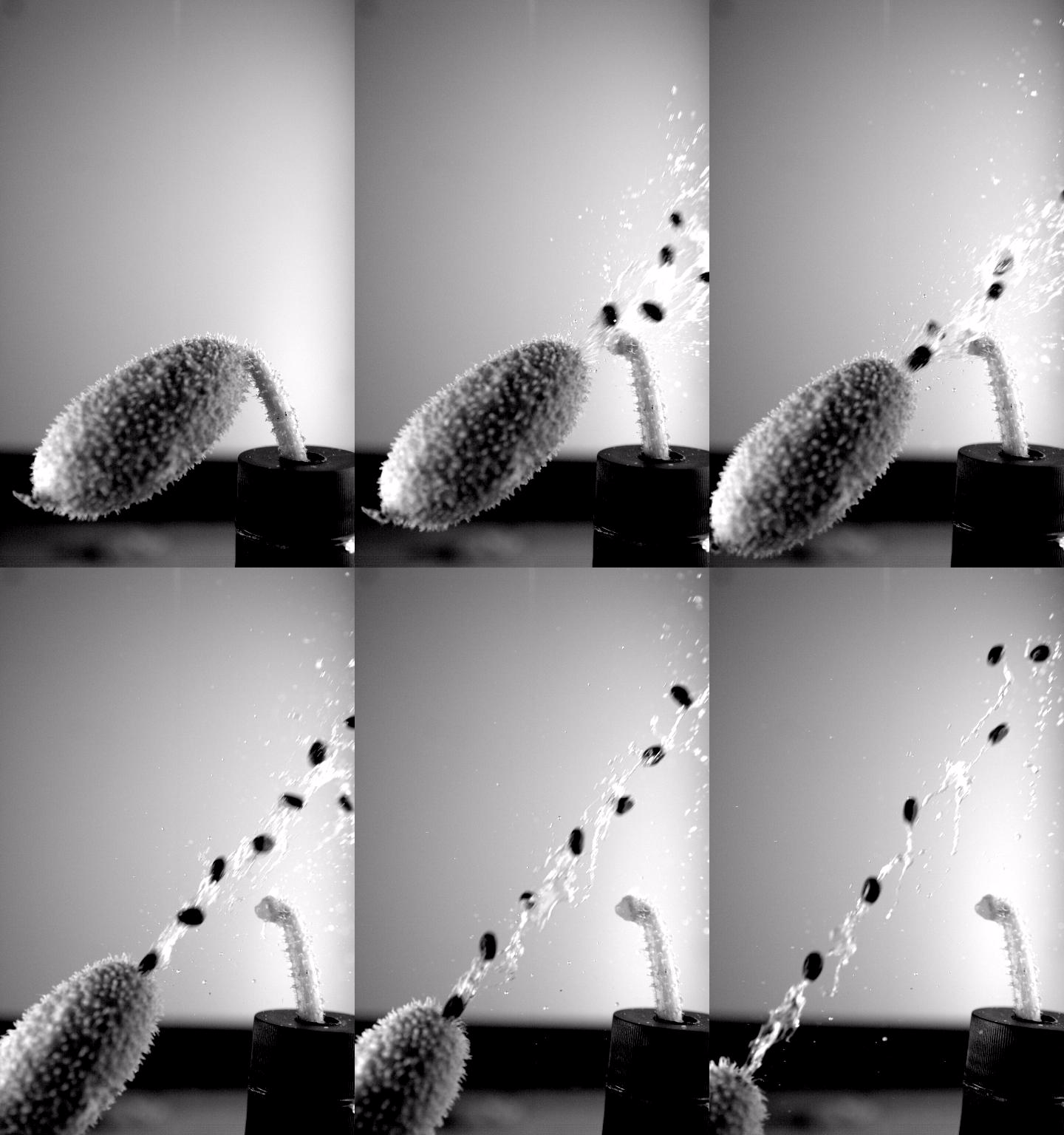
    Ferns don’t rely on pollen and pollinators to spread. Instead, they use a little water and a lot of ingenuity, as shown in this video from Deep Look. Peer underneath a fern and you’ll find leaves dotted with spores. As they mature, water evaporates from the sporangium, eventually triggering a catapult that launches the spores. Those spores grow little gametophytes that produce the fern’s sperm and eggs; given a little rain or a nice puddle, the sperm and eggs can find each other and trigger the birth of a new baby fern. (Video and image credit: Deep Look)

  • “Divebomb”

    “Divebomb”

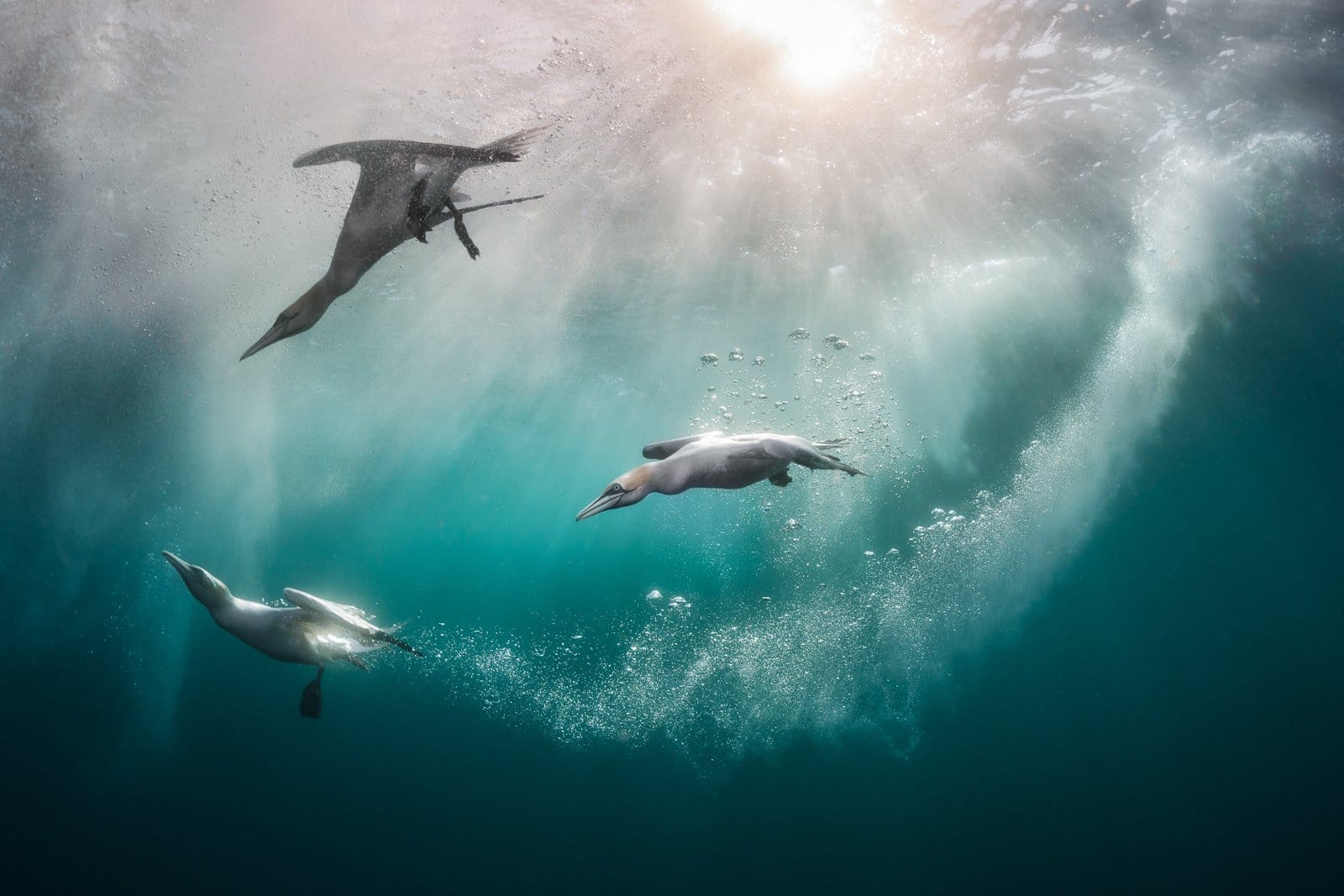
    Seabirds like gannets and boobies are engineered for diving. They fly to a certain altitude, locate fish underwater, and then fold themselves into a streamlined projectile. With this, they plunge into the water at high-speed, positioned to protect themselves from the forces of impact. Under the water, they dart among their prey, hunting with singular purpose. Photographer Kat Zhou’s “Divebomb” captures the underwater side of this behavior, while showing off the energetic bubbles (and bubble rings!) created by the birds. (Image credit: K. Zhou; via UPY 2024 and Colossal)

  • How Moths Confuse Bats

    How Moths Confuse Bats

    When your predators use echolocation to locate you, it pays to have an ultrasonic deterrence. So, many species of ermine moths have structures on their wings known as tymbals. These areas have a band of ridges, and, when the moth’s wing lifts or falls, the ridges buckle one-by-one. A nearby bald patch on the wing acts as an amplifier, making these ultrasonic snaps louder. Altogether, the mechanism deters prowling bats anytime the moth flaps its wings — without any additional effort on the moth’s part. Since the moths have no ears, they presumably don’t even know that they’re making the sound! (Image credit: Wikimedia/entomart; research credit: H. Mendoza Nava et al.; via APS Physics)

  • Mimicking Plant Movement

    Mimicking Plant Movement

    Many plants control the curvature of their leaves by selectively pumping water into cells that line the outer surface. This swelling triggers bending. Engineers created their own version of this structure by 3D-printing trapezoidal shapes onto a fabric. Then, they heat sealed a second layer of fabric over this, creating airtight channels. When inflated, these channels make the structure bend, allowing them to create complex shapes by selectively inflating different areas. (Image credit: T. Gao et al.; via GoSM)