Tag: biology

  • Featured Video Play Icon

    Tar Pit, Sweet Tar Pit

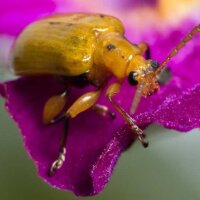
    The La Brea Tar Pits have delivered countless creatures to their doom over tens of thousands of years. But the sticky quagmire of the pits’ natural asphalt is a comfy home to at least one animal: the petroleum fly. The fly’s maggots secrete a lipophobic — in other words, oil-repelling — fluid that allows them to move freely through the viscous black tar. That freedom means they can take full advantage of the asphalt’s trapping power by consuming a smorgasbord of stuck victims. Any asphalt the maggots swallow just passes harmlessly through them. As adults, only their feet are asphalt-resistant, but the petroleum fly still spends most its time hanging out in the pit, seeding the next generation. (Video and image credit: Deep Look)

    Fediverse Reactions
  • Dry Plants Warn Away Moths

    Dry Plants Warn Away Moths

    Drought-stressed plants let out ultrasonic distress cries that moths use to avoid plants that can’t support their offspring. In ideal circumstances, a plant is constantly pulling water up from the soil, through its roots, and out its leaves through transpiration. This creates a strong negative pressure — varying from 2 to 17 atmospheres’ worth — inside the plant’s xylem. If there’s not enough water to keep the plant’s inner flow going, cavitation occurs — essentially a tiny vacuum bubble opens in the xylem. That cavitation isn’t silent; it creates a click at ultrasonic frequencies above human hearing. But just because we don’t hear it doesn’t mean that sound goes unheard.

    In fact, recent research suggests that, not only do moths hear the plant’s cavitation cries, female moths will avoid laying eggs on a healthy plant that sounds like it’s cavitating. Evolutionarily, this makes sense. Hatchlings rely on their birth plant for food and habitat; if an adult moth picks a dying, drought-stressed plant, its offspring won’t survive. It pays to be sensitive to the plant’s signs of distress. (Image credit: Khalil; research credit: R. Seltzer et al.; via NYTimes)

    Fediverse Reactions
  • Inside the Squirting Cucumber

    Inside the Squirting Cucumber

    Though only 5 cm long, the squirting cucumber can spray its seeds up to 10 meters away. The little fruit does so through a clever combination of preparation and ballistic maneuvers. Ahead of launch, the plant actually moves water from the fruit into the stem; this reorients the cucumber so that its long axis sits close to 45 degrees. It also makes the stem thicker and stiffer.

    This high-speed video shows the explosive release of the squirting cucumber's seeds.
    This high-speed video shows the explosive release of the squirting cucumber’s seeds.

    When the burst happens, fruit spews out a jet of mucus that propels the seeds at up to 20 m/s. The initial seeds move the fastest — thanks to the fruit’s high-pressure reservoir — and fly the furthest. As the pressure drops, the jet slows and the fruit’s rotation sends the seeds higher, causing them to land closer to the original plant. With multiple fruits in different orientations, a single plant can spread its seeds in a fairly even ring around itself. (Research and image credit: F. Box et al.; via Gizmodo)

    Fediverse Reactions
  • Inside a Big Cat’s Roar

    Inside a Big Cat’s Roar

    The roars of big cats — tigers, lions, jaguars, and leopards — carry long distances. In part, this reflects the animals’ size: large lungs exhale lots of air through a large voice-box, whose vibrations resonate in a large throat. But size alone does not make the roar. Below are examples of two big cat voice-boxes. On the left is the nonroaring snow leopard; on the right is the voice-box of a roaring jaguar. The red boxes labeled “VF” mark each cat’s vocal folds. Nonroaring cats have triangular folds, while roaring ones have thick square or rectangular vocal folds. These rectangular folds are more aerodynamically efficient, allowing them to produce a wider range of output levels. They’re also more resilient to the intense forces of a roar, thanks to the cushioning effect of fat deposits inside them. If interested, you can learn more over at Physics Today. (Image credit: tiger – T. Myburgh, voice box – E. Walsh and J. McGee; research credit: E. Walsh and J. McGee)

    The vocal folds (VF) of nonroaring cats are triangular (left), whereas roaring cats have rectangular vocal folds (right).
    The vocal folds (VF) of nonroaring cats are triangular (left), whereas roaring cats have rectangular vocal folds (right).
  • Featured Video Play Icon

    Skydiving Salamanders

    The wandering salamander can spend its entire 20-year lifespan in the canopy of a coast redwood. When predators come calling, they have a special skill that helps them get away: skydiving. These little amphibians have no webbed appendages and no wings, but they’re some of the most skillful skydivers out there. By carefully repositioning its tail and feet, a wandering salamander controls its pitch, yaw, and roll. It’s not only able to orient itself as it falls; it can actually steer itself to a safe landing! Other salamander species, as seen in the video above, do not share this skill. Check out the full Deep Look video to see these incredible gliders in action. (Video and image credit: Deep Look; see also C. Brown)

  • Seeking Mars’ Past

    Seeking Mars’ Past

    Although Mars is quite dry and inhospitable today, our rovers continue to search for evidence of a past Mars that could have sustained life. A recent study suggests that, at least in Gale Crater, the opportunities for life to flourish may have been short-lived. In particular, the team looked at carbonates found by the Curiosity rover. These minerals contain varying amounts of carbon and oxygen isotopes that can hint at the conditions the carbonates formed under. The team found a high proportion of heavier isotopes, which suggest one of two possible formation paths. In the first, Gale Crater underwent wet-dry cycles that alternated between more- and less-habitable conditions for life. The second possibility is a cryogenic past, where most of the local water was locked in ice, and life would have had to survive — if possible — in small pockets of extremely salty water. Neither possibility is a great one for the kinds of life we’re accustomed to. (Image credit: NASA; research credit: D. Burtt et al.; via Gizmodo)

  • “Last Breath of Autumn”

    “Last Breath of Autumn”

    On a rainy autumn day, Agorastos Papatsanis headed to the forest in search of fungi. There he captured this fairytale-like scene with falling rain and drifting spores. Near the forest floor, any breeze is slight, so mushrooms use their own humidity to move air and spread their spores. As water evaporates from the mushroom’s cap, it cools the air nearby, causing it to spread outward. Since that water vapor is lighter than air, it rises, too, carrying the mushroom’s spores along with it. (Image credit: A. Papatsanis; via Wildlife PotY)

  • “Immersion”

    “Immersion”

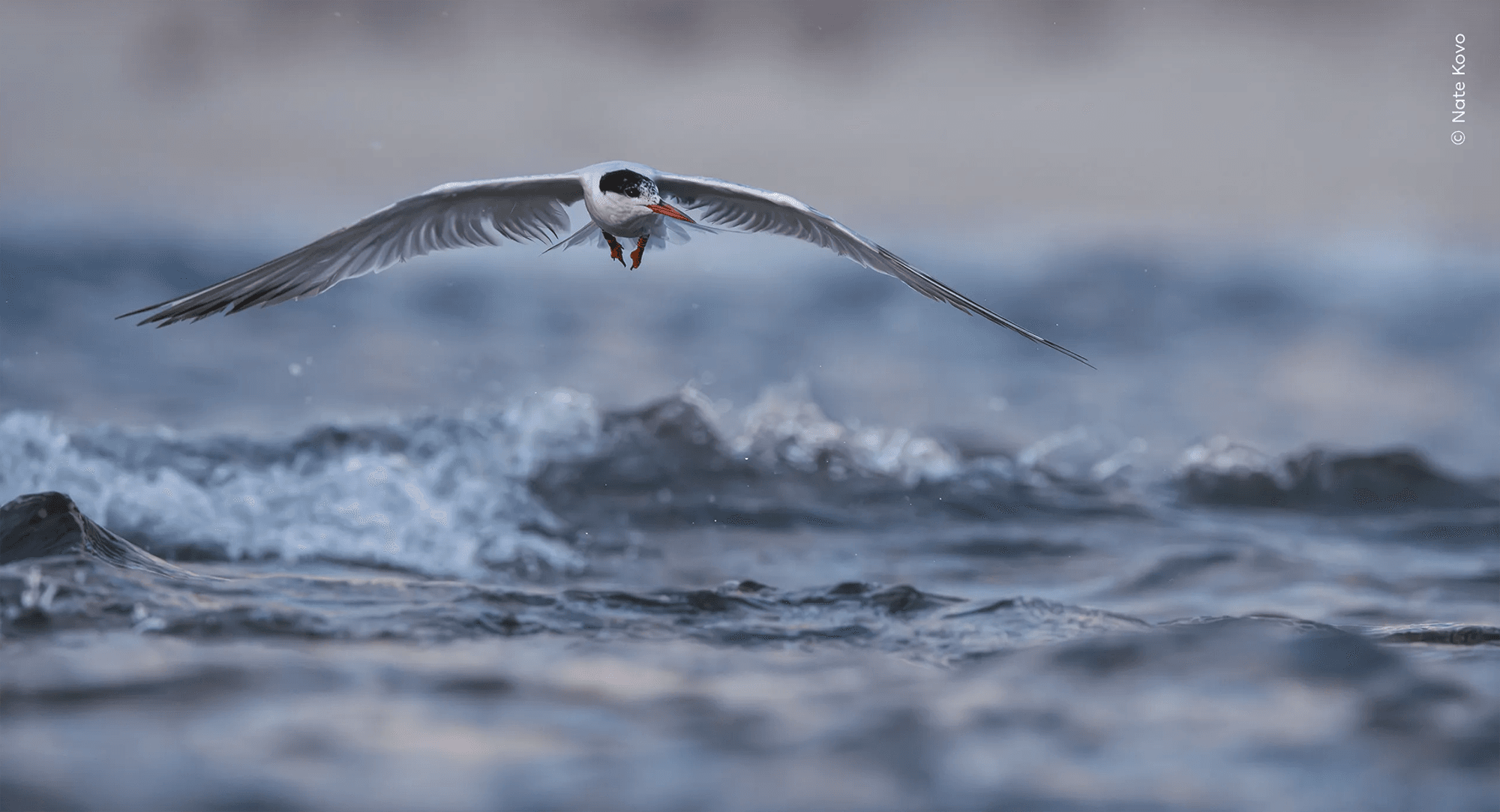
    Some seabirds, including gannets and boobies, feed by plunge diving. From high in the air, they fold their wings and dive like darts into the water, impacting at speeds around 24 m/s to help them reach the depths where their prey swim. With their narrow beaks and necks, the critical moments in this feat come when the bird’s head is submerged but its body remains out of the water. At this point, the bird’s head is decelerating quickly and its body is still moving at full speed; if the neck cannot withstand this combination of forces, it will buckle.

    But plunge divers, it turns out, have a secret weapon that helps them handle impact: their head shape. A study of water entry dynamics using 3D-printed models of birds’ heads found that plunge divers have a shape that increases the amount of time it takes to enter the water. The impact forces stretch out over that longer period of contact, which also stretches out the time it takes for the bird to reach its maximum deceleration. The end result? That extended contact time protects birds from unsafe levels of deceleration, just like a crumple-zone in a crashing car keeps its occupants from experiencing the worst decelerations. (Image credit: K. Zhou/BPOTY; research credit: S. Sharker et al.; via Colossal)

  • Featured Video Play Icon

    Swimming With Cilia

    Like most microswimmers, these Synura uvella algae use cilia to swim. Cilia are tiny, hair-like appendages that flap to produce thrust. Even under a microscope, the cilia are hard to see because they are so thin and move quickly in and out of the microscope’s narrow focus. A cilia’s stroke is always asymmetric — no simple back-and-forth motions for them — because, at the algae’s scale, symmetric motion won’t move you anywhere. This is a peculiar feature of small swimmers in viscous fluids. At the human scale, we can mimic the same physics by mixing and unmixing fluids like corn syrup. (Video and image credit: L. Cesteros; via Nikon Small World in Motion)

    Synura uvella algae swimming under magnification.
    Synura uvella algae swimming under magnification.

  • Pterosaur Tail Vanes

    Pterosaur Tail Vanes

    Among vertebrates, pterosaurs were the first to achieve powered flight. Early pterosaurs have tail vanes — similar in appearance to the frills seen on some lizards — but later species lost this feature. Whether the tail vanes helped in flight or served a display purpose is an open question among paleontologists. One group, in a recent pre-print, studied the vanes’ fossilized interior structure and found a cross-linked lattice that provided internal tension to the vanes. That means the vanes could potentially be held stiff, even in the face of aerodynamic forces that would cause untensioned surfaces to flutter. The result suggests that the tail vanes could have helped early fliers steer, even if evolution later moved that function (along with display) to other parts of the body. (Image credit: Sviatoslav-SciFi; research credit: N. Jagielska et al.; via jshoer)