Tag: biology

  • In Deep Lakes, Mixing is Disappearing

    In Deep Lakes, Mixing is Disappearing

    With a depth of nearly 600 meters, Crater Lake in Oregon is the deepest lake in the United States. It’s known for its brilliant blue hue and startling clarity. But, like other deep lakes, Crater Lake is changing as temperatures warm. It’s edging ever closer to a day where its deep, cold waters no longer mix.

    Although the details of mixing vary from lake to lake, older records show that most deep lakes would overturn and fully mix on a frequency that ranged from twice a year to every seven years. This overturning happens when winds push frigid, near-frozen water. As that water approaches the shoreline, it gets forced downward, where the pressure at depth makes the cold water denser still, causing it to sink beneath the warmer water layer near the lake bottom. That kicks off larger-scale mixing that redistributes oxygen, nutrients, and toxins in the lake.

    When this regular mixing stops, the entire ecosystem gets affected. Over time, oxygen gets depleted in deeper in the lake, leaving a dead zone unable to support fish and other aquatic life. Meanwhile, longer and warmer growing seasons favor phytoplankton and algae that cloud the waters and disrupt a lake’s unique ecology.

    For a much more detailed look at deep lake mixing and the changes we’re seeing, check out this article over at Quanta Magazine. It’s a longer read but well worth your time. (Image credit: N. Perez Aguilar; see also: Quanta Magazine)

    Fediverse Reactions
  • Deep Breaths Renew Lung Surfactants + A Special Announcement

    Deep Breaths Renew Lung Surfactants + A Special Announcement

    Taking a deep breath may actually help you breathe easier, according to a new study. When we inhale, air fills our alveoli–tiny balloon-like compartments within our lungs. To make alveoli easier to open, they’re coated in a surfactant chemical produced by our lungs. Just as soap’s surfactant molecules squeezing between water molecules lowers the interface’s surface tension, our lung surfactants gather at the interface and lower the surface tension, making alveoli easier to inflate.

    But things are a little more complicated in our lungs than in our kitchen sink because of our constant cycle of breathing, which stretches and compresses our lungs’ surfaces and surfactant layers. Imagine a flat interface, lined with surfactant molecules; then stretch it. As the interface stretches, gaps open between the surfactant molecules and allowing molecules from the interior of the liquid to push their way to the newly stretched interface, changing the surface tension. If the interface gets compressed, some of the excess molecules will get pushed back into the liquid bulk.

    In looking at how lung surfactants respond to these cycles of compression and stretching, the researchers found that the lung liquid develops a microstructure during cycles of shallow breathing that makes the surface tension higher, thus making lungs harder to fill. In contrast, a deep breath like a sigh replenished the saturated lipids at the interface, lowering surface tension and making lungs more compliant. So a deep sigh actually can help you breathe easier. (Image credit: F. MΓΈller; research credit: M.. Novaes-Silva et al.; via Gizmodo)

    P.S.I’ve got a book (chapter)! Several years ago, I joined an amazing group of women to write two books (one for middle grades and one for older audiences) about our journeys as scientists. And they are out now! In fact, today we’re holding a “Book Bomb” where we aim for as many of us as possible to buy the book(s) on the same day. If you’d like to join (and get ahead on your gift shopping), here are (affiliate) links:

    Fediverse Reactions
  • Spores Get a Lift

    Spores Get a Lift

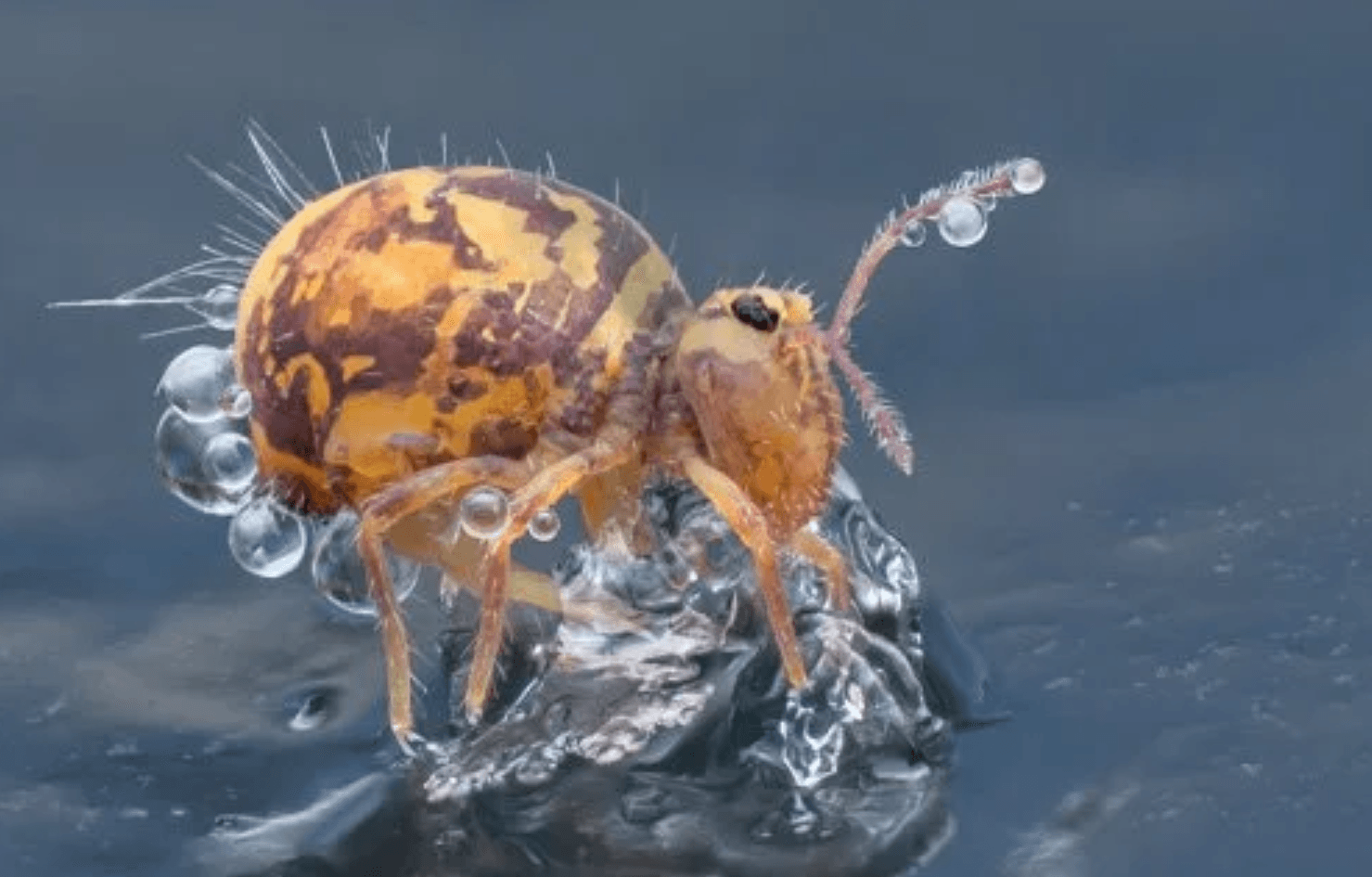
    Mushrooms have the challenging task of dispersing spores, typically from heights no more than a few centimeters above the ground. At that altitude, viscosity and friction with the ground mean that air barely moves, if it does at all. And mushrooms rely on a wide range of methods, from explosive launches to rain assistance to making their own weather. Every one of these methods gives spores a lift in altitude to reach higher winds and greater dispersal. (Image credit: A. Bejczi/CUPOTY; via Colossal)

  • Fluids at the Angstrom-Scale

    Fluids at the Angstrom-Scale

    We spend our lives dealing with fluids at a scale where the motion of individual molecules is beneath our notice. There’s no reason to track every molecule of water moving through a municipal pipe; it’s effectively impossible, anyhow! But once you are dealing with pipes that are small enough–below about 1 nanometer in diameter–fluids have to be considered molecule-by-molecule. At this scale, so-called angstrofluidics behave very differently.

    Intuition suggests that flow through such tiny channels would be extremely slow, however researchers have observed protein channels that allow a single water molecule through at a time while still processing a billion molecules each second. Combine this throughput with charged channel walls that can sort molecules by polarity, and angstrofluidics offers the possibility for unprecedented control for filtering, desalination, and drug testing. (Image credit: T. Miroshnichenko; see also R. Boya et al.)

    Fediverse Reactions
  • Why Sharper Knives Mean Fewer Onion Tears

    Why Sharper Knives Mean Fewer Onion Tears

    Onions are a well-known source of tears for many a cook. And while the chemical source of their power–onions release a chemical that reacts in our eyes to produce tears–has been known for years, no one has looked at the fluid dynamics in the process until now.

    Video of droplets sprayed as a knife cuts into an onion.

    As seen above, a knife piercing the onion’s surface releases a mist of high-speed droplets, followed by a slower spray. Much like a citrus fruit’s microsprays, the onion’s fountain depends on both solid and fluid mechanics. As the knife presses into the onion’s stiffer outer layer, pressure builds in the softer layer underneath, which contains pores of fluid. Once the knife breaks the epidermis, that pressurized fluid sprays out.

    The good news is that the team also confirmed a common culinary wisdom: using a sharper knife and a slower, gentler cut will reduce the spray and its speed, resulting in fewer tears. (Image credit: M. Stone; research credit: Z. Wu et al.)

    Fediverse Reactions
  • Circulation in a Capillary Network

    Circulation in a Capillary Network

    Today’s video shows red blood cells flowing through a capillary network in a rat’s skeletal muscle. At this resolution, our eyes can follow the paths of individual red blood cells squeezing through each capillary, as well as the faster blur of thicker capillaries where many cells can pass at once. Watching videos like this is a great way to build intuition for particle image velocimetry, streaklines, and other flow visualization methods as our brains can readily recognize where the cells are moving fast and where they are slower. (Video and image credit: Dr. G. McEvoy et al.; via Colossal)

    Fediverse Reactions
  • Featured Video Play Icon

    Cornflower Roots Growing

    As children, most of us plant a seed or two and watch it sprout, but we never get a view quite like this one. This microscopic timelapse shows the roots of a cornflower plant extending into moist, porous soil, establishing xylem, and extending root hairs outward to collect water and nutrients to fuel further growth. At the end, there’s even a close-up view of flow inside the root hairs. What an incredible glimpse inside a world we so often take for granted! (Video and image credit: W. van Egmond; via Colossal)

    Fediverse Reactions
  • Watch Hagfish Slime Unfurl

    Watch Hagfish Slime Unfurl

    The eel-like hagfish has one of the best defenses in the ocean. When threatened, it releases a slime that clogs the gills of its predator but allows the hagfish itself to slough off the slime and escape. The hagfish slime’s secret weapon is long protein threads, which are initially rolled into bundles called skeins. Seen above, these skeins resemble the yarn skeins knitters and crocheters buy, but a hagfish’s skeins are only as big as the width of a human hair.

    When water flows by quickly enough, the thread in a skein begins to unwind and stretch out. With enough threads unwound, the slime gets stretchy and viscous. Researchers found that it takes relatively little flow to begin this unwinding because the adhesion between threads and the surrounding fluid is higher than the thread-to-thread sticking power. (Research and image credit: M. Hossain et al., video)

    Fediverse Reactions
  • Biodegradable PIV Particles

    Biodegradable PIV Particles

    Particle image velocimetry–PIV, for short–is used to visualize fluid flows. The technique introduces small, neutrally-buoyant particles into the flow and illuminates them with laser light. By comparing images of the illuminated particles, computer algorithms can work out the velocity (and other variables) of a flow. Typical methods use hollow glass spheres or polystyrene beads as the particles that follow the flow, but these options have many downsides. They’re expensive–as much as $200/pound–and they can potentially harm test subjects, like animals whose swimming researchers are studying. Instead, researchers are now looking at biodegradable options for PIV particles.

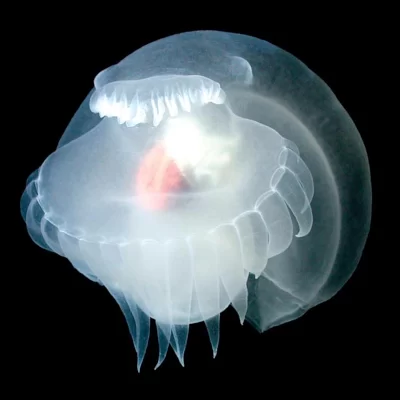
    One study found that corn and arrowroot starches were good candidates, at least for applications using artificial seawater. The powders were close to neutrally-buoyant, had uniform particle sizes, and accurately captured the flow around an airfoil, live brine shrimp, and free-swimming moon jellyfish. (Image credit: M. Kovalets; research credit: Y. Su et al.; via Ars Technica)

    Fediverse Reactions
  • Thawing Out

    Thawing Out

    Lake Erie, the shallowest of the Great Lakes, can almost completely freeze over in winter. In this satellite image of the lake in March 2025, about a third of the lake remains ice-covered, while sediment — resuspended by wind and currents — and phytoplankton swirl in the ice-free zone. In recent decades, scientists discovered that diatoms, one of the phytoplankton groups found in the lake, can live within and just below Erie’s ice, thanks to a symbiotic relationship with an ice-loving bacteria. This symbiosis allows the diatoms to attach to the underside of the ice and gather the light needed for photosynthesis. Even in the depths of winter, an ice-covered lake can teem with life. (Image credit: M. Garrison; via NASA Earth Observatory)

    Fediverse Reactions