Tag: biology

  • Gliding Like a Grasshopper

    Gliding Like a Grasshopper

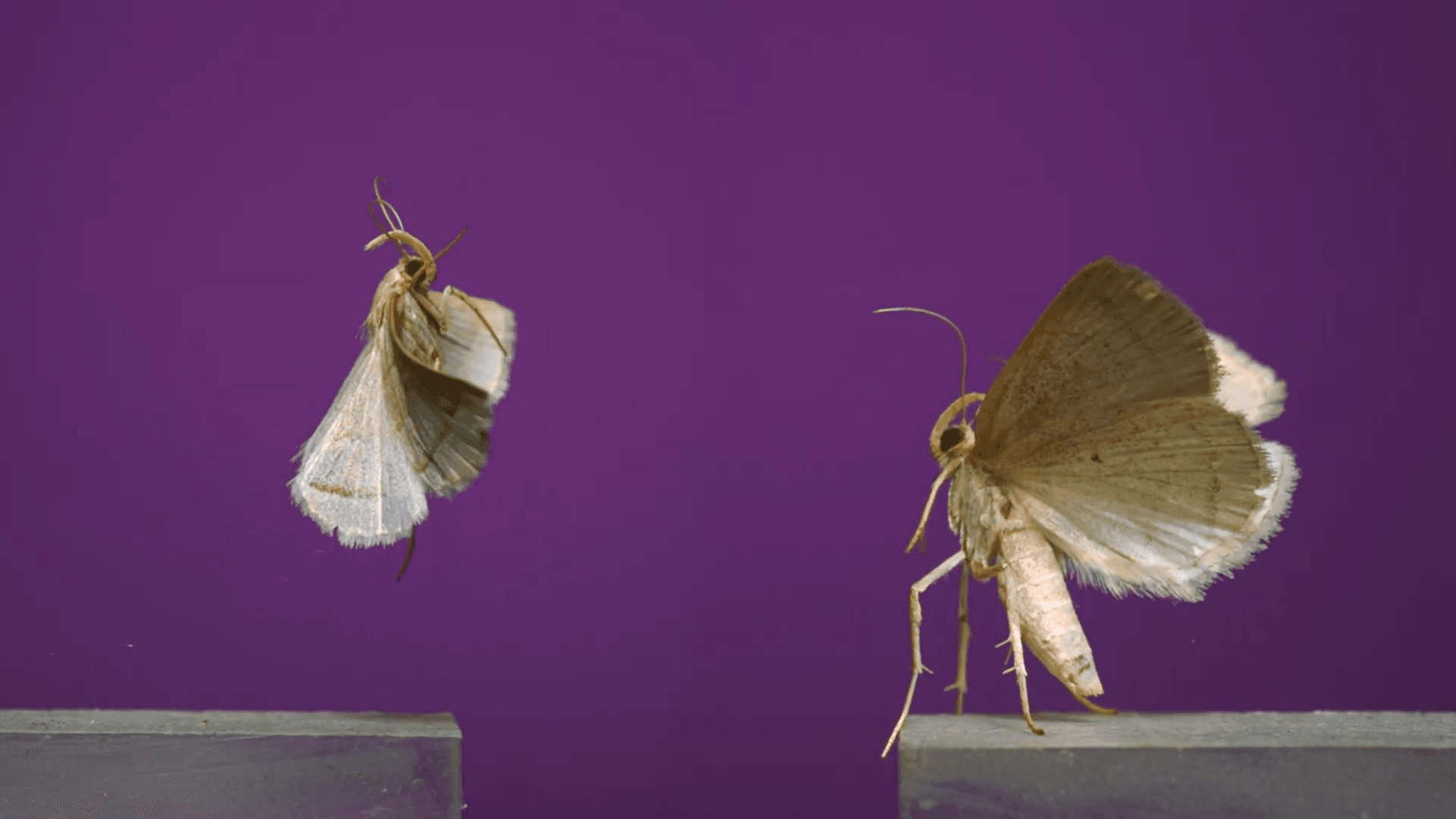
    Many biorobots are built after flies and bees–insects that rely heavily on flapping flight. For small robots, this means carrying heavy batteries or remaining tethered in order to power their motors. Instead, researchers have turned to grasshoppers for a lesson in small-scale gliding.

    Grasshoppers have two sets of wings. The forward set provide protection and camouflage, while the hindwings are used to fly. The team studied the corrugated, foldable hindwings of the American grasshopper, then 3D-printed model wing designs and attached them to gliders. They found that the corrugated wings performed well at low angles of attack, but that non-corrugated wings–which still shared the outline and camber of the insect’s wings–were more efficient gliders over a range of conditions.

    The team hopes that their grasshopper-inspired gliders give insect-like biorobots more efficient flying options. (Image credit: Princeton/S. Khan/Fotobuddy; research credit: K. Lee et al.; via Physics World)
    Fediverse Reactions
  • Caught in a Spider’s Web

    Caught in a Spider’s Web

    Grains of pollen are caught amid droplets on a spider’s web in this award-winning image by John-Oliver Dum. How droplets behave on fibers has been a popular topic in recent years with research on how droplets nestle into corners, how they slide on straight or twisted wires, the patterns formed by streams of falling drops, and what happens to a droplet on a plucked string. (Image credit: J. Dum; via Ars Technica)

    Fediverse Reactions
  • Necroprinting By Mosquito

    Necroprinting By Mosquito

    Engineers have been adapting biological materials into robotics in recent years. One of the latest versions of this trend is “necroprinting,” in which researchers built a microscale 3D printer around a mosquito’s proboscis. Made to pierce thick skin to reach blood, the mosquito proboscis offered the kind of size, geometry, and stiffness needed for small-scale printing. The team found that their necroprinter performed well at the ~20 micron scale, with the mosquito-based nozzle costing only a fraction of what a conventional human-made nozzle would. (Image credit: NIAID; research credit: J. Puma et al.; via Ars Technica)

    Fediverse Reactions
  • A Drop of Algae

    A Drop of Algae

    Spheres of a Volvox colonial algae glow green inside a droplet in this award-winning microphotograph by Jan Rosenboom. Pinned on an inclined surface, the droplet is frozen in a balance between gravity and surface tension that keeps its shape–and its contact angles–asymmetric. Droplets will also take on a shape similar to this when air is blowing past them. (Image credit: J. Rosenboom; via Ars Technica)

    Fediverse Reactions
  • Marangoni Effect in Biology

    Marangoni Effect in Biology

    For decades, biologists have focused on genetics as the key determiner for biological processes, but genetic signals alone do not explain every process. Instead, researchers are beginning to see an interplay between genetics and mechanics as key to what goes on in living bodies.

    For example, scientists have long tried to unravel how an undifferentiated blob of cells develops a clear head-to-tail axis that then defines the growing organism. Researchers have found that, rather than being guided purely by genetic signals, this stage relies on mechanical forces–specifically, the Marangoni effect.

    The image above shows a mouse gastruloid, a bundle of stem cells that mimic embryo growth. As they develop, cells flow up the sides of the gastruloid, with a returning downward flow down the center. This is the same flow that happens in a droplet with higher surface tension in one region; the Marangoni effect pulls fluid from the lower surface tension region to the higher one, with a returning flow that completes the recirculation circuit.

    The same thing, it turns out, happens in the gastruloid. Genes in the cells trigger a higher concentration of proteins in one region of the bundle, creating a lower surface tension that causes tissue to flow away, helping define the head-to-tail axis. (Image credit: S. Tlili/CNRS; research credit: S. Gsell et al.; via Wired)

    Fediverse Reactions
  • The Best of FYFD 2025

    The Best of FYFD 2025

    Happy 2026! This will be a big year for me. I’ll be finishing up and turning in the manuscript for my first book — which flows between cutting edge research, scientists’ stories, and the societal impacts of fluid physics. It’s a culmination of 15 years of FYFD, rendered into narrative. I’m so excited to share it with you when it’s published in 2027.

    As always, though, we’ll kick off the year with a look back at some of FYFD’s most popular posts of 2025. (You can find previous editions, too, for 2024202320222021202020192018201720162015, and 2014.) Without further ado, here they are:

    What a great bunch of topics! I’m especially happy to see so many research and research-adjacent posts were popular. And a couple of history-related posts; I don’t write those too often, but I love them for showing just how wide-ranging fluid physics can be.

    Interested in keeping up with FYFD in 2026? There are lots of ways to follow along so that you don’t miss a post.

    And if you enjoy FYFD, please remember that it’s a reader-supported website. I don’t run ads, and it’s been years since my last sponsored post. You can help support the site by becoming a patronbuying some merch, or simply by sharing on social media. And if you find yourself struggling to remember to check the website, remember you can get FYFD in your inbox every two weeks with our newsletter. Happy New Year!

    (Image credits: droplet – F. Yu et al., starlings – K. Cooper, espresso – YouTube/skunkay, fountain – Primal Space, Uranus – NASA, turbulence – C. Amores and M. Graham, capsule – A. Álvarez and A. Lozano-Duran, melting ice – S. Bootsma et al., puquios – Wikimedia, cooling towers – BBC, solar wind – NASA/APL/NRL, Lake Baikal – K. Makeeva, sprite – NASA, roots – W. van Egmond, sunflowers – Deep Look)

    1. I know what I did. ↩︎
    Fediverse Reactions
  • Lung Flows

    Lung Flows

    When a fluid coats the inner walls of a cylinder, it can move downward in what’s called a collar flow. In our airways, a sinking collar flow can thicken as it falls, eventually blocking the airway completely.

    In a Newtonian fluid, this thickening during motion is essentially unavoidable; any small disturbance to the fluid will make its thickness change. But in a viscoplastic fluid–one more akin to the mucus in our airways–researchers found that, below a critical film thickness, the collar flow won’t thicken to form a blockage. (Image and research credit: J. Shemilt et al.; via APS)

    Fediverse Reactions
  • Featured Video Play Icon

    Ripple Bugs

    Ripple bugs are a type of water strider capable of moving at a blazing fast 120 body lengths per second across the water surface. In addition to their speed, ripple bugs are incredibly agile and are active almost constantly. Researchers believe they’ve found the insect’s secret: feather-like hydrophilic fans that spread on contact with the water. These fans help the insects push off the water and steer, but they require no effort to open and close. They’ve even adapted the technique to bio-inspired robots and seen improvements in speed, agility, and efficiency. (Video credit: Science; research credit: V. Ortega-Jimenez et al.)

    Fediverse Reactions
  • Featured Video Play Icon

    Leaves Dance in the Wind

    Once a breeze kicks up, leaves on a tree start dancing. Every tree’s leaves have their own shapes, some of which appear very different from other trees. But their dances have patterns, as this video shows. In it, researchers explore how leaves of different shapes deform in the wind and how they can decompose that motion to compare across leaves. (Video and image credit: K. Mulleners et al.; via GFM)

    Fediverse Reactions
  • Controlling Hovering

    Controlling Hovering

    Hummingbirds and many insects hover when feeding, escaping predators, and mating. While scientists have decoded the mechanics of a hummingbird’s figure-8-like hovering wingstroke, it’s been harder to understand how the creatures control their hovering. Most of our attempts to control hovering require more computational power than hummingbirds and insects are thought to have. But this study describes a new control scheme: one that allows stable, real-time hovering with little computational cost. (Image credit: J. Wainscoat; research credit: A. Elgohary and S. Eisa; via APS)

    Fediverse Reactions