Tag: viscoplasticity

  • Lung Flows

    Lung Flows

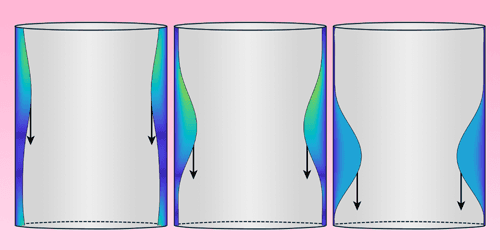
    When a fluid coats the inner walls of a cylinder, it can move downward in what’s called a collar flow. In our airways, a sinking collar flow can thicken as it falls, eventually blocking the airway completely.

    In a Newtonian fluid, this thickening during motion is essentially unavoidable; any small disturbance to the fluid will make its thickness change. But in a viscoplastic fluid–one more akin to the mucus in our airways–researchers found that, below a critical film thickness, the collar flow won’t thicken to form a blockage. (Image and research credit: J. Shemilt et al.; via APS)

    Fediverse Reactions
  • Featured Video Play Icon

    Viscoplastic Drop Impact

    There are many materials that don’t behave exactly as a fluid or a solid, instead displaying characteristics of both. In this video, we see drops of hair gel falling into water. The gel is viscoplastic – showing some of the viscous behavior of a fluid and some of the plastic behavior (the inability to change back to its initial shape) of a solid.

    On impact, the gel deforms due to the forces on it, but the final shape does not depend solely on the amount of force; instead, it’s the rate at which the forces are applied that determines the final shape. By tuning the impact speed and the gel stiffness, it’s possible to make many final capsule shapes, something that could be useful in applications like drug manufacturing. (Image and video credit: M. Jalaal et al.)