Tag: atomization

  • Daily Fluids, Part 1

    Daily Fluids, Part 1

    Just getting cleaned up and ready for the day involves a lot of fluid physics. Here are a few of the phenomena you may see daily without realizing:

    Plateau-Rayleigh Instability
    This behavior is responsible for the dripping of your faucet. More specifically, it’s the reason that a falling jet breaks up into droplets. It works on rain, too!

    Forced Convection
    Everyone is familiar with a winter wind making them colder or hot air from a dryer getting the moisture off their hands. These are examples of forced convection – heat transfer by driving a fluid past a solid. Another common example? The fans in your computer!

    Liquid Atomization
    This is the process of breaking a liquid into lots of tiny droplets. Aside from any aerosol can ever, this phenomenon is also key to your daily shower and internal combustion in your car.

    Archimedes Principle
    This might be one of my favorite bits of the whole video because it hearkens back to some of my own earliest fluid dynamics exposure. Archimedes Principle says that buoyancy is equal to the weight of the fluid a body displaces. My mom (a science teacher) taught me about this one in the bathtub! It’s key to everything that ever floated, including us!

    Tune in all week for more examples of fluid dynamics in daily life. (Image credit: S. Reckinger et al., source)

  • Reader Question: Shower Curtains

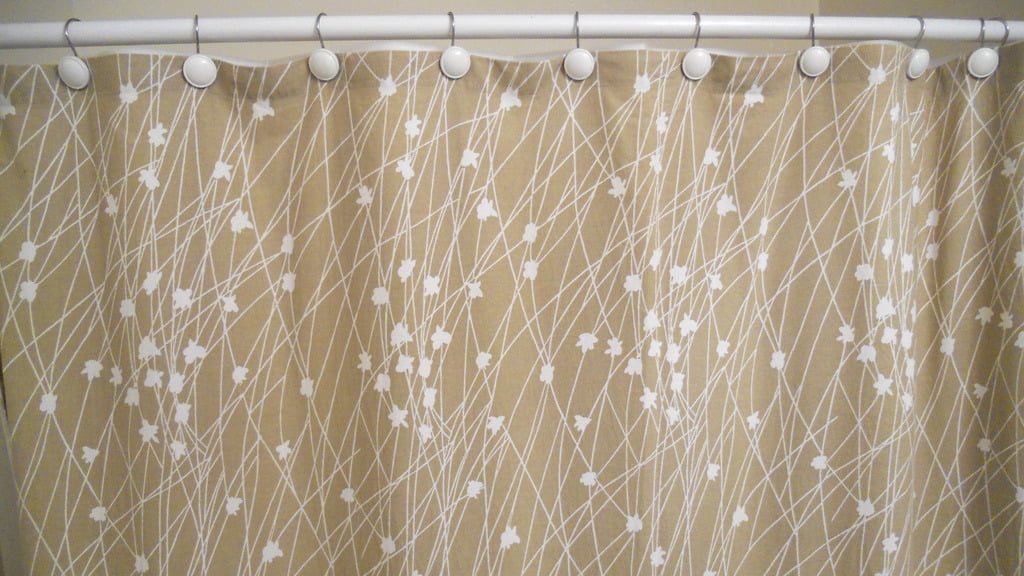
    Reader Question: Shower Curtains

    Reader thansy asks:

    Why do the bottoms of shower curtains drift in toward the water coming from the shower head?

    We all know that moment. You’re minding your own business, scrubbing away, and all of a sudden, the shower curtain billows up and grabs you. Scientists have debated the cause of this behavior for years. Some argued that the curtain billowed due to hot air rising from the shower. Others claimed the fast-moving spray caused lift that pulled the curtain up. But fifteen years ago, one scientist tackled the problem computationally. He performed a numerical simulation of a shower head spraying into a bath and found that this spray of droplets creates a weak horizontal vortex in the shower.

    This shower vortex has a low-pressure core at the middle, which is thought to provide the suction that causes the shower curtain to billow. The scientist, David Schmidt, was awarded the 2001 Ig Nobel Prize for his work. (Image credits: N. Paix, D. Schmidt; research credit: D. Schmidt)

  • Boiling Water to Snow

    Boiling Water to Snow

    When it’s really cold outside–to the tune of -40 degrees (Fahrenheit or Celsius)–physics can get a little crazy. In this photo, boiling-hot water from a thermos turns into an instant snowstorm when tossed. How is this possible? It turns out there are a combination of factors that affect this. Firstly, the rate of heat transfer between two objects depends on the magnitude of the temperature difference between them. The bigger the difference in temperature, the faster the hot object cools. Of course, as the hot object cools down, the temperature difference between it and its surroundings is smaller and the rate of heat transfer decreases.

    The second important factor here is that the water is being tossed. When you throw water, it breaks into droplets, and droplets have a large surface area compared to their volume. As it turns out, the rate of heat transfer also depends on surface area. By breaking the hot water into smaller droplets, you increase the surface area exposed to the cold air, allowing the hot water to freeze faster. (Image credit: M. Davies et al.; via Gizmodo)

    Also: Since there are a few events scheduled around the country over the next couple months, I’ve added an events page where you can find details for those appearances. And as always, if you’re interested in scheduling a talk or event, feel free to contact me directly.

  • Featured Video Play Icon

    Bullet-Time Inferno

    Remember the bullet time effect from The Matrix? This spectacular video gives you a similar effect with the turbulent flames created by firebreathers. To capture this level of detail, Mitch Martinez uses an array of 50 cameras placed around the performers, allowing him to reconstruct the full, three-dimensional representation of the flames. Similarly, some scientists use arrays of high-speed video cameras to collect 3D, time-resolved data about phenomena like combustion. Because these flows are so complex in terms of their fluid dynamics and chemistry, capturing full 3D data is important to help understand and model the flow better. (Video credit: M. Martinez; via Rakesh R.)

  • Alligators Water Dancing

    Alligators Water Dancing

    Amorous alligators call to mates with a behavior known as water dancing. Their audible bellows are accompanied by infrasonic soundvibrations below the 20 Hz limit of human hearing. These vibrations from their lungs excite Faraday waves in the water near the alligator’s back and make the surface explode in a dance of jets and atomized droplets. I’ve seen similar results in other instances of vibration, but this may be the only example of this I’ve seen in the wild. Researchers studying the phenomenon noted that the frequency of sound the alligators emit corresponds to a wavelength equal to the spacing of the raised scales, or scutes, on the alligators’ backs. They hypothesize that the shape of the scutes helps males create the display.  (Image credit: N. Marven, source; research credit: P. Moriarty and R. Holt; h/t to io9)

    ——————

    Don’t forget about our FYFD survey! I’ve teamed up with researcher Paige Brown Jarreau to create a survey of FYFD readers. By participating, you’ll be helping me improve FYFD and contributing to novel academic research on the readers of science blogs. It should only take 10-15 minutes to complete. You can find the survey here. Please take a few minutes to participate and share!

  • Featured Video Play Icon

    Rain-spread Pathogens

    Like humans, plants can spread pathogens to one another. Although scientists had observed correlations between rainfall and the spread of diseases among plants, this study is one of the first to look at the fluid dynamics of leaf and rainfall interaction. When a raindrop hits a leaf, it doesn’t simply splash as it would against an immobile surface. The impact of the drop deforms the leaf, and the plant’s rebound significantly affects the trajectory and size of the resulting droplets. Depending on factors like the leaf’s stiffness, a large drop, carrying many pathogens, may rebound and splatter onto a neighboring leaf. Other leaves tend to catapult out many smaller droplets, which may fly farther afield but carry fewer pathogens. For more, check out the press release or the original research paper. (Video credit: Massachusetts Institute of Technology; research credit: Bourouiba Research Group)

  • Hand Dryers and Atomization

    Hand Dryers and Atomization

    Some newer electric hand dryers, like the Dyson Airblade, use jets of high-speed air to dry hands faster than traditional models. Much of their effectiveness comes from the rapid atomization–or break-up into tiny droplets–of water on one’s hands. This is demonstrated in the animation above, which comes from a high-speed video of a water drop falling through the jets of a homemade dryer. Breaking up the water quickly disperses the microdroplets but it also speeds up evaporation by greatly increasing the exposed surface area of the water. This is similar to how you can get instant snow from throwing boiling water if it’s cold enough outside. (Image credit: tesla500, source video; submitted by Nick)

  • Featured Video Play Icon

    Zesty Fireballs

    Zesting the skin of a citrus fruit like oranges releases a spray of tiny oil droplets. Citrus oil has several volatile components, meaning that it evaporates quickly at room temperature. It is also a liquid with a relatively low flash point, meaning that only modest temperatures (~40-60 degrees Celsius) are needed to generate enough vapor to ignite a vapor/air mixture. With volatile and flammable liquid fuels, a spray of droplets is an ideal platform for combustion because the essentially spherical droplets have a high surface area from which they can evaporate and provide vaporous fuel.  (Video credit: ChefSteps)

  • Breaking Drops with Vibration

    Breaking Drops with Vibration

    Atomization is the process of breaking a liquid into a spray of fine droplets. There are many methods to accomplish this, including jet impingement, pressure-driven nozzles, and ultrasonic excitement. In the images above, a drop has been atomized through vibration of the surface on which it rests. Check out the full video. As the amplitude of the surface’s vibration increases, the droplet shifts from rippling capillary waves to ejecting tiny droplets. With the right vibrational forcing, the entire droplet bursts into a fine spray, as seen in the photo above. The process is extremely quick, taking less than 0.4 seconds to atomize a 0.1 ml drop of water. (Photo and video credit: B. Vukasinovic et al.; source video)

  • Inside a Rocket

    Inside a Rocket

    Rockets often utilize liquid propellants for their combustion. To maximize the efficiency during burning, the liquid fuel and oxidizer must mix quickly and break up into an easily vaporized spray. One method to achieve this is to inject the fuel and oxidizer as liquid jets that collide with one another. For high enough flow rates, this creates a highly unstable liquid sheet that quickly atomizes into a spray of droplets. The animation above shows an example of two impinging jets, but rockets using this method would typically have more than just two injection points. Other rockets use co-axial or centrifugal injectors to mix and atomize the fuel and oxidizer prior to combustion.  (Image credit: C. Inoue; full-scale GIF)