Search results for: “wind tunnel”

  • Reapproaching Supersonic Air Travel

    Reapproaching Supersonic Air Travel

    Before the Concorde even began regular flights, protests over its sound levels caused the U.S. and many other countries to ban overland commercial supersonic flight. Those restrictions have stood for fifty years. But NASA and Lockheed Martin Aeronautics are hoping to make supersonic air travel a possibility again with their experimental X-59 aircraft, designed to have a much quieter sonic boom.

    In supersonic flight, every curve, bolt, and bump generates a shock wave, and these waves tend to coalesce at the front and back of the aircraft, creating strong leading and trailing shocks. It’s these shock waves that are responsible for the double sonic boom that rattles windows and startles those of us on the ground. The X-59 reduces its noise by spreading out those shock waves, a feat designers managed with heavy reliance on computational fluid dynamics. They used wind tunnel studies mainly for validation, since iterating designs in the wind tunnel was far slower than working computationally. With the initial aircraft built, the team will now do test flights and, starting in 2026, will fly over the public and solicit feedback on whether the aircraft is acceptably quiet. (Image credit: NASA; via Physics Today)

    The sound of the X-59's sonic boom compared to other familiar sound levels.
    The sound of the X-59’s sonic boom compared to other familiar sound levels.
  • Featured Video Play Icon

    Visualizing Wingtip Vortices

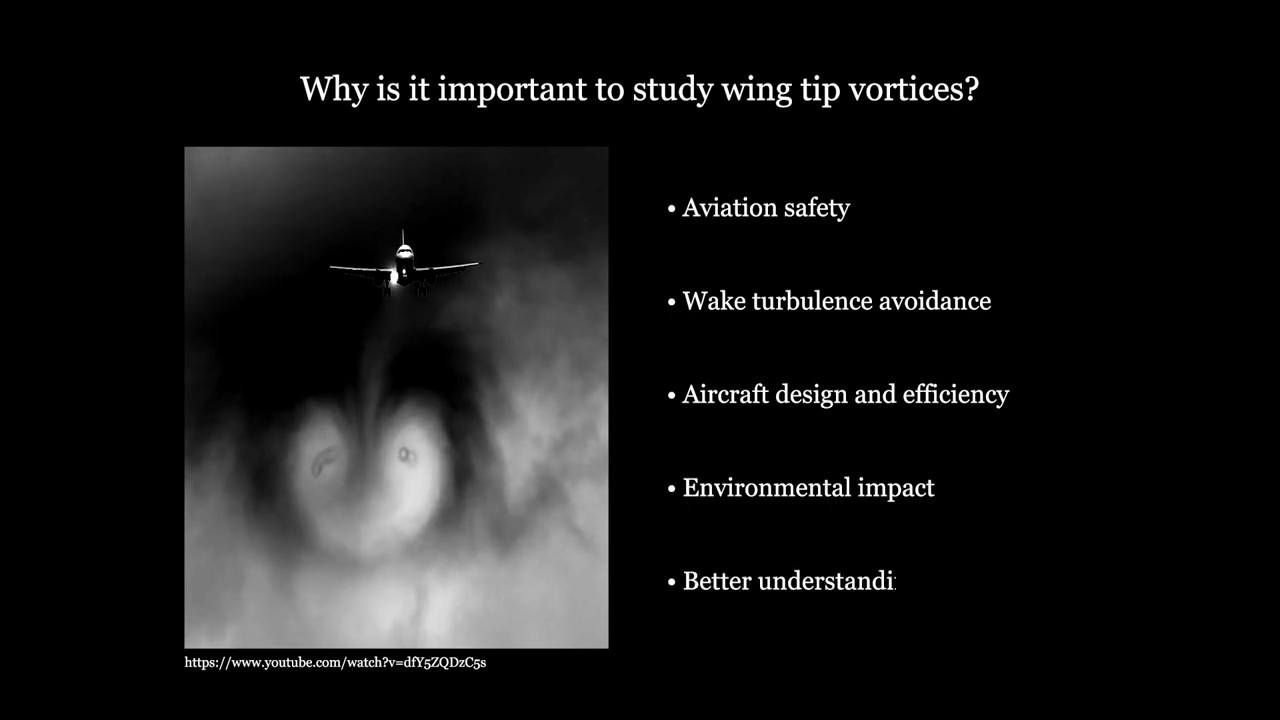
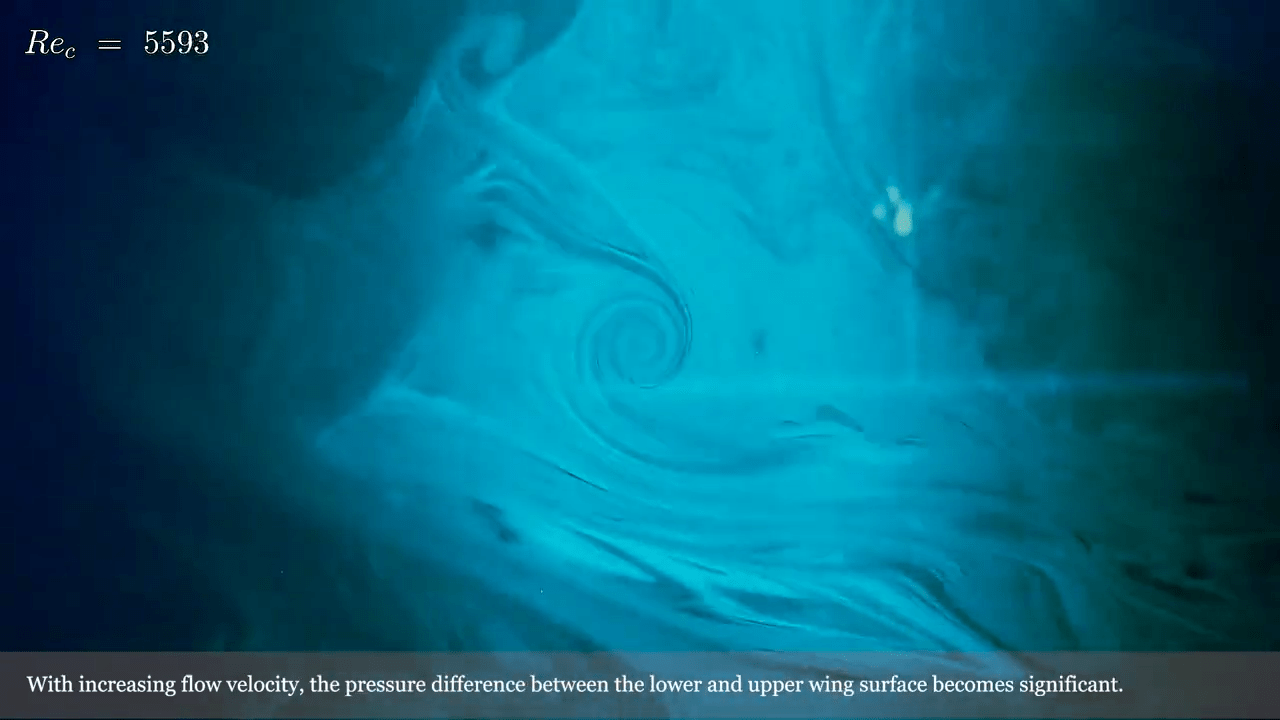
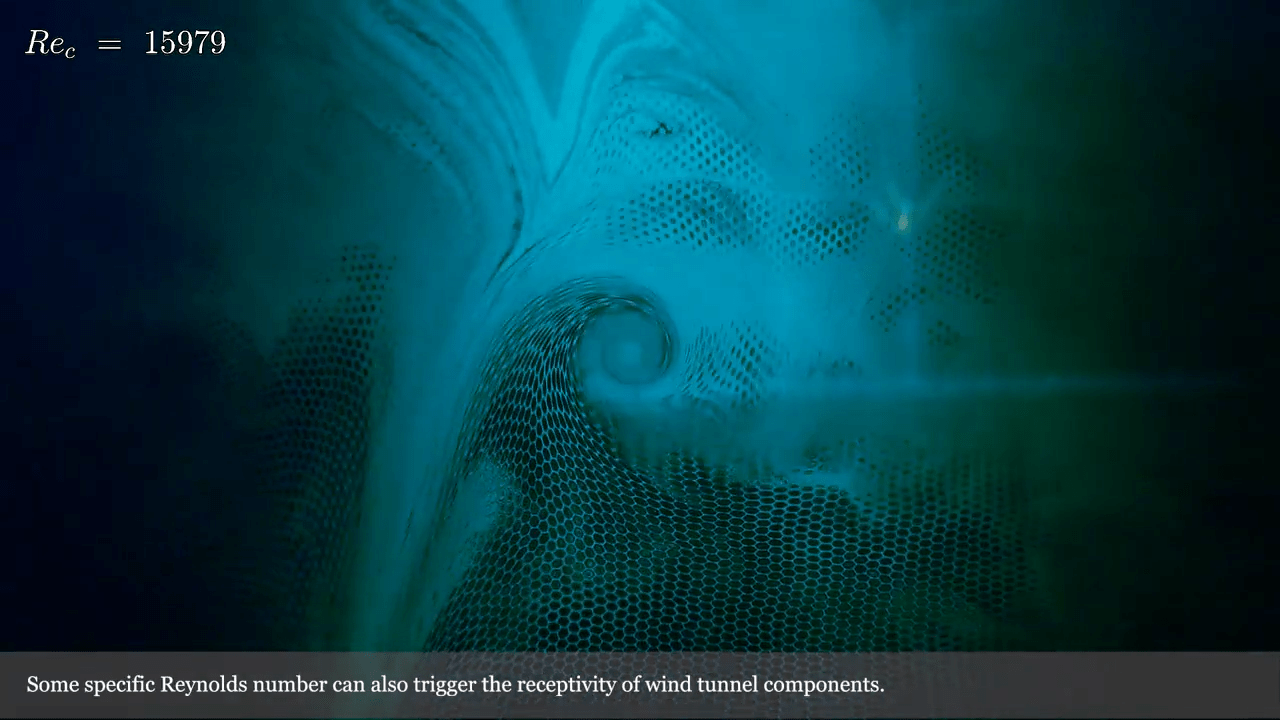
    At the ends of an airplane‘s wings, the pressure difference between air on top of the wing and air below it creates a swirling vortex that extends behind the aircraft. In this video, researchers recreate this wingtip vortex in a wind tunnel, visualized with laser-illuminated smoke. The team shows the progression from no vortex to a strong, coherent vortex as the flow in the tunnel speeds up. Along the way, there are interesting asides, like the speed where the honeycomb used to smooth the upstream flow is suddenly visibly imprinted on the smoke! (Video and image credit: M. Couliou et al.)

  • Farewell, Saffire!

    Farewell, Saffire!

    After eight years and six flight tests, NASA said a fiery farewell to the Spacecraft Fire Safety Experiment, or Saffire, mission. Each Saffire test took place on an uncrewed Cygnus supply vehicle after undocking from the space station. Cygnus craft burn up during atmospheric re-entry, so using them as a platform guaranteed safety for the station’s crew.

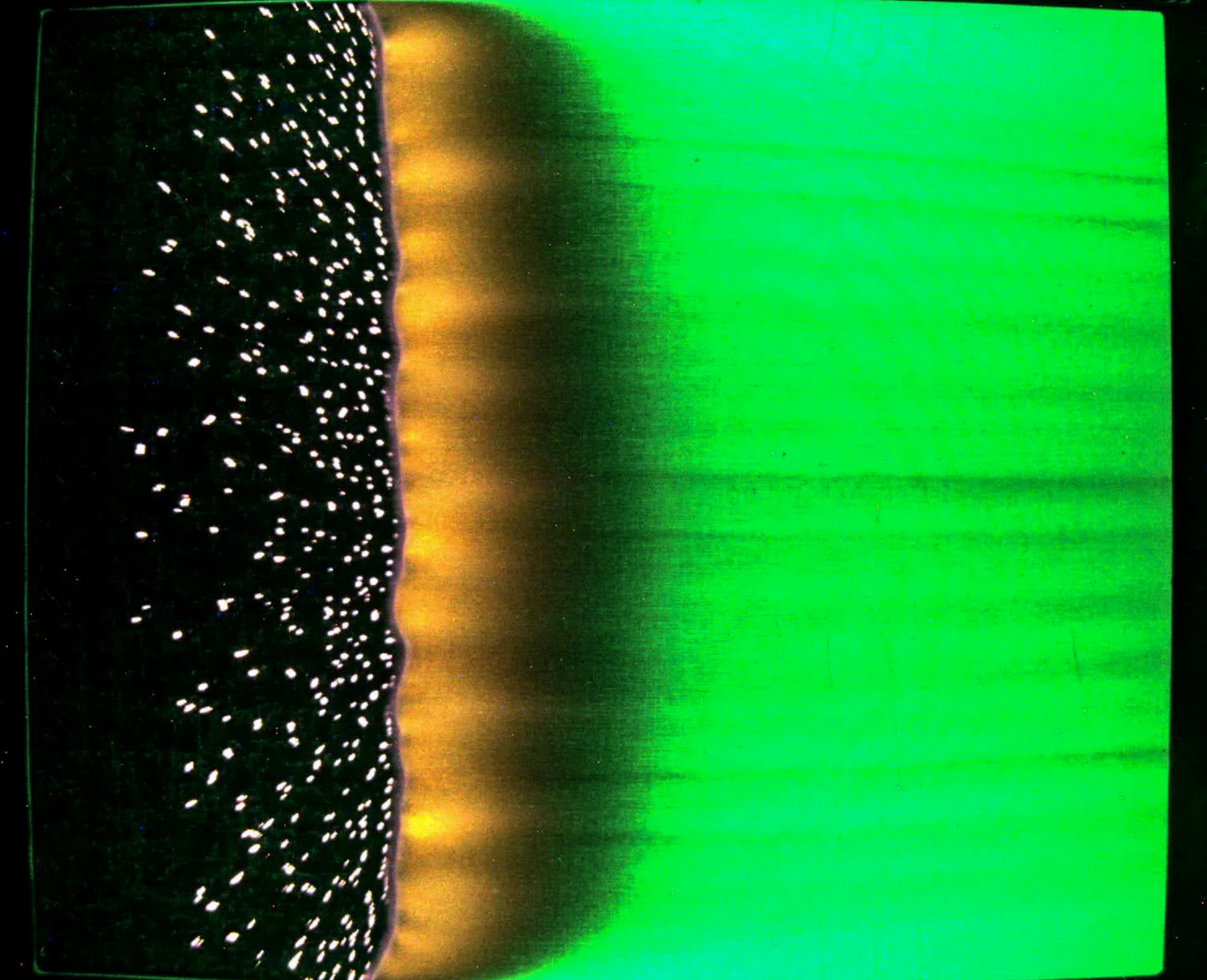
    A Plexiglass sample burns as part of Saffire-V’s experiments. In this experiment, researchers found that flames grew and spread faster on thin ribs of Plexiglass (left) than on thicker samples (right).

    Saffire itself used a small wind tunnel to push air past its burning materials. The tests included materials like plexiglass, cotton, Nomex, and other fabrics that might be found on a spacecraft or its occupants. The goal, of course, is to understand how fires grow and spread in a spacecraft in order to protect the crew. To that end, Saffire experiments recorded not only what went on inside their test unit, but also what the conditions were in the spacecraft as Saffire burned. (Image and video credit: NASA; via Gizmodo and NASA Glenn)

  • Why Moths Are Slow Fliers

    Why Moths Are Slow Fliers

    Hawkmoths and other insects are slow fliers compared to birds, even ones that can hover. To understand why these insects top out at 5 m/s, researchers simulated their flight from hovering to forward flight at 4 m/s. They analyzed real hawkmoths flying in wind tunnels to build their simulated insects, then studied their digital moths with computational fluid dynamics.

    During hovering flight, they found that hawkmoths generate equal amounts of lift with their upstroke and downstroke. As the moth transitions into forward flight, though, its wing orientation shifts to reduce drag, and the upstroke stops being so helpful. Instead, the upstroke generates a downward lift that the downstroke has to counter in addition to the insect’s weight. At higher forward speeds, this trend gets even worse.

    The final verdict? Hawkmoths don’t have the flexibility to twist their wings on the upstroke the way birds do to avoid that large downward lift. Since they can’t mitigate that negative lift, the insects have a slower top speed overall. (Image and research credit: S. Lionetti et al.; via APS Physics; submitted by Kam-Yung Soh)

  • Featured Video Play Icon

    Flying With Geese

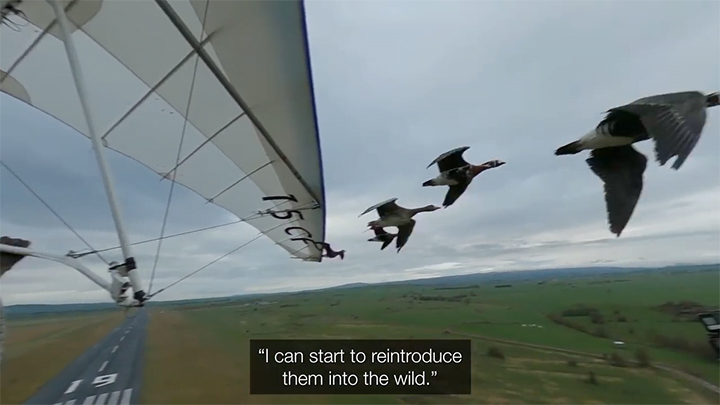
    Some people fly with geese to train them for wind tunnel tests, and some people fly with them to teach them safer migratory paths. Today’s video focuses on the latter, specifically conservationist Christian Moullec, who has spent decades living and flying with lesser white-fronted geese as part of an effort to save the threatened species. He flies with them using an ultralight aircraft, exercising daily to prepare for the cross-continental migration. To help fund the effort, he offers passengers a spot on his short flights, letting people fly with the birds! (Image and video credit: T. Scott; via Colossal)

  • Measuring Drag

    Measuring Drag

    After a noticeable rise in the prevalence of home runs beginning in 2015, Major League Baseball commissioned a report that found the increase was caused by a small 3% reduction in drag on the league’s baseballs. When such small differences have a big effect on the game, it’s important to be able to measure a baseball’s drag in flight accurately.

    In the past, that measurement has often been done in a wind tunnel, but the mounting mechanisms used there result in drag measurements that are a little higher than what’s seen from video tracking in actual games. Now researchers have developed a new free-flight method for measuring a baseball’s drag. The drag measurements from their new method are lower than those for wind-tunnel-mounted baseballs and in better agreement with video-based methods. The authors’ method should be adaptable to other sports like cricket and tennis, which will hopefully provide new insight into the subtleties of their aerodynamics. (Image credit: T. Park; research credit: L. Smith and A. Sciacchitano; via Ars Technica; submitted by Kam-Yung Soh)

  • Beijing 2022: Monobob

    Beijing 2022: Monobob

    Bobsleigh, as a discipline, has been dominated in recent years by teams seeking every aerodynamic advantage to shave hundredths of a second off their runs. So it’s fascinating that the newest event in the discipline — the women-only monobob — cuts away that secretive part of the sport by permitting sleds from only one manufacturer. Every athlete competes in an identical sled. Not only that, they swap sleds between runs based on their times! So the fastest athlete from the first run will switch sleds with whomever had the slowest time.

    The event’s rules refocus the competition on athletic performance and skill rather than incentivizing countries who can afford to spend more money on wind tunnel testing and F1 design companies. That’s a great step toward leveling the playing field. I can’t wait to watch! (Image credit: OIS)

  • Beijing 2022: Ski Jumping

    Beijing 2022: Ski Jumping

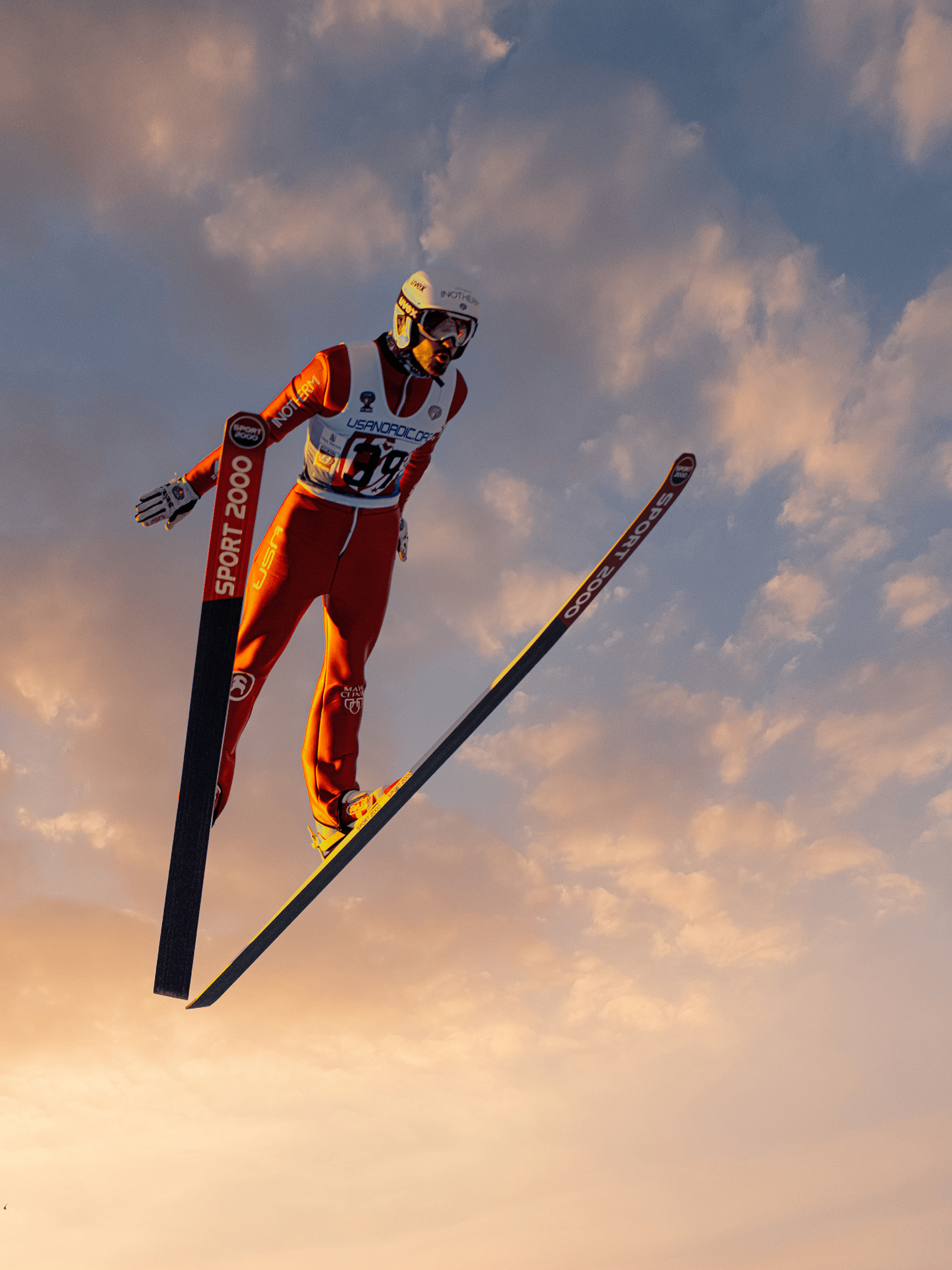
    In ski jumping, aerodynamics are paramount. Each jump consists of four segments: the in-run, take-off, flight, and landing. Of these, aerodynamics dominates in the in-run — where jumpers streamline themselves to minimize drag and maximize their take-off speed — and in flight. During flight, ski jumpers spread their skis in a V-shape and lift their arms to the sides to turn themselves into a glider. Their goal is to maximize their lift-to-drag ratio, so that the air keeps them aloft as long as possible. Because of the short flight time and high risk of taking jump after jump, many elite ski jumpers use wind tunnel time to practice and hone their flight positioning, as seen in the video below.

    Weather also plays a significant role in ski jumping; it’s one of the few sports where a headwind is an advantage to athletes. To try to adjust for wind effects, scoring for the sport uses a wind factor. (Image credit: T. Trapani; video credit: NBC News)

  • Featured Video Play Icon

    Streamlining Circa 1936

    This 1936 promotional film by Chevrolet explains the concept of streamlining objects to reduce their drag. And it actually does a pretty nice job of it, including some wind tunnel footage and table-top demonstrations. It’s also an amazing snapshot of the era, both in terms of engineering and the vision they had for the future. Just check out that City of the Future and its torpedo cars! (Video and image credit: Chevrolet; submitted by Larry S.)

  • Crocodilian-Inspired Aerodynamics

    Crocodilian-Inspired Aerodynamics

    Inspired by crocodilians, young scientist Angela Rofail designed attachments to reduce wind loads on high-rise buildings. When crocodilians swim, the ridges on their back help hide their motion from observation above the surface. Rofail wondered whether similar ridges would reduce the wind-induced swaying of high-rise buildings. Using a scale-model and crocodile-inspired knobs, the Year 10 student (read “high-school freshman” for U.S. readers) conducted wind tunnel tests that showed her modifications reduced drag on the model and kept it from moving in windy conditions. (Image credit: H. Roettger; video credit: CSIRO; via CSIRO; submitted by Kam-Yung Soh)