Search results for: “wind tunnel”

  • Bats in Ground Effect

    Bats in Ground Effect

    As pilots can tell you, flying near the ground (or an open expanse of water) gives one an aerodynamic boost. Essentially, the surface acts like a mirror, reflecting and dissipating the wingtip vortices that create downwash. That reduces the power necessary to fly, as long as you’re flying within about a wingspan of the surface.

    Theoretically, flapping fliers like bats and birds should also benefit from this ground effect, but measurements have been hard to come by. A new study using bats trained to fly in a wind tunnel provides some of the first detailed measurements of ground effect for flapping animals. The researchers found a 29% reduction in the power necessary for flight when in ground effect compared to being out of it! That’s twice the savings predicted by modeling, meaning we still have a ways to go to accurately capture the physics of flapping flight under these circumstances.

    Such a substantial savings also strengthens arguments for flight developing from the ground up. Using ground effect, surface-dwelling animals could have evolved flight gradually, taking advantage of the energy savings offered by sticking close to the surface. (Image and research credit: L. Johansson et al.; submitted by Marc A.)

  • The Protection of the Peloton

    The Protection of the Peloton

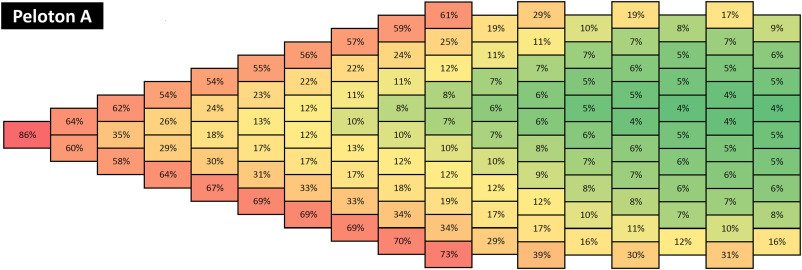
    It’s well-known by professional cyclists that sitting in the middle of the peloton requires little effort to overcome aerodynamic drag, but now, for the first time, there’s a scientific study to back that up. Researchers built their own quarter-scale peloton of 121 riders to investigate the aerodynamic effect of cycling in such a large group versus riding solo. Through wind tunnel studies and numerical simulation, they found that riders deep in the peloton can experience as little as 5-10% of the aerodynamic drag of a solo cyclist. 

    Tactically, this means teams should aim to position their protected leader or sprinter mid-way in the pack, where they’ll receive lots of shelter without risking one of the crashes common near the back of the peloton. It also suggests that teams wanting to isolate another team’s leader should try to push them toward the outer edges of the peloton rather than letting them sit in the middle. It will be interesting to see whether pro teams shift their race strategies at all with these numbers in hand.

    Of course, this study considers only a pure headwind. But other groups are looking at the effects of side winds on cyclists. (Image credit: J. Miranda; image and research credit: B. Blocken et al.; submitted by 1307phaezr)

  • PyeongChang 2018: Bobsleigh

    PyeongChang 2018: Bobsleigh

    In bobsleigh, two- and four-person teams compete across four runs down an ice track. The shortest cumulative time wins, and since typical runs are separated by hundredths of a second, teams look for any advantage that helps them shave time. The size, weight, and components of a sled are restricted by federation rules; for example, teams cannot use vortex generators to improve their aerodynamics. Instead bobsledders work with companies like BMW, McLaren, and Ferrari to engineer their sleds. Both computational fluid dynamics and wind tunnel tests with the actual team in the sled are used to make each sled as aerodynamic as possible. (Image credit: IOC, Gillette World Sports, source)

  • PyeongChang 2018: Speedskating

    PyeongChang 2018: Speedskating

    Four years ago in Sochi, Under Armour’s suits for the U.S. speedskating team took a lot of flak after the team failed to medal. The company defended the physics and engineering of their suits, and an internal audit of the speedskating program ultimately placed blame on flaws in their training regimen, unfamiliarity with the new suits, and overconfidence.

    This time around Under Armour has taken a more hands-on approach with the team, helping with training regimens in addition to providing suits. Under Armour spent hundreds of hours testing the suits in Specialized’s wind tunnel, including testing many fabrics before settling on the slightly rough H1 fabric used in patches on the skater’s arms and legs. Like the previous suit’s dimpled design, the roughness of the fabric promotes turbulent flow near it. Because turbulent flow follows curved contours better than laminar flow does, air stays attached to the athlete for longer, thereby reducing their drag. The suit is also designed with asymmetric seams that help the athlete stay low and comfortable in the sport’s frequent left turns.

    U.S. speedskaters have been competing in a version of the suits since last winter, ensuring that athletes are familiar with the equipment this time around. Whether the new suits and training program will pay off remains to be seen. After their disastrous experience in Sochi, both the team and the company are shy about setting expectations. (Image credits: D. Maloney/Wired; US Speedskating)

  • PyeongChang 2018: Skeleton

    PyeongChang 2018: Skeleton

    Skeleton, the sliding event in which athletes race down an ice track head first, is a fast-paced and punishing sport. Skeleton racers can reach speeds of 125 kph (~80 mph) during their descents. This is a little slower than the feet-first luge, in part because the skeleton sled runs on circular bars rather than sharp runners. 

    Body positioning is key in the sport. It’s the athlete’s primary method of steering, and it controls how much drag slows them down. But skeleton runs are brutally taxing; athletes pull 4 or 5g in the turns – more than astronauts experience during a launch! All that jostling means athletes cannot stand more than about 3 trips down the track in a day. To practice positioning without the bone-jarring descent, athletes can work in a wind tunnel. While the wind tunnel provides the aerodynamic equivalent of their usual speed, athletes focus on holding their bodies in the most streamlined position. Some wind tunnels are even able to provide screens that let the athletes see their drag values in real-time, letting them adjust to learn what works best for them. (Image credit: N. Pisarenko/AP, Bromley Sports)

  • Flying Fish Aerodynamics

    Flying Fish Aerodynamics

    Flying fish, strange as it sounds, have aerodynamic prowess comparable to hawks. The fish aren’t true fliers, but they do glide for hundreds of meters using their large pectoral and pelvic fins as wings. Wind tunnel research shows the fish have their maximum lift at an angle of attack around 30-35 degrees, matching their typical take-off angle (top). Their best gliding performance occurs when they’re roughly parallel to the water (middle). The researchers even found that the fish use ground effect to enhance their lift. Although their aerodynamics allow flying fish to get out of reach of their aquatic predators, the fish must be wary of flying too high, as this makes them a target for frigatebirds (bottom). These acrobatic seabirds can’t get wet, but they have some impressive aerodynamics of their own to help make up for it.  (Image credit: BBC Earth, source; research credit: H. Park and H. Choi; see also SciAm)

  • Flow in a Turbine

    Flow in a Turbine

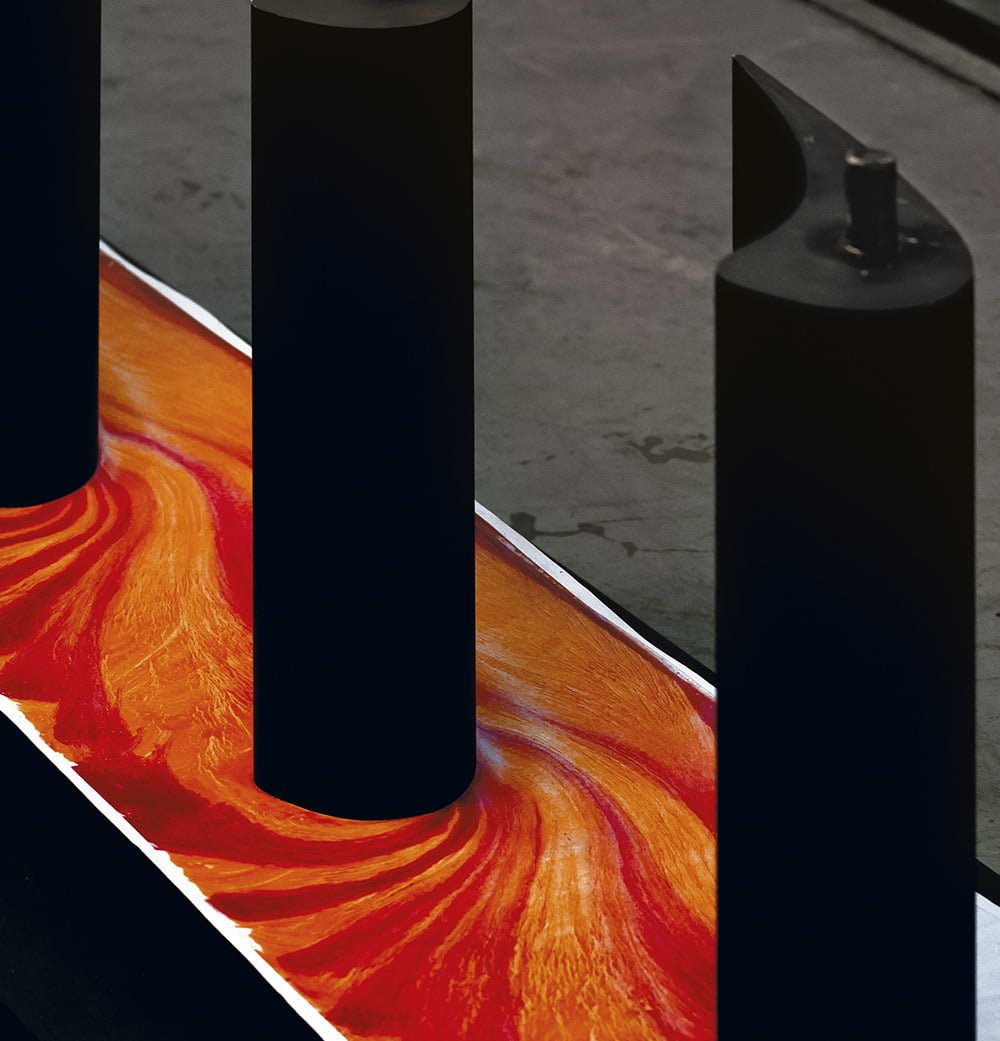
    Fluid flows are complex, complicated, and ever-changing. Researchers use many techniques to visualize parts of a flow, which can help make what’s happening clearer. One technique, shown above, uses oil and dye to visualize flow at the surface. The vertical, black, airfoil-shaped pieces are stators, stationary parts within a turbine that help direct flow. After painting the stator mount surface with a uniform layer of oil, the model can be placed in a wind tunnel (or turbine) and exposed to flow. Air moving around the stators drags some of the oil with it, creating the darker and lighter streaks seen here. Notice how the lines of oil turn sharply around the front of the stator and bunch up near its widest point. Those crowded flow lines tell researchers that the air moves quickly around this corner. (Image credit: D. Klaubert et al., source)

  • Featured Video Play Icon

    Fluttering Feathers

    Birds do not always vocalize in order to make their songs. The male African broadbill, shown in the top video above, makes a very distinctive brreeeet in its flight displays, but as newly published research shows, the sound comes from its wings, not its voice. During the display, the broadbill spreads its primary feathers and sound is produced on the downstroke, when wingtip speeds reach about 16 m/s. By filming a broadbill wing with a high-speed camera in a wind tunnel at comparable air speeds, researchers could localize the sound production to the 6th and 7th primary feathers.

    In the second video above, you can see these feathers twisting and fluttering in the breeze. This is an example of aeroelastic flutter, a phenomenon in which aerodynamic and structural forces couple to induce oscillations. The same phenomenon famously caused the collapse of the Tacoma Narrows Bridge in 1940. In the birds, however, the flutter is non-destructive and the vibration produces audible sound which the other feathers modulate into the calls we hear. Broadbills aren’t the only birds to use this trick; some species of hummingbirds use flutter in their tail feathers during mating displays. (Video, image, and research credits: C. Clark et al.; additional videos here)

  • Featured Video Play Icon

    Hummingbird Hovering

    Hummingbirds have a unique way of flying among birds. By flapping in a figure-8 motion, they generate lift on both the upstroke and the downstroke, which enables them to fly forward, backward, and even hover for extended periods. Such mid-air acrobatics are necessary for a species that feeds on flower nectar. What is especially impressive about the birds, though, is how they hold up even in adverse conditions like wind or rain. By placing birds in a wind tunnel and filming with high-speed video, researchers can see how hummingbirds maintain their feeding position even in 20 mph (32 kph) winds. By fanning out their tail feathers like a rudder, they can control their body orientation despite turbulent gusts. Not even rain stops them. The birds will periodically shake themselves dry, much like a dog if a dog could manage to fly while shaking itself. (Video credit: Deep Look; submitted by entropy-perturbation)

  • Featured Video Play Icon

    Lab-borne Tornadoes

    Conventional wind tunnels are great, but some aerodynamic testing requires facilities of a different nature. The video above is from the WindEEE dome, a hexagonal chamber with sixty fans on one wall, eight directional fans on the other five walls, and six fans in the upper chamber. Each is individually computer controlled, allowing the researchers to create straight flows as well as complex vortical ones. The video shows their tornado flow, which stands 5 m tall and swirls at 30 m/s. They can also move the tornado around the chamber at 2 m/s. This capability enables a kind of scale-model analysis of tornadoes and their impact that’s not possible in most facilities. You can read more about the dome at New Scientist or the WindEEE website. (Video credit: New Scientist/WindEEE; submitted by entropy-perturbation)