
Inspired by crocodilians, young scientist Angela Rofail designed attachments to reduce wind loads on high-rise buildings. When crocodilians swim, the ridges on their back help hide their motion from observation above the surface. Rofail wondered whether similar ridges would reduce the wind-induced swaying of high-rise buildings. Using a scale-model and crocodile-inspired knobs, the Year 10 student (read “high-school freshman” for U.S. readers) conducted wind tunnel tests that showed her modifications reduced drag on the model and kept it from moving in windy conditions. (Image credit: H. Roettger; video credit: CSIRO; via CSIRO; submitted by Kam-Yung Soh)
Search results for: “wind tunnel”

Aerodynamic Flight Testing


Flight testing models has a long history in aerodynamics. Above you see a Curtiss JN-4 biplane in flight with a model wing suspended below the fuselage. This test was conducted circa 1921 by NASA’s predecessor, NACA. At the time, of course, computational simulations were non-existent, and, although wind tunnels existed, presumably they could not recreate the exact circumstances needed for the test. Available wind tunnels might have lacked the power to reach the speeds engineers wanted, or they could have been too small for the model or had too many disturbances compared to the pristine flight environment. Any or all of these concerns can drive decisions to use flight testing instead of ground tests.
Flight testing in aerodynamics is still used today, albeit sparingly. The second image shows a crew of Texas A&M graduate students (including yours truly) with a swept wing model we were about to test with a Cessna O-2 aircraft. By this point (roughly 10 years ago), we had wind tunnels capable of overlapping the conditions we could achieve in flight, but flight testing still gave us a larger range of conditions than working solely in the wind tunnel. (Image credits: JN-4 – NASA, O-2 – M. Woodruff; via Rainmaker1973; submitted by Marc A.)
COVID-19 and Outdoor Exercise
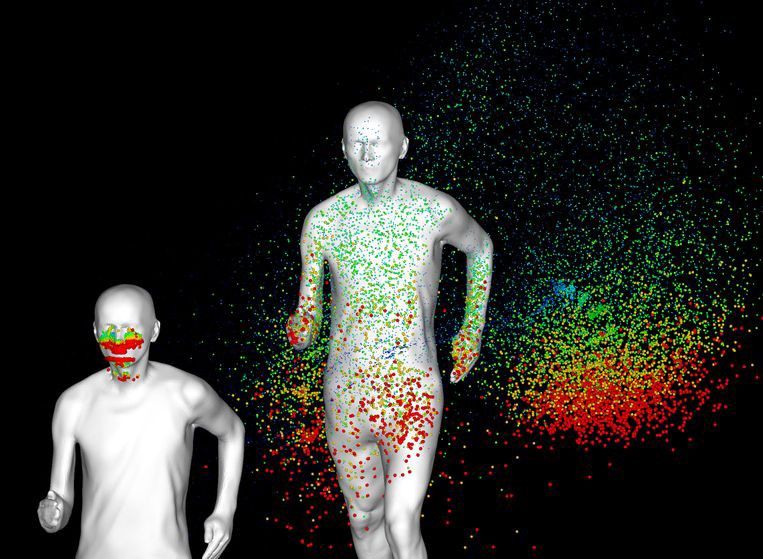
By now you’ve probably come across some blog posts and news articles about a new pre-print study looking at the aerodynamics of running and the potential exposure to exhaled droplets. And you may also have seen articles questioning the accuracy and validity of such simulations. I’ve had several readers submit questions about this, so I dug into both the research and the criticisms, and here are my thoughts:
Is this study scientifically valid?
I’ve seen a number of complaints that since this paper hasn’t been peer-reviewed, we shouldn’t trust anything about it. That seems like an unreasonable overreaction to me considering how many studies receive press attention prior to their actual peer-reviewed publication. This is not a random CFD simulation produced by someone who just downloaded a copy of ANSYS Fluent. This work comes from a well-established group of engineers specializing in sports aerodynamics, and long-time readers will no doubt recognize some of their previous publications. Over the past decade, Blocken and his colleagues have become well-known for detailed experimental and simulation work that indicates larger aerodynamic effects in slipstreams than what we generally recognize.
In this paper, they lay out previous (biological) studies related to SARS and droplet exhalation; they use those papers and several wind tunnel studies to validate computational models of droplet evaporation and runner aerodynamics; and then they use those inputs to simulate how a cloud of exhaled droplets from one runner affects someone running alongside, behind, or in a staggered position relative to the first runner.
In other words, their work includes all the components one would expect of a scientific study, and it makes scientifically justifiable assumptions with regard to its methods. (That’s not, mind you, to say that no one can disagree with some of those choices, but that’s true of plenty of peer-reviewed work as well.) All in all, yes, this is a scientifically valid study, even if it has not yet undergone formal peer-review*.
Can simulations actually tell us anything about virus transmission?
One complaint I’ve seen from both biologists and engineers is that simulations like these don’t actually capture the full physics and biology involved in virus transmission. While I agree with that general sentiment, I would point out two important facts:
1) Blocken et al. acknowledge that this is not a virology study and confine their scientific results to looking at what happens physically to droplets when two people are moving relative to one another. Whether those droplets can transmit disease or not is a question left to biological researchers.
2) Most medical and biological research also does not account for the physics of droplet transmission and transport. For the past century, this research has focused almost exclusively on droplet sizes, with the assumption that large droplets fall quickly and small droplets persist a little longer. To my knowledge, some of the only work done on the actual physics of the turbulent cloud produced by coughing or sneezing comes from Lydia Bourouiba’s lab at MIT. And, to me, one of the fundamental conclusions from her work is that droplets (especially small ones) can persist a lot longer and farther than previously assumed. Can those droplets facilitate transmission of COVID-19? The general consensus I’ve seen expressed by medical experts is no, but, to my knowledge, that is based on opinion and assumption, not on an actual scientific study.
The bottom line
In my opinion, there’s a big disconnect right now between the medical/biological community and the engineering community. To truly capture the physics and biology of COVID-19 transmission requires the expertise and cooperation of both. Right now both sides are making potentially dangerous assertions.
Honestly, based on what I know about aerodynamics, I am personally skeptical as to whether 6 ft of physical separation is truly enough; whether it is or not seems to depend on how transmissible the novel coronavirus is through small droplets, which, again, to my knowledge, is unestablished.
Should we leave more distance than 6ft between us when exercising outdoors? Absolutely. Aerodynamically, it makes perfect sense that following in someone’s slipstream would put you inside their droplet cloud, which needs time and space to disperse. Personally, I’ve sidestepped the question entirely by doing all my cycling indoors while quarantined.
tl;dr: There are a lot of open questions right now about COVID-19 transmission and what qualifies as safe distancing, but it’s smarter to err on the side of more distancing. Don’t hang close to others when running or cycling outdoors.
(Image and research credit: B. Blocken et al.; submitted by Corky W. and Wendy H.)
*I will add that, with my training, I have and do occasionally peer-review studies such as this one, and I read the full paper with the same sort of critical eye I would turn to a paper I was asked to review.

Why Compressed Air Cans Get Cold
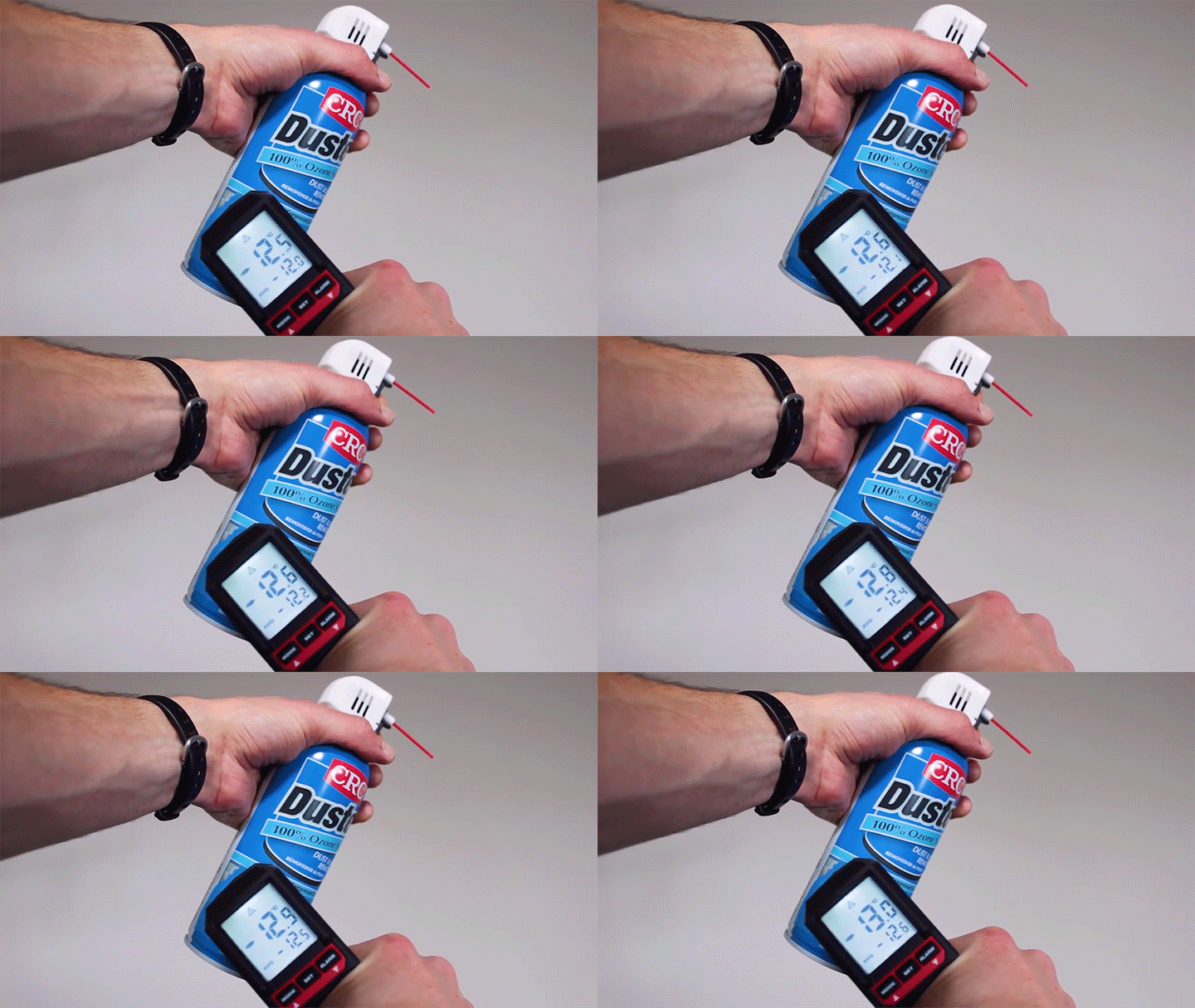


Anyone who’s used a can of compressed air to clean their computer or keyboard knows that the can quickly gets quite cold to the touch. This Minute Physics video explores some of the thermodynamics behind that process. Henry first identifies a few explanations that don’t quite line up with observations, before focusing in on the contents of the can: 1,1-difluoroethane. Inside the sealed can, this chemical sits in an equilibrium of part-liquid, part-vapor. But when pressure is released by opening the nozzle, the liquid boils, generating extra vapor and cooling whatever remains in the reservoir.
Although it’s not a good explanation for the compressed air can’s cooling, the cooling of an expanding gas is very important in applications like supersonic wind tunnels. That first equation you see at 0:36 in the video (for isentropic adiabatic expansion) is key to what happens in a nozzle with supersonic flow. As the flow accelerates to supersonic speeds, its temperature drops dramatically. When I was in graduate school, we actually had to preheat our hypersonic wind tunnel (in pretty much the same way you would preheat your oven at home) before we ran at Mach 6 because otherwise the temperature inside the test section would drop so low that the oxygen would liquefy out of the air! (Image and video credit: Minute Physics)
“It’s All About Flow”


Fluid dynamicists, like other scientists, have lives and interests well beyond our research. Ivo Nedyalkov, for example, is a professional rapper in addition to a PhD-level fluid dynamicist. In “It’s All About Flow,” Dr. Ivo brings those areas of expertise together with a rap all about fluid dynamics. The version embedded here is a bit shorter than the full version, which digs not only into experimental fluid dynamics but into computational work as well.
Check it out, and if you’d like to see the full lyrics and explanation behind them, he’s posted those as well. You can also ping me here or on Twitter if you’d like to know more about the phenomena he discusses. (Video and image credit: I. Nedyalkov/ASME; full video here; lyrics and explanation)
Superman’s Hair Gel
I love a good tongue-in-cheek physical analysis of superheroes. This estimate of the drag force experienced by Superman’s hair when outracing a plane or speeding bullet was done by Cornell students. According to their calculations, Superman’s hair (or his hair gel) must withstand nearly 80,000 Newtons of force. That’s a bit less than the typical force experienced by a restrained passenger in a car crash at highway speeds.
In grad school, my labmates and I held a spirited debate about the difference in drag Superman would experience when flying at hypersonic speeds depending on whether he had one or both arms extended in front of him. Sadly, we never found the chance to test our hypotheses in the wind tunnel. (Image and video credit: R. Geltman et al.)


Flow on Commercial Wings
Even in an era of supercomputers, there is a place for quick and dirty methods of flow visualization. Here we see a model of a swept wing like those seen on many commercial airliners. It was painted with a layer of fluorescent oil, then placed in a wind tunnel and subjected to flow. As air blows across the model, it moves the oil, leaving behind streaks that show how air near the surface moves.
We can see, for example, that near the fuselage, the air flows mostly front to back across the wing. That’s what we expect, especially for a wing generating lift. But further out on the wing, the flow moves mostly along the wing, not across it. There’s also a distinctive line running just a short ways behind the leading edge on this outer section of wing. It looks as though air flowing over the wing separated at this point, leaving disordered and unhelpful flow behind. It’s likely that the model was tested at an angle of attack where the outer section of the wing was beginning to stall. (Image credit: ARA)
Themed Series
Occasionally, FYFD will feature a series of posts on a special theme. This page serves as an archive of these themed series. Got an idea for theme? You can always suggest one via Tumblr, Twitter, or email.

Fluid Dynamics of Plants
- Introduction: previous plant posts
- The extraordinary flight of the dandelion seed
- Bladderworts use ultra-fast suction to catch prey
- Moisture allows horsetail plant spores to walk and jump
- The structure of citrus peels sprays oil at up to 30 m/s

Collective Motion of Humans and Animals
- What makes flocks of birds and schools of fish so hard to predict?
- The solid and fluid characteristics of black aquatic worms
- What crowds of people and granular materials have in common
- The shimmering of giant honeybees
- When collective motion isn’t always beneficial…
PyeongChang Winter Olympics 2018
- What makes ice so slippery
- How moguls form and move
- The gliding flight of a ski jumper
- Aerodynamics of a skeleton run
- How the newest U.S. speedskating suit beats the wind
- How artificial snow gets made
- Wind tunnel testing bobsleds for speed
- Not all Olympic ice is created equal
- Drafting in cross-country skiing
- The odd physics behind curling
Pilot-Wave Hydrodynamics
Completed in collaboration with FYP.- Introduction
- How vibration and Chladni patterns depend on fluids
- Vibrating a liquid creates the ripple-like Faraday instability
- Droplets on a vibrating surface can bounce and even walk
- Bouncing droplets can form lattices
- Quantum double-slit experiments established wave and particle properties for light and electrons…
- …But walking droplets behave the same way in slit experiments
- Quantum tunneling allows electrons to escape…
- …And walking droplets can tunnel out, too!
- So what are the connections between quantum mechanics and pilot-wave hydrodynamics?
- Resources, links, and ways to learn more
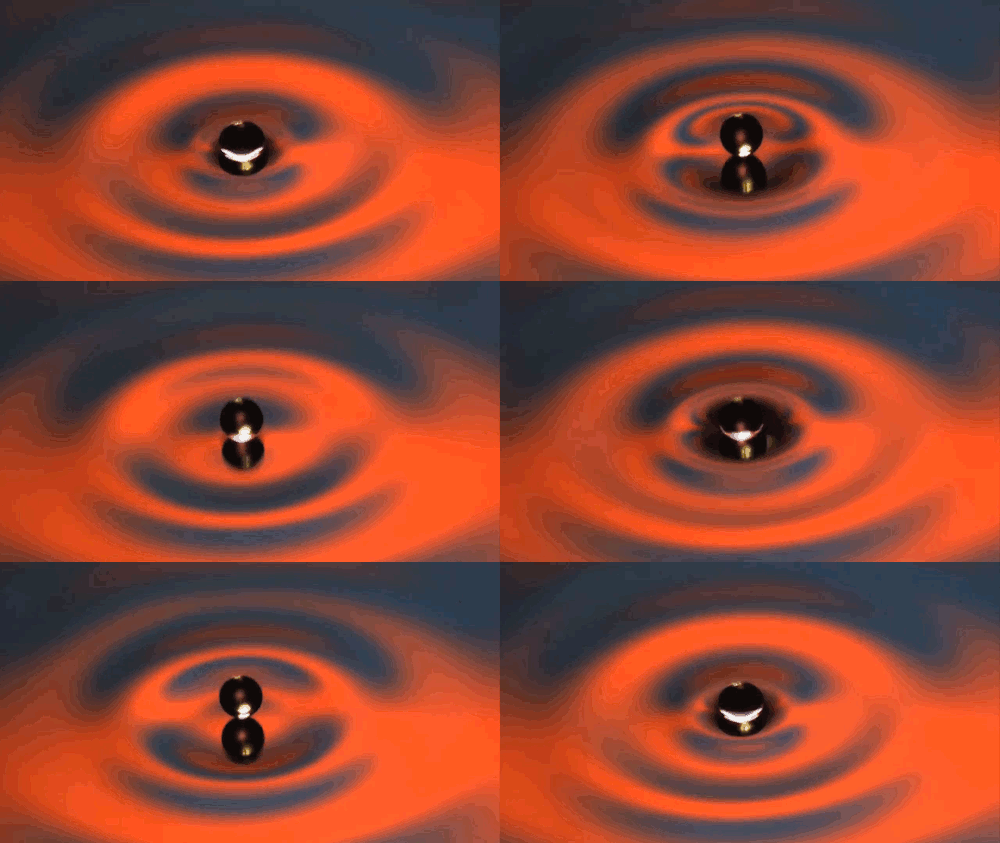
(Image credit: D. Harris et al.)

Galapagos Week
- Introducing the Galapagos Islands
- How marine iguanas swim
- What makes the tiny pistol shrimp so loud
- Learning about lava flows: a’a versus pahoehoe
- How blue-footed boobies dive at 20 m/s without breaking their necks
- Sea turtles are aquatic fliers
- Bonus related posts: how frigatebirds cruise the seas without getting wet; the aerodynamics of flying fish; hydrodynamics of humpback whales; incredible bioluminescent plankton; and leaping mobula rays.
(Image credit: N. Sharp and J. Shoer)

Rio Summer Olympics 2016
- How motorbikes can unfairly influence cycling races
- Why swimmers can be faster underwater
- The aerodynamics of rugby
- How to design and build a whitewater course
- The spinning physics of table tennis
- The aerodynamic tactics of track cycling
- How water polo players and synchronized swimmers stay afloat
- How wind and altitude affect the long jump
- Rule 42 and why rocking the boat in sailing is cheating
- The high-speed science of badminton
- Was there a current in the Rio swimming pool?
- What commentators don’t tell you about the perfect diving splash
(Image credit: Getty Images)
A Day in the Life of a Fluid Dynamicist
(Image credit: S. Reckinger et al.)

Walking on Water
- Introduction
- The common basilisk (a.k.a. Jesus Christ lizard)
- Pygmy geckos and other tiny water-walkers
- “Rushing” in Western and Clark’s grebes
- Jumping off water
- How fast does the Flash have to go to run on water?
- Bonus: Calculate what it takes to run on water in English units or metric
(Original grebe image: W. Watson/USFWS)

Fluid Dynamics on Pluto
(Image credit: NASA/JHU APL/SwRI)
FYFD’s Fourth Birthday Celebration
(Image credit: Nat. Geo/BBC2)

Sochi Winter Olympics 2014
- Preview: Wind tunnel testing for ski jumping
- Why ice is slippery
- How lugers slide so fast
- Aerodynamics in long-track speed skating
- How ski jumpers fly farther
- Effects of wind conditions on ski jumping
- The US speedskating suit controversy
- How to make artificial snow
- How skiers glide across snow
- Aerodynamics and technology of bobsledding
- The physics of curling
- Speed skiing
- Link round-up: some of my favorite Olympic science stories
(Image credit: Exa Corp)

Holiday Fluid Dynamics 2013
- Introduction
- The structure of snowflakes
- The aerodynamics of Santa’s sleigh
- Buoyancy-driven Christmas pyramids
- Convection in cocoa
- What’s in a Yuletide fire?
- Bonus: The physics of your New Year’s champagne
(Photo credit: G. Liger-Belair)

Gallery of Fluid Motion Favorites 2013
- Fluid juggling
- Ultrasonic levitation of a droplet
- Leidenfrost droplet propulsion
- Why tapping a beer bottle makes it foam
- Magnetocappillary swimmers
(Photo credit: APS DFD)
Fluid Dynamics and the Ig Nobel Prize
- On the lack of fluid dynamics among Nobel Prize winners
- How a human can run on water
- The physics of cookie dunking
- Does a person swim faster in water or syrup?
- Why shower curtains billow
- Other Ig Nobel fluids winners
- (Added in 2016) The law of urination
(Image credit: Improbable Research)

FYFD’s Third Birthday Celebration
- Introduction
- Visible shock waves from a rocket launch
- Double-spiral so\ap film
- A soap bubble popping
- The fluid dynamic sewing machine
(Photo credit: T. Schnipper et al.)

London Summer Olympics 2012
- The Olympic torch
- What makes a pool fast?
- The aerodynamics of archery
- The physics of badminton
- How cyclists get aero
- How divers minimize splash
- Aerodynamics in running
- How rowers avoid drag
- How javelins fly far
- Why corner kicks swerve
- The aerodynamics of the discus
(Photo credit: AP/Reuters)

Fluid Dynamics of the Tour de France
- The benefits of the peloton
- Crosswinds and the echelon
- The lead-out train
- Aero gear and the time trial
- Wind tunnel testing
(Photo credit: Veeral Patel)

If You Teach a Goose to Fly
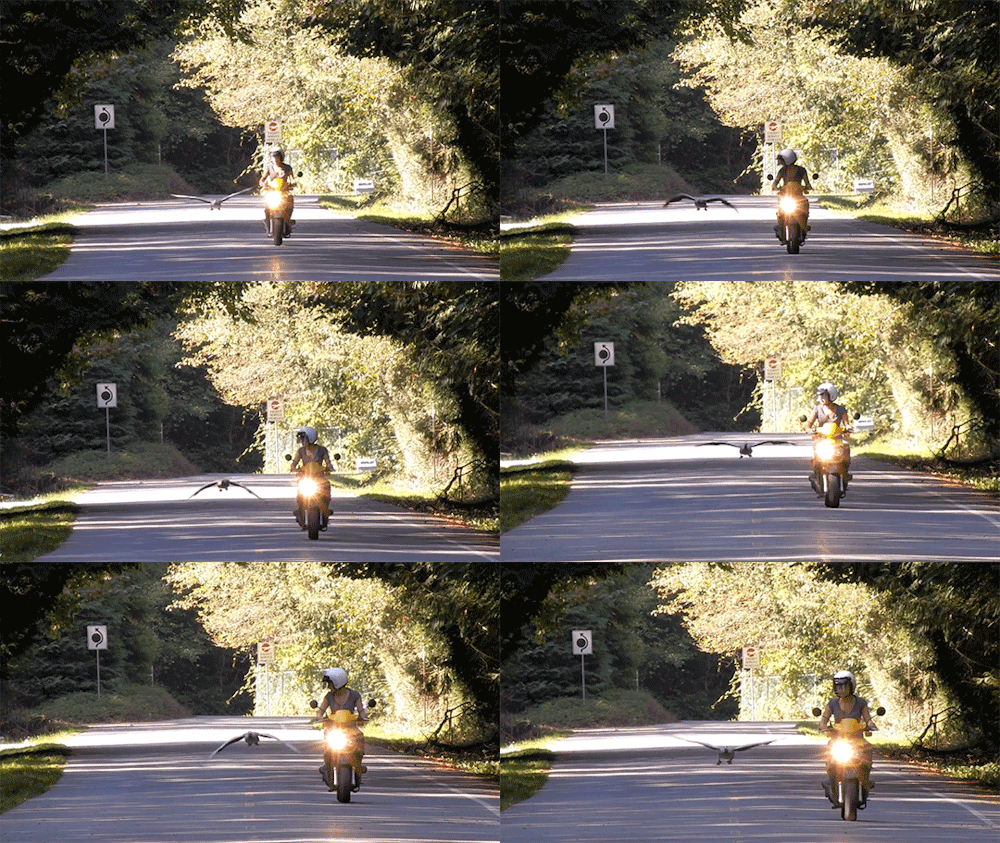

Scientists do all manner of odd things in the name of science. To teach bar-headed geese – birds capable of flying at the altitude of Everest – to fly in a wind tunnel, one group of researchers fostered a group of geese from the moment they hatched. They taught them to fly, first by chasing their bicycling parent and then following her on a motor scooter. Only then could they train the geese to fly in a wind tunnel designed to test how these birds manage to keep flying with only 30% of the oxygen found at sea level*.
The birds’ secret, it turns out, is metabolic. As the oxygen dropped, so did the temperature of the geese’s blood. Hemoglobin, which binds oxygen in blood cells, is more efficient at lower temperatures, allowing the birds to get more oxygen. At the same time, though, their overall metabolism slowed down, meaning that they required less oxygen overall to function. Taken together, these adaptations make the geese excellent fliers in conditions most animals cannot tolerate. (Image and research credit: J. Meir et al.; via WashPo; submitted by Marc A.)
* Occasionally I get comments pointing out that drag decreases with altitude, thereby making it easier to cut through the air. While this is true, I can say from my own experience of living and exercising at altitude that, for most of us, the effects of low oxygen levels far outweigh the savings in drag. It’s hard to appreciate a tiny drop in drag when your heart rate is sky high!

Inside the Canopy

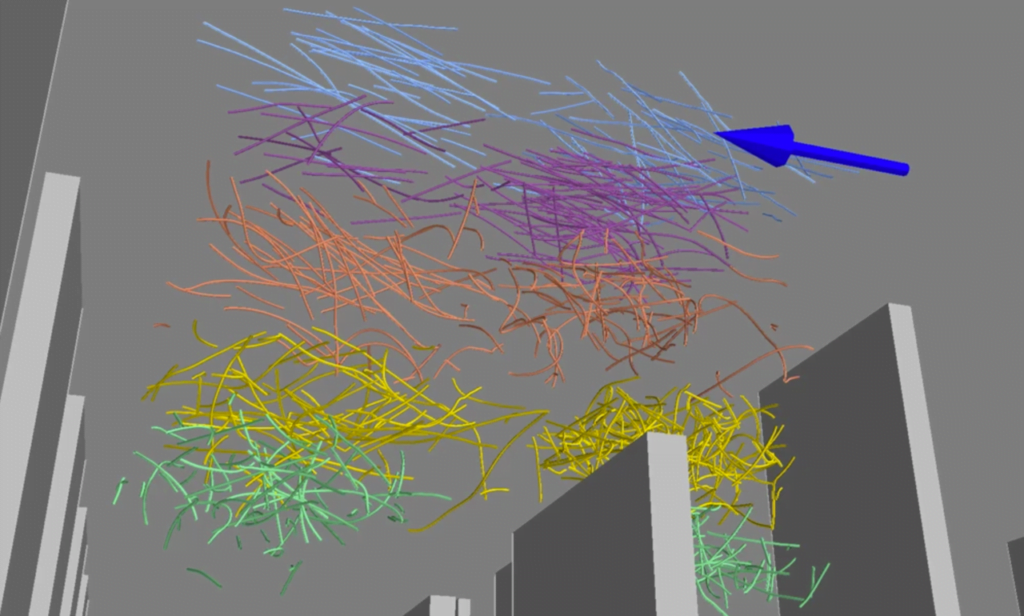


If you’ve ever gone into the woods on a windy day, you know that conditions there are drastically different than in the open. To blowing wind, trees of different sizes act like enormous roughness that disturbs the flow. Inside the canopy, flows can become incredibly complicated and many of the common techniques used by researchers no longer hold.
You can get a sense for this complexity with the second image above, which visualizes data from a wind tunnel experiment. The gray blocks represent roughness elements – the trees of this wind-tunnel-scale forest – and the large, blue arrow shows the direction of the flow. The thin colored lines show the paths taken by particles in the flow. The lines’ colors indicate what height the trajectory began at.
Notice how the blue and purple lines are relatively straight and oriented in the direction of the flow. This indicates that the flow here is relatively steady and uncomplicated. At the lower heights, though, especially in the green and yellow regions, the pathlines are far more twisted and complex. The flow here is turbulent, and the particles’ trajectories don’t necessarily correlate at all to the winds higher up. (Image credit: T. Japyassu and R. Shnapp et al.; research credit: R. Shnapp et al.; submitted by Ron S.)