Wave motion in a bay or near a beach can cause significant sediment transport. Individual granular particles, like sand, can be lifted by the passage of a single wave, but, over time, complex patterns form as the granular bottom surface shifts due to the waves. This video shows time-lapse footage of the ripples that form and move in submerged sand during many hours of wave motion. A slight imperfection in the surface causes a network of sand ripples to grow and spread. Once formed, those ripples shift and reform depending on changes in the wave conditions. (Video credit: T. Parron et al.)
Search results for: “waves”

Tidal Bore
The daily ebb and flood of the tides results from the competing forces of the Earth’s rotation and the sun and moon’s gravitational pull on the oceans. In a few areas, the local topography funnels the incoming water into a tidal bore with a distinctive leading edge. The photo above comes from the Turnagain Arm of the Cook Inlet in Alaska, where bore tides can reach a height of 7 ft and move as quickly as 15 mph. For surfers, the bore can provide a long ride–40 minutes in this case–but they can be extremely dangerous as well. Bore tides are associated with intense turbulence capable of ripping out moorings and structures; the waves are often accompanied by a roar caused by air entrainment, impact on obstacles, and the erosion of underlying sediment. (Photo credit: S. Dickerson/Red Bull Illume; via Jennifer Ouellette)
Fluids Round-up – 11 January 2014
It’s a big fluids round-up today, so let’s get right to it.
- Over at txchnologist, there’s a great article on controlling combustion instabilities in rocket engines with sound.
- Quanta Magazine asks if knot theory can help unravel turbulence. (submitted by iamaponyrocket)
- SciAm takes a look at how FIFA finally got their aerodynamics right so that their video game football (soccer) balls fly correctly.
- The Smithsonian considers an important question: can you fry foods in space?
- The Navy unveiled a fantastic new facility for simulating ocean waves (via J. Ouellette)
- At SciAm, there’s a nice explanation of the polar vortex and its effects on recent freezing weather. For additional background, check out this excerpt from a presentation by meteorology professor Jennifer Francis. (via Nicholas Travers)
- Cold weather also brings a host of new viral videos; NatGeo explains some of the science behind instant snow, ice fog, and frozen bubbles. See also: our own explanation of the instant snow phenomenon.
- io9 looks at the physics of knuckleballs.
- Over at Wired, Rhett Allain questions whether dwarves should stand in floating barrels. Also on the subject of The Hobbit, here’s an analysis of fire-breathing in dragons.
- At SciAm, Kyle Hill explains how inertia lets one pour a drink toward the sky.
- SciAm reports on a manufacturing process for superhydrophobic paper.
- I don’t know what banking has to do with a pool of non-Newtonian fluids, but this Malaysian ad sure makes it look fun. (via physicsphysics and jmlinhart)
- Wired has a great write-up on the mantis shrimp, which kills its prey with cavitation.
- io9 tackles explaining one of the most vexing brain teasers in fluid dynamics, the Feynman sprinkler.
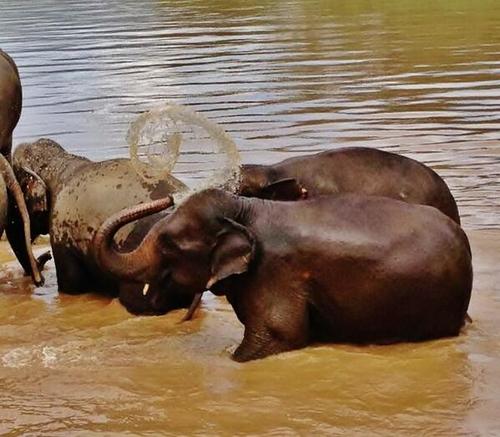
- Finally, today’s lead image comes from our friends at Think Elephants, who study elephant intelligence over in Thailand and occasionally capture the animals’ mastery of fluid dynamics. Be sure to check them out and follow them on Twitter and Facebook.
(Photo credit: Think Elephants International/R. Shoer)

Acoustic Levitation in Three Dimensions
Acoustic sound is a form of pressure wave propagating through air or another fluid. Place a speaker opposite a plate, and its sound will reflect off the surface. The original pressure wave and its reflection form a standing wave. With intense enough sound waves, the acoustic radiation pressure can be large enough to counter the force of gravity on an object, causing it to levitate. We’ve shown you several examples of acoustic levitation before, including squished and vibrating droplets and applications for container-free mixing. Today’s video, however, shows the first acoustic levitation system capable of manipulating objects in three dimensions, an important step in developing the technology for application. (Video credit: Y. Ochiai et al.; via NatGeo)
Aurora From Space
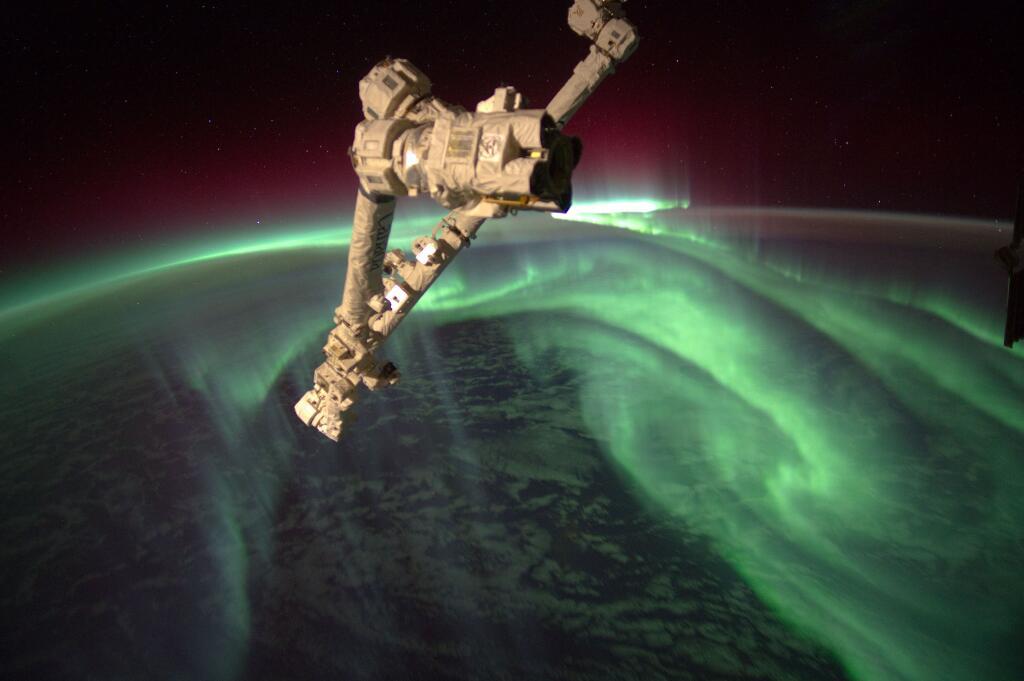
An aurora, as seen from the International Space Station, glows in green and red waves over the polar regions of Earth. These lights are the result of interactions between the solar wind–a stream of hot, rarefied plasma from the sun–and our planet’s magnetic field. A bow shock forms where they meet, about 12,000-15,000 km from Earth. The planet’s magnetic field deflects much of the solar wind, but some plasma gets drawn in along field lines near the poles. When these energetic particles interact with nitrogen and oxygen atoms in the upper atmosphere, it can excite the atoms and generate photon emissions, creating the distinctive glow. Similar auroras have been observed on several other planets and moons in our solar system. (Photo credit: NASA)
Huddling Penguins and Traffic Jams
Male emperor penguins have the unenviable task of incubating their eggs in temperatures as cold as -50 deg Celsius and winds of up to 200 km/h. To stay warm, the penguins form huddles of up to thousands of individuals. Observations in the wild show that these huddles move in a stop-and-go fashion, with changes propagating through the penguins like waves. Researchers adapted a model used for heavy traffic flow to describe the penguins’ motion. They found that motions like those found in observed penguin huddles could be initiated by slight movements of any penguin in the model huddle, regardless of its position; in other words, the huddle has no leader. They also found that the wave that travels through the penguins can align the huddle to uniform density or help two huddles merge. To learn more, check out the researchers’ video or their paper. (Video credit: D. Zitterbart et al./New Scientist; via J. Ouellette)

Bullet Through a Bubble
A bullet passes through a soap bubble in the schlieren photo above. The schlieren optical technique is sensitive to changes in the refractive index and, since a fluid’s refractive index changes with density, permits the visualization of shock waves. A strong curved bow shock is visible in front of the bullet as well as weaker lines marking additional shocks waves around the bullet. Impressively, the bullet’s passage is so fast (and the photo’s timing so perfect) that there are no imperfections or signs of bursting in the soap bubble. The photo’s caption suggests that the bubble may be filled with multiple gases. If they are unmixed and of differing densities, this may be the source of the speckling and plume-like structures inside the bubble. Incidentally, if anyone out there has high-speed schlieren video of a bullet passing through a soap bubble, I would love to see it. (Photo credit: H. Edgerton and K. Vandiver)
Lenticular Clouds Over Ice
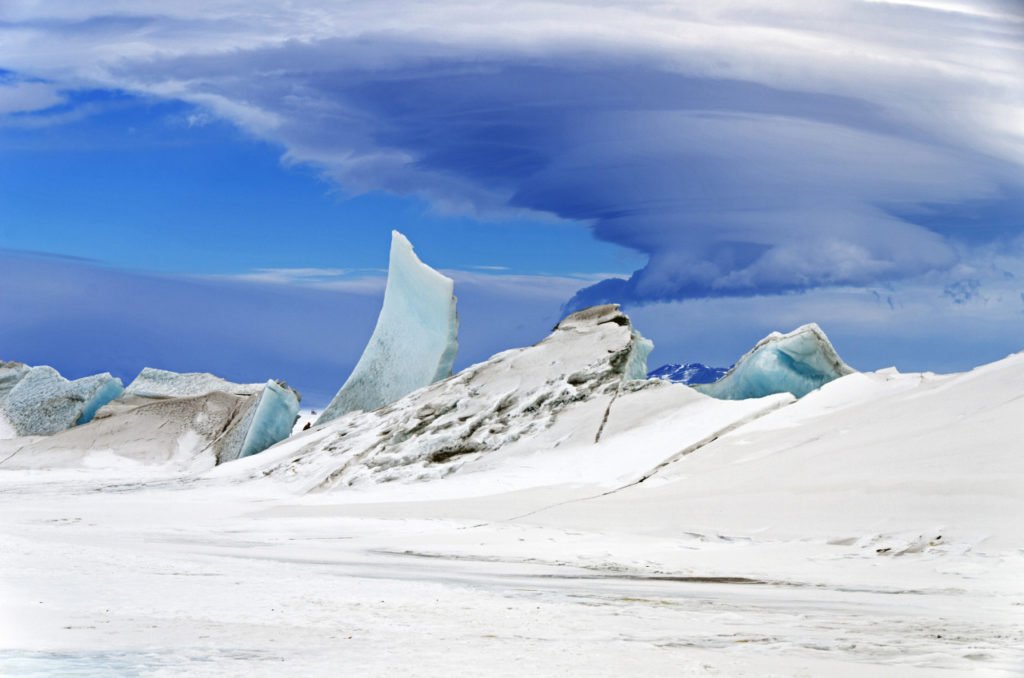
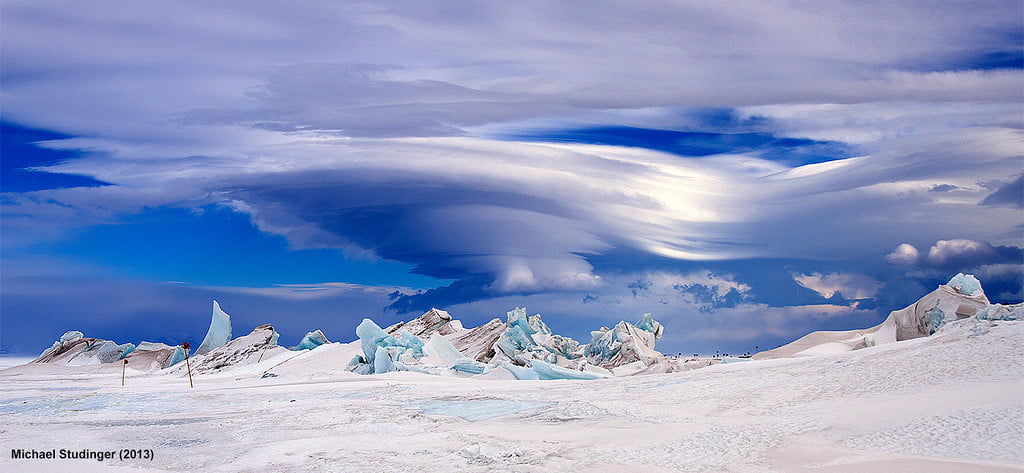
Lenticular clouds, like the one shown above, often attract attention due to their unusual shape. These stationary, lens-shaped clouds can form near mountains and other topography that force air to travel up and over an obstacle. This causes a series of atmospheric gravity waves, like ripples in the sky. If the temperature at the wave crest drops below the dew point, then moisture condenses into a cloud. As the air continues on into a warmer trough, the droplets can evaporate again, leaving a stationary lenticular cloud over the crest. This particular lenticular cloud was captured by Michael Studinger during Operation IceBridge in Antarctica. The line of ice in the foreground is a pressure ridge of sea ice formed when ice floes collided. (Photo credit: M. Studinger; via NASA Earth Observatory)
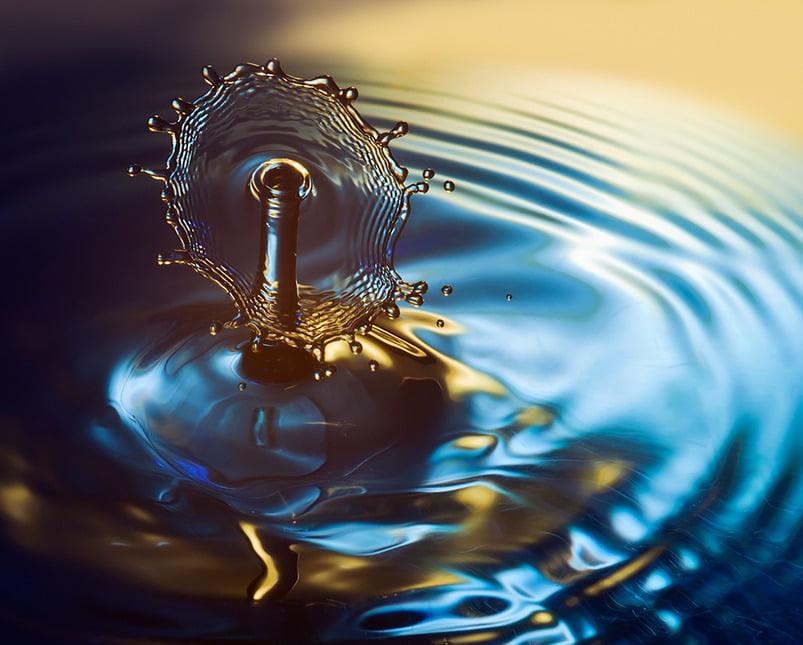
Liquid Umbrella
When a water drop strikes a pool, it can form a cavity in the free surface that will rebound into a jet. If a well-timed second drop hits that jet at the height of its rebound, the impact creates an umbrella-like sheet like the one seen here. The thin liquid sheet expands outward from the point of impact, its rim thickening and ejecting tiny filaments and droplets as surface tension causes a Plateau-Rayleigh-type instability. Tiny capillary waves–ripples–gather near the rim, an echo of the impact between the jet and the second drop. All of this occurs in less than the blink of an eye, but with high-speed video and perfectly-timed photography, we can capture the beauty of these everyday phenomena. (Photo credit: H. Westum)
Fluids Round-up – 16 November 2013
Time for another fluids round-up. Here are your links:
- PhysicsBuzz takes a look at the use of plasma actuators to control airflow.
- Over at Deep Sea News, you can learn about parasitic capillary waves.
- NanoWerk reports on self-steering particles in microfluidic devices.
- The 9th drop of the Queensland pitch drop experiment–believed to be the longest continuously running experiment in the world–is expected to fall at any time. Want to be part of the historic moment? Check out their Ninth Watch website.
- Aatish Bhatia examines the concepts behind the Fourier transform, an important mathematical technique used throughout fluid dynamics and physics. (via io9)
- Fluid dynamics and adaptive control might help alleviate traffic jams. (via @AIP_Publishing)
- On the whimsical side, take a look at these beautiful flying model boats built by Luigi Prina. (submitted by jshoer)
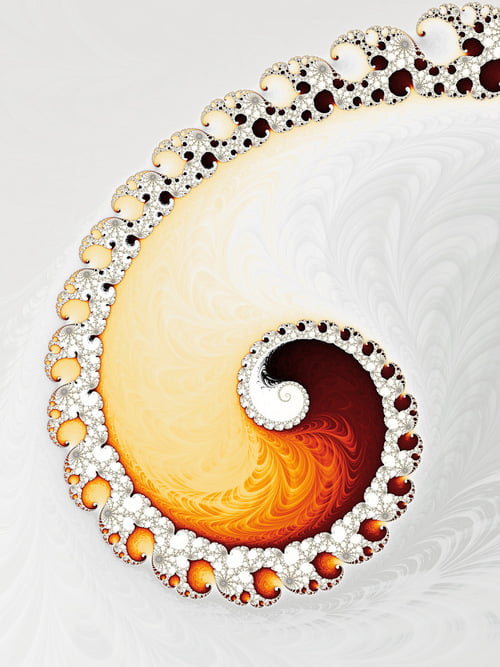
- Finally, our lead image was created with the app Frax, which allows users to make their own fractal-based art. Fluid dynamics has a lot of fractal behaviors. iOS users who want to play with fractals should check it out.
(Image credit: Ath3na)
