Search results for: “water droplet”

  • Featured Video Play Icon

    Bursting Droplets

    Mixing multiple fluids can often lead to surprising and mesmerizing effects, whether it’s droplets that dance or tears along the walls of a wine glass. A recent paper highlights another such mixture-driven instability – the bursting of a water-alcohol droplet deposited on an oil bath. The Lutetium Project tackles the physics behind this colorful burst in the short video above. The behavior is driven by the quick evaporation rate of alcohol in the droplet and the way this changing chemical concentration affects surface tension in the droplet. Alcohol evaporates more quickly from the edges of the drop, creating a region of higher surface tension around the edge. This pulls fluid to the rim of the drop, where it breaks up into droplets that get pulled outward as the inner drop shrinks.

    The oil bath plays an important role in the instability, too. Without it, friction between the drop and a wall is too high for the droplet to “burst”. A thick layer of oil acts as a lubricant, allowing the escaping satellite drops to speed away. (Video and image credit: The Lutetium Project; research credit: L. Keiser et al.; submitted by G. Durey)

  • A Water Balloon on a Bed of Nails

    A Water Balloon on a Bed of Nails

    If you dropped a water balloon on a bed of nails, you’d expect it to burst spectacularly. And you’d be right – some of the time. Under the right conditions, though, you’d see what a high-speed camera caught in the animation above: a pancake-shaped bounce with nary a leak. Physically, this is a scaled-up version of what happens to a water droplet when it hits a superhydrophobic surface.

    Water repellent superhydrophobic surfaces are covered in microscale roughness, much like a bed of tiny nails. When the balloon (or droplet) hits, it deforms into the gaps between posts. In the case of the water balloon, its rubbery exterior pulls back against that deformation. (For the droplet, the same effect is provided by surface tension.) That tension pulls the deformed parts of the balloon back up, causing the whole balloon to rebound off the nails in a pancake-like shape. For more, check out this video on the student balloon project or the original water droplet research. (Image credits: T. Hecksher et al., Y. Liu et al.; via The New York Times; submitted by Justin B.)

    image
  • Featured Video Play Icon

    Droplet Bounce

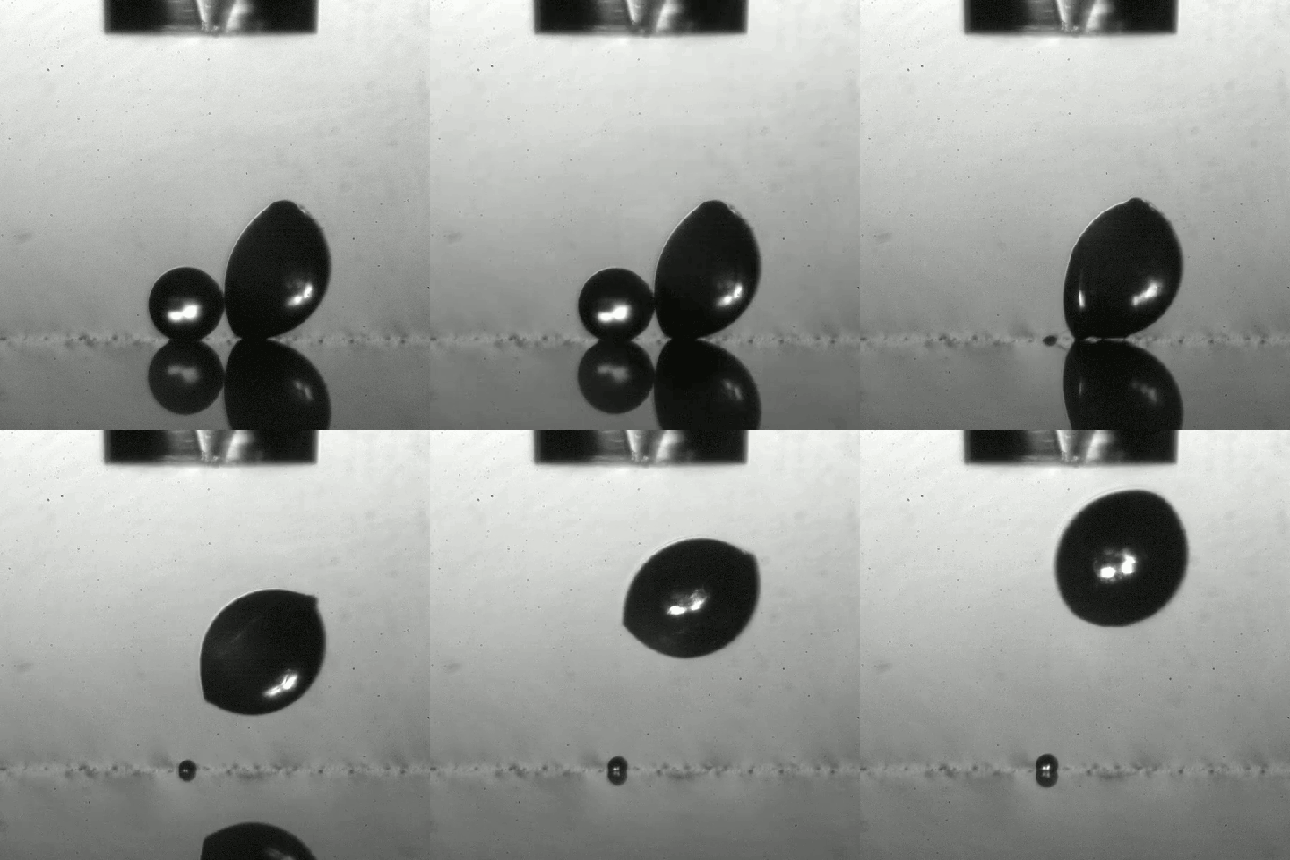
    Water droplets don’t always immediately disappear into a pool they’re dropped onto. If the droplet is small and doesn’t have much momentum, it will join the pool gradually through a process known as the coalescence cascade, seen here in high speed video. The droplet bounces off the surface, then settles. A thin layer of air is caught between it and the pool. Slowly the weight of the drop pushes that air out until there is contact between the drop and pool. Before the drop can merge completely, though, surface tension pinches it off, creating a smaller daughter droplet. Ripples caused by the merger help bounce the little droplet, which repeats the same process until the tiniest droplet merges completely. (Video credit: B. ter Huume)

  • Featured Video Play Icon

    Making Droplets Stick

    Lots of plants have evolved leaves that are superhydrophobic – that is, water repellent. For a plant, this makes a lot of sense. A superhydrophobic leaf will make water bounce and run off, draining down to where the plants roots can drink it up. But this same feature can be a frustration to farmers who spread pesticides by spraying plants. They need the pesticide to stick to the leaves if it’s to deter insects, and the superhydrophobicity of the leaves forces them to spray more pesticides in the hopes of getting some to stick. Researchers at MIT are looking to change this status quo with a few biodegradable polymer additives that can counter the leaves’ superhydrophobic tendencies and help droplets stick to the surface. This could reduce the amount of pesticides needed to protect crops. (Video credit: MIT)

  • Bursting Into Droplets

    Bursting Into Droplets

    Our atmosphere is full of aerosols – extremely tiny particles and droplets of salt, dust, pollutants, and other substances. Wind’s effects alone cannot account for the sizes and quantities of aerosols we measure. Another potential source is the bursting of bubbles; more specifically, the bubbles that form at the oceans’ surface. Frothy, crashing waves often capture pockets of air. When these bubbles burst, the thin film of their surface ruptures into long filaments that break into tiny droplets. Such droplets can be small enough to get carried on the breeze, eventually evaporating and leaving the particulates that were once in the water to ride the winds. (Image credit: H. Lhuissier & E. Villermaux; see also: Y. Couder)

  • Featured Video Play Icon

    Dancing Droplets

    The seemingly-alive dancing droplets are back in a new video from Veritasium. These droplets of food coloring attract, merge, and chase one another due to evaporation and surface tension interactions between their two components: water and

    propylene glycol. Because the droplets are constantly evaporating, they are surrounded by a cloud of vapor that helps determine a drop’s surface tension. These localized differences in surface tension are what causes the drops to attract. The chasing is also surface-tension-driven. Like any liquid, the drops will flow from areas of low surface tension to those of higher surface tension due to the Marangoni effect. Thus drops of different concentration appear to chase one another. This is a relatively simple experiment to try yourself at home, and Derek outlines what you need to know for it.  (Video credit: Veritasium; research credit: N. Cira et al.; submitted by @g_durey)

  • Molten Salt in Water

    Molten Salt in Water

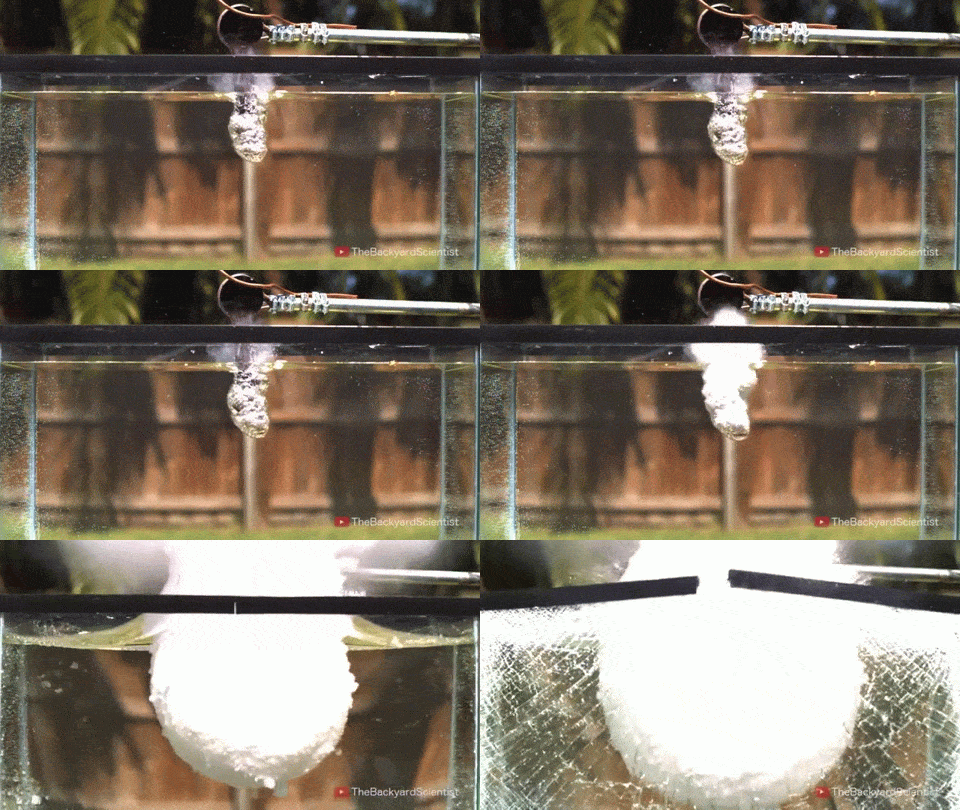
    In his latest video, The Backyard Scientist explores what happens when molten salt (sodium chloride) gets poured into water. As you can see, the results are quite dramatic! He demonstrates pretty convincingly that the effect is physical – not chemical. The extreme difference in temperature between the liquid water (< 100 degrees Celsius) and the molten salt (> 800 degrees Celsius) causes the water to instantly vaporize due to the Leidenfrost effect. This vapor layer protects the liquid water from the molten salt – until it doesn’t. When some driving force causes a drop of water to touch the salt without that protective vapor layer, the extreme temperature difference superheats the water, causing it to expand violently, which drives more water into salt and feeds the explosion.

    But why don’t the other molten salts he tests explode? Sodium carbonate, the third salt he tests, has a melting point of 851 degrees Celsius, 50 degrees hotter than sodium chloride. Yet for that test, the Leidenfrost effect prevents any contact between the two liquids. The key in this case, I hypothesize, is not simply the temperature difference between the water and salt, but the difference in fluid properties between sodium chloride and sodium carbonate. The breakdown of the vapor layer and subsequent contact between the water and the molten salt depends in part on instabilities in the fluids. A cavity where instabilities can grow more easily is one where the Leidenfrost effect is less likely to protect and separate the two fluids. And, in fact, it turns out that the surface tension of molten sodium chloride is significantly lower than that of molten sodium carbonate! A lower surface tension value means that the molten sodium chloride breaks into droplets more easily and its vapor cavity will respond more strongly to fluid instabilities, making it more likely to come in contact with liquid water and, thus, cause explosions. (Image/video credit: The Backyard Scientist; submitted by Simon H)

  • Boiling Water to Snow

    Boiling Water to Snow

    When it’s really cold outside–to the tune of -40 degrees (Fahrenheit or Celsius)–physics can get a little crazy. In this photo, boiling-hot water from a thermos turns into an instant snowstorm when tossed. How is this possible? It turns out there are a combination of factors that affect this. Firstly, the rate of heat transfer between two objects depends on the magnitude of the temperature difference between them. The bigger the difference in temperature, the faster the hot object cools. Of course, as the hot object cools down, the temperature difference between it and its surroundings is smaller and the rate of heat transfer decreases.

    The second important factor here is that the water is being tossed. When you throw water, it breaks into droplets, and droplets have a large surface area compared to their volume. As it turns out, the rate of heat transfer also depends on surface area. By breaking the hot water into smaller droplets, you increase the surface area exposed to the cold air, allowing the hot water to freeze faster. (Image credit: M. Davies et al.; via Gizmodo)

    Also: Since there are a few events scheduled around the country over the next couple months, I’ve added an events page where you can find details for those appearances. And as always, if you’re interested in scheduling a talk or event, feel free to contact me directly.

  • Collecting Water in the Desert

    Collecting Water in the Desert

    Desert-dwelling plants like cactuses have to be efficient collectors of water. Many types of cactus are particularly good at gathering water from fog that condenses on their spines. Droplets that form near a spine’s tip move slowly but inexorably toward the base of the spine so that the cactus can absorb them. The secret to this clever transport lies in the microstructure of the spine’s surface. The

    Gymnocalycium baldianum cactus, for example, has splayed scales along its spines. Capillary interactions with the scales result in differences in curvature on either side of the droplet. Curved fluid surfaces generate what’s known as Laplace pressure, with a tighter radius of curvature causing a larger Laplace pressure. Because the curvature of the droplet varies from the base side to the tip side of the spine, the difference in Laplace pressures across the droplet creates a force that drives the droplet toward the spine’s base. (Image credit: C. Liu et al., source)

  • Featured Video Play Icon

    Oil Film on Water

    This award-winning short film features a thin layer of volatile oil on water. The oil evaporates quickest from shallow pools only microns deep, which appear bluish in the video. Surface instabilities along the edge of the pool create flow that draws oil in, generating the iridescent droplets seen floating among the evaporation pools. The droplets combine and coalesce as they come in contact with one another. Since droplets have a larger volume per surface area than the shallow pools, they evaporate more slowly. The behaviors observed here are important to applications like oil and fuel spills, which can persist longer if the floating fluid layer tends to form droplets. (Video credit: J. Hart; via txchnologist)