
What is the shape of a falling raindrop? Surface tension keeps only the smallest drops spherical as they fall; larger drops will tend to flatten. The very largest drops stretch and inflate with air as they fall, as shown in the image above. This shape is known as a bag and consists of a thin shell of water with a thicker rim at the bottom. As the bag grows, its shell thins until it ruptures, just like a soap bubble. The rim left behind destabilizes due to the surface-tension-driven Plateau-Rayleigh instability and eventually breaks up into smaller droplets. This bag instability limits the size of raindrops and breaks large drops into a multitude of smaller ones. The initial size of the drop in the image was 12 mm, falling with a velocity of 7.5 m/s. The interval between each image is 1 ms. (Photo credit: E. Reyssat et al.)
Search results for: “water droplet”

Self-Assembling Ferrofluids
Ferrofluids–colloidal suspensions made up of ferromagnetic nanoparticles and a carrier liquid–are known for their interesting and sometimes bizarre behaviors due to magnetic fields. The video above shows how, when subjected to an increasing magnetic field, a single droplet of a ferrofluid on a superhydrophobic surface will split into several droplets. The process is called static self-assembly, and it results from the ferrofluid seeking a minimum energy state relative to the force supplied by the magnetic field. Change the magnetic field and the droplets shift to the next energy minimum. But what happens when you change the magnetic field continuously and too quickly for the droplets to respond? A whole different set of structures and behaviors are observed (video link). This is dynamic self-assembly, a different ordered state only achieved when the ferrofluid is forceably kept away from the energy minima seen in the first video. For more, see the additional videos and the original paper. (Video credit: J. Timonen et al.; via io9)

Bubbles, Drops, and Colors


The immiscibility of oil and water creates a multitude of bubbles of all sizes. A lack of miscibility occurs when the forces between like molecules are very strong for two liquids–essentially the oil molecules and the water molecules are so much more strongly attracted to themselves than they are to one another that they cannot mix. Surface tension–another expression of molecular forces–pulls the oil into droplets that float in the water and refract the light in such lovely ways. (Photo credit: Vendula Adriana Kaprálová Hauznerová; via thinxblog)

Stopping Jet Break-Up
When a stream of liquid falls, a surface tension effect called the Plateau-Rayleigh instability causes small variations in the jet’s radius to grow until the liquid breaks into droplets. For a kitchen faucet, this instability acts quickly, breaking the stream into drops within a few centimeters. But for more viscous fluids, like honey, jets can reach as many as ten meters in length before breaking up. New research shows that, while viscosity does not play a role in stretching and shaping the jet as it falls–that’s primarily gravity’s doing–it plays a key role in the way perturbations to the jet grow. Viscosity can delay or inhibit those small variations in the jet’s diameter, preventing their growth due to the Plateau-Rayleigh instability. In this respect, viscosity is a stabilizing influence on the flow. (Photo credit: Harsha K R; via Flow Visualization)

The Red Crown
A drop of red dye falls into a thin layer of milk, forming a crown splash. Notice the pale edges of the droplets at the rim of the crown; this is milk that has been entrained by the original drop. The rim and satellite droplets surrounding the splash are formed due to surface tension effects, chiefly the Plateau-Rayleigh instability–the same effect responsible for breaking a falling column of liquid into droplets like in a leaking faucet. The instability will have a most unstable wavelength that determines the number of satellite droplets formed. (Photo credit: W. van Hoeve et al., University of Twente)

Fishbones
When two liquid jets collide, they can form an array of shapes ranging from a chain-like stream or a liquid sheet to a fishbone-type structure of periodic droplets. This series of images show the collision of two viscoelastic jets–in which polymer additives give the fluids elasticity properties unlike those of familiar Newtonian fluids like water. The jet velocities increase with each image, changing the behavior from a fluid chain (a and b); to a fishbone structure (c and d); to a smooth liquid sheet (e); to a fluttering sheet (f and g); to a disintegrating ruffled sheet (h), and finally a violently flapping sheet (i and j). The behavior of such jets is of particular interest in problems of atomization, where it can be desirable to break an incoming stream of liquid up into droplets as quickly as possible. (Photo credit: S. Jung et al.)
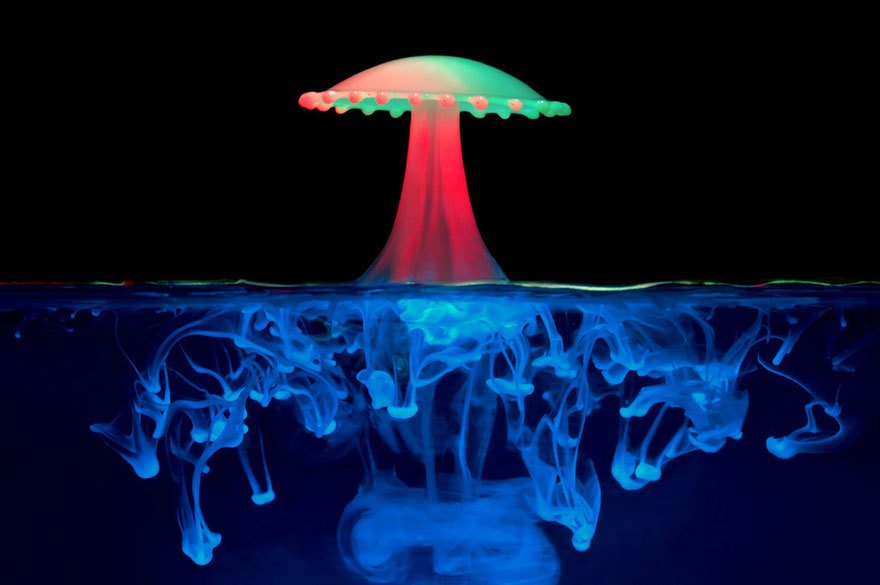
Liquid Sculptures
Artist Corrie White uses dyes and droplets to capture fantastical liquid sculptures at high-speed. The mushroom-like upper half of this photo is formed when the rebounding jet from one droplet’s impact on the water is hit by a well-timed second droplet, creating the splash’s umbrella. In the lower half of the picture, we see the remains of previous droplets, mixing and diffusing into the water via the Rayleigh-Taylor instability caused by their slight difference in density relative to the water. There’s also a hint of a vortex ring, likely from the droplet that caused the rebounding jet. (Photo credit: Corrie White)
Dropping Through Strata
When a droplet falls through an air/water interface, a vortex ring can form and fall through the liquid. In this video, the researchers investigate the effects of a stratified fluid interface on this falling vortex ring. In this case, a less dense fluid sits atop a denser one. Depending on the density of the initial falling droplet and the distance it travels through the first fluid, the behavior and break-up of the vortex ring when it hits the denser fluid differs. Here four different behaviors are demonstrated, including bouncing and trapping of the vortex ring. (Video credit: R. Camassa et al.)
Perpetual Motion?
In the 17th century, scientist Robert Boyle proposed a perpetual motion machine consisting of a self-filling flask. The concept was that capillary action, which creates the meniscus of liquid seen in containers and is responsible for the flow of water from a tree’s roots upward against gravity, would allow the thin side of the flask to draw fluid up and refill the cup side. In reality, this is not possible because surface tension will hold it in a droplet at the end of the tube rather than letting it fall. In the video above, the hydrostatic equation is used to suggest that the device works with carbonated beverages (it doesn’t; the video’s apparatus has a hidden pump) because the weight of the liquid is much greater than that of the foam. Of course, the hydrostatic equation doesn’t apply to a flowing liquid! The closest one can come to the hypothetical perpetual fluid motion suggested by Boyle is the superfluid fountain, which flows without viscosity and can continue indefinitely so long as the superfluid state is maintained. (Video credit: Visual Education Project; submission by zible)

Tears of Wine
Physicist Richard Feynman once famously ended a lecture by describing how the whole universe can be found in a glass of wine. And there is certainly plenty of fluid dynamics in one. In the photo above, we see in the shadows how a film of wine drips down into the main pool below. This effect is known by many names, including tears of wine and wine legs; it can also be found in other high alcohol content beverages. Several effects are at play. Capillary action, the same effect that allows plants to draw water up from their roots, helps the wine flow up the wall of the glass. At the same time, the alcohol in this wine film evaporates faster than the water, raising the surface tension of the wine film relative to the main pool of wine below. Because of this gradient in surface tension, the wine will tend to flow up the walls of the glass away from the area of lower surface tension. This Marangoni effect also helps draw the wine upward. When the weight of the wine film is too great for capillary action and surface tension to hold it in place, droplets of wine–the legs themselves–flow back downward. (Photo credit: Greg Emel)