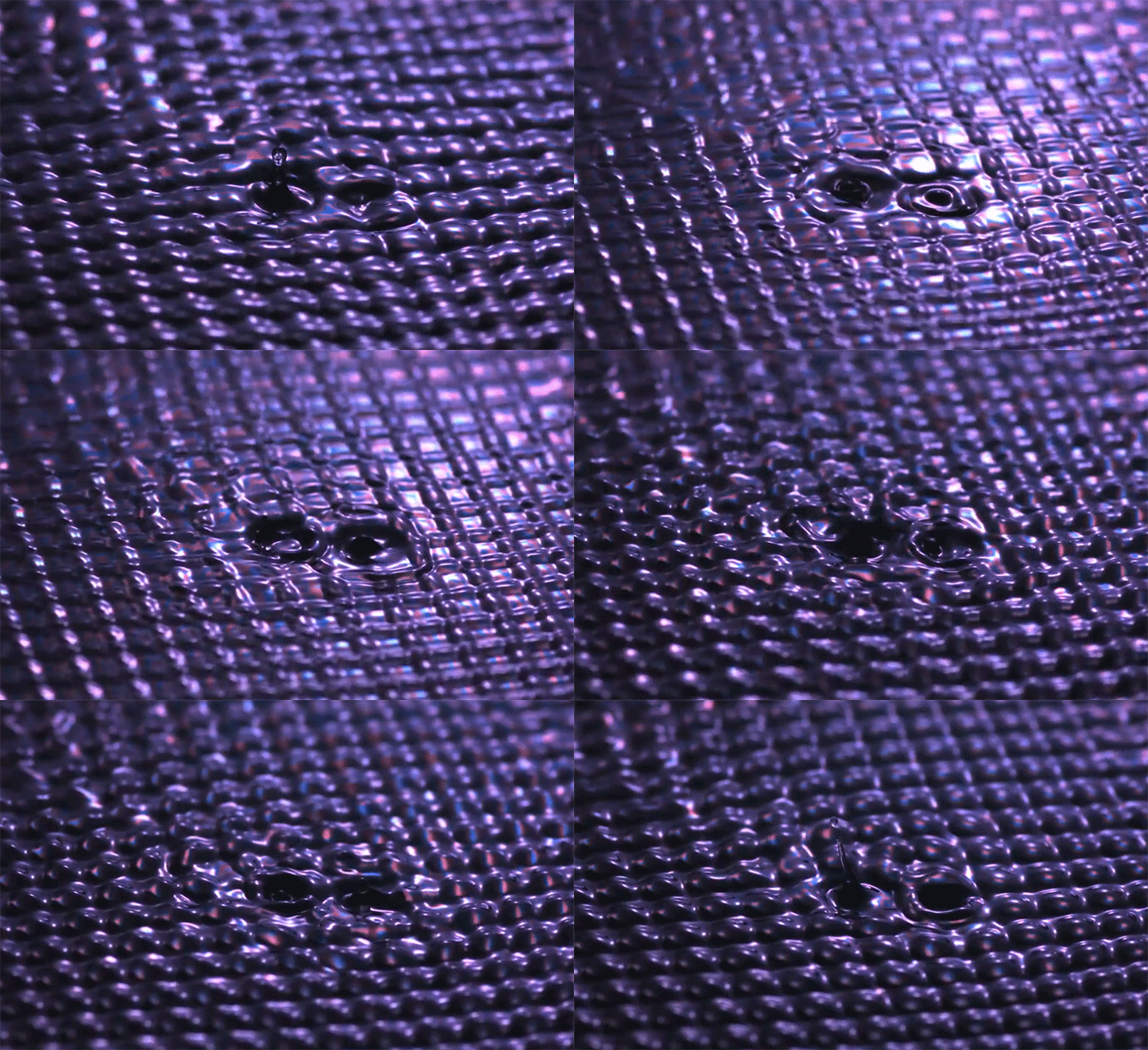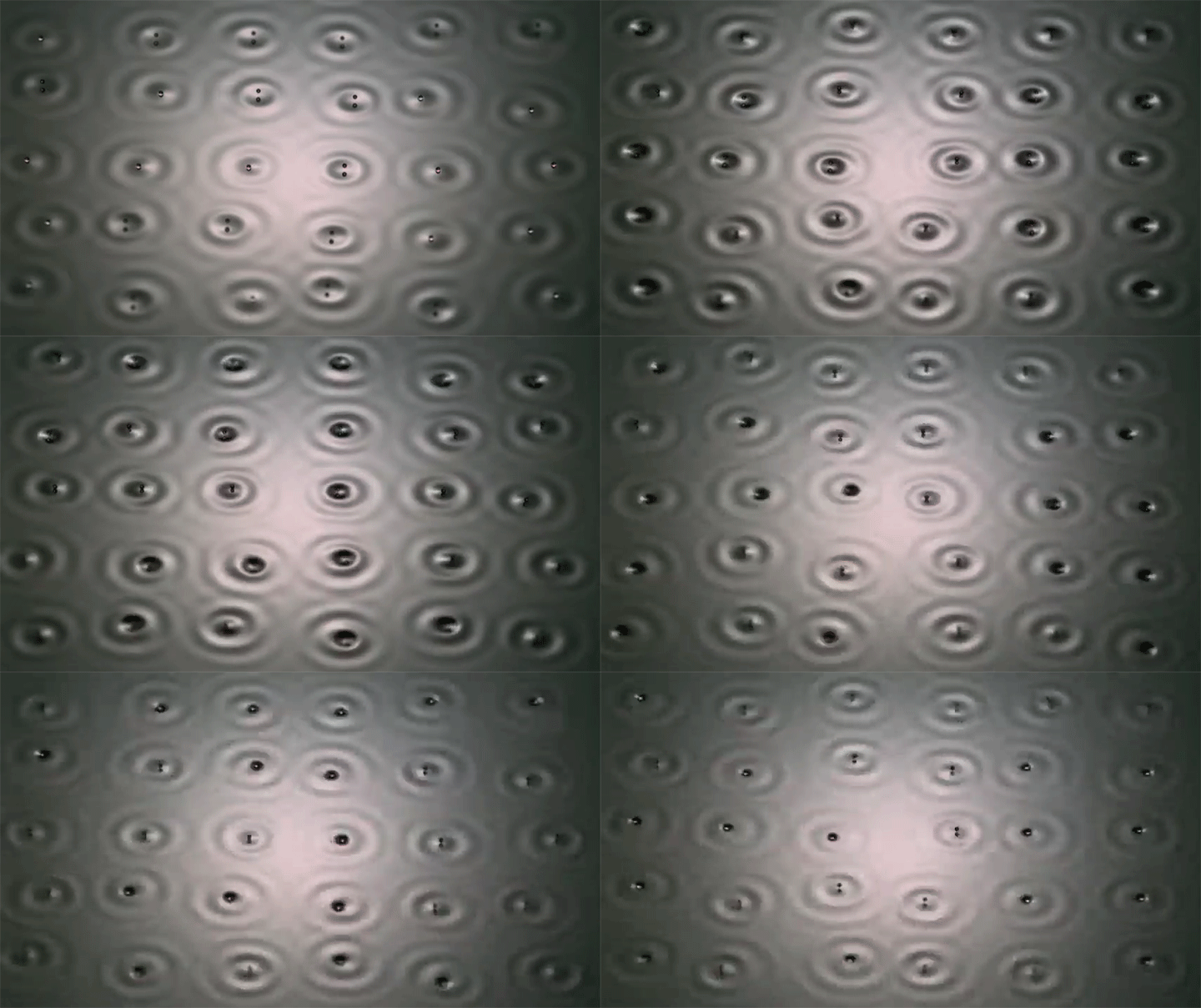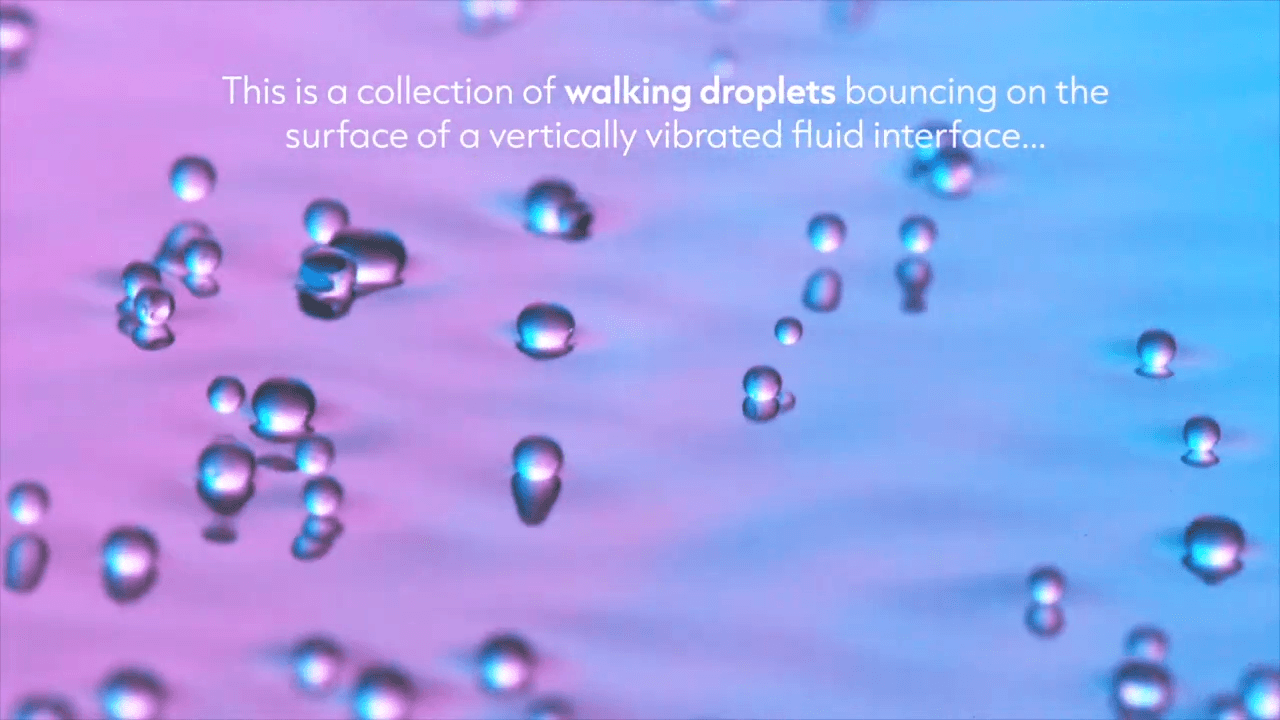
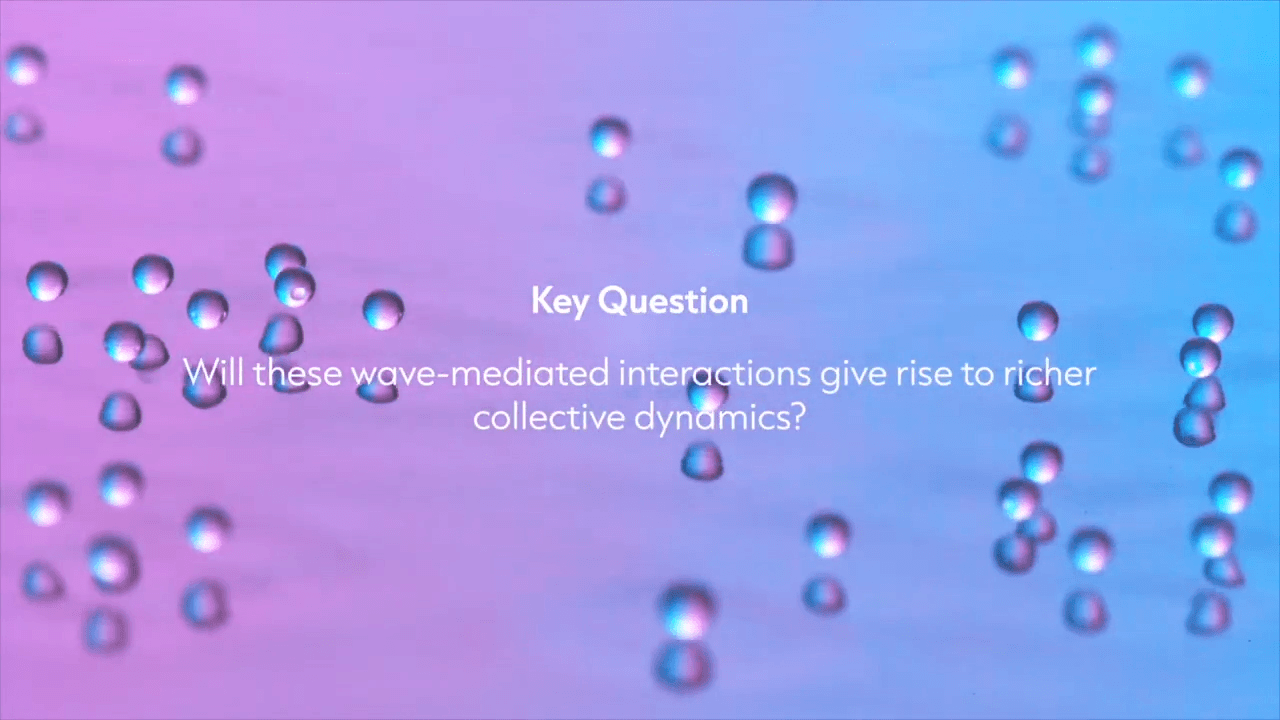
On a vibrating fluid, droplets can bounce and interact in complex ways. Here, researchers demonstrate some of the peculiar dynamics of these wave-guided droplets, showing how they can do things like pair up in waltzes. To keep the droplets from coalescing with one another, they perform their experiments in a pressurized chamber; the higher air pressure makes it harder for the air film between droplets to drain during a collision, making the droplets unable to coalesce. Under these conditions, the authors show that the droplet-wave system has quantum-like statistics. (Video and image credit: J. Clampett et al.)
Tag: hydrodynamic quantum analogs

Mimicking Quantum Effects
Over the last 15 years or so, researchers have been exploring pilot-wave theory–originally proposed by De Broglie in the 1920s as a way to understand quantum mechanics–using hydrodynamic quantum analogs. In these experiments, researchers vibrate pools of silicone oil, which allows oil drops to bounce–and in some conditions, walk–indefinitely on the pool. By mixing in obstacles that mimic classic quantum mechanical experiments, they reproduce effects like the double-slit experiment in a macroscopic system.
In this video and the accompanying papers, a team recreates the Kapitsa-Dirac effect where a standing electromagnetic wave diffracts electrons. Here, the standing wave is instead a Faraday wave in the surface of the pool. Yet the droplets, too, diffract in a manner resembling the quantum version. (Video credit: B. Primkulov et al.; research credit: B. Primkulov et al. 1, 2)

Superradiance in Fluids
A group of excited atoms can collectively emit more photons than they could individually in a phenomenon known as superradiance. Now researchers have shown that vibrating fluids can produce superradiance as well.

Two different wave fields used in the experiment, each with a different distance between the circular cavities. Similar to other hydrodynamic quantum analogs, the researchers vertically vibrated a pool of liquid at a frequency that produced Faraday waves. Beneath the pool, they placed two circular wells, varying the distance between them to observe how their wave fields interacted. With a large enough vibration, the two circular wells emitted droplets (top image), and the number of droplets they produced was higher than expected for two independent wells, indicating superradiance. The results suggest that it may be possible to build even more hydrodynamic analogs of quantum systems than previously thought! (Image and research credit: V. Frumkin et al.; via APS Physics)

Hydrodynamic Spin Lattices
Droplets bouncing on a fluid bath display some strikingly quantum-like behaviors thanks to the interactions between a drop and its guiding surface wave. Here, researchers use submerged wells beneath the drop to confine each droplet into a space where it bounces in a clockwise or anticlockwise trajectory.
With an array of these wells, the droplets form a lattice. Each drop remains in its well, but its wave travels beyond and interacts with nearby wells. Through this interaction, the researchers found that lattices tended to synchronize, similar to the way groups of fireflies will synchronize their flashing. This sort of behavior is also observed in quantum systems, and the researchers hope that further studying their bouncing droplets will give insight into quantum spin systems and their behaviors. (Image and research credit: P. Saenz et al.; via Nature; submitted by Kam-Yung Soh)

Quantum Droplets
Over the past decade, fluid dynamicists have been investigating tiny droplets bouncing on a vibrating fluid. This seemingly simple experiment has remarkable depth, including the ability to recreate quantum behaviors in a classical system. In this video, some of the researchers demonstrate their experimental techniques, including how they vary the frame rate relative to the bouncing of the drops. At the right frame rate, this sampling makes the droplets appear to glide along with their ripples, giving us a look at a system that is simultaneously a particle (drop) and wave (ripple). (Video credit: D. Harris et al.)

Hydrodynamic Quantum Analogs
Over the past few years, researchers have been exploring the dynamics of droplets bouncing on a vibrating fluid. These systems display many behaviors associated with quantum mechanics, including wave-particle duality, single-slit and double-slit diffraction, and tunneling. A new paper examines the system mathematically, showing that the droplets obey many of the same mathematics as quantum systems. In fact, the droplet-wave system behaves as a macroscopic analog of 2D quantum behaviors. The implications are intriguing, especially for teaching. Now students of quantum mechanics can experiment with a simple apparatus to understand some of the non-intuitive aspects of quantum behavior. For more, see the paper on arxiv. (Image credit: D. Harris and J. Bush; research credit: R. Brady and R. Anderson)