Search results for: “water droplet”

  • Elastic Bounces

    Elastic Bounces

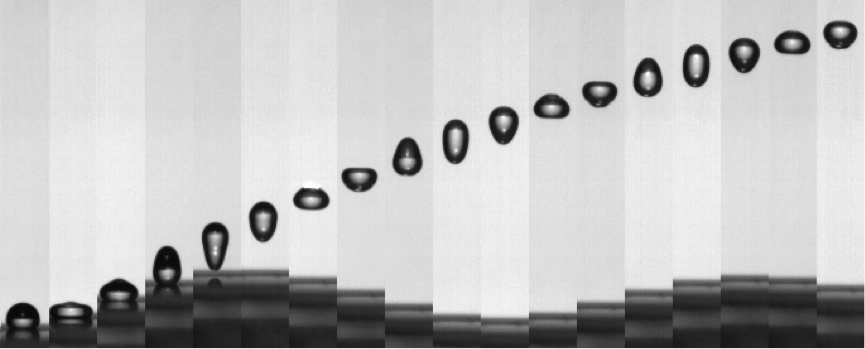
    A rigid ball accelerated by a moving surface can only ever move as fast as the surface propelling it. But that’s not true for squishy objects like a water droplet. The composite image above shows the trajectory of a water droplet launched from a moving superhydrophobic surface. As the surface starts rising, it squishes the droplet like a pancake, triggering a deformation cycle where the droplet will squish and extend repeatedly. How quickly the drop changes shape depends on factors like its size and surface tension. The researchers found that a droplet’s launch was strongly affected by the ratio of the droplet’s shape-changing frequency and the frequency of the plate’s motion. When the drop’s shape changed three times faster than the surface’s motion, it would catapult off the surface with 250% of the kinetic energy of a rigid ball!

    Launching elastic balls works the exact same way as droplets, indicating that the phenomenon depends on the way the projectiles deform. The process is similar to jumping on a trampoline. If a trampolinist times her jump just right, she’ll get more energy from the trampoline and fly higher. The droplet does the same when its deformation is properly tuned to its catapult. (Image credit: C. Raufaste et al.; via APS Physics; submitted by Kam-Yung Soh)

  • Rocket Launch Systems

    Rocket Launch Systems

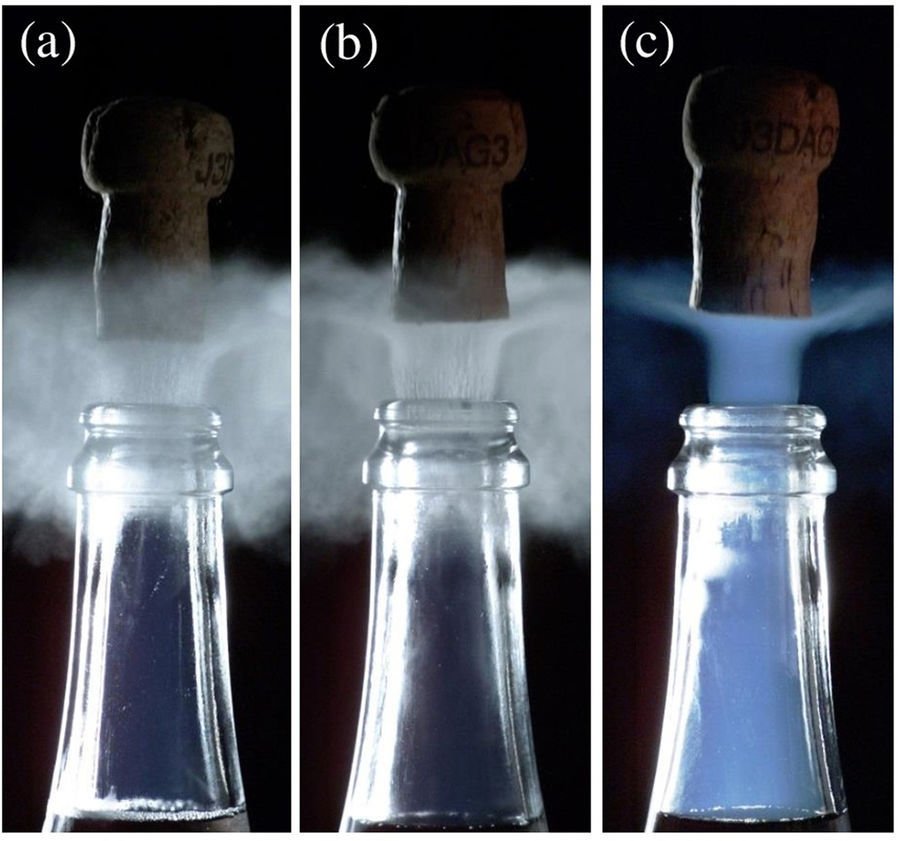
    If you’ve ever watched a rocket launch, you’ve probably noticed the billowing clouds around the launch pad during lift-off. What you’re seeing is not actually the rocket’s exhaust but the result of a launch pad and vehicle protection system known in NASA parlance as the Sound Suppression Water System. Exhaust gases from a rocket typically exit at a pressure higher than the ambient atmosphere, which generates shock waves and lots of turbulent mixing between the exhaust and the air. Put differently, launch ignition is incredibly loud, loud enough to cause structural damage to the launchpad and, via reflection, the vehicle and its contents.

    To mitigate this problem, launch operators use a massive water injection system that pours about 3.5 times as much water as rocket propellant per second. This significantly reduces the noise levels on the launchpad and vehicle and also helps protect the infrastructure from heat damage. The exact physical processes involved – details of the interaction of acoustic noise and turbulence with water droplets – are still murky because this problem is incredibly difficult to study experimentally or in simulation. But, at these high water flow rates, there’s enough water to significantly affect the temperature and size of the rocket’s jet exhaust. Effectively, energy that would have gone into gas motion and acoustic vibration is instead expended on moving and heating water droplets. In the case of the Space Shuttle, this reduced noise levels in the payload bay to 142 dB – about as loud as standing on the deck of an aircraft carrier. (Image credits: NASA, 1, 2; research credit: M. Kandula; original question from Megan H.)

  • Featured Video Play Icon

    Quad Copter Schlieren

    Schlieren photography is a classic method of flow visualization that utilizes small variations in density (or temperature) to make otherwise unseen air motion visible. Because changing air’s density or temperature changes its index of refraction, variations in either quantity show up as dark and light regions. Here researchers use it to reveal some of the airflow around a small quadcopter, including the vortices that spiral off each propeller and help generate the lift necessary for take-off. The full video includes a couple of neat demos, including what happens when the blades are wet (shown below). In that case, the wingtip vortices are somewhat disrupted by strings of water droplets being flung off the blades by centrifugal force. Beautiful!  (Video and image credit: K. Nolan et al., source; submitted by J. Stafford)

  • Icy Spikes

    Icy Spikes

    Water is one of those strange materials that expands when it freezes, which raises an interesting question: what happens to a water drop that freezes from the outside in? A freezing water droplet quickly forms an ice shell (top image) that expands inward, squeezing the water inside. As the pressure rises, the droplet develops a spicule – a lance-like projection that helps relieve some of the pressure. 

    Eventually the spicule stops growing and pressure rises inside the freezing drop. Cracks split the shell, and, as they pull open, the cracks cause a sudden drop in pressure for the water inside (middle image). If the droplet is large enough, the pressure drop is enough for cavitation bubbles to form. You can see them in the middle image just as the cracks appear. 

    After an extended cycle of cracking and healing, the elastic energy released from a crack can finally overcome surface energy’s ability to hold the drop together and it will explode spectacularly (bottom image). This only happens for drops larger than a millimeter, though. Smaller drops – like those found in clouds – won’t explode thanks to the added effects of surface tension. (Image credit: S. Wildeman et al., source)

    ETA: A previous version of this post erroneously said this was freezing from the “inside out” instead of “outside in”.

  • Freezing Impact

    Freezing Impact

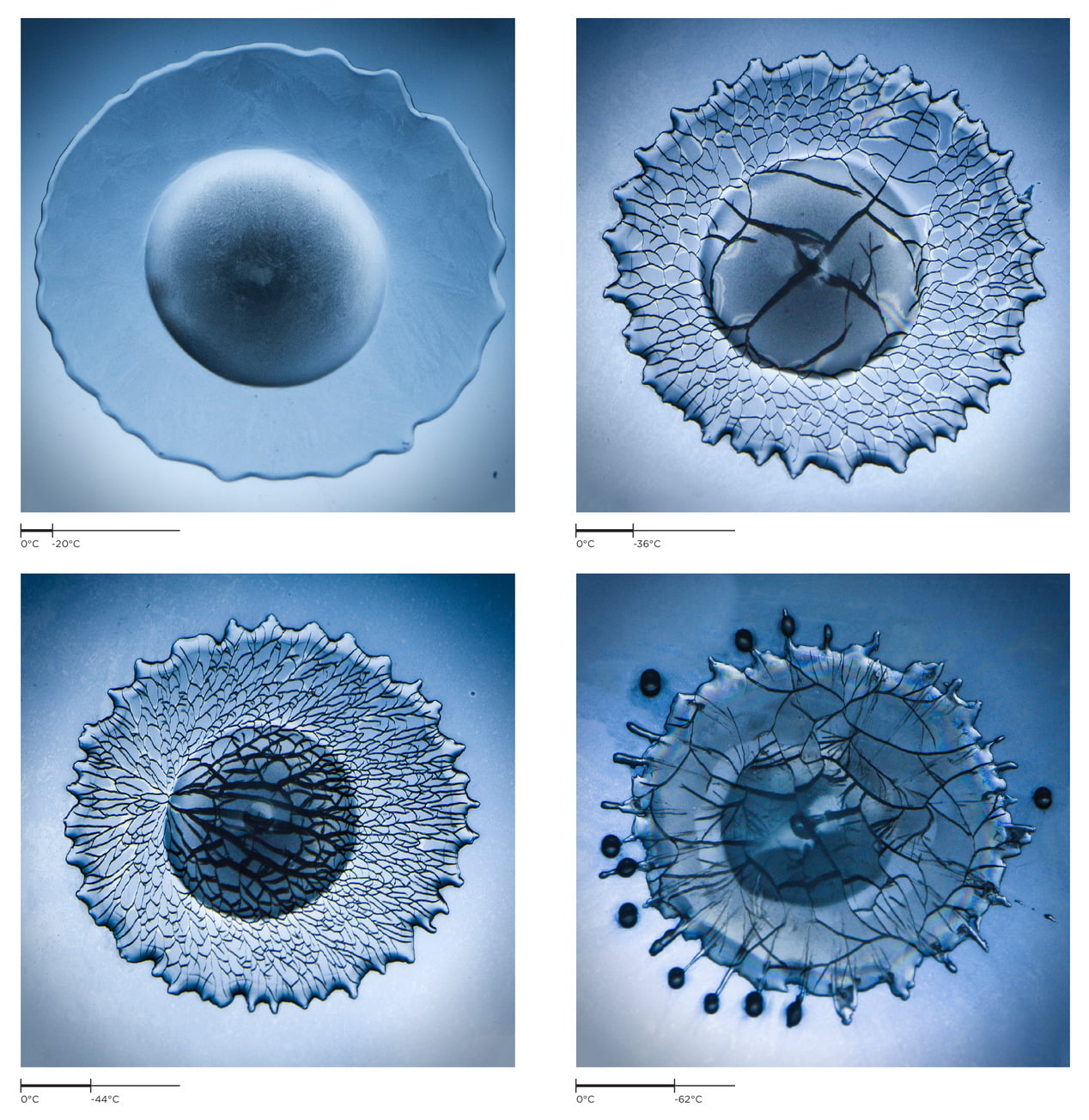
    When a water droplet hits a frozen surface, what happens depends significantly on the temperature of the substrate. At relatively high temperatures (-20 degrees C), the droplet freezes without any cracking (upper left). As the surface gets colder, drops begin to crack. At first the cracks are relatively large and unstructured (upper right), but at lower temperatures, they grow in a network of smaller cracks with more distinctive structure (lower left). Cold temperatures can also affect the contact line where water, air, and substrate meet. This can cause droplets to splash even as they’re freezing (lower right). (Image credit: V. Thievenaz et al.; see also E. Ghabache et al.)

  • Featured Video Play Icon

    Freezing Drops

    A water droplet deposited on a cold surface freezes from the bottom up. As anyone who has made ice cubes knows, water expands when it freezes. But watch the outline of the drop carefully. The drop isn’t expanding radially outward while it freezes. Instead the remaining liquid part of the drop forms what’s known as a spherical cap, a shape like the sliced-off top of a sphere. Surface tension creates that spherical shape, but the water still has to expand when it freezes. The result? The last bit of the drop freezes into a point! This means that surface tension maintains the drop’s spherical shape, for the most part, and all the expansion the water does takes place vertically. (Video credit: D. Lohse et al.)

  • Featured Video Play Icon

    Avoiding Coalescence

    If you watch closely as you go about your day, you may notice drops of water sometimes bounce off a pool of water instead of coalescing. Fluid dynamicists have been fascinated by this behavior since the 1800s, but it was Couder et al. who explained that these droplets can bounce indefinitely as long as the thin air layer separating the drop and pool is refreshed by vibrating the pool. In this video, Destin teams up with astronaut Don Pettit to film the phenomenon in beautiful high-speed. My favorite part of the video starts around 8:18, where Destin shows Don’s experiments with this effect in microgravity. It turns out that the cello produces just the right frequencies to create a cascade of bouncing water droplets, much like a Tibetan singing bowl turned back on itself! (Video credit: Smarter Every Day; submitted by Destin and effyeahjoebiden)

  • Floating on a Granular Raft

    Floating on a Granular Raft

    A thin layer of hydrophobic particles dispersed at an oil-water interface is strong enough to prevent a water droplet from coalescing. The researchers refer to this set-up as their granular raft. As the red-dyed water droplet gets larger (top row), it deforms the raft more and more, but the grains continue to keep the drop separate from the fluid beneath (middle row). When water is removed from the droplet, wrinkles form on the raft as the drop’s volume shrinks. This is because the contact line – where the droplet, grains, and air meet – is pinned. The grains already touching the drop are held there by adhesion. But since the drop is shrinking, the area on the raft has to shrink, too – thus wrinkles! (Photo credits: E. Jambon-Puillet and S. Protiere, original)

  • Resonating Bowls

    Resonating Bowls

    Rub your hands on the handles of a Chinese resonance bowl and you can generate a spray of tiny droplets. The key to this, as the name suggests, is vibration. Rubbing the handles vibrates the bowl, causing small oscillations in the bowl’s shape that are too small for us to see. But those vibrations do produce noticeable ripples on the water in the bowl. When you hit the right frequency and amplitude, those vibrations disturb the water enough that the up-and-down vibration at the surface actually ejects water droplets. The vibration of the bowl affects water near the wall most strongly, which is why that part of the bowl has the strongest reaction. It takes even larger amplitude vibrations to get droplets jumping in the middle of the bowl, but you can see that happening in this video of a Tibetan singing bowl. (Image/video credit: Crazy Russian Hacker, source)

  • Bubbles and Films Merging

    Bubbles and Films Merging

    As we’ve seen before, a water droplet can merge gradually with a pool through a coalescence cascade. It turns out that the coalescence of a soap bubble with a soap film can follow a similar process! Initially, the bubble and film are separated by a thin layer of air. Once that air drains away and the bubble contacts the fluid, it starts to coalesce. But the bubble pinches off before its entire volume merges, leaving behind a daughter bubble with about half the radius of the previous bubble. This process repeats until the bubble is small enough that it merges completely. To see more great high-speed footage of this bubble merger, check out the full video below.  (Image/video credit: D. Harris et al.)