Search results for: “water droplet”

  • Swapping Emulsions

    Swapping Emulsions

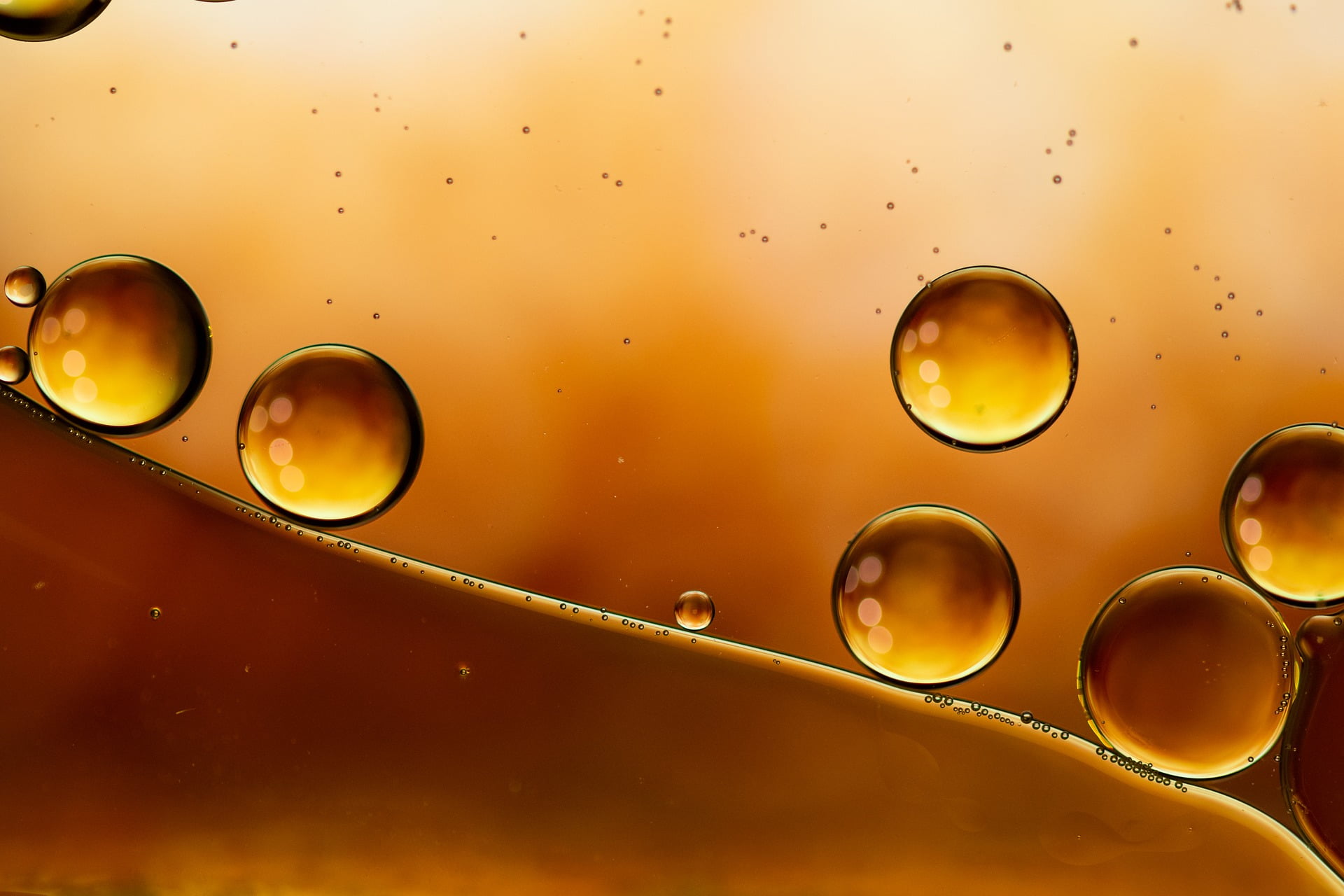
    Chemically speaking, oil and water don’t mix. But with a little fluid mechanical effort, it’s possible to make them an emulsion — a mixture of oil droplets in water or water droplets in oil. Researchers in the Netherlands discovered that the viscosity of these emulsions depends critically on which of those mixtures you have.

    To create their emulsions, the team used a tank consisting of two concentric cylinders. When the inner cylinder spins, it creates a well-understood flow field between the inner and outer cylinder. By varying the ratio of oil to water in the tank, they could explore a wide range of emulsions. They found that the emulsion’s viscosity changed dramatically when the emulsion shifted from oil droplets in water to water droplets in oil, something known as a catastrophic phase inversion. During this switch the viscosity dropped from 3 times higher than pure water to 2 times lower! (Image credit: A_Different_Perspective; research credit: D. Bakhuis et al.; via APS Physics; submitted by Kam-Yung Soh)

  • Fallstreak Holes

    Fallstreak Holes

    Occasionally clouds appear to have a hole in them; these are known as fallstreak holes or hole-punch clouds. To form, the water droplets in the cloud must be supercooled; in other words, they must be colder than their freezing point but still in liquid form. When disturbed — say, by the temperature drop caused by flowing over an airplane wing — the supercooled water droplets will suddenly freeze. This typically kicks off a chain reaction in which many droplets freeze and the heavy ice crystals fall out of the sky, leaving behind a void in the cloud. Because airplanes are particularly good at creating these fallstreak holes, they’re often seen near busy airports. (Image credit: J. Stevens/NASA; via NASA Earth Observatory)

  • Featured Video Play Icon

    Ultrasonic Vibrations

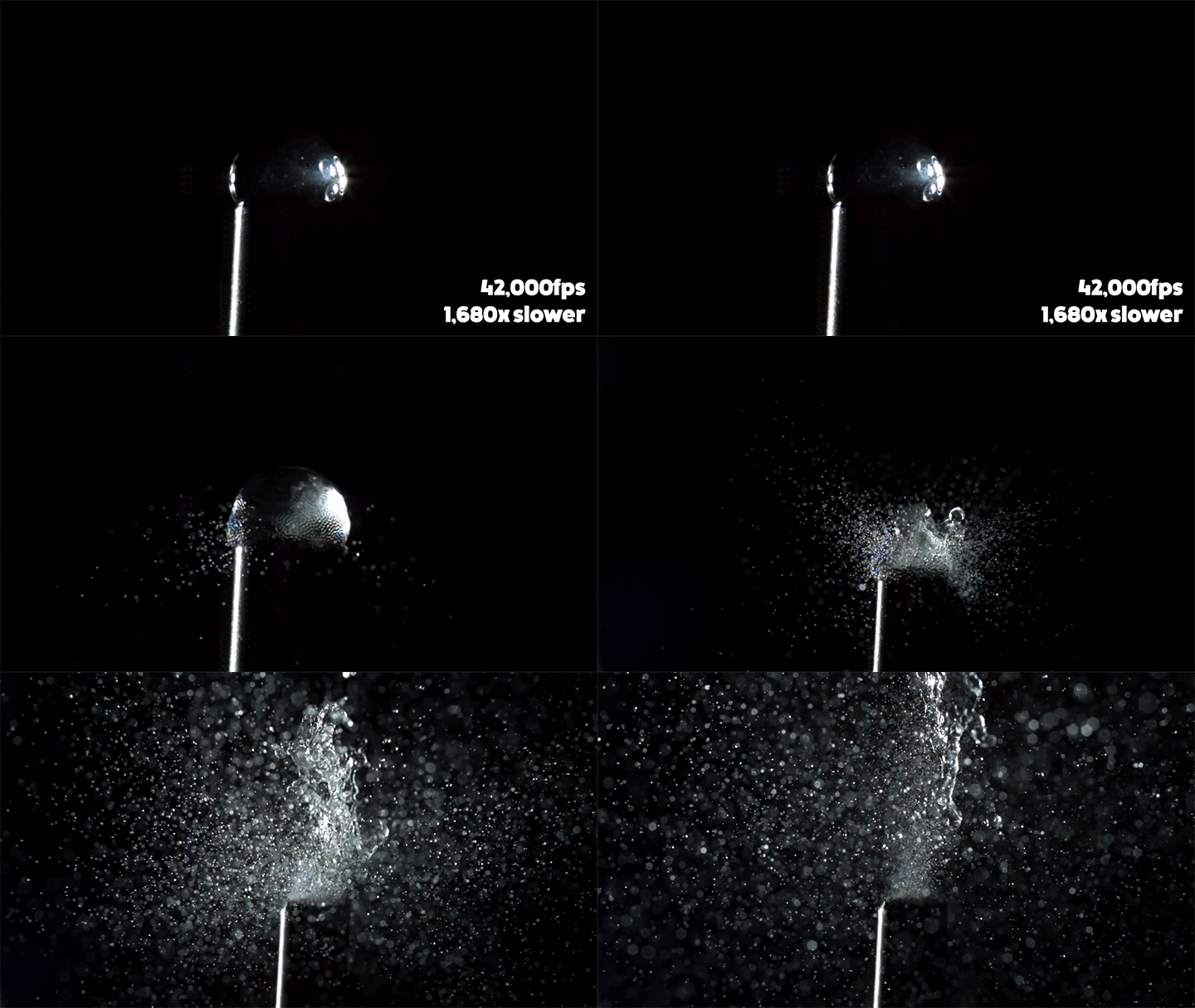
    Ultrafast vibrations can break up droplets, mix fluids, and even tear voids in a liquid. Here, the Slow Mo Guys demonstrate each of these using an ultrasonic homogenizer, a piece of lab equipment capable of vibrating 30,000 times a second. At that speed generating cavitation bubbles is trivial, and the flow induced by that cavitation is well-suited to emulsifying otherwise immiscible liquids like oil and water. They also show how a lone droplet gets torn into many microdroplets, a process formally known as atomization. (Image and video credit: The Slow Mo Guys)

  • A Lenticular Cloud With a Curl

    A Lenticular Cloud With a Curl

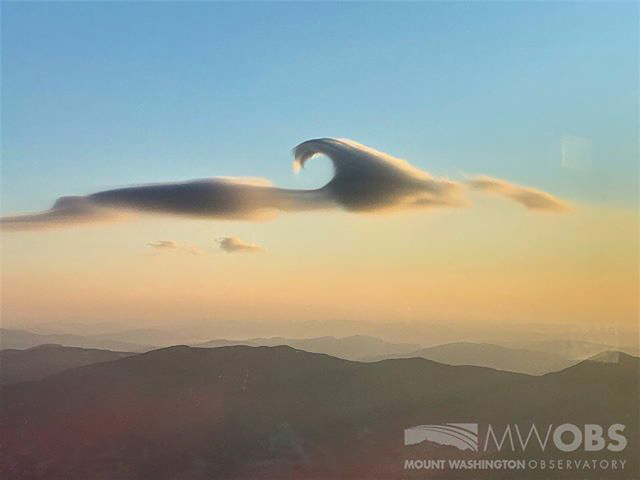
    Lens-shaped lenticular clouds are not terribly rare in mountainous areas, but observers at Mount Washington caught a very unusual cloud near sunrise in late February. This lenticular cloud had an added curl on top thanks to the Kelvin-Helmholtz instability!

    Lenticular clouds form when air is forced to flow up over a mountain in such a way that its temperature and pressure drop and water vapor in the air condenses. The resulting water droplets form a cloud that appears stationary over the mountain, even though the air continues to flow.

    To get that added wave-like curl, there needs to be another, faster-moving layer of air just above the cloud. As that air flows past, it shears the cloud layer, causing the interface to curl. Neither of these cloud types is long-lived — Kelvin-Helmholtz formations often last only a few minutes — so catching such a great dual example is lucky, indeed! (Image credit: Mount Washington Observatory; via Smithsonian Magazine; submitted by Kam-Yung Soh)

  • Featured Video Play Icon

    The Birth of a Liquor

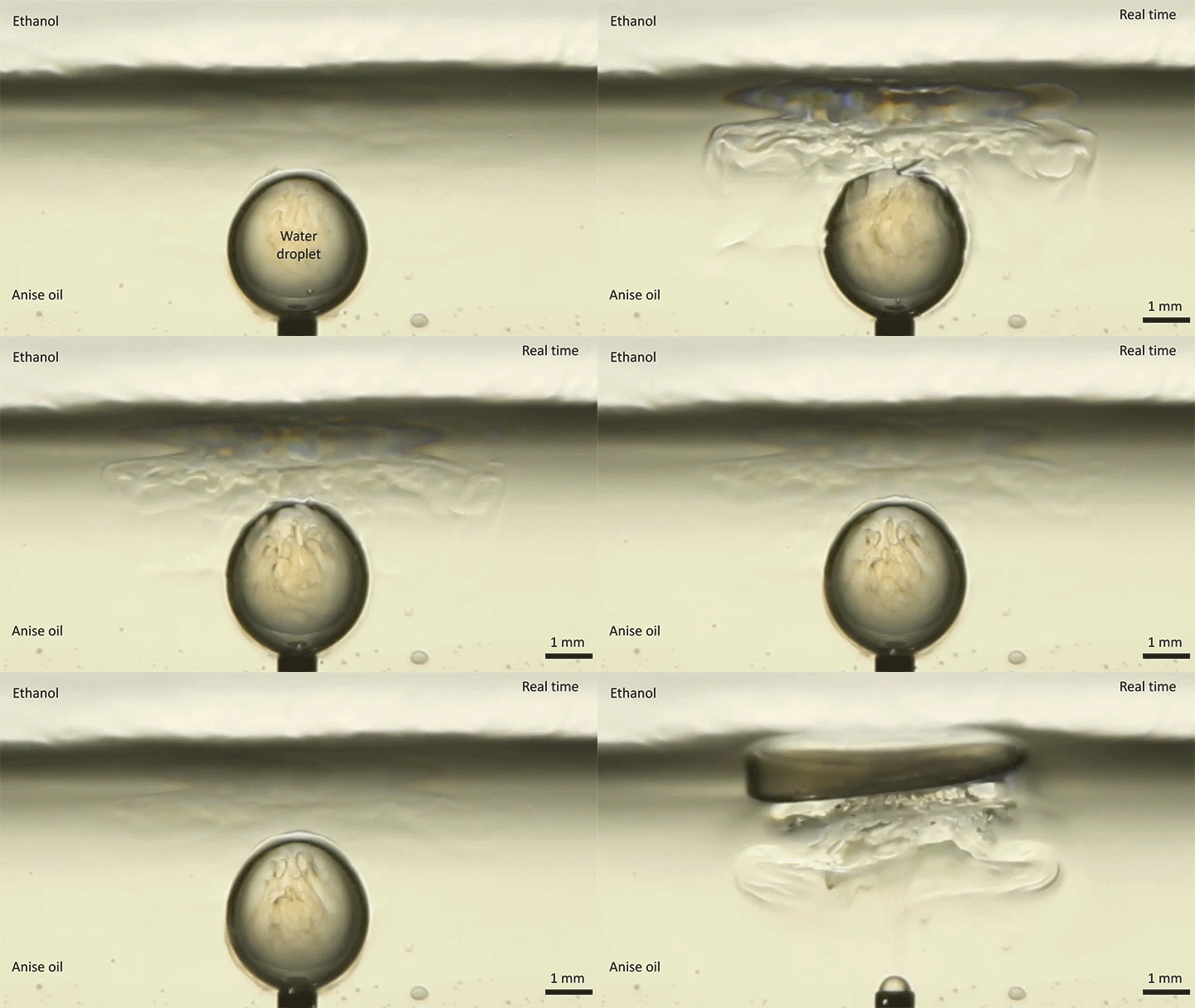
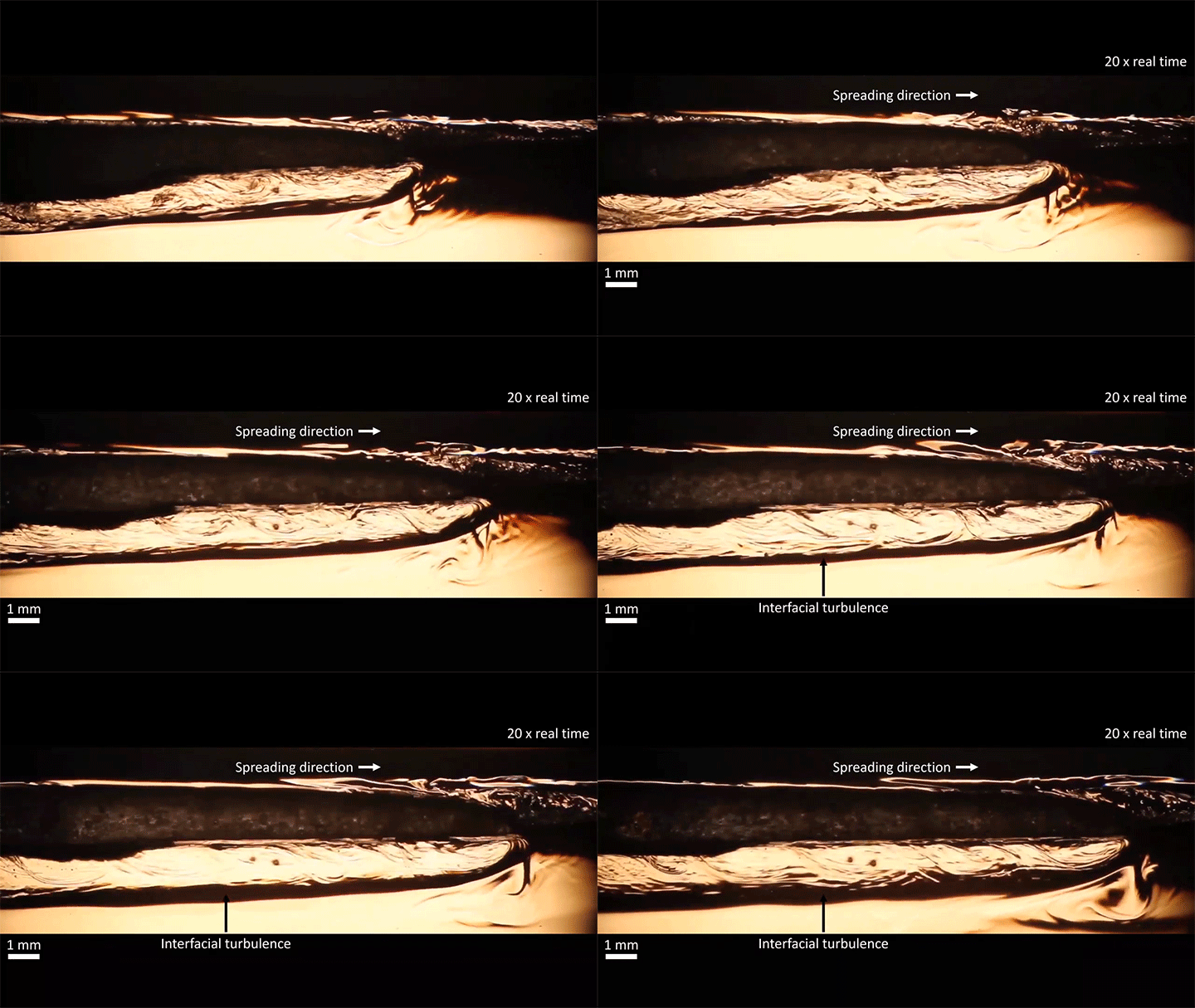
    A water droplet immersed in a mixture of anise oil and ethanol displays some pretty complicated dynamics. Its behavior is driven, in part, by the variable miscibility of the three liquids. Water and ethanol are fully miscible, anise oil and ethanol are only partially miscible, and anise oil and water are completely immiscible. These varying levels of miscibility set up a lot of variations in surface tension along and around the droplet, which drives its stretching and eventual jump.

    Once detached, the droplet takes on a flattened, lens-like shape that continues to spread. That spreading is driven by the mixing of ethanol and water, which generates heat and, thus, convection around the drop. This not only spreads the droplet, it causes turbulent behavior along the drop’s interface. (Image and video credit: S. Yamanidouzisorkhabi et al.)

  • Levitation Without Boiling

    Levitation Without Boiling

    One way to levitate droplets is to place them on a surface heated much higher than the droplet’s boiling point. This creates the Leidenfrost effect, where a droplet levitates on a thin layer of its own evaporating vapor. In this study, the situation is quite different.

    Although the underlying pool of liquid — here, silicone oil — is heated, its temperature is well below the boiling point of the water droplet. But the droplet still levitates over the pool, thanks to an air layer fed by convection. Aluminum powder in the oil reveals large-scale convection in the pool; note how the oil moves radially toward the droplet. That movement drags the air in contact with the oil with it, which forms the vapor layer keeping the droplet aloft.

    One side effect of this convection-driven levitation is that the droplet hovers over the coldest point in the oil. That fact suggests that users can manipulate the droplet’s motion by tuning the underlying heating. (Image and research credit: E. Mogilevskiy)

  • Featured Video Play Icon

    Rattlesnakes Sip Rain From Their Scales

    Getting enough water in arid climates can be tough, but Western diamondback rattlesnakes have a secret weapon: their scales. During rain, sleet, and even snow, these rattlesnakes venture out of their dens to catch precipitation on their flattened backs, which they then sip off their scales.

    Researchers found that impacting water droplets tend to bead up on rattlesnake scales, forming spherical drops that the snake can then drink. Compared to other desert-dwelling snakes, Western diamondbacks have a far more complicated microstructure to their scales, with labyrinthine microchannels that provide a sticky, hydrophobic surface for impacting drops. (Video and image credit: ACS; research credit: A. Phadnis et al.; via The Kid Should See This)

  • Featured Video Play Icon

    “Viscoelasticity Gives You Wings!”

    What happens when you drop a hydrogel bead on a water droplet? Because of the hydrogel’s viscoelasticity and its hydrophilic nature, the rebounding bead carries the droplet with it. As seen in the video above, when the impact energy is small enough, the droplet forms a reverse crown during lift-off, kind of like giving the hydrogel bead a skirt. The key feature for lift-off is the bead’s deformation on impact. Because the hydrogel widens at its base, it is sometimes able to push the entire droplet off its initial footprint and detach it from the surface. (Image, research, and video credit: R. Rabbi et al.)

  • CU Flow Vis 2019

    CU Flow Vis 2019

    I love when science and art come together, which is why I’ve long been a fan of the Flow Vis course at CU Boulder. Some of my earliest posts on FYFD date from previous editions of the course. Here are a few of my favorite images from the Fall 2019 class, from the top:

    •  Ferrofluid and India ink merge in this colorful photo. A magnet underneath the mixture on the left side causes the dark spikes of ferrofluid, but without magnetic influence, the ink and ferrofluid form cell-like droplets.
    • Although it looks like a shower head, this is actually fluorescent oobleck dripping through a strainer. A relatively long exposure time means that it’s impossible to tell whether the oobleck is falling in a fluid stream or broken-up chunks.
    • These colorful water droplets are sitting on a hydrophobic surface, hence their extremely rounded edges. I particularly like how this makes each one like a little lens for the light shining through them and into their shadows.
    • A thin layer of ferrofluid reacts to the magnet beneath. Gotta love those little streaks left behind the flow.

    For those in the Front Range area, the Flow Vis class will be showcasing their work on Saturday, December 14th at the Fiske Planetarium. Snacks are at 4:30 pm and the show starts at 5 pm. For those not nearby, you can peruse the art from this semester and previous ones at your leisure online. (Image credits: colorful ferrofluid – R. Drevno; falling oobleck – A. Kumar; droplets – A. Barron; macro ferrofluid – A. Zetley)

  • Making Drops Stick

    Making Drops Stick

    As you may have noticed when washing vegetables, many plants have superhydrophobic leaves. Water just beads up on their surface and slides right off. This is a useful feature for plants that want to direct that water toward their roots, but it’s a frustration in agriculture, where that superhydrophobicity means extra spraying of pesticides in order to get enough to stick to the plant.

    But that may not be the case for much longer. Researchers have found that adding a little polymer to water droplets (right) can suppress their ability to rebound (left) from superhydrophobic surfaces. Above a critical concentration, the high shear rate of the droplet as it tries to detach activates the viscoelastic properties of the polymer. That viscoelasticity suppresses the rebound, keeping the droplet attached. That’s good news for everyone, since it means less spraying is needed to protect crops. (Image and research credit: P. Dhar et al.)