Search results for: “water droplet”

  • Featured Video Play Icon

    Pouring a Liquid Mirror

    In this video, the Slow Mo Guys play with liquid gallium, giving us a chance to see how molten metals behave (outside of, say, the Terminator movies). Near its melting point, gallium is about six times denser than water, with a viscosity three times higher, and a surface tension about ten times greater. So how do those properties affect its behavior?

    You may be surprised that when watching the gallium vibrate on a speaker or get poured into a pan, it doesn’t look all that different from water. Yes, it’s highly reflective, but, on the whole it doesn’t look radically different from a distance. We can use the Reynolds number to quantify what’s going on here. It’s a dimensionless number that compares the fluid’s inertial force to the viscous force. Imagine we have two versions of an experiment, one where we pour gallium at a given speed and one pouring at the same volume and speed but with water. If we compared the Reynolds numbers of the water and the gallium, they only differ by a factor of two. Overall, that’s not very much. That’s why the two pours look similar.

    The story is different, though, if we look at individual drops of gallium and water, like when the first few drops of our pour hit the surface. Check out the gallium drops below. They’re conical on either end! This looks very different from what we expect with water droplets. You might think that’s because the metal is more viscous, but if we compare a water drop with a gallium drop of the same characteristic size and impact speed, we find a different story. For this, we’ll use the Ohnesorge number, which compares the viscous forces to a combination of inertia and surface tension. In this case, we find that the gallium drop’s Ohnesorge number is almost an order of magnitude smaller than the water droplet’s. That means that viscosity isn’t a major factor for our gallium drop. Both surface tension and inertia are more important.

    But if the surface tension is so high, then why aren’t the droplets spherical? Mostly because they don’t have time to form spheres before they hit. Their shape suggests that they’ve only just broken into droplets, which makes sense if the pour is fast and the surface tension is strong. (Video and image credit: The Slow Mo Guys)

  • Condensing Halos

    Condensing Halos

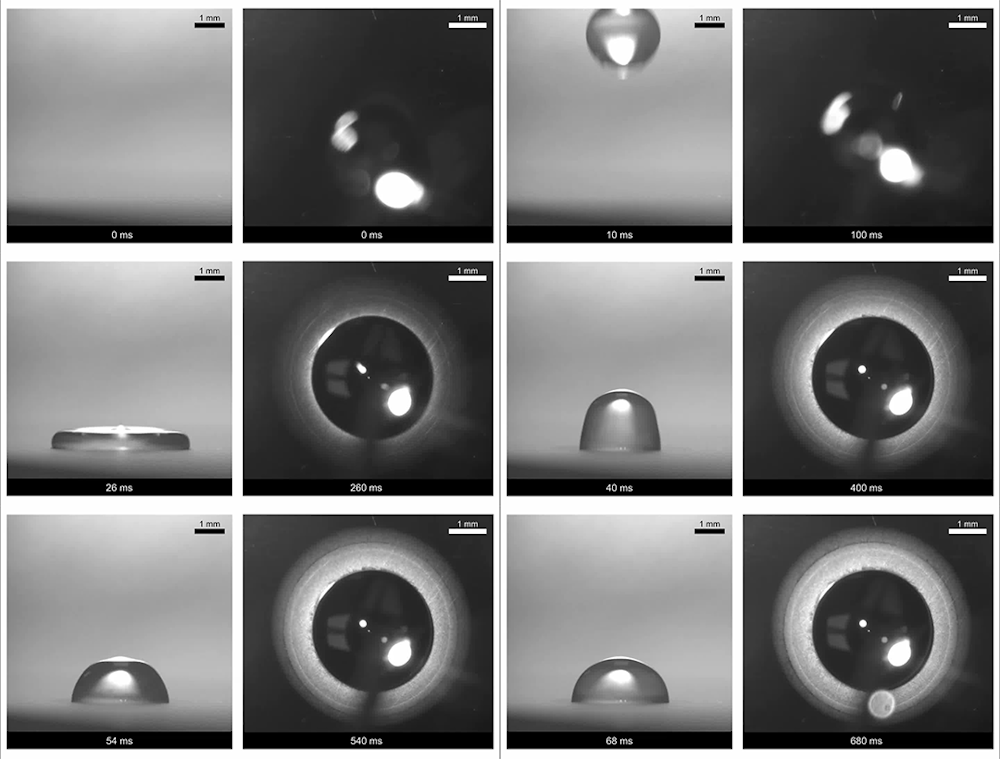
    Drops that impact a very hot surface will surf on their own vapor, and ones that hit a very cold surface will freeze almost immediately. But what happens when the temperature differences aren’t so extreme? Scientists explored this (above) by dropping room-temperature water droplets onto a cool surface – one warmer than the freezing point but cooler than the dew point at which water condenses. 

    They found that impacting drops formed a triple halo of condensate (right).  The first and brightest ring forms at the radius of the drop’s maximum extent during impact. The second band forms from water vapor that leaves the droplet at impact. As that vapor cools, it condenses into a second band. The final, dimmest band forms as the droplet stabilizes and cools. It’s the result of water vapor near the droplet continuing to cool and condense. (Image and research credit: Y. Zhao et al.; via Nature News; submitted by Kam-Yung Soh)

  • Coalescence at the Smallest Scales

    Coalescence at the Smallest Scales

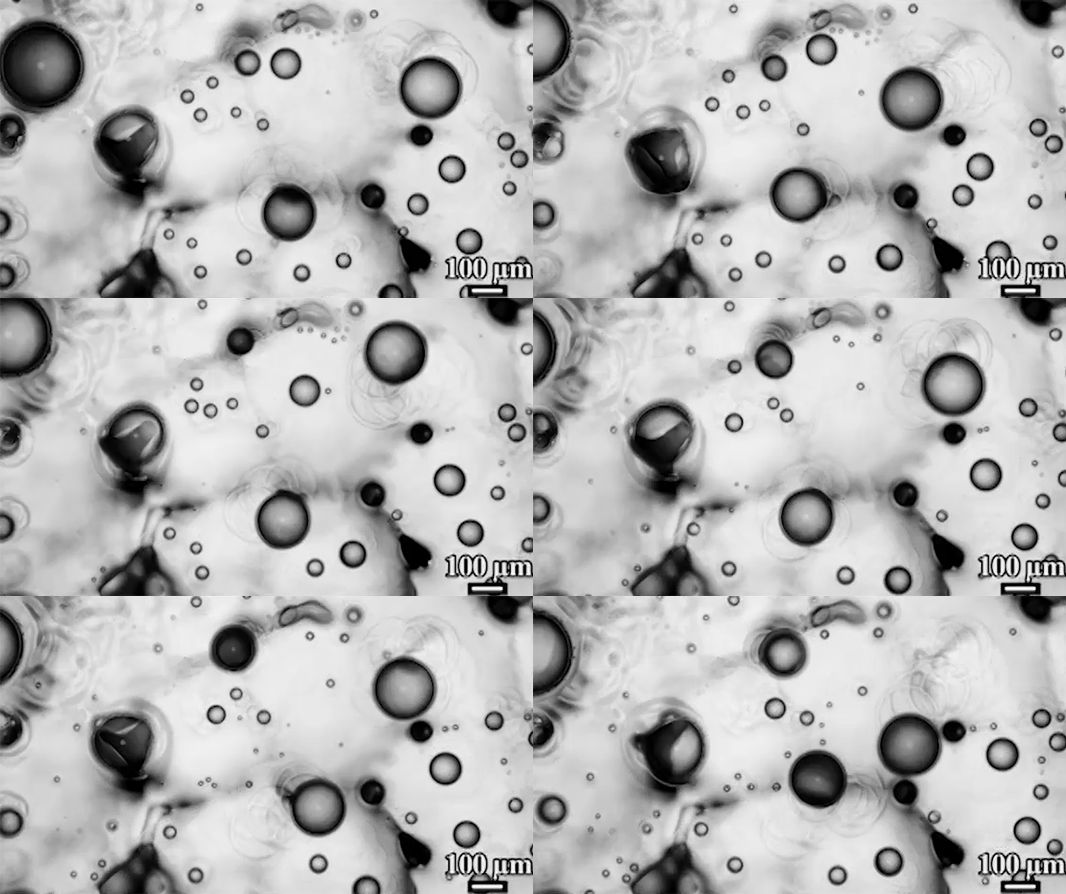
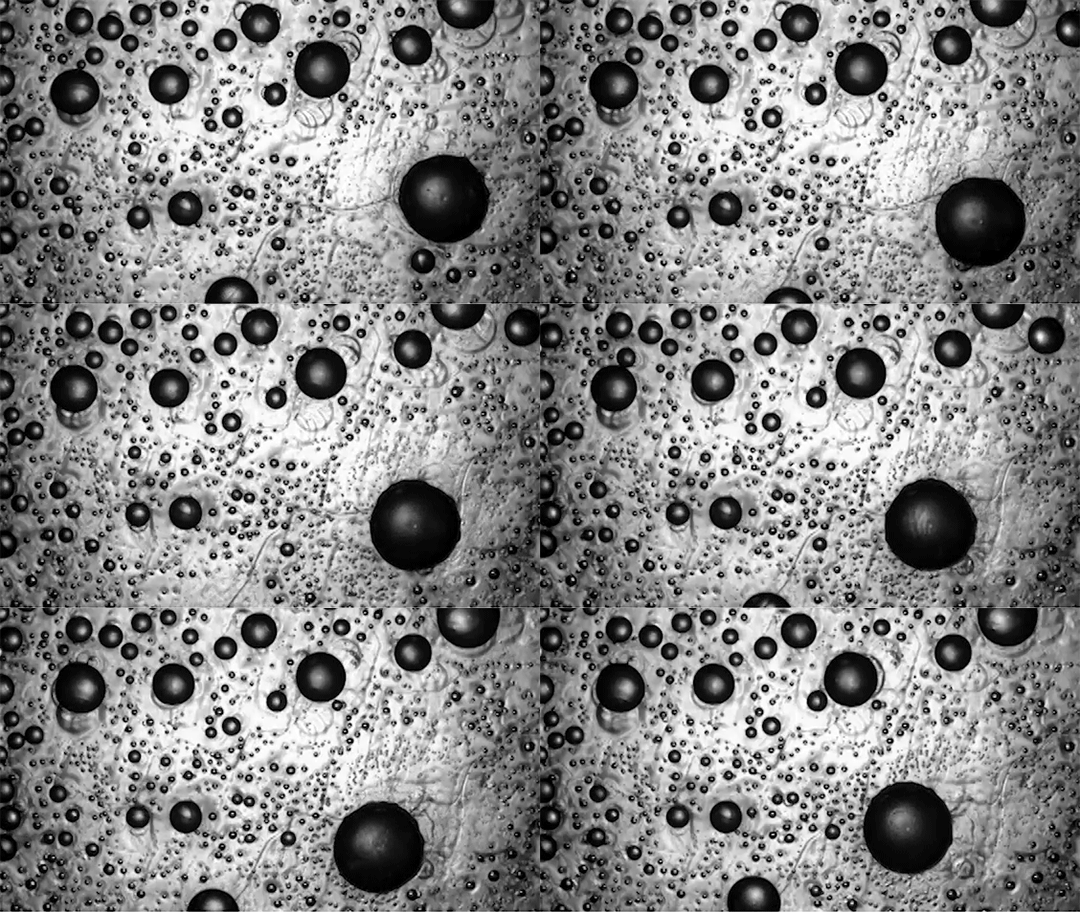
    The coalescence of two water droplets happens so quickly, it’s essentially impossible to see, even with high-speed cameras. For this reason, researchers have turned to simulating molecular dynamics – essentially building computer programs that model the actions of all the molecules contained in the water droplets. Viewed this way, the very first contact between drops comes from thermal fluctuations – the random jumping of molecules across the separating gap. Once the bridge starts to form, it continues to grow, driven by thermal forces and opposed by surface tension. Eventually, this thermal regime gives way to the more familiar hydrodynamic one, where the bridge is large enough for flow to drive its growth. (Image credits: experiment – S. Nagel et al.; simulation – S. Perumanath et al.; research credit: S. Perumanath et al.; submitted by Rohit P.)

  • Phase-Switching to Avoid Icing

    Phase-Switching to Avoid Icing

    Preventing ice and frost from forming on surfaces – especially airplane wings – is a major engineering concern. The chemical de-icing cocktails currently used in aviation are a short-lived solution, and while superhydrophobic surfaces can be helpful, they tend to be easily damaged and therefore impractical. Another possible solution, shown here, are so-called phase-switching liquids – substances like cyclohexane that have freezing points higher than that of water. This means that they form a solid coating near the freezing temperature of water.

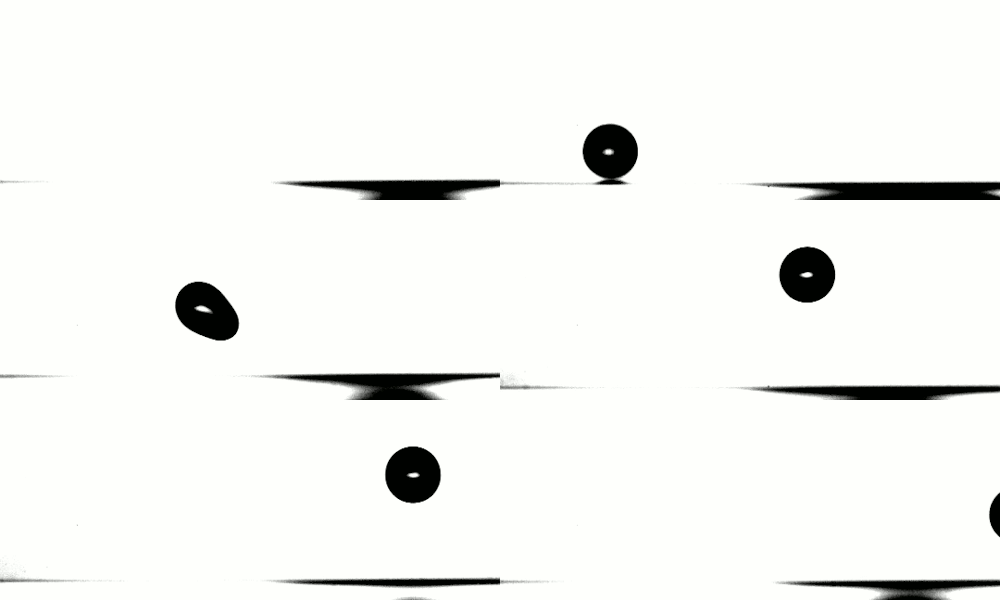
    Water droplets on these coatings move in a random stick-slip walk (above) but they tend not to freeze. This is because freezing requires the droplets to release heat, which melts part of the phase-switching liquid. Now, instead of solidifying to the surface, the droplet moves on a film of the phase-switching liquid. Re-freezing that liquid is tough because it’s thermodynamically unfavorable, and the smoothness of the liquid layer makes it harder for ice to find a nucleation point. In lab tests, the phase-switching liquid surfaces resisted ice and frost more than an order of magnitude longer than conventional materials. (Image and research credit: R. Chatterjee et al.; video credit: Univ. of Illinois at Chicago; submitted by Night King)

  • A Splat is Born

    One day calligrapher Mae Nguyen accidentally squeezed a droplet out of her waterbrush pen, and a fun, new technique was born. Nguyen sometimes uses the arrays of droplets to paint and other times blows on them to create colorful splatters, like in the video above. I’d love to see the latter technique, in particular, in slow motion! I expect there is some really cool mixing as the droplets coalesce. Check out more of Nguyen’s work on her website and Instagram account. (Video credit: M. Nguyen)

  • Supernumerary Bows

    Supernumerary Bows

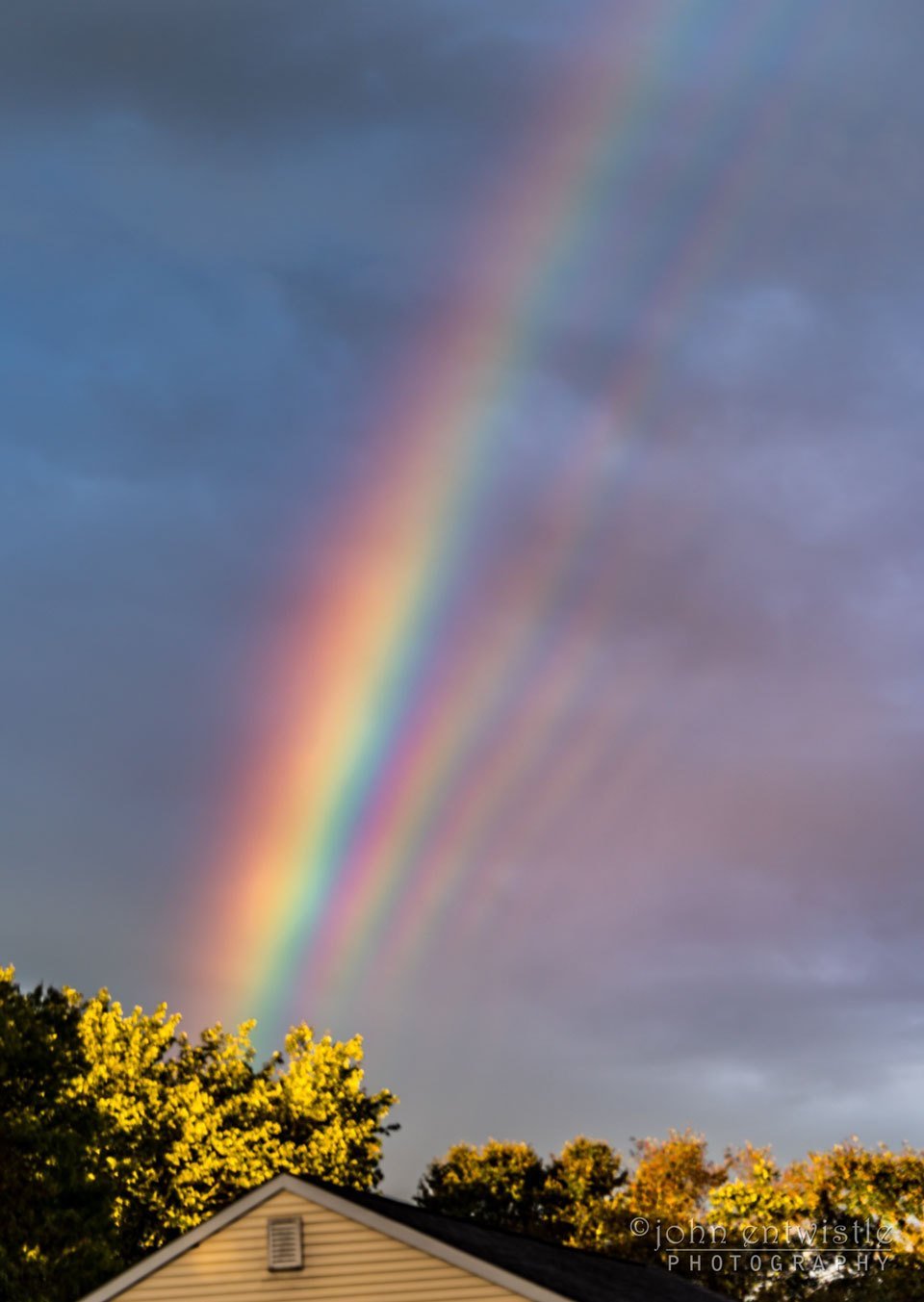
    After the rain of Hurricane Florence came the rainbow, or rainbows, in this case. Photographer John Entwistle captured this image of a rainbow with several additional supernumerary bows. The inner fringes seen here form when light passes through water droplets that are all close to the same size; given the spread seen here, the droplets are likely smaller than a millimeter in diameter. Supernumerary rainbows cannot be explained with a purely geometric theory of optics; instead, they require acknowledging the wave nature of light. (Image credit: J. Entwistle; via APOD; submitted by Kam-Yung Soh)

  • Bouncing Off a Moving Wall

    Bouncing Off a Moving Wall

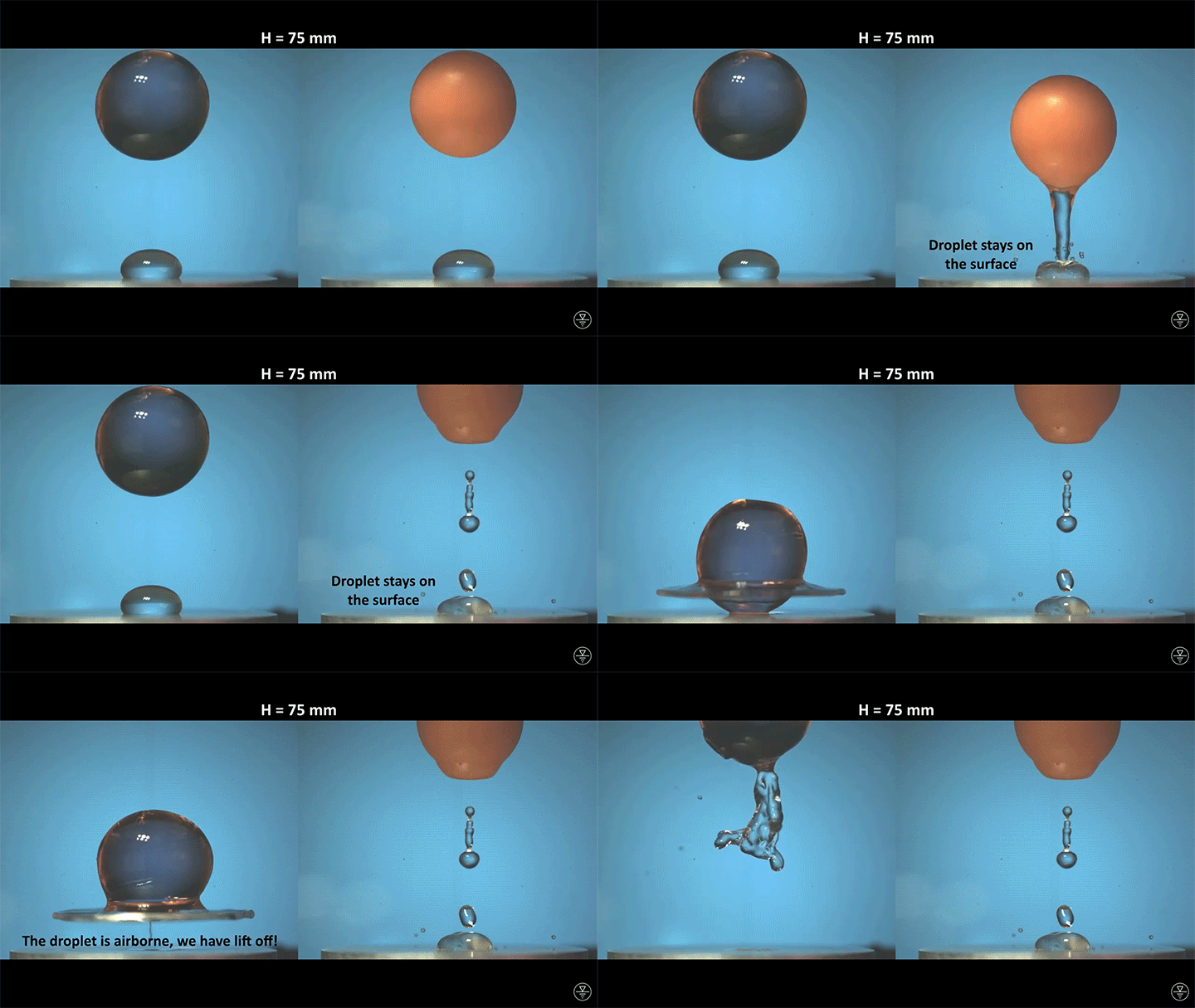
    There are many ways to repel droplets from a surface: water droplets will bounce off superhydrophobic surfaces due to their nanoscale structures; a vibrating liquid pool can keep droplets bouncing thanks to its deformation and a thin air layer trapped under the drop; and heated surfaces can repel droplets with the Leidenfrost effect by vaporizing a layer of liquid beneath the droplet. But all of these methods will only work for certain liquids under specific circumstances. 

    More recently, researchers have begun looking at a different way to repel droplets: moving the surface. The motion of the plate drags a layer of air with it; how thick that layer of air is depends on the plate’s speed. (Faster plates make thinner air layers.) Above a critical plate speed, a falling droplet will impact without touching the plate directly and will rebound completely. This works for many kinds of liquids – the researchers used silicone oil, water, and ethanol – across many droplet sizes and speeds. The key is that the air dragged by the plate deforms the droplet and creates a lift force. If that lift force is greater than the inertia of the droplet, it bounces. (Image and research credit: A. Gauthier et al., source)

  • Snowmelt

    Snowmelt

    Much of the rain that falls on Earth began as snow high in the atmosphere. As it falls through warmer layers of air, the snowflakes melt and form water droplets. The details of this melting process have been difficult to capture experimentally, but a new computational model may provide insight. The basic process has a couple stages. As snow begins to melt, surface tension draws the water into concave areas nearby. When those regions fill up, the water flows out and merges with neighboring liquid, forming water droplets around a melting ice core.

    Although this same sequence was observed for many types of snow, scientists also observed some important differences between rimed and unrimed snowflakes. Rime forms when supercooled water droplets freeze onto the surface of a snowflake. Lightly rimed snow still looks light and fluffy, like the animation above, but heavily rimed snow forms denser and more spherical chunks. Because there are lots of porous gaps in heavily rimed snow, water tends to gather there during initial melting. Rimed snow was also more likely to form one large water droplet rather than breaking into multiple droplets like snow with less rime. For more, check out NASA’s video and the Bad Astronomy write-up. (Image credit: NASA, source; research credit: J. Leinonen and A. von Lerber; via Bad Astronomy; submitted by Kam Yung-Soh)

  • Atmospheric Aerosols

    Atmospheric Aerosols

    Recently, NASA Goddard released a visualization of aerosols in the Atlantic region. The simulation uses real data from satellite imagery taken between August and October 2017 to seed a simulation of atmospheric physics. The color scales in the visualization show concentrations of three major aerosol particles: smoke (gray), sea salt (blue), and dust (brown). One of the interesting outcomes of the simulation is a visualization of the fall Atlantic hurricane season. The high winds from hurricanes help pick up sea salt from the ocean surface and throw it high in the atmosphere, making the hurricanes visible here. Fires in the western United States provide most of the smoke aerosols, whereas dust comes mostly from the Sahara. Tiny aerosol particles serve as a major nucleation source for water droplets, affecting both cloud formation and rainfall. With simulations like these, scientists hope to better understand how aerosols move in the atmosphere and how they affect our weather. (Image credit: NASA Goddard Research Center, source; submitted by Paul vdB)

  • The Mist of Champagne

    The Mist of Champagne

    If you’ve ever popped open a chilled bottle of champagne, you’ve probably witnessed the gray-white cloud of mist that forms as the cork flies. Opening the bottle releases a spurt of high-pressure carbon dioxide gas, although that’s not what you see in the cloud. The cloud consists of water droplets from the ambient air, driven to condense by a sudden drop in temperature caused by the expansion of the escaping carbon dioxide. Scientifically speaking, this is known as adiabatic expansion; when a gas expands in volume, it drops in temperature. This is why cans of compressed air feel cold after you’ve released a few bursts of air.

    If your champagne bottle is cold (a) or cool (b), the gray-white water droplet cloud is what you see. But if your champagne is near room temperature ( c ), something very different happens: a blue fog forms inside the bottle and shoots out behind the cork. To understand why, we have to consider what’s going on in the bottle before and after the cork pops.

    A room temperature bottle of champagne is at substantially higher pressure than one that’s chilled. That means that opening the bottle makes the gas inside undergo a bigger drop in pressure, which, in turn, means stronger adiabatic expansion. Counterintuitively, the gas escaping the warm champagne actually gets colder than the gas escaping the chilled champagne because there’s a bigger pressure drop driving it. That whoosh of carbon dioxide is cold enough, in fact, for some of the gas to freeze in that rushed escape. The blue fog is the result of tiny dry ice crystals scattering light inside the bottleneck.

    That flash of blue is only momentary, though, and the extra drop in temperature won’t cool your champagne at all. Liquids retain heat better than gases do. For more, on champagne physics check out these previous posts. (Image and research credit: G. Liger-Belair et al.; submitted by David H.)